
An electrocardiogram (ECG) takes only a few minutes and costs very little. Doctors run hundreds of millions of them around the world every year. Now, researchers have shown that these ordinary heart traces may already contain the clues to a disease that is usually missed until it is dangerously advanced and that a simple photo of the trace, read by artificial intelligence, can be enough to raise the alarm.
A new AI ECG platform developed at Yale School of Medicine screens for amyloid cardiomyopathy, a progressive stiffening of the heart caused by misfolded proteins. The tool, described in JAMA, does not replace hospital imaging. Instead, it is designed to flag the people most likely to need it before the damage becomes irreversible.
“For a disease that’s massively underdiagnosed, identifying those at risk is very critical,” says Rohan Khera, MD, director of the Cardiovascular Data Science (CarDS) Lab at Yale School of Medicine and the study’s principal investigator.
What Is Amyloid Cardiomyopathy?
Amyloid cardiomyopathy, often called cardiac amyloidosis, develops when normally harmless proteins fold into the wrong shape and clump together in the heart muscle. The deposits crowd out healthy tissue, making the heart stiff and less able to pump. Over time, the condition can lead to heart failure, dangerous heart rhythms, and death.
There are two main forms, named for the protein involved. The new study focused on transthyretin amyloid cardiomyopathy, or ATTR-CM. Transthyretin is a protein made in the liver, and it can misfold because of genetics or simply with age.
Misfolded proteins are not unique to the heart, either. Similar deposits sit at the center of other conditions, which is why researchers are also using AI to catch Alzheimer’s disease years before symptoms appear.
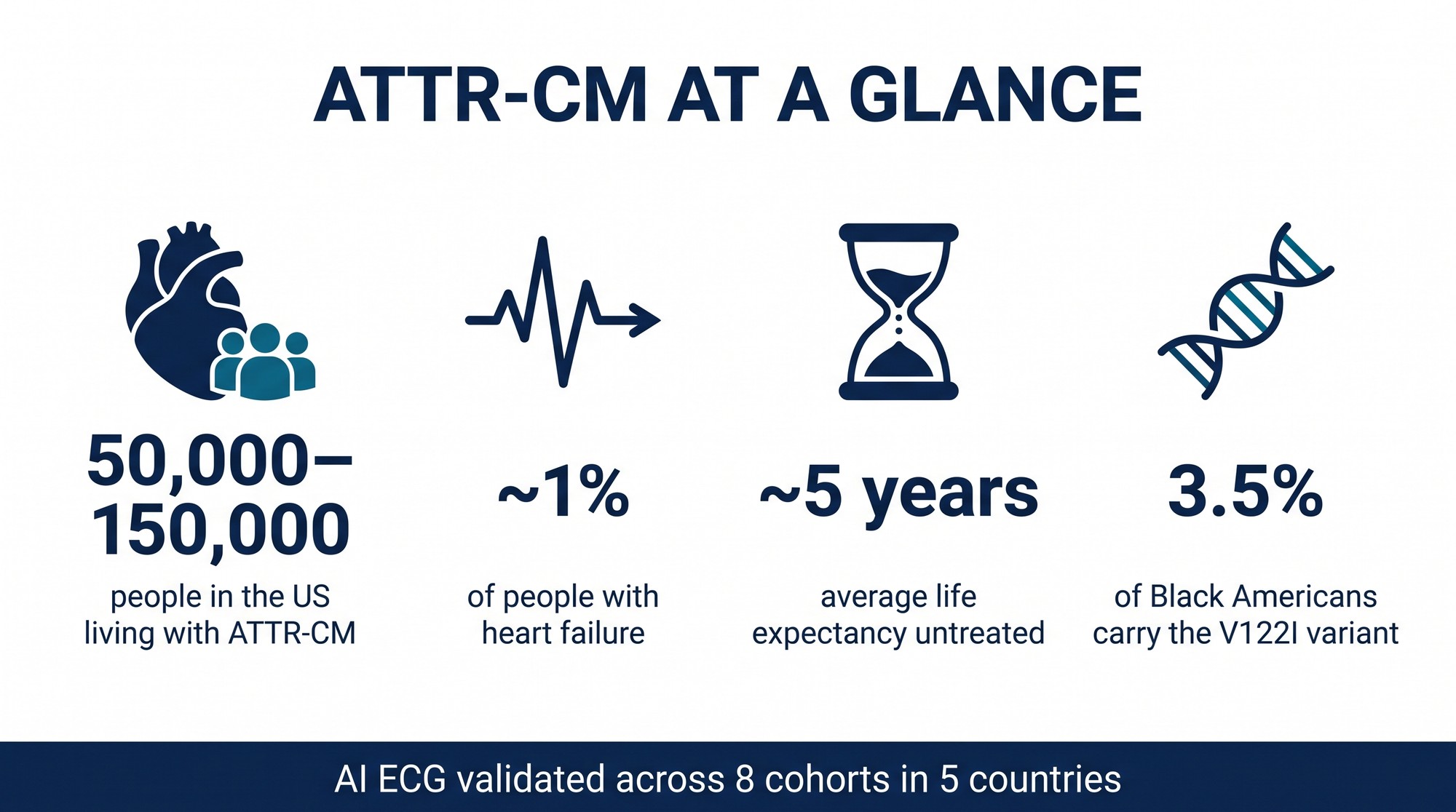
ATTR-CM is more common than once believed, yet it is still frequently overlooked. Estimates suggest roughly 50,000 to 150,000 people in the United States are living with it, and it may affect around 1% of people with heart failure. For patients who go untreated, average life expectancy is about five years.
“It’s as aggressive as some of the most aggressive cancers,” Khera says.
Why the Disease Slips Through
Part of the problem is that amyloid cardiomyopathy hides in plain sight. Its symptoms, including fatigue, shortness of breath, and swelling in the legs, overlap with far more common heart conditions, so doctors often look elsewhere first.
The electrocardiogram is one of the oldest and cheapest cardiac tests available, and it can show subtle signatures of the disease. But those signatures are extremely difficult to spot with the naked eye. Low-voltage patterns appear in only about a quarter to 40% of ATTR-CM patients, so a “normal-looking” ECG is no reassurance.
Confirming the diagnosis usually means nuclear imaging with a radiotracer or a heart biopsy, tests that are costly and not available everywhere. That combination of subtle signals and hard-to-reach confirmation is exactly the gap the AI tool aims to close.
Warning Signs Worth Knowing
Because early treatment matters, certain clues should prompt a conversation with a doctor. They include:
- Shortness of breath or fatigue that does not match your usual fitness
- Swelling in the legs, ankles, or abdomen
- An irregular heartbeat or palpitations
- Fainting or light-headedness
- A history of carpal tunnel surgery, especially in both hands
- Spinal stenosis or a family history of amyloidosis
How the AI ECG Tool Works
Khera’s team trained a deep-learning model on tens of thousands of ECGs drawn from the Yale New Haven Health System, including 293 patients with confirmed ATTR-CM. From that data, the model learned to recognize patterns in the electrical signal that the human eye tends to miss.
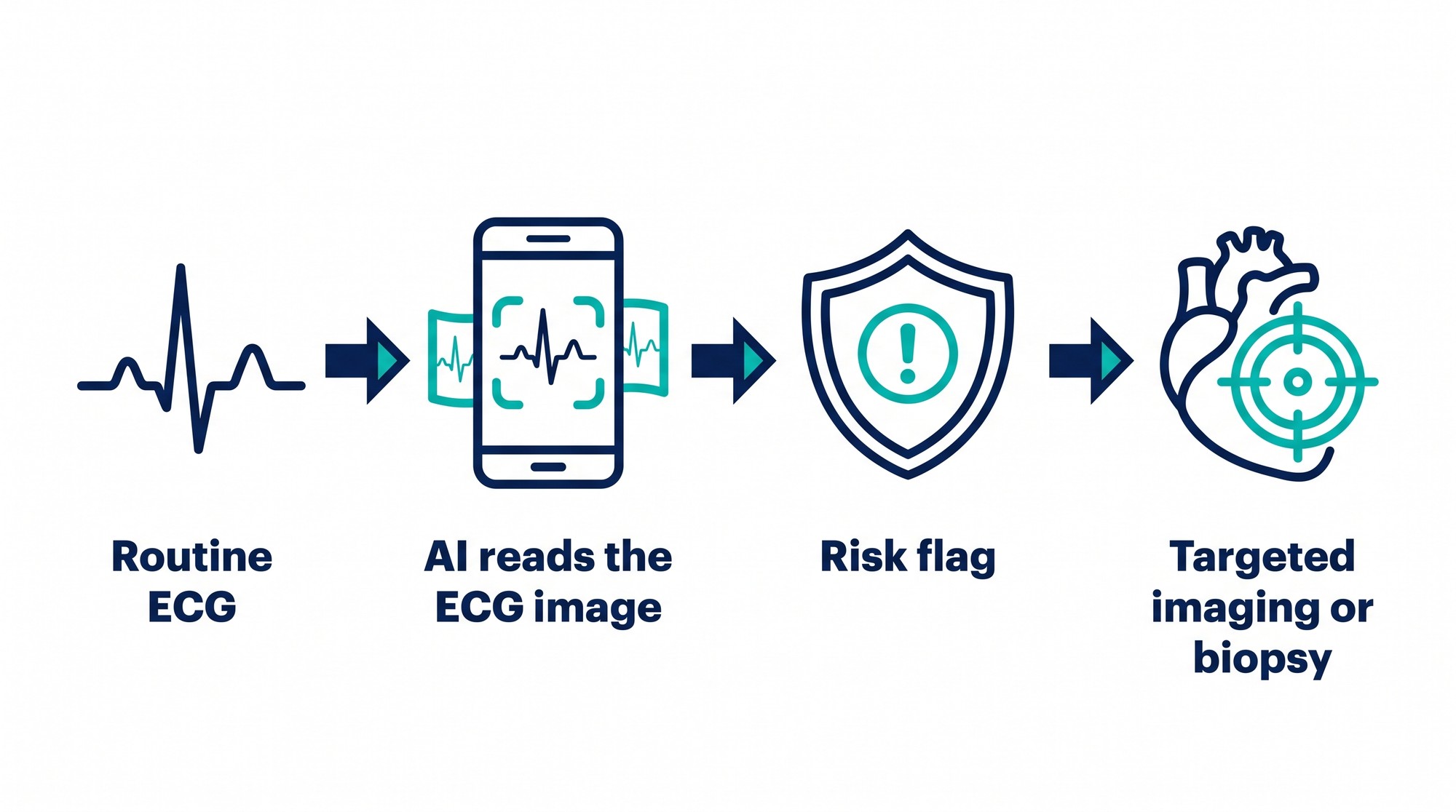
Crucially, it can read the ECG the way most people actually encounter one: as an image. “You can take a photo of an ECG like you would take a photo of a bank check,” Khera says. “Our model can pick up from that photo whether the ECG came from somebody at risk for cardiac amyloid or not.”
The system works on scanned tracings, PDFs, or a smartphone snapshot, so no special hardware and no rebuilt hospital IT system is required.

Tested Across Eight Cohorts in Five Countries
The model was developed on 28,174 ECGs from 11,291 patients, 293 of whom had confirmed ATTR-CM. In an internal validation group of 44,123 patients, it scored 0.84 on the area under the receiver operating characteristic curve, a measure where 0.5 is a coin flip and 1.0 is perfect. At the study’s preset threshold, that translated to 72% sensitivity and 86% specificity. It held up even in people whose conditions mimic amyloidosis, such as left ventricular hypertrophy or severe aortic stenosis, where the score was 0.81.
To check that it was not simply memorizing one hospital’s habits, the researchers then tested it on eight separate groups of patients across nine hospitals in the United States, the United Kingdom, the Netherlands, Denmark, and Greece. Across those cohorts the score ranged from 0.76 to 0.91, including in higher-risk screening groups such as older Black and Hispanic adults with heart failure and adults who had previously undergone carpal tunnel surgery.
A Triage Tool, Not a Diagnosis
The team is careful about what the AI ECG can and cannot do. Because ATTR-CM is rare, screening everyone indiscriminately would generate too many false alarms. So the model is aimed at higher-risk groups, where it performs far better. It cannot confirm the disease, and it does not replace echocardiography or nuclear imaging, which remain the standard for confirming cardiac amyloidosis at centers such as the Mayo Clinic. What it can do is help clinicians decide who needs those tests first.
| AI ECG screening | Standard diagnosis | |
|---|---|---|
| What it needs | An existing 12-lead ECG, as a scan, PDF, or photo | Blood tests, nuclear imaging (radiotracer scan), or heart biopsy |
| Cost and access | Essentially free; no new equipment | Expensive; not available at every hospital |
| Its role | Flags who should be tested next | Confirms whether the disease is present |
| Main limitation | Not a standalone test; too many false alarms if used on everyone | Can take time and specialist centers to arrange |
First author Philip Croon, a cardiology resident and PhD candidate at Amsterdam UMC, put it simply: “For rare diseases, context is everything.” In an exploratory analysis, pairing the AI ECG with a separate AI model that reads echocardiograms raised the positive predictive value from 0.24 to 0.66, at the cost of sensitivity, which fell from 0.84 to 0.68. In practice, that means fewer nuclear scans were needed for each confirmed diagnosis.
Can AI Read Your ECG? What the Apps Actually Do
The Yale platform is a research and clinical triage tool, not something patients download. But the idea of AI reading heart traces is already part of everyday technology, and it is worth separating the serious tools from the marketing. AI is also being tested to spot other conditions from routine images, such as chest X-rays that reveal heart problems and systems that screen for cancer and more than a hundred other conditions.
Can ChatGPT Read My ECG?
Chatbots can offer a general explanation of what an ECG shows if you upload an image, and they can help you understand the terms in a report. But they are not validated medical devices; they can misread the tracing, and they cannot substitute for a clinician’s interpretation. Treat any chatbot reading as background information, never as a diagnosis.
Is There a Free App That Can Interpret My ECG?
Several apps and platforms now advertise AI-powered ECG interpretation, including tools such as PMcardio and ECG Buddy that are built for healthcare professionals. Some offer free tiers, but most are designed for clinicians who are already trained to read ECGs, and they carry regulatory limits on who may use them. Consumer smartwatches can also flag irregular rhythms such as atrial fibrillation, though they detect a different set of problems and should not be mistaken for a cardiac amyloid screen.
Who Stands to Benefit Most
ATTR-CM comes in two forms. The wild-type form develops with age and has no clear genetic cause, while the hereditary form, sometimes called variant ATTR, is passed down through families. Both appear in the study’s data.
The study focused on groups where suspicion should already be higher: older Black and Hispanic adults with heart failure, people who have had carpal tunnel surgery, and carriers of a transthyretin gene variant. One variant, V122I, is especially common in people of West African ancestry. It is carried by roughly 3.5% of Black Americans, about 1.5 million people, and it raises the risk of the disease.
Early detection matters because treatments now exist. In May 2019, tafamidis (Vyndamax) became the first drug approved for ATTR-CM. It was joined by acoramidis (Attruby) in November 2024 and by vutrisiran (Amvuttra) in March 2025. The first two are “stabilizers” that keep the transthyretin protein from falling apart and misfolding, while vutrisiran is a “silencer” that signals the liver to produce less of the protein in the first place.
None of them can undo damage that has already occurred; they work by slowing the disease down. That is precisely why catching it earlier, before the heart stiffens beyond repair, changes the prognosis.
What to Do If This Sounds Like You
Because the AI tool is still under FDA review, it is not yet part of routine care. In the meantime, the most useful step is awareness. If you have unexplained heart failure symptoms alongside one of the red flags listed above, such as a previous carpal tunnel surgery, spinal stenosis, or a relative with amyloidosis, it is worth asking your doctor whether cardiac amyloidosis has been ruled out.
That conversation can lead to a simple blood test and, if warranted, a nuclear imaging scan that can confirm the diagnosis without a biopsy. Early referral to a cardiologist familiar with amyloidosis matters, because the available treatments work best before the disease has advanced.
What Happens Next
The tool has received the FDA’s Breakthrough Device Designation, a status designed to speed review of promising technologies, and it is currently under FDA review. A prospective study needed for full approval is underway, and researchers are already studying how AI platforms such as this one perform at 13 health centers through the TRACE-AI Network Study.
“We’ve been able to solve a critical bottleneck in deploying therapies by identifying more at-risk people,” Khera says. “This is one of our biggest accomplishments, making care accessible by finding people who need treatment the most.”
Key Takeaways
- A new AI ECG tool can flag transthyretin amyloid cardiomyopathy from an ordinary ECG image.
- It was validated across eight cohorts in five countries, including patients whose conditions mimic the disease.
- It is a triage aid, not a diagnosis: it helps prioritize who needs nuclear imaging or a biopsy.
- ATTR-CM is underdiagnosed and, untreated, has an average life expectancy of about five years.
- Early detection matters because disease-modifying treatments are available but cannot undo existing damage.


