
Wind farms routinely fall short of the performance their designers predict. Part of the blame lies with a measurement problem that has dogged the industry for decades. Engineers can model a turbine on a computer or test a scaled-down copy in a wind tunnel. But neither approach faithfully reproduces what happens when a machine with blades the length of a football field meets real, turbulent air.
A new study led by researchers at MIT, with collaborators at Queen’s University, Princeton University, and Penn State University, may have closed that gap. By raising the air pressure inside a wind tunnel until the flow physics matched the atmosphere, the team reproduced realistic conditions around a laboratory turbine and used the results to sharpen the models that steer real wind farms.
The payoff is not a new turbine. It is a better way of running the machines we already have. The researchers estimate that improved control of turbine alignment, blade pitch, and tip speed could unlock tens of thousands of dollars per turbine every year, a rare case where more wind farm efficiency comes from software rather than steel.
The Lab-vs-Field Gap That Caps Wind Farm Efficiency
Anyone trying to squeeze more power from a turbine faces an awkward obstacle: the open sky is a terrible place to run a controlled experiment. Wind farms operate in chaotic, constantly shifting conditions, so isolating the effect of a single change is almost impossible.
Wind tunnels offer control, but at a cost. A scaled-down turbine in a conventional tunnel behaves very differently from a full-size machine in the field. The physics does not scale neatly on its own. That mismatch has left engineers unsure about basic questions, including how much power a turbine really produces when the wind shifts direction.
The result is a quiet, systemic inefficiency. Many models used to forecast wind farm output assume that turbines sit perfectly perpendicular to the wind. In reality that is rarely true, because gusts change direction faster than a turbine’s yaw system, and the motorized assembly that rotates the nacelle can respond.
Michael Howland, MIT’s Jeffrey Cheah Career Development Professor, has spent years building models to simulate how wind farms behave. Earlier work of his showed that managing the wake of individual turbines could raise a farm’s output. But proving it took an expensive field experiment that deliberately misaligned real turbines for months. A faster, more controlled way to test such ideas was clearly needed.
Inside the 240-Atmosphere Chamber
To bridge the gap, the team turned to a technique pioneered at Princeton: pressurising the wind tunnel itself. Raising the pressure increases air density. That gives a small turbine the same inertia and flow behavior as a much larger one. The experiments pushed the chamber to pressures as high as 240 atmospheres.
The test turbine measured just 15 centimeters across, yet under those conditions it reproduced the aerodynamics of a machine 15 to 20 meters in diameter and potentially up to 35 meters. Air density inside the tunnel was raised by a factor of 100 to 220 compared with the surrounding atmosphere.

Over several weeks, the researchers tested how the turbine performed at different angles to the wind and under different control strategies, isolating the effect of each factor on power output. Crucially, they ran those experiments alongside a new predictive model developed by Howland’s group.
That model, described as a unified momentum model, avoids the empirical fudge factors that older wind power models have historically relied on. It is also light enough to run on an ordinary laptop, which matters for engineers who design and operate turbines around the world.
The Surprise: Why Misaligned Turbines Can Make More Power
The most striking finding concerns what happens when a turbine is not facing the wind head-on. Rather than simply losing power, a misaligned turbine can reach a new power maximum when its tip speed is adjusted to match its misalignment angle.
Tip speed is how fast the outermost section of the blade travels. It is rarely tuned in this way at commercial wind farms today, which means operators may be leaving energy on the table at almost no added cost.
“The big output of the experiments was clearly showing that new power maximums can be achieved when the turbine becomes misaligned with the wind through only changes to the tip speed,” said John Kurelek, an assistant professor at Queen’s University and the study’s lead author.
The finding matters because misalignment is the norm, not the exception. Even modern turbines that gradually adjust their angle cannot keep pace with every gust, so they spend much of their time partly sideways to the wind. Understanding how to extract more power from those moments is, in effect, free capacity.
A Model Engineers Can Run on a Laptop
Experiments alone do not change a wind farm, which is why the study’s second contribution may prove just as valuable. The pressurized tests gave the team a rare chance to validate its model against measured physics rather than assumptions.
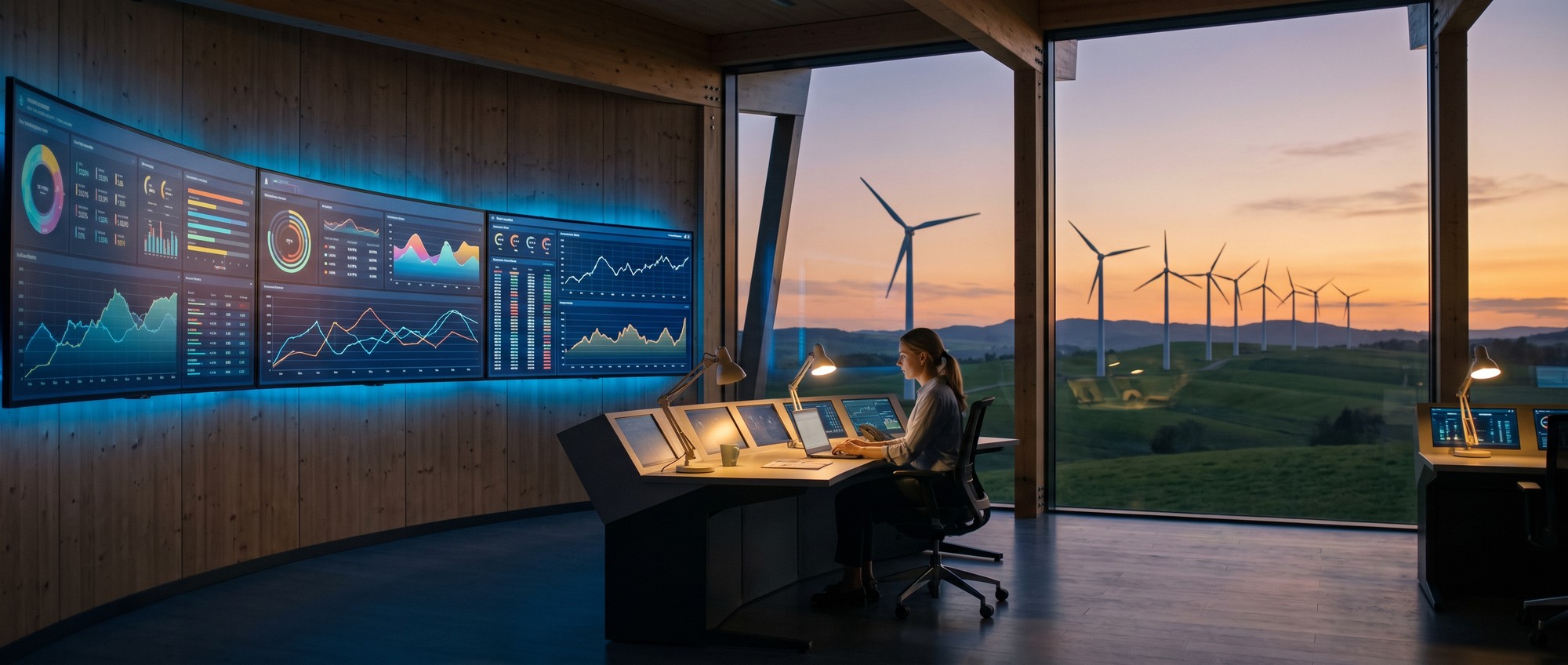
“The immediate impact of this study is that we’ve now both improved and validated models that go into wind turbine control protocols for existing farms,” Howland said. He added that the larger, medium-term upside is the experimental paradigm itself, a way to prototype designs and control strategies far faster than before.
The work was supported in part by the Natural Sciences and Engineering Research Council of Canada, the U.S. National Science Foundation, and the MIT-GE Vernova Alliance, and the findings appear in the open-access journal PNAS Nexus.
For operators, the practical implication is straightforward. Three control levers can be tuned together to improve output without adding hardware: the turbine’s alignment with the wind, its blade pitch angles, and its tip speed relative to the wind. That is an unusual proposition. Most gains in this sector have historically come from making turbines bigger.
Why No Wind Turbine Can Reach 100% Efficiency
It helps to understand the ceiling that every turbine runs into. A wind turbine cannot capture all the energy in moving air. If it did, the air behind the rotor would stop completely, and no fresh wind could flow in to keep the machine turning.
Physics sets the limit. In 1919, the German physicist Albert Betz calculated that no turbine can capture more than 16/27 of the kinetic energy in wind, a figure of about 59.3 percent that is now known as the Betz limit. Practical utility-scale turbines reach peak performance of roughly 75 to 80 percent of that ceiling, or around 44 to 47 percent of the wind’s energy.
Farm-level losses take another bite. Turbulence shed by upstream turbines, known as the wake, can cost a wind plant anywhere from 10 to 20 percent of its gross production. That is why a fleet of individually excellent machines can still underperform as a group.
| Stage | Efficiency | What it means |
|---|---|---|
| Theoretical maximum (Betz limit) | 59.3% | The absolute ceiling for capturing wind’s kinetic energy |
| Best modern turbines (peak) | About 44 to 47% | Roughly 75 to 80% of the Betz limit under ideal conditions |
| Wind farm wake losses | 10 to 20% | Energy lost to turbulence from upstream turbines |
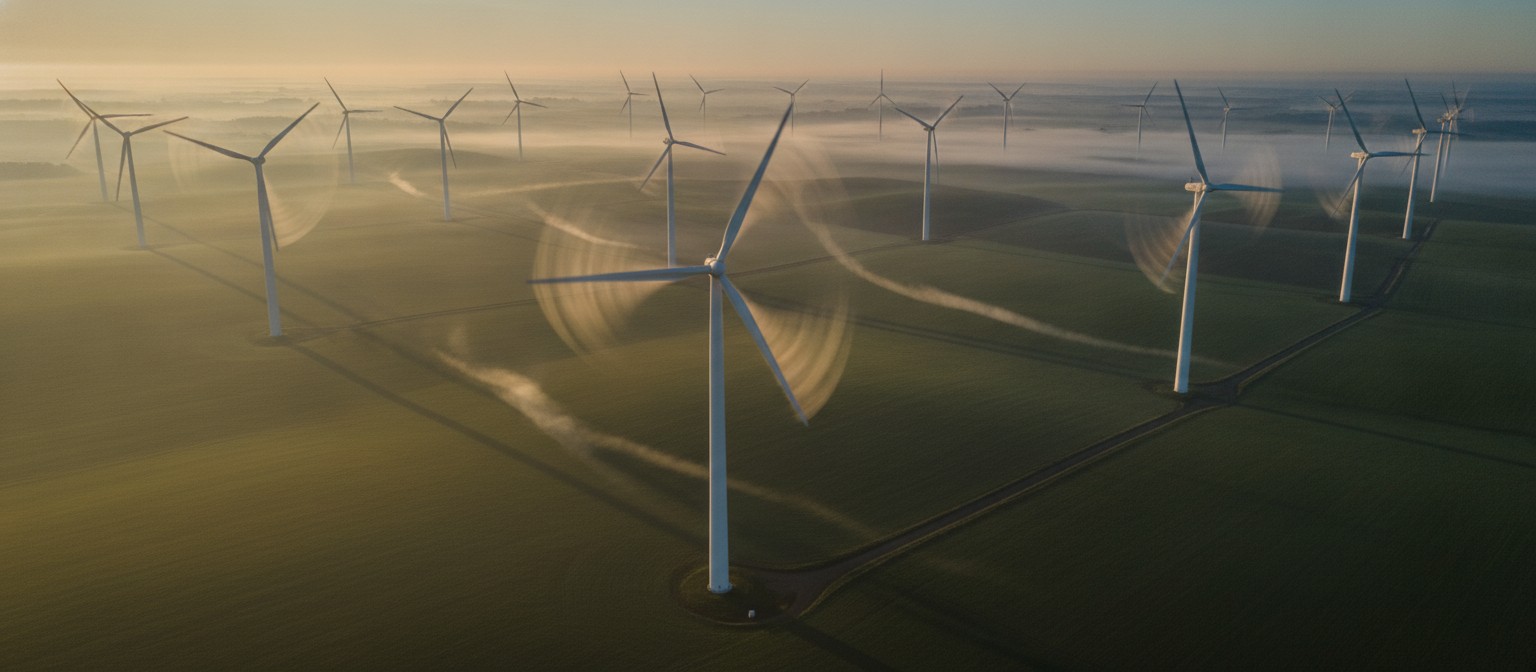
Seen against that backdrop, the MIT finding is less about reinventing the turbine and more about clawing back a slice of the gap between theory and reality. The tip-speed adjustment the team identified is one such slice, and it costs nothing but a change in control software.
How Efficient Are Wind Turbines in the Real World?
Theoretical ceilings only tell part of the story. In daily operation, a turbine’s output swings widely with the weather, and the figure that matters most to operators is the capacity factor.
Why efficiency changes with wind speed
Efficiency peaks at the wind speeds a turbine is designed for, typically around 6 to 9 meters per second. Below that range there is simply less energy in the air to capture. Above it, turbines deliberately spill energy by pitching their blades, shedding load to protect the gearbox and generator from overload.
The capacity factor: the number that matters
The capacity factor captures this reality. It is a turbine’s actual output over a year divided by the maximum it could produce if it ran flat out the whole time. Modern onshore wind farms typically land in the 30 to 45 percent range, while well-sited offshore farms do better.
Onshore versus offshore
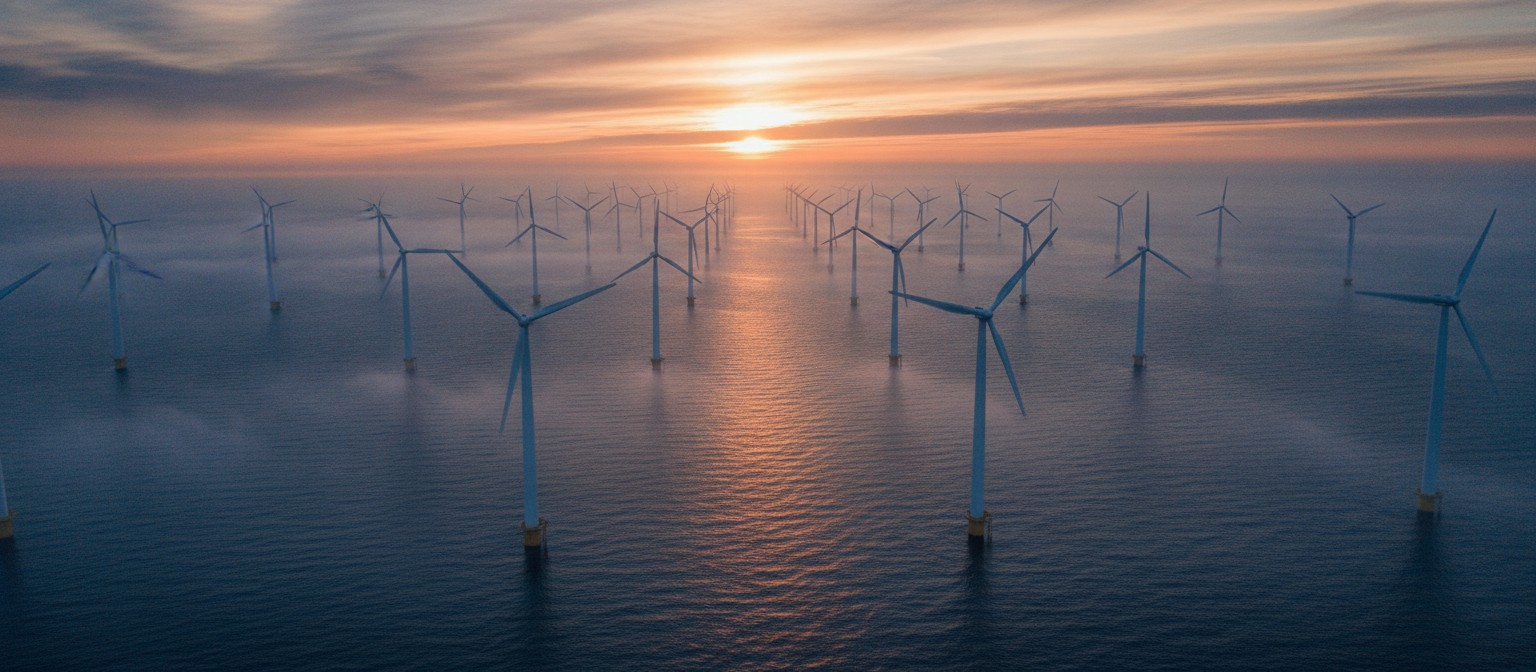
Offshore turbines tend to be larger, face stronger and steadier winds, and encounter less turbulence. All three factors lift output, which is why offshore capacity factors generally exceed onshore ones. Component losses explain much of the remaining gap between the Betz limit and a farm’s real output: aerodynamic losses at the rotor take the largest share, while the gearbox and the generator each trim a few more percentage points. Added together, a modern wind facility typically converts 30 to 40 percent of the energy passing through its rotors into electricity.
What More Wind Farm Efficiency Is Worth
Wind power has become one of the cheapest sources of electricity in many markets, which makes small percentage gains surprisingly valuable at scale. A single turbine can generate millions of dollars of revenue over its lifetime, so even a modest improvement in output compounds quickly across a farm.
The MIT team’s estimate of tens of thousands of dollars per turbine per year reflects that arithmetic. Applied across a utility-scale wind farm of dozens or hundreds of turbines, the gains add up to a meaningful shift in the economics of an existing asset.
The appeal is that the improvement does not require new blades, taller towers or heavier foundations. It comes from:
- Tuning how each turbine responds when it is angled away from the wind.
- Adjusting blade pitch to keep the airfoil at its most effective angle of attack.
- Matching tip speed to the turbine’s misalignment, a step rarely taken today.
- Applying the same logic across an entire wind farm, not just a single turbine.
- Testing new control strategies in the lab before committing to an expensive field trial.
- Running the validated model on ordinary laptops, where it is fast enough to be practical.
Those changes sit in the same family as wake steering, a related strategy in which the front row of turbines is deliberately angled so that its turbulent wake is deflected away from the machines behind it.
The Bigger Picture: Wake Steering and the Race for More Wind Power
Wake steering is not theoretical. Field tests at a utility-scale wind farm have shown that deliberately misaligning upstream turbines can raise a plant’s overall energy capture, and simulations suggest annual energy production gains of 2 percent or more. The MIT experiments add a sharper, faster way to test that kind of control logic before it is deployed.
The stakes are rising with the scale of the industry. According to the Global Wind Energy Council, the world ended 2025 with about 1,299 gigawatts of installed wind capacity, after adding a record 165 gigawatts during the year, up 40 percent on 2024. Wind now spans 138 countries.
That growth is exactly why marginal gains matter. Every fraction of a percent of extra output from existing farms is emissions-free electricity that does not require new land, new permits or new turbines. Manufacturers keep chasing scale, from record-setting machines such as the world’s biggest wind turbine to radically different concepts like airborne wind energy, but the MIT work suggests some of the most accessible gains lie in how existing machines are controlled.
Frequently Asked Questions
Why can’t wind turbines be 100% efficient?
Because extracting all of the energy from moving air would stop the air dead behind the rotor, leaving nothing to keep fresh wind flowing through the blades. The German physicist Albert Betz showed in 1919 that the theoretical maximum is about 59.3 percent of the wind’s kinetic energy, a ceiling known as the Betz limit. Real turbines reach roughly 75 to 80 percent of that figure, and farm-level wake losses remove more still.
Are wind farms cost effective?
In many markets, yes. Onshore wind is among the cheapest sources of new electricity, and modern turbines generate far more power per unit of cost than they did a decade ago. The MIT study points to one reason operators keep chasing small efficiency gains: on an existing farm, a few percentage points of extra output can translate into tens of thousands of dollars per turbine each year with no new equipment.
How much power does a wind turbine produce per day?
It depends on the turbine and the site. A large modern onshore turbine rated at 3 to 5 megawatts might generate tens of thousands of kilowatt-hours on a windy day, while a calm day produces far less. Output rises with the cube of wind speed, so a doubling of wind speed can increase the available power roughly eightfold, which is why siting and control matter so much.
What is the Betz limit?
The Betz limit is the maximum fraction of the kinetic energy in wind that any turbine can extract, about 16/27, or 59.3 percent. It follows from the conservation of mass and momentum and applies to all wind turbines regardless of design. Practical machines achieve roughly 75 to 80 percent of that limit at peak.
What are the pros and cons of wind energy?
Wind power is fuel-free, produces no emissions at the point of generation and has become inexpensive at scale. Its drawbacks include variability, the land and materials it requires, and effects on wildlife and landscapes. Intelligent Living has a fuller breakdown of the advantages and disadvantages of wind energy.
Conclusion: Squeezing More From the Wind We Already Have
The MIT experiments do not promise a new machine. They promise a better understanding of the ones already turning, and a faster, cheaper way to test ideas that could make every turbine on a farm pull a little harder.
In an industry that added a record 165 gigawatts in a single year and is racing toward two terawatts of capacity by 2030, that kind of quiet gain may matter more than any single breakthrough. Wind farm efficiency, it turns out, is not only a question of bigger blades. Increasingly, it is a question of smarter control.


