
For decades, geothermal power was confined to a handful of lucky locations where nature had already assembled the ingredients: hot rock, plenty of water, and cracks that let fluid circulate. Almost everywhere else, the heat was there but locked away.
In 2026, that barrier began to give way. On September 24, Fervo Energy synchronized its Cape Station project in Beaver County, Utah, to the grid and declared commercial operation a week later. It is the first greenfield enhanced geothermal system in the world to reach contractual commercial operations, and it moves the technology from a demonstration project to a working power plant.
This guide explains what enhanced geothermal systems are, how the drilling works, why 2026 is the turning point, what the electricity costs, and the real risks that still need managing.
What Are Enhanced Geothermal Systems?
A conventional geothermal plant relies on three things: heat, fluid, and permeability, which is simply the ability of fluid to move through rock. Nature supplies all three in places such as Iceland, Kenya, and California. In much of the world, however, the rock is hot but too tight for water to flow through it.
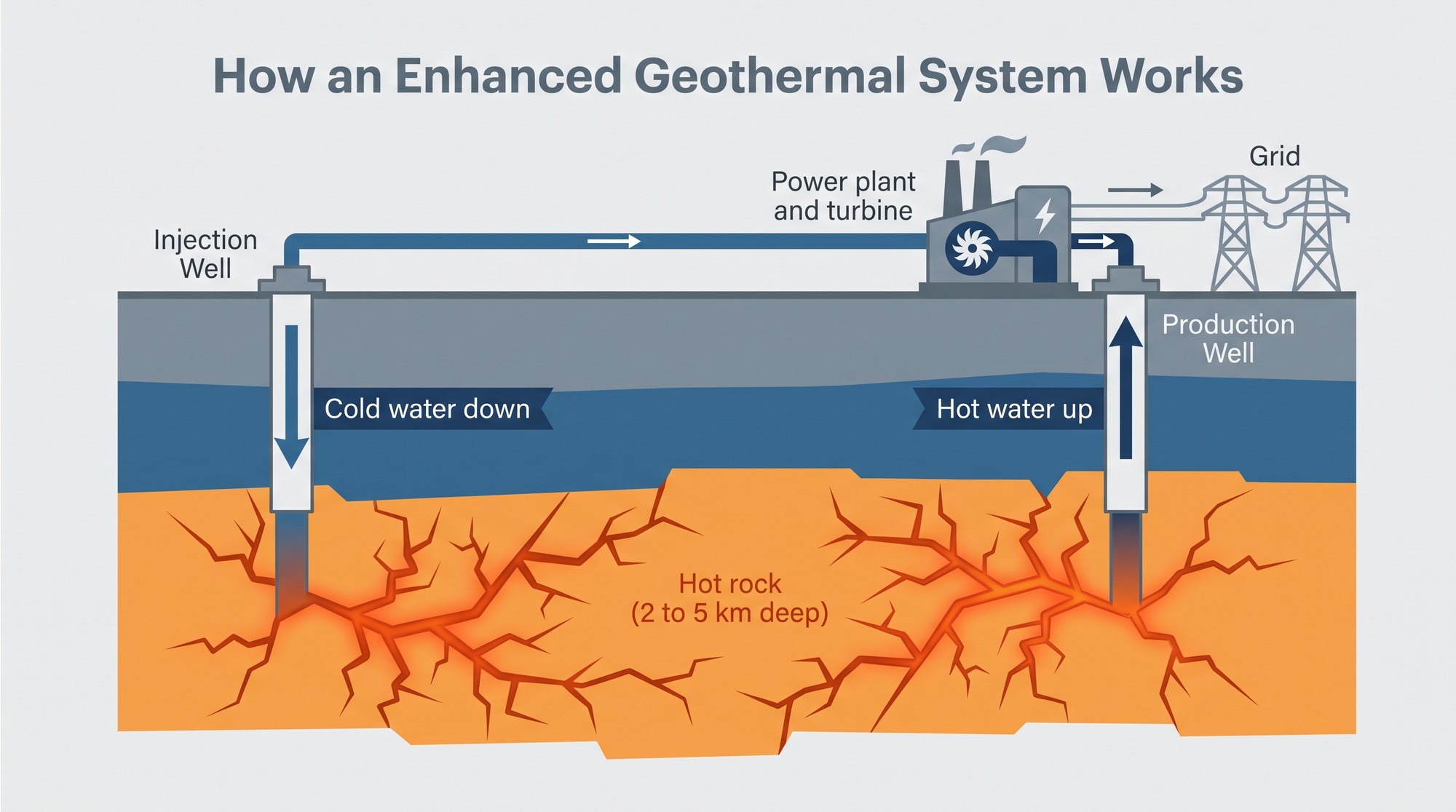
An enhanced geothermal system, or EGS, supplies what the geology is missing. Operators drill deep into hot rock, then inject fluid under carefully controlled pressure to reopen existing fractures and create new ones, forming a reservoir where none existed before. Water circulates through that fractured rock, absorbs heat, and returns to the surface to spin a turbine and generate electricity. The U.S. Department of Energy calls the result human-made geothermal energy.
EGS sits within a wider family of next-generation geothermal technologies. Closed-loop systems circulate fluid through sealed pipes without fracturing rock, while superhot systems target temperatures that most equipment cannot survive. What they share is a single goal: taking geothermal beyond rare volcanic hotspots and making it possible almost anywhere.
| Approach | How it works | Best suited to |
|---|---|---|
| Conventional (hydrothermal) | Taps natural heat, fluid, and permeable rock | Volcanic and rift zones such as Iceland and Kenya |
| Enhanced geothermal (EGS) | Injects fluid to create a fractured, human-made reservoir | Hot rock that is too tight for water to flow |
| Closed loop | Circulates fluid through sealed underground pipes | Sites where fracturing is unsuitable |
| Superhot | Targets resources above 375°C, where water turns supercritical | Deep, extremely hot rock |
Why 2026 Is the Turning Point
The idea is not new. The first serious attempt began at Fenton Hill, New Mexico, in the 1970s, and a landmark 2006 MIT study estimated that the United States alone held enough accessible geothermal energy to power the country many times over. Progress then stalled for decades, held back by drilling costs and seismic risk. In 2022, the Department of Energy launched its Enhanced Geothermal Shot, aiming to cut costs by 90 percent. Then 2026 arrived.
Fervo Energy’s Cape Station reached first power on September 24 and declared commercial operation on October 1, one day ahead of its contractual deadline. Its first 33-megawatt GeoBlock is now selling power under long-term agreements. Phase I totals roughly 100 megawatts across three units, with the next two expected to reach commercial operation by January 1, 2027, and a further 400 megawatts already under construction for 2028. The project is fully contracted, with customers including Southern California Edison, Shell Energy, and community choice aggregators, and Fervo has also signed an offtake agreement with Google.
The superhot frontier advanced at the same time. Quaise Energy’s Project Obsidian in Central Oregon was selected for up to $25 million in support from the Department of Energy, part of a broader federal effort to prove commercial superhot geothermal. The three-well project is designed to reach reservoir temperatures above 300 degrees Celsius and target more than 25 megawatts of gross electric power.
Federal money has followed the momentum. In February 2026, the Department of Energy announced $171.5 million for next-generation geothermal field tests, with the first round of applications aimed at enhanced geothermal systems and exploration drilling. The department notes that the United States already leads the world with about four gigawatts of geothermal capacity, yet its own analysis points to at least 300 gigawatts of potential on the grid by 2050. It also continues to run the FORGE field laboratory in Utah, where researchers test drilling and reservoir techniques.
Where Enhanced Geothermal Is Being Built
Enhanced geothermal is not a single-country experiment. Pioneering sites have operated in the United States, the United Kingdom, France, Australia, and South Korea, and today the frontier stretches across three continents, from a dedicated research laboratory in Utah to a closed-loop project in Bavaria.
The geographic spread is the whole point. Where conventional geothermal needs rare geology, EGS and its cousins are designed to work almost anywhere, and the projects above show how far that idea has already traveled.
How EGS Works, From Drilling to Grid
An enhanced geothermal project follows a sequence that borrows heavily from the oil and gas industry.
- Drill deep wells, often two to five kilometers down, into hot but impermeable rock.
- Stimulate the rock by injecting fluid at controlled pressure to reopen existing fractures and create new ones.
- Circulate water through the resulting fracture network, where it absorbs heat from the surrounding rock.
- Return the hot water to the surface, where it drives a turbine and feeds electricity to the grid.
EGS is often mistaken for fracking under a new name. In practice, it typically relies on water rather than the sand and chemical additives used in oil and gas operations, and it works by shearing existing fractures instead of propping new ones open. The engineering remains demanding: the Department of Energy notes that casing and cementing alone can account for 30 to 40 percent or more of well costs, which is why cheaper, heat-tolerant well construction is central to making EGS economical.
The Superhot Rock Frontier
If ordinary EGS is about reaching hot rock, the superhot frontier is about reaching extreme heat. Superhot geothermal targets resources above 375 degrees Celsius, where water becomes supercritical and behaves like both a liquid and a gas. That allows it to carry far more energy, producing several times the power density of cooler rock.
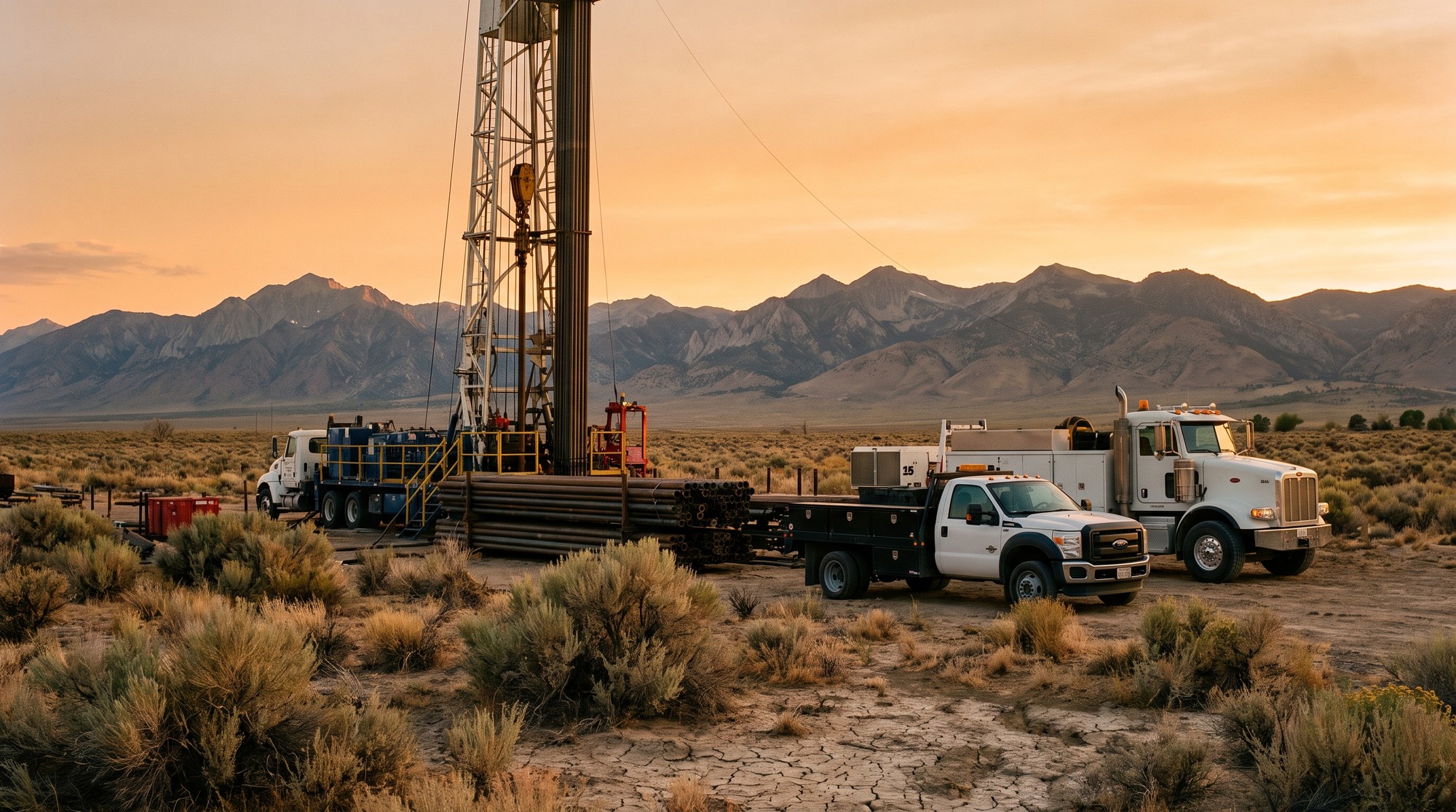
Mazama Energy’s Newberry pilot in Central Oregon drilled nearly two miles into hot dry rock that reached 331 degrees Celsius, which the company calls the world’s hottest engineered geothermal system. Its next well, Athena, is designed to descend almost three miles into rock above 400 degrees Celsius while testing supercritical carbon dioxide as a drilling fluid. A later project aims for 15 megawatts of initial output.
In Iceland, engineers have gone further still, drilling directly into a volcano’s magma chamber to study how extreme heat behaves underground. The payoff, if superhot drilling works at scale, is fewer wells and less surface land for the same output, which could finally make geothermal viable in regions with no volcanoes at all.
Why the AI Boom Is Supercharging EGS
The timing is not a coincidence. Data centers now consume enormous amounts of electricity and need it every hour of the day, which variable solar and wind cannot guarantee. Geothermal can, with capacity factors above 90 percent, meaning it runs almost continuously.
Fervo’s agreement to supply Google shows where the market is heading. The Department of Energy has framed its own geothermal funding in similar terms, describing it as a way to “enable data center growth” alongside affordable, reliable power. For technology companies under pressure to cut emissions while keeping data centers running, firm and always-on power is worth paying a premium for. EGS offers that kind of power without tying a project to a specific geography.
Campus-scale projects are testing the same idea on a smaller footprint, including a university system that heats and cools its buildings with underground loops.
Can EGS Compete on Cost?
None of this matters if the electricity is too expensive. The Department of Energy’s Enhanced Geothermal Shot set a target of cutting enhanced geothermal costs by 90 percent, to $45 per megawatt-hour, by 2035, and federal analysis suggests advanced deep-EGS resources could approach roughly $46 per megawatt-hour by that point. Independent levelized-cost analysis already ranks geothermal’s economics favorably against offshore wind, gas, nuclear, and coal.
The remaining obstacle is drilling. Because casing and cementing alone can consume 30 to 40 percent of well costs, the industry’s central challenge is building wells that are cheaper and can tolerate hotter rock. Eavor, whose closed-loop project in Germany reached the grid in 2025, reports that its technology is already cost competitive for district heating and in certain power markets.
Two features make EGS attractive next to other low-carbon sources: it runs around the clock, and it uses far less land than solar farms of comparable output. Those advantages explain why Fervo is building out Cape Station in stages, scaling from a single 33-megawatt unit toward 500 megawatts.
The Real Risks: Earthquakes, Water, and Wildlife
Induced seismicity is the headline concern, and it is not hypothetical. On November 15, 2017, a magnitude 5.4 earthquake struck Pohang, South Korea, injuring about 90 people and causing roughly $52 million in damage. Two studies published in Science concluded the quake was likely triggered by fluid injected at an EGS site, making it the largest known induced earthquake at an enhanced geothermal project. The study’s authors found that the volume of injected fluid, far smaller than their models predicted, was enough to trigger a quake of that size, a result that reshaped how developers assess seismic risk.
That does not make EGS inherently dangerous, but it explains why the industry now treats seismic risk as an engineering problem. Modern projects rely on induced seismicity monitoring, traffic-light systems that pause or stop injection when activity rises, careful siting away from critically stressed faults, and better forecasting tools.
Water is a more manageable issue. EGS water does not need to be drinkable, and it is largely reinjected into the same reservoir it came from, which limits risks to drinking-water supplies because the reservoirs sit far deeper than groundwater. Wildlife can still complicate siting: in 2023, a Nevada geothermal project was halted to protect the endangered Dixie Valley toad.
The Companies Racing to Scale EGS
A small group of companies now dominates the push toward commercial EGS.
| Company | Approach | What to know |
|---|---|---|
| Fervo Energy | Utility-scale EGS | Cape Station in Utah reached commercial operation in 2026 |
| Quaise Energy | Superhot rock drilling | Selected for up to $25 million in DOE support for Project Obsidian |
| Mazama Energy | Superhot EGS | Newberry pilot reached 331°C; deeper Athena well underway |
| Eavor | Closed loop | Its first commercial Eavor-Loop began delivering power to the German grid in December 2025 |
| Sage Geosystems | Geopressured EGS and storage | Commissioned a 3 MW storage facility in Texas and completed a 120-day power generation test |
| Ormat Technologies | Conventional geothermal | Long-established plant operator and equipment maker |
Beyond these developers, oil-field service companies are increasingly involved, since geothermal drilling relies on similar rigs, bits, and expertise. Fervo Energy is publicly traded, but the sector remains early and capital-intensive, and project timelines depend heavily on permitting and grid connections.
Frequently Asked Questions
What is the difference between geothermal and enhanced geothermal systems?
Conventional geothermal taps naturally occurring heat, fluid, and permeable rock, so it works only where geology provides all three. An enhanced geothermal system creates the missing permeability by drilling and injecting fluid to fracture hot rock, which opens up far more locations.
What is the downside of enhanced geothermal systems?
The main risks are induced earthquakes, high upfront drilling costs, and potential conflicts over land and water. The 2017 Pohang earthquake in South Korea, linked to an EGS site, remains the clearest cautionary example.
What companies are involved in enhanced geothermal systems?
Leading developers include Fervo Energy, Quaise Energy, and Mazama Energy, alongside established geothermal operators and oil-field service firms. Government programs such as the Department of Energy’s FORGE site also drive much of the underlying research.
Is there still a geothermal tax credit in 2026?
Yes. Unlike wind and solar, geothermal largely kept its federal tax credits when the One Big Beautiful Bill Act reshaped US energy incentives in 2025. Geothermal projects remain eligible for the technology-neutral investment and production tax credits, with the phase-down not beginning until the 2030s, though new restrictions apply to projects with certain foreign ownership links.
How much does enhanced geothermal electricity cost?
The Department of Energy aims for $45 per megawatt-hour by 2035 under its Enhanced Geothermal Shot, roughly a 90 percent reduction from earlier cost estimates. Current projects are more expensive, which is why cheaper drilling is the industry’s central challenge.
A Power Source That Could Work Almost Anywhere
Enhanced geothermal has spent decades as a promising idea in search of a business. In 2026, that changed: power is flowing to the grid from a purpose-built EGS plant, superhot drilling is pushing into rock hotter than any previous project, and data centers are creating demand for exactly the kind of firm, clean power geothermal provides.
The obstacles have not disappeared. Drilling is expensive, seismic risk must be managed carefully, and scaling from a single commercial plant to thousands of megawatts will take years. Still, the direction of travel is clear. For the first time, geothermal’s biggest limitation, geography, looks like a problem that engineering can solve.


