
When a headline promises a 504 Wh/kg battery breakthrough, the first rule of battery literacy is to ask whether that number came out of an electric car pack, a shipping drone pouch, or a spreadsheet. In the case of a new ultrathin lithium anode battery demonstration from researchers in China, the honest answer is two separate laboratory achievements that popular coverage has blended together: a 10-micrometer printed anode that survived 260 cycles in a standard coin cell, and a stack-level calculation showing that a 20-micrometer version paired with a heavy nickel-rich cathode reaches 504 Wh/kg (and up to 512 Wh/kg in the paper’s thinnest configuration).
That distinction does not make the chemistry any less clever. By forcing molten lithium through a laser-cut stencil together with a reactive magnesium salt, the team solved two problems that usually kill thin lithium metal anodes before they leave the glovebox: molten lithium refuses to spread smoothly on copper, and thin lithium gets chewed up by side reactions inside the cell. Here is how the printing trick works, why shaving microns off the anode matters more than tweaking the cathode, and where 504 Wh/kg actually sits on the battery energy density ladder.
What the Chinese team actually built
The study, published in Nano-Micro Letters (Volume 19, Article 37) and indexed on the journal’s article page, comes from Wenting Liu, Wei Wu, and colleagues at the Shenzhen Institutes of Advanced Technology (Chinese Academy of Sciences), Southern University of Science and Technology, and Guilin University of Technology. After recent coverage of the 504 Wh/kg figure framed the result around future EV batteries, looking directly at the primary data clarifies what was physically tested on the bench.
Rather than rolling a continuous, mirror-flat sheet of lithium foil, the researchers screen-printed arrays of tiny, isolated lithium microdiscs directly onto 10-micrometer copper foil. By changing the thickness of a stainless-steel stencil mask and the spacing of its laser-cut holes, they produced ultrathin anodes with effective thicknesses of 10, 20, and 28 micrometers (one micrometer is one-millionth of a meter; a human hair is roughly 70 micrometers across). Those three grades deliver areal capacities of roughly 2.0, 4.1, and 5.5 milliamp-hours per square centimeter (mAh/cm2), matching the capacity demands of commercial cathodes.
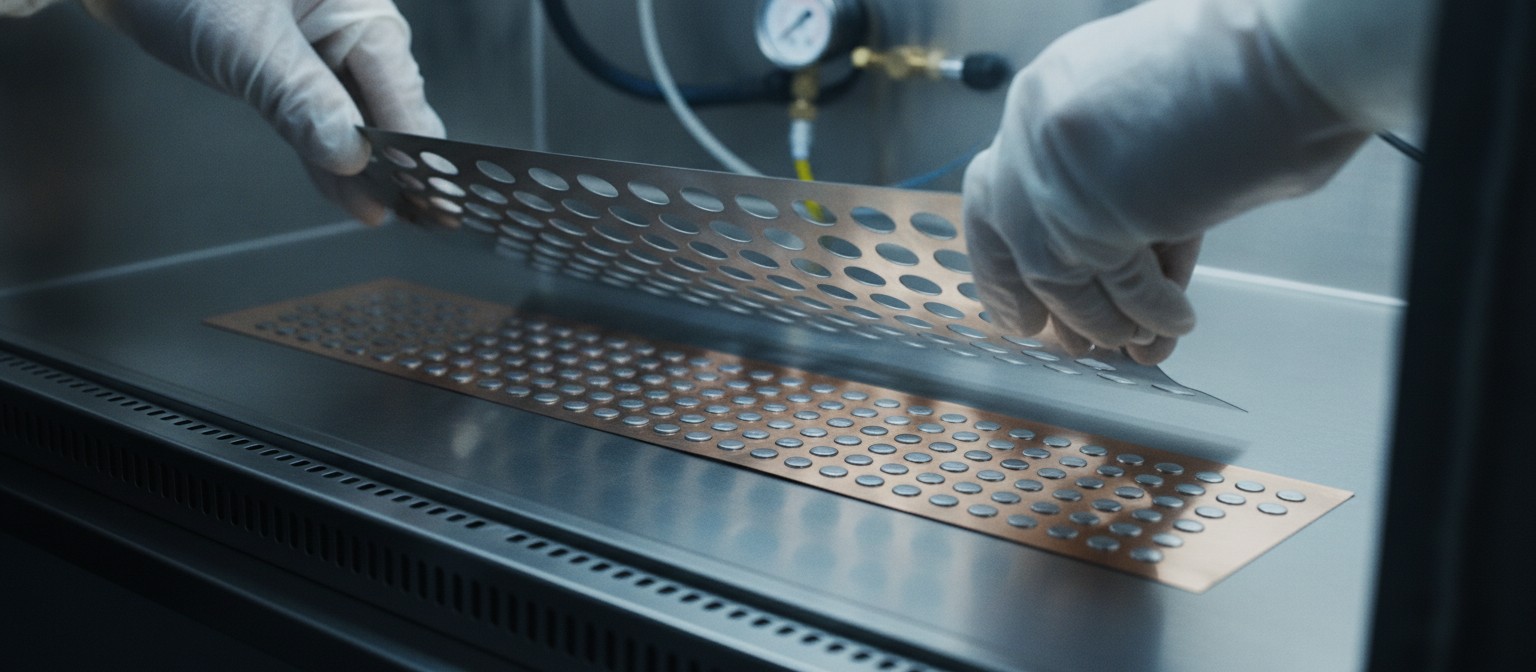
To prove the method is not limited to postage-stamp electrodes, the team printed a 30 by 10 centimeter sheet inside an argon glovebox. The discs stayed locked onto the copper through tape-peel tests and survived 200 back-and-forth bending cycles without flaking off. Crucially, the molten lithium was pre-mixed with a salt called magnesium bis(trifluoromethanesulfonyl)imide, or Mg(TFSI)2, which reacted in the melt to seed the metal with protective ceramic and alloy nanoparticles before the anode ever touched an electrolyte.
Why thinner lithium matters more than a better cathode
To understand why battery engineers obsess over shaving 30 micrometers off a piece of foil, it helps to separate the jobs of the lithium-ion battery anode and cathode. Inside every rechargeable lithium cell, the cathode (typically lithium iron phosphate, known as LFP, or a nickel-rich oxide such as NCM811) acts as the source of lithium ions when the battery is built, while the anode catches and stores those ions during charging. Today’s commercial EV cells use a host material like graphite (sometimes blended with a silicon anode) on the negative side, which acts like a multi-story parking garage for lithium ions but adds dead weight and volume of its own.
A lithium metal battery strips away that graphite parking garage and plates pure metallic lithium directly onto the copper current collector. On paper, pure lithium is the ultimate negative electrode: it holds 3,860 milliamp-hours per gram (about ten times the weight capacity of graphite) and sits at the lowest electrochemical potential of any solid element (-3.04 volts versus the standard hydrogen electrode), which maximizes cell voltage.
The catch is thickness. Most laboratory lithium-metal cells cheat by using commercially rolled lithium foil that is 50 micrometers thick or more. Because a standard cathode only cycles a fraction of that lithium back and forth on each charge, a 50-micrometer foil leaves a huge reservoir of unused metal sitting idle. According to the authors’ analysis, foil at or above 50 micrometers accounts for roughly 15% to 25% of the entire cell’s weight as dead mass, dragging total energy density down and hiding how fast the cell is actually burning through its active lithium. Getting cell-level energy density Wh/kg above the 400 Wh/kg mark requires pulling the anode down to 20 micrometers or less, where the ratio of negative-to-positive capacity (the N/P ratio) drops close to 1.0.
The printing trick that beats molten lithium’s refusal to spread
Making an ultrathin anode sounds simple: melt a block of lithium and wipe a thin coat across copper foil. In practice, molten lithium behaves like liquid mercury on a plastic tablecloth. Copper is naturally “lithiophobic” (lithium-repelling), and molten lithium has high surface tension, so the liquid metal beads up rather than wetting the foil.
In baseline contact-angle tests run inside an argon atmosphere (with water and oxygen each kept at or below 0.01 parts per million), the researchers showed that molten lithium sitting on copper between 190C and 240C maintains an obtuse contact angle between 116.2 degrees and 91.3 degrees. Even when heated to 300C, where lithium and copper begin to dissolve into each other at the interface, the angle only drops to 60.7 degrees, which is still far too high to spread a uniform 10-to-20-micrometer film.
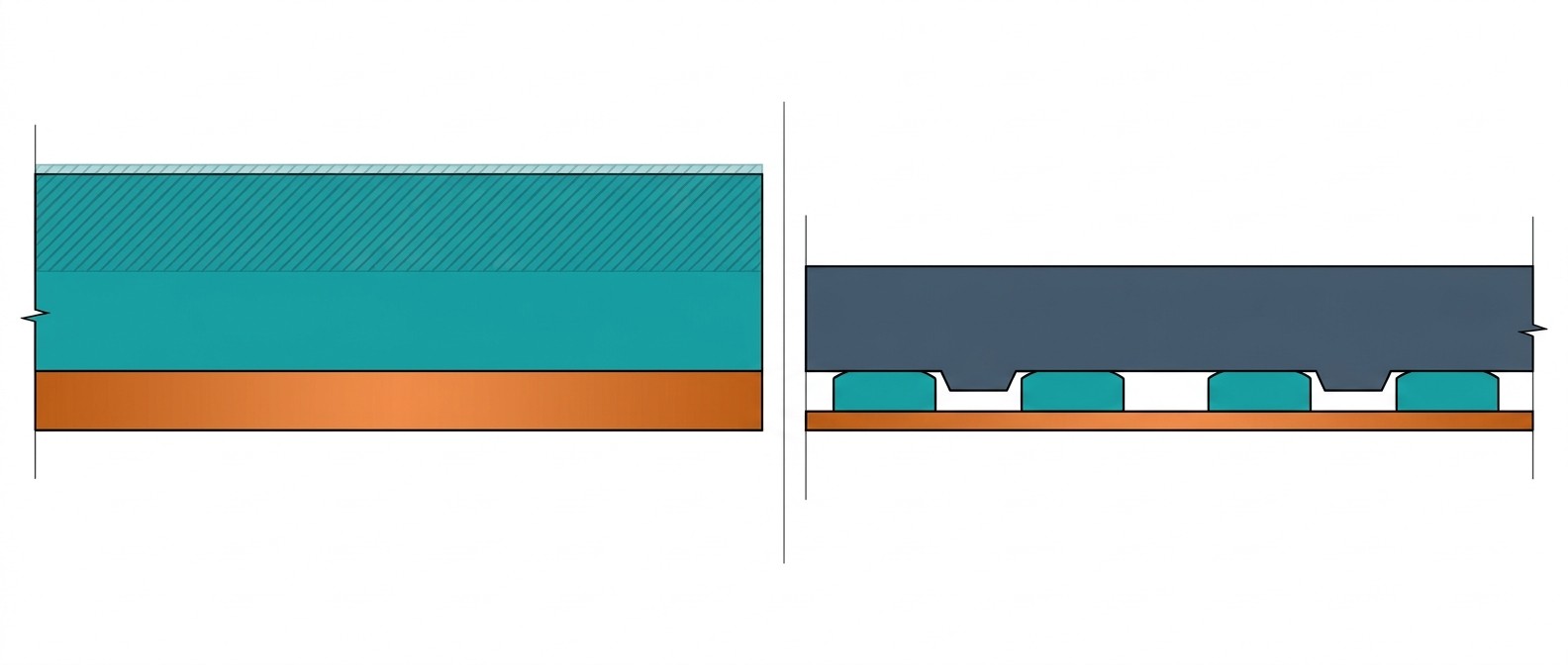
Instead of fighting surface tension across an open sheet, the team used a femtosecond laser to cut periodic circular holes into a stainless-steel stencil mask, laid the mask flat over copper foil, and used an applicator roll to press the molten lithium-salt mixture into the holes. Once cooled and peeled free of the stencil, the lithium stays behind as an ordered grid of isolated microdiscs. That geometry offers two mechanical bonuses:
- Dial-in thickness via coverage area: By fixing the open hole area at 50% of the copper sheet (for example, 1.25-millimeter hole radii spaced on a 3-millimeter pitch) and varying the stencil thickness, a 20-micrometer-tall disc yields an effective anode thickness of 10 micrometers across the whole electrode. Stepping up to 70% hole coverage produces the 28-micrometer grade (~5.5 mAh/cm2).
- Built-in stress relief: Finite-element simulations (COMSOL) run by the team showed that breaking a continuous lithium film into discrete islands spreads out mechanical stress during plating and stripping. When the researchers modeled a tiny pre-existing crack, the continuous film let the crack rip straight through, whereas the discrete disc layout stopped the crack from propagating and kept lithium-ion flux even across the surface.
The salt that builds its own protective skin
Thinning the lithium solves the weight problem, but it makes the chemistry far less forgiving. With no spare metal in reserve, every microgram of lithium lost to side reactions with the liquid electrolyte permanently drains the battery. Worse, uneven electric fields on bare lithium cause incoming ions to pile up into sharp, branching whiskers called a dendrite, which can puncture the separator and short-circuit the cell, or snap off to form “dead” mossy lithium.
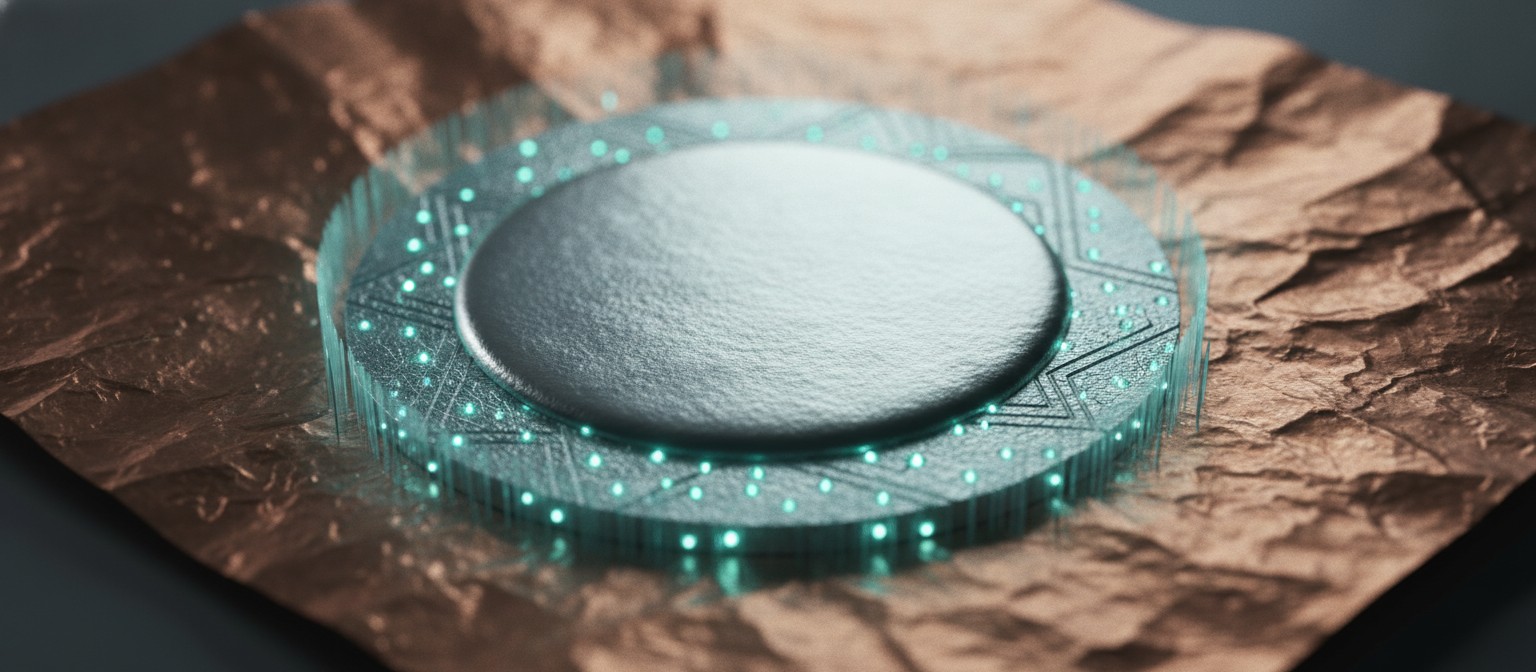
That is where the Mg(TFSI)2 salt mixed into the molten lithium earns its keep. As the salt reacts with the liquid lithium in the crucible, it breaks down in place (in situ) into a uniform dispersion of nanoparticles ranging from tens of nanometers to about 200 nanometers across. Cross-sectional focused-ion-beam scanning electron microscopy (FIB-SEM) confirmed that these particles sit distributed from the top surface right down through the bulk of each microdisc without sinking to the bottom.
X-ray photoelectron spectroscopy (XPS) identified the exact ingredients of that built-in nanocomposite shield: lithium fluoride (LiF at 684.8 eV), lithium nitride (Li3N at 397.5 eV), lithium sulfide and persulfide (Li2S at 161.2 eV and Li2S2 at 162.8 eV), lithium sulfate (Li2SO4 at 168.4 eV), and a lithium-magnesium alloy phase (Li3Mg at 1304.8 eV). Together, they change how the anode behaves on every charge cycle:
- Lithiophilic landing pads: Density functional theory (DFT) calculations showed that bare lithium (-0.009 eV per atom) and bare copper (-0.022 eV per atom) barely attract incoming lithium atoms. By contrast, the embedded nanoparticles bind lithium much more strongly (with adsorption energies of -0.251 eV for Li2CO3, -0.119 eV for Li2S, -0.041 eV for Li3Mg, and -0.036 eV for Li3N). Instead of clustering into spiky dendrites at a few hot spots, incoming ions spread across thousands of nanoparticle nucleation sites and grow as a flat, dense granular layer.
- An inorganic-rich SEI: Every lithium battery forms a microscopic surface crust called the solid electrolyte interphase (SEI) when the anode reacts with the electrolyte. A fragile, organic-heavy SEI cracks as the anode breathes in and out, drinking up fresh electrolyte and active lithium on every cycle. The pre-embedded LiF, Li3N, and Li2S phases seed a tough, fast-conducting inorganic SEI right from the start, keeping Coulombic efficiency (the percentage of charge recovered on each cycle) above 99.8% in LFP coin-cell testing.
- Island-first deposition: At normal cycling loads up to 2 mAh/cm2 (tested at 0.5 milliamps per square centimeter), fresh lithium plates preferentially onto the existing modified microdiscs rather than spilling randomly into the bare copper gaps, which only fill in when capacity is pushed to extreme levels (5 to 8 mAh/cm2).
In symmetric coin cells (two identical anodes shuffling 1 mAh/cm2 back and forth at 1 mA/cm2 in an ether electrolyte), the modified array held a steady overpotential of about 40 millivolts at 500 hours and ran for 800 to 1,100 hours before failing. Bare lithium ran at a higher resistance (~60 millivolts) and shorted or dried out between 530 and 670 hours.
What 504 Wh/kg really is, and where it sits on the ladder
Here is the single most important detail for reading the headline number accurately: the 260-cycle endurance result and the 504 Wh/kg energy-density number did not come from the same cell configuration, and 504 Wh/kg is a stack-level calculation from CR2032 coin-cell parameters rather than a weighed pouch cell or a finished EV battery pack.
In their full-cell coin tests (using a 1.0 M LiTFSI ether electrolyte with 2 wt% LiNO3 additive), the authors ran two distinct classes of experiments:
- The 260-cycle longevity test: A 10-micrometer modified lithium array (~2.0 mAh/cm2) was paired with a moderate-loading LFP cathode (12.3 mg/cm2, N/P ratio of 1.0, cycled between 2.5 and 3.8 volts). That cell delivered more than 130 mAh per gram of cathode material and maintained a Coulombic efficiency above 99.8% across 260 cycles, whereas a bare lithium cell faded by 200 cycles and an unpatterned continuous modified film faded around 235 cycles.
- The 504 Wh/kg high-energy calculation: To push gravimetric and volumetric energy density, the team paired 20-micrometer and 28-micrometer anodes with heavy, high-voltage cathodes cycled up to 4.3 volts (N/P ratios of 0.6 to 1.2), including NCM811 (at 9.2 and 16.9 mg/cm2), high-loading LFP (20.0 mg/cm2), lithium cobalt oxide (12.0 mg/cm2), and an ultra-high-nickel nickel-rich cathode labeled Ni92 (LiNi0.92Co0.03Mn0.05O2 at 22.9 mg/cm2, or ~4.6 mAh/cm2). Using the standard Betz stack-calculation method (Table S1 of the paper, accounting for electrode dimensions, N/P balancing, electrolyte excess, inactive stack components, and volume change, but excluding outer coin-cell steel casings), the 20-micrometer configuration calculates to 504 Wh/kg by weight and 1,071 watt-hours per liter (Wh/L) by volume. The thinnest configuration in the paper calculates up to a maximum of 512 Wh/kg and 1,222 Wh/L, while the thicker 28-micrometer anode configuration calculates to 419 Wh/kg and 873 Wh/L.
How does that 504 Wh/kg stack number compare with the rest of the battery world? If you track our battery energy-density ladder, which separates slow-discharge lab cells from shipping aviation pouches and highway-ready EV packs, the new anode lands right in the middle of the 500 Wh/kg prototype frontier.
| Battery System | Development Status | Gravimetric (Wh/kg) | Volumetric (Wh/L) | Key Testing or Operating Condition |
|---|---|---|---|---|
| Kakiage Li-S pouch cell (Communications Engineering) | Lab record | 761 | Not reported | 0.05C (~20-hour discharge), sulfurized polyacrylonitrile, not production-ready |
| Tsinghua fluorinated polymer no-anode solid-state (Nature, Sept 2025) | Lab record | 604 | 1,027 | 0.05C discharge under 1 MPa mechanical clamp |
| SES H6AF drone pouch cell | Datasheet (shipping Q4 2026) | 525 | Not reported | 6.3 Ah (24.3 Wh) drone format, 7C burst rating, 71.5 x 48.5 x 6.2 mm |
| Amprius CES Innovation Award design | Award prototype | 520 | Not reported | Silicon-anode prototype design |
| Amprius delivered HAPS aviation cell | Delivered to customer | 515 | Not reported | 25 Ah high-altitude pseudo-satellite pouch (12.7 x 57 x 95 mm) |
| SIAT/SUSTech screen-printed Li array (max config, this paper) | Lab stack calculation (CR2032) | 512 | 1,222 | Thinnest printed anode variant via Betz stack method |
| SIAT/SUSTech 20-um Li array + high-loading Ni-rich (this paper) | Lab stack calculation (CR2032) | 504 | 1,071 | N/P 0.6 to 1.2, high-loading cathode; up to 120 cycles shown for Ni92 |
| CATL sulfide all-solid-state prototype | Lab TRL 4 (20 Ah class) | 500 | Not reported | Target 60 Ah pilot in 2027, mass production around 2030 |
| Amprius SiMaxx silicon-anode cell | Commercial shipping since 2022 | 450 | 1,150 | Shipping aviation cells; companion SiCore hits 500 Wh/kg at 1C on standard lines |
| SIAT/SUSTech 28-um Li array + high-loading cathode (this paper) | Lab stack calculation (CR2032) | 419 | 873 | Thicker 70%-coverage printed array variant; up to 120 cycles with Ni92 |
| Donut Lab VTT-measured cell | Verified lab test | 409 | Not reported | 0.1C discharge; tested single cell differed from promised Q1 2026 car cell |
| Factorial FEST quasi-solid cell | Delivered to OEM | 390 | Not reported | 85% manufacturing yield, targeting ~450 Wh/kg drone version (77 Ah auto version hits 375 Wh/kg, >600 cycles) |
| WeLion semi-solid EV battery (NIO 150 kWh) | In-production car | 360 (cell) / 260 (pack) | Not reported | Delivers >1,000 km range in NIO ET7/ES6 subscription packs |
| CATL Qilin / condensed high-nickel + silicon | Mass-production car tier | 350 | Not reported | High-nickel cathode with silicon-blended anode |
| Tesla 4680 cylindrical cell | Mass production | ~246 | Not reported | Standard automotive cylindrical format |
| Commodity EV LFP (plus BYD Blade Gen 2 at 162 Wh/kg system) | Mass production | 150 to 190 | Not reported | Powers the majority of mass-market electric cars today |
Placed on this what Wh/kg actually measures scoreboard, the 504 Wh/kg stack calculation sits below slow-discharge laboratory champions like the 761 Wh/kg lithium-sulfur pouch and Tsinghua University’s 604 Wh/kg no-anode polymer cell. It lands in a dead heat with CATL’s 500 Wh/kg lab claim for its 20-amp-hour sulfide prototype, though the two projects attack opposite bottlenecks: CATL is trying to scale a dry sulfide solid electrolyte from Technology Readiness Level 4 toward a 2027 pilot line, whereas the Shenzhen team is trying to make ultrathin metallic lithium survive without excess foil.
Just as important, 504 Wh/kg as a coin-cell stack calculation sits only moderately ahead of shipping silicon-anode cells from Amprius, which have delivered 450 Wh/kg and 1,150 Wh/L to aerospace customers since early 2022 (and up to 515 Wh/kg in delivered 25 Ah high-altitude drone formats). Meanwhile, every battery actually bolted into a highway electric car today sits far lower down the chart, from WeLion’s 360 Wh/kg semi-solid cell (which drops to 260 Wh/kg once packaged into a 150-kilowatt-hour car battery) to commodity LFP cells at 150 to 190 Wh/kg.
Why this is not an EV battery yet
Seeing how the microdisc anode works makes it clear why this is a legitimate fabrication advance, and equally clear why it is not ready to drop into a passenger car as a lithium metal anode EV battery tomorrow. Moving from a coin-cell stack calculation to an automotive battery pack requires clearing five hurdles that this paper did not test:
- Cycle life drops when the high-energy cathode goes in: The high-loading Ni92 cells behind the 504 figure ran up to 120 cycles under asymmetric 0.2C charge / 0.5C discharge, well short of the 800 to 1,500+ full cycles highway EVs demand.
- Coin cells are not 60-amp-hour pouches: All electrochemical cycling took place in single-layer CR2032 coin cells holding a few milliamp-hours of capacity. Automotive cells stack dozens of big electrode sheets into 60 to 100 Ah pouches or prisms, where heat buildup, gas generation, and tiny coating defects multiply rapidly.
- The “solid-state” demo is a polymerized gel, not a ceramic separator: That version used an in situ polymerized fluorinated gel (ionic conductivity 1.61 millisiemens per centimeter at room temperature, oxidation window to 5.0 volts), not a dry ceramic oxide or sulfide separator.
- Unreported pressure, fast-charge, and safety metrics: The accessible data does not disclose external clamping pressure for the 504 Wh/kg stack configuration, fast-charging behavior above 0.2C/0.5C in the high-loading full cells, nail-penetration or thermal-runaway testing, or roll-to-roll manufacturing cost beyond the 30 by 10 centimeter glovebox sheet.
None of those caveats take away from what the Shenzhen, SUSTech, and Guilin team actually accomplished. Getting molten lithium to lock onto copper at an effective thickness of 10 to 28 micrometers without fragile vacuum-evaporation gear gives battery builders a practical new tool for trimming dead anode weight. As our laboratory frontier vs car tier tracking shows, every real jump in battery performance starts by fixing one bottleneck on the bench, and then proving it can survive the long walk from a coin cell to the highway.
Frequently Asked Questions
Is lithium used as a cathode or anode?
Lithium works on both sides of a battery depending on the design. In standard lithium-ion cells, the cathode is a lithium-metal oxide or phosphate (such as LFP or NCM811) and the anode is graphite or a silicon blend that hosts incoming lithium ions. In a lithium-metal battery like the one in this study, pure metallic lithium printed onto copper foil serves directly as the anode.
Are there two types of lithium batteries?
Among rechargeable cells, researchers divide batteries into conventional lithium-ion cells (which store lithium ions inside a graphite or silicon host anode) and lithium-metal cells (which plate pure metallic lithium on the anode). Because pure lithium holds 3,860 mAh/g without the dead weight of a graphite scaffold, lithium-metal anodes can push cell energy density past 400 to 500 Wh/kg, but they must control needle-like dendrites and active-lithium loss.
What is the biggest problem with lithium batteries?
For high-density lithium-metal batteries, the central bottleneck is active-lithium consumption paired with thin-foil fabrication. Molten lithium beads up on copper at contact angles above 90 degrees between 190C and 240C, forcing most lab cells to use thick 50-micrometer foils that add 15% to 25% dead weight. Without a protective inorganic interphase (SEI), thin lithium rapidly loses active metal to electrolyte side reactions and dendritic short circuits.
What is the holy grail of batteries?
There is no single “holy grail” because energy density, cycle life, fast charging, and pack safety pull against one another. While 500 Wh/kg is a major benchmark that this study’s 504 Wh/kg stack calculation and CATL’s 500 Wh/kg sulfide lab prototype both target, production EV cells currently top out around 350 to 360 Wh/kg (and 150 to 190 Wh/kg for mass-market LFP) to guarantee hundreds of safe, affordable cycles.
Will 504 Wh/kg double EV range?
Not from this laboratory stage. First, 504 Wh/kg is a stack-level calculation from coin-cell components, and packaging cells into a crash-protected, thermally managed EV pack typically reduces Wh/kg by about 25% to 35% (as seen when WeLion’s 360 Wh/kg cell becomes a 260 Wh/kg pack). Second, the high-loading Ni92 configuration was demonstrated for 120 cycles in coin cells, well short of automotive qualification.

