
Amprius, a California-based firm, has recently delivered the first batch of what it claims are the most energy-dense lithium batteries on the market. By weight, these silicon anode cells carry 73% more energy than Tesla’s Model 3 cells, yet they take up 37% less space.
According to Enpower, Tesla’s current Model 3 cells carry roughly 260 Wh/kg and 730 Wh/l, making them a state-of-the-art comparable. However, the new Amprius cells are a significant step up in specific energy and energy density, with 450 Wh/kg and 1,150 Wh/l, respectively. And the company points out that the undisclosed number of cells it delivered to “an industry leader of a new generation of High-Altitude Pseudo Satellites” gives it the right to brag about having “the highest energy density cells available in the battery industry today.”
The outstanding performance of the highest density batteries, according to Amprius, is attributed to its silicon nanowire anode technology. Since electrons can’t move through the electrolyte or separator between the cathode and anode – when you charge a lithium-ion battery – you’re effectively plucking an electron from each lithium atom sitting peacefully at the cathode and transporting it across to the anode via external wiring. The positively charged lithium ions are drawn across the electrolyte and separator by their negative charge. As a result, they each find an electron and become implanted in the graphite lattice at the anode.
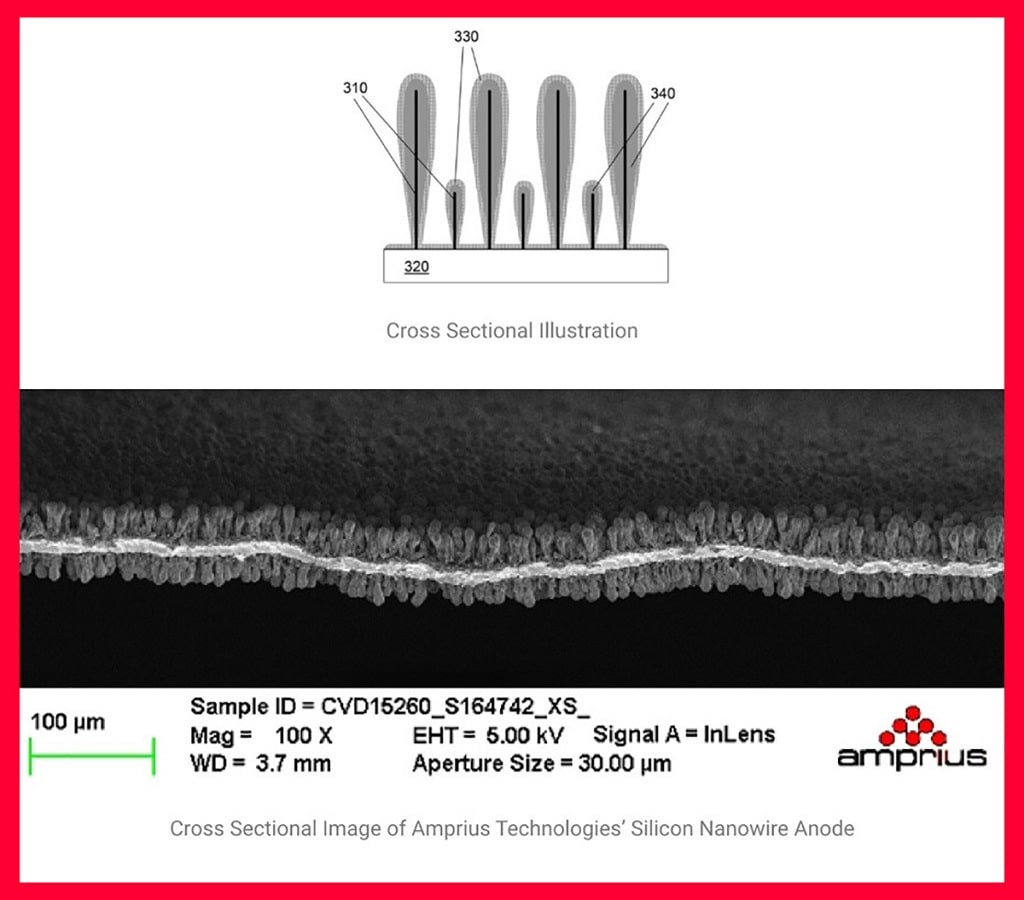
Amprius has substituted silicon nanowires for the graphite lattice. Silicon can hold ten times the amount of lithium as graphite, but it swells and cracks easily, decreasing cell life. According to Amprius, when silicon is formed into porous nanowires arranged in a forest of shorter wires with longer ones in between, the silicon can sustain expansion and resist breaking, increasing the cell life to the point where silicon anodes might become a competitive technology.
According to the company, since the silicon nanowires are embedded in the anode’s substrate, conductivity (and consequently power) is high. In addition, it claims that the cell cycle life is “outstanding” and “continually improving,” but it gives no figures and that the anode is the only portion of the battery that changes; the rest can be made with existing production methods and components.

The world is ready and waiting for next-generation battery cells that can store more energy in a smaller and lighter package. Everything from electric vehicles to smartphones would benefit from space and weight reduction. Besides, emerging technologies like electric VTOL aircraft are in desperate need of batteries that can extend their range and capabilities.
Of course, specific energy and energy density are only two measures that a battery must compete on. Charge/discharge rates, thermal performance, safety, cycle life, and the price will all play a role. The fact that Amprius’s initial customer is in advanced aerospace and makes satellites suggests that these cells will not compete on pricing at this time.
The company will soon select a location to begin constructing a large production plant, bringing economies of scale to make this technology relevant in the EV market and beyond.


