
The Qatar Investment Authority (QIA) has quietly executed one of the most aggressive deep tech investment runs of any sovereign wealth fund in 2026, with QIA deep tech investments now spanning satellites, semiconductors, and autonomous freight. In just ten weeks, the $600 billion fund has backed a Finnish satellite company, a Dutch semiconductor equipment maker, and now a California autonomous trucking startup, committing hundreds of millions of dollars into the hardware backbone of the AI era.
On August 25, 2026, QIA co-led Gatik’s $200 million Series D round alongside Koch Disruptive Technologies, with participation from ARK Invest, Millennium Management, Intact Private Capital, and Arca Continental. It was the third significant deep tech deal for the Qatari fund since June, and its largest single venture investment of the summer.
What makes the streak unusual is not the size of each check but the consistency of the thesis. All three companies sell physical infrastructure, not software. All three have commercial and defense applications. And all three sit at the growth stage, where QIA can take meaningful ownership in businesses that have already proven their technology at commercial scale.
QIA Co-Leads Gatik’s $200 Million Series D
Gatik, the Mountain View-based autonomous freight specialist, announced the $200 million round on August 25, 2026, marking the company’s largest funding to date. The company has now raised approximately $500 million in total capital, according to reporting from Bloomberg.
Unlike other autonomous vehicle companies chasing robotaxis or long-haul trucking, Gatik focuses on a narrow but commercially important segment: high-frequency routes between distribution centers and retail stores. The company currently operates fully driverless box trucks for Fortune 50 retailers, grocery companies, and consumer packaged goods businesses across Texas, Arizona, Arkansas, and Ontario, Canada, joining a growing field of autonomous freight operators now moving real commercial cargo.
The commercial traction is significant. Gatik has generated more than $600 million in contracted revenue and completed 85,000 fully driverless orders across its live operations, according to a company spokesperson cited by Reuters. The company is targeting more than 100 driverless trucks in service by the end of 2026.
“Autonomous freight is transforming the global logistics industry, making it more efficient and reliable,” said Abdulla Al-Kuwari, head of industrials at QIA, in the company’s announcement. “QIA is committed to supporting next-generation solutions providers like Gatik that are shaping the future of freight infrastructure.”
Koch Disruptive Technologies co-led the round. Millennium Management, ARK Invest, Intact Private Capital, and the Mexican Coca-Cola bottler Arca Continental also participated. The capital will fund fleet expansion, technology development, and entry into new regions, Gatik said.
The Two European Bets That Came Before
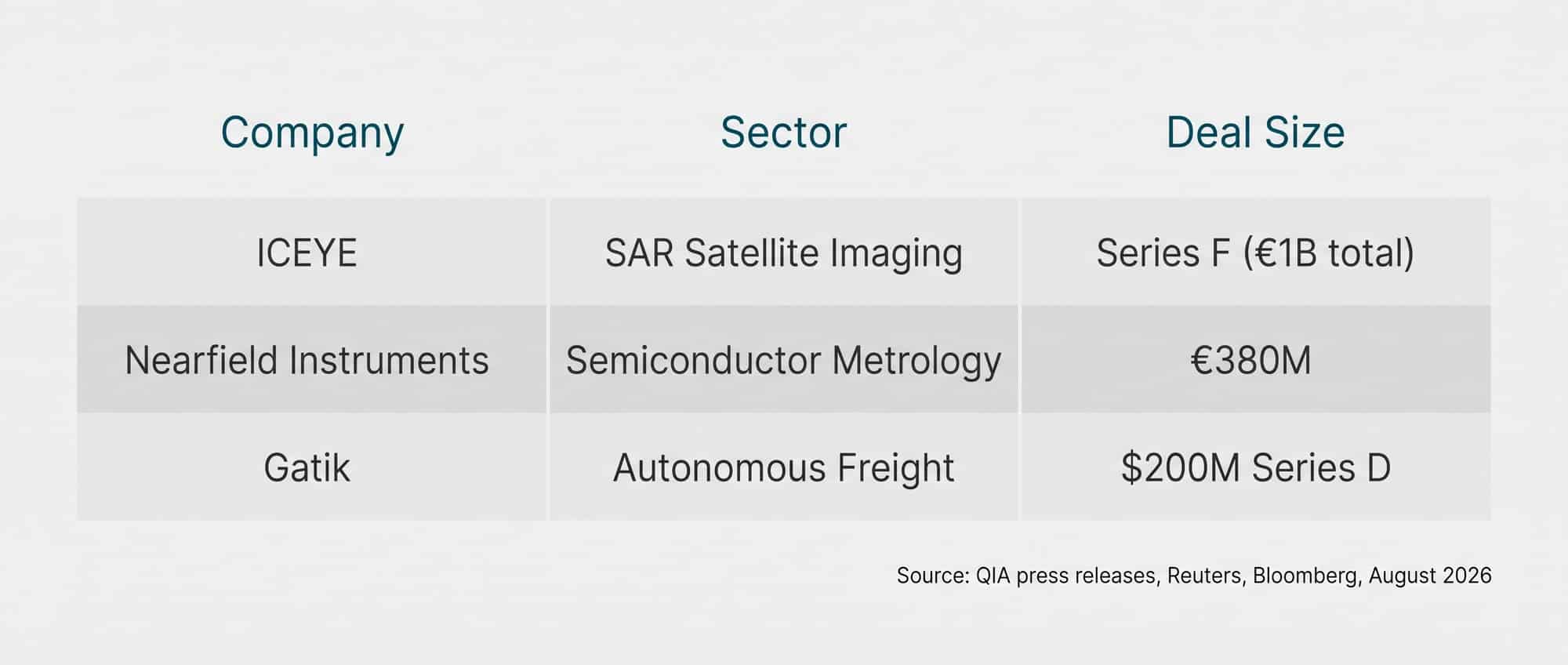
Gatik is the third leg of a strategic pattern, not a one-off. The first two deals were both European.
On June 9, 2026, QIA participated in ICEYE’s Series F, a €1 billion funding round (€450 million primary placement plus a secondary component) that valued the Finnish satellite company at over €10 billion, according to the QIA newsroom. The round was led by General Atlantic, with additional participation from Solidium, Tesi, Varma, Ilmarinen, Lifeline Ventures, Nokia, and TCV.

ICEYE operates the world’s largest commercial constellation of synthetic aperture radar (SAR) satellites, capable of imaging through clouds and at night. The company’s €1.5 billion order backlog, driven by defense and government contracts across Europe, the Middle East, and Asia, helped quadruple its valuation in six months. QIA’s role as a participating investor alongside defense-aligned capital (Nokia, Finnish state-backed funds) reflects the fund’s pattern of co-investing with national security-aligned capital in dual-use technology.
The same month, QIA backed Nearfield Instruments, a Rotterdam-based semiconductor metrology startup that raised €380 million at a $1.6 billion valuation. Nearfield builds precision measurement equipment used to inspect the next generation of 3D chip architectures, including the stacked designs used in AI accelerators and high-bandwidth memory. As chip geometries shrink and 3D integration becomes standard, the inspection problem becomes harder and more capital-intensive. Nearfield’s equipment is designed for that transition.
Together, ICEYE and Nearfield represent two halves of the AI hardware stack: the data collection layer in orbit and the manufacturing inspection layer in the fab. Gatik adds the third layer: physical logistics networks that move goods without human drivers.
QIA’s pattern of backing large-scale AI infrastructure commitments alongside venture-stage deep tech deals mirrors a broader Gulf sovereign wealth strategy. Saudi Arabia’s Humain, the UAE’s G42, and Qatar’s Qai are all building parallel national AI platforms, each anchored by their country’s sovereign fund.
The $20 Billion AI Infrastructure Thesis Behind the Pivot
The 10-week deal streak did not emerge in a vacuum. On December 9, 2025, QIA announced the formation of “Qai,” a national AI company established as a direct subsidiary of the sovereign fund. Unlike the UAE’s G42 or Saudi Arabia’s Humain, both of which are building their own large language models, Qai is designed to evaluate and commercialize existing frontier models, develop high-performance computing infrastructure, and deploy AI systems at scale across the Qatari economy.
The same day, Qai and Brookfield Asset Management announced a $20 billion joint venture to build AI infrastructure in Qatar and select international markets. The deal was unveiled at the World Summit AI in Doha and forms part of Brookfield’s broader AI Infrastructure Fund, which targets up to $100 billion in total global investment.
The thesis is straightforward: Qatar cannot rely on hydrocarbon revenue forever, and the new economy runs on data centers, advanced chips, autonomous systems, and orbital infrastructure. The Qai-Brookfield JV is the platform, part of a broader wave of $100 billion-plus AI infrastructure commitments now reshaping the global compute map. ICEYE, Nearfield, and Gatik are the venture-scale expressions of the same strategy.
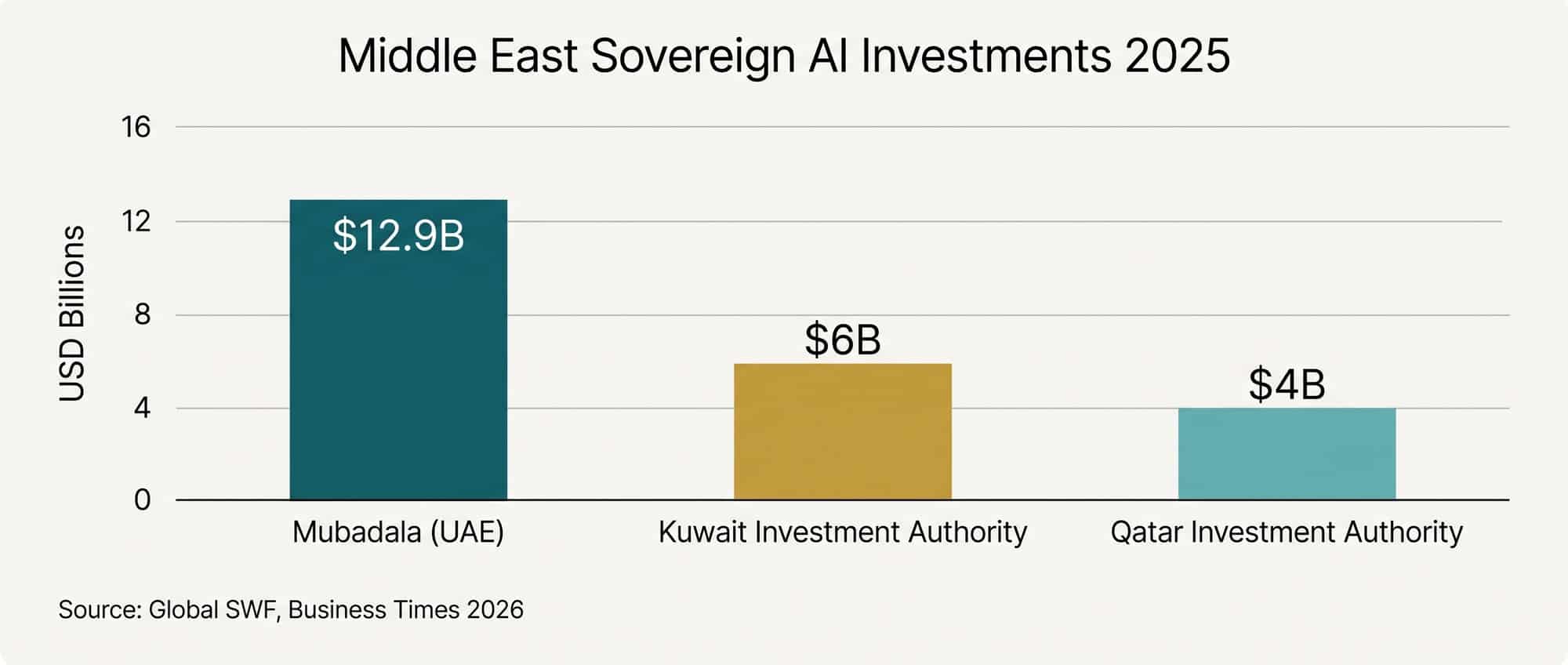
According to industry data compiled by Global SWF, Middle Eastern sovereign funds led global digital investment in 2025, with Abu Dhabi’s Mubadala committing $12.9 billion to AI and digitalization, the Kuwait Investment Authority committing $6 billion, and QIA committing $4 billion. Qatar is now stacking venture-stage bets on top of its infrastructure-scale commitments.
What QIA Looks For: Hardware, Dual-Use, and Growth-Stage
Across the three deals, the investment criteria are remarkably consistent.
- Hardware over software. Each company sells a physical product, whether satellites, metrology tools, or trucks. Pure-software plays are absent from this run.
- Dual-use potential. ICEYE’s SAR satellites serve both commercial and defense customers. Nearfield’s inspection tools support commercial chipmakers but also have national security applications. Gatik’s autonomous freight reduces logistics costs for retailers but can be adapted for military logistics.
- Growth-stage entry. QIA does not typically invest at seed or Series A. Its direct venture checks cluster at Series C and beyond, when companies have proven technology, meaningful revenue, and a credible path to scale.
This pattern is consistent with QIA’s broader approach. The 2025-2026 deep tech deal pattern includes:
- Anthropic’s $13 billion funding round (Q4 2025)
- xAI’s $10 billion raise at a $200 billion valuation (late 2024-2025)
- Databricks’ $15 billion round (late 2025)
- A data center joint venture with Blue Owl Capital, with QIA committing approximately $1 billion in new equity
- The $20 billion Qai-Brookfield AI infrastructure joint venture (December 2025)
- ICEYE’s €1 billion Series F (June 2026)
- Nearfield Instruments’ €380 million round (June 2026)
- Gatik’s $200 million Series D (August 2026)
These are not venture-scale bets in the traditional sense, but they reinforce the same thesis: AI infrastructure requires capital at scales only sovereign funds can deploy, and QIA is now active at every layer of the stack.
Mapping the Deals to Qatar’s National Vision 2030
Qatar’s National Vision 2030, launched in 2008 and updated in 2024, sets out a multi-decade plan to reduce the country’s dependence on oil and gas revenue. QIA was established in 2005 to operationalize that goal, and the fund’s investment strategy maps directly onto the policy framework.
Real estate, infrastructure, and financial services remain core holdings, but the deep tech run signals where the marginal dollar is going. The three sectors represented in the 10-week run, orbital intelligence, semiconductor manufacturing, and autonomous logistics, all align with the infrastructure of the next economy rather than the extractive industries of the last one.
Every QIA deal also has a dual logic: financial return and geopolitical positioning. Backing ICEYE gives Qatar access to sovereign-grade satellite intelligence. Backing Nearfield gives it a foothold in the European semiconductor supply chain, which is increasingly shaped by export controls and industrial policy. Backing Gatik gives it exposure to autonomous logistics, a sector that will be reshaped by US labor and trucking regulations in the coming decade.
The fund does not disclose portfolio company valuations or its stake sizes in private rounds, which makes independent verification difficult. The public announcements only confirm participation, not check size.
For context, QIA’s broader capital deployment in 2025 included major AI and digital infrastructure commitments. The fund’s $1 billion Blue Owl data center venture, the $20 billion Qai-Brookfield joint venture, and participation in Anthropic’s $13 billion round, xAI’s $10 billion raise, and Databricks’ $15 billion round all sit on the same strategic axis. The Gatik, ICEYE, and Nearfield deals are the venture-scale complement to those infrastructure-scale bets.
QIA’s European Deep Tech Track Record
QIA is not new to European technology. The fund led the $400 million extension of Celonis’ Series D at a $13 billion valuation, holds a 10% stake in Rolls-Royce SMR, and maintains positions in Volkswagen, RWE, and the London Stock Exchange Group. It also committed €300 million to Bpifrance, the French entrepreneurial platform, and became an anchor shareholder in Ardian Semiconductor, a fund that invests in Europe’s semiconductor industry.
What is new is the pace and the sector concentration. QIA is no longer a passive sovereign fund parking oil revenue in blue-chip European assets. It is now co-investing alongside top-tier VCs at the growth stage in companies building the physical infrastructure of the AI era. For European founders in defense, semiconductors, and autonomous systems, QIA is becoming one of the most consequential capital sources to understand.
The path to QIA capital for earlier-stage companies runs through its network of VC fund partners. The fund rarely invests below Series C directly, but it anchors funds and follows established VCs into growth rounds. Founders building in dual-use sectors would be wise to map those relationships early.
Frequently Asked Questions
How large is the Qatar Investment Authority?
As of mid-2026, QIA manages approximately $600 billion in assets under management, making it one of the nine largest sovereign wealth funds globally, according to the Global SWF Institute. The fund was established in 2005 to manage Qatar’s oil and gas surpluses and diversify the country’s economy.
What is Qai, and how does it relate to QIA?
Qai is a national AI company launched in December 2025 as a direct subsidiary of QIA. It is designed to evaluate and commercialize existing frontier AI models, develop high-performance computing infrastructure in Qatar, and deploy AI systems across the Qatari economy. In December 2025, Qai formed a $20 billion joint venture with Brookfield Asset Management to build AI infrastructure in Qatar and select international markets.
Why is QIA focusing on deep tech now?
Three converging factors are driving QIA’s deep tech concentration: the maturation of AI as an infrastructure build-out, the policy priority of Qatar’s National Vision 2030 to reduce hydrocarbon dependence, and the rise of dual-use technologies where commercial and defense applications overlap. QIA’s check sizes have grown to match these opportunities, with participation in Anthropic’s $13 billion and xAI’s $10 billion rounds in 2025.
What stage does QIA typically invest at?
QIA’s direct venture deals cluster at Series C and beyond, where companies have meaningful revenue and a clear path to scale. The fund does not typically invest at seed or Series A. Earlier-stage companies access QIA capital indirectly through the fund’s network of VC fund partners, which includes Thrive Capital, General Catalyst, and Lightspeed.
Are these investments purely financial, or do they serve a strategic purpose?
Both. QIA’s stated framework pairs financial return with geopolitical positioning. Every deal maps onto Qatar’s National Vision 2030 diversification strategy, and the fund’s participation in defense-aligned rounds (such as ICEYE, alongside Finnish state-backed investors) reflects the strategic dimension of capital deployment.
Conclusion
The 10-week deep tech run from QIA is not a portfolio reshuffle but a continuation of a thesis that crystallized in late 2025 with the $20 billion Qai-Brookfield partnership. Orbital intelligence, advanced chip manufacturing, and autonomous freight are not random sectors. They are the load-bearing infrastructure of the next economic cycle, and Qatar’s sovereign fund is positioning itself at every node.
For founders, investors, and policymakers watching the intersection of sovereign capital and frontier technology, the takeaway is clear: QIA has moved from passive asset allocation to active co-investment at the growth stage. The next decade of deep tech will be shaped, in part, by how Gulf sovereign wealth funds deploy their hydrocarbon revenues into the industries that will define the post-oil economy.

