
Nvidia is reportedly in talks to invest in Perplexity AI at a valuation exceeding $30 billion, according to The Information. If completed, the deal would mark a 50% jump from the AI search startup’s $20 billion valuation just one year ago and would deepen one of the most strategically significant relationships in the artificial intelligence industry. The move signals that AI search is evolving from a consumer tool into the infrastructure layer for autonomous AI agents, a shift that could redefine how billions of people and machines interact with information.
Nvidia’s Latest Move in the AI Search Race
The reported investment discussions, first published by The Information on August 23, 2026, describe an equity funding round worth several billion dollars. Neither Nvidia nor Perplexity has confirmed the talks, and there is no guarantee a deal will close.
What makes this round notable is not just the valuation, but the strategic context. Nvidia has backed Perplexity since its Series B in January 2024, returned for the unicorn round two months later, and joined a $100 million extension at an $18 billion valuation in July 2025. The chipmaker is already one of Perplexity’s most important financial partners, alongside Amazon founder Jeff Bezos and SoftBank Group.
According to The Information, Nvidia initially explored a technology licensing arrangement and the possibility of hiring some of Perplexity’s staff before the conversation shifted to a straightforward equity stake. That pivot suggests Nvidia sees long-term strategic value in Perplexity as a customer and ecosystem partner, not just a licensing opportunity.
Perplexity’s Meteoric Valuation Rise: $520M to $30B+
Perplexity’s valuation trajectory is one of the fastest in AI startup history. Founded in August 2022 by Aravind Srinivas, Denis Yarats, Johnny Ho, and Andy Konwinski, the company has gone from a $520 million valuation to over $30 billion in roughly two and a half years.
The following table traces every major funding milestone:
| Date | Round | Valuation | Key Investors |
|---|---|---|---|
| January 2024 | Series B ($73.6M) | $520M | Nvidia, NEA, IVP |
| March 2024 | Unicorn Round ($63M) | $1.04B | Nvidia, Databricks Ventures |
| Late 2024 | Growth Round ($500M) | $9B | SoftBank, Bezos Expeditions |
| May 2025 | Extension ($500M) | $14B | SoftBank Vision Fund 2 |
| July 2025 | Extension ($100M) | $18B | Nvidia, SoftBank, NEA, IVP |
| September 2025 | Growth Round ($200M) | $20B | Undisclosed |
| January 2026 | Growth Round | $23B | Undisclosed |
| August 2026 (reported) | Equity Round (TBD) | $30B+ | Nvidia (in talks) |
At $750 million in annualized revenue, a $30 billion valuation prices Perplexity at close to 40 times sales. That is a multiple private markets can tolerate, but it will face sharper scrutiny if the company follows through on its plans to go public.
The Revenue Engine Behind the Numbers
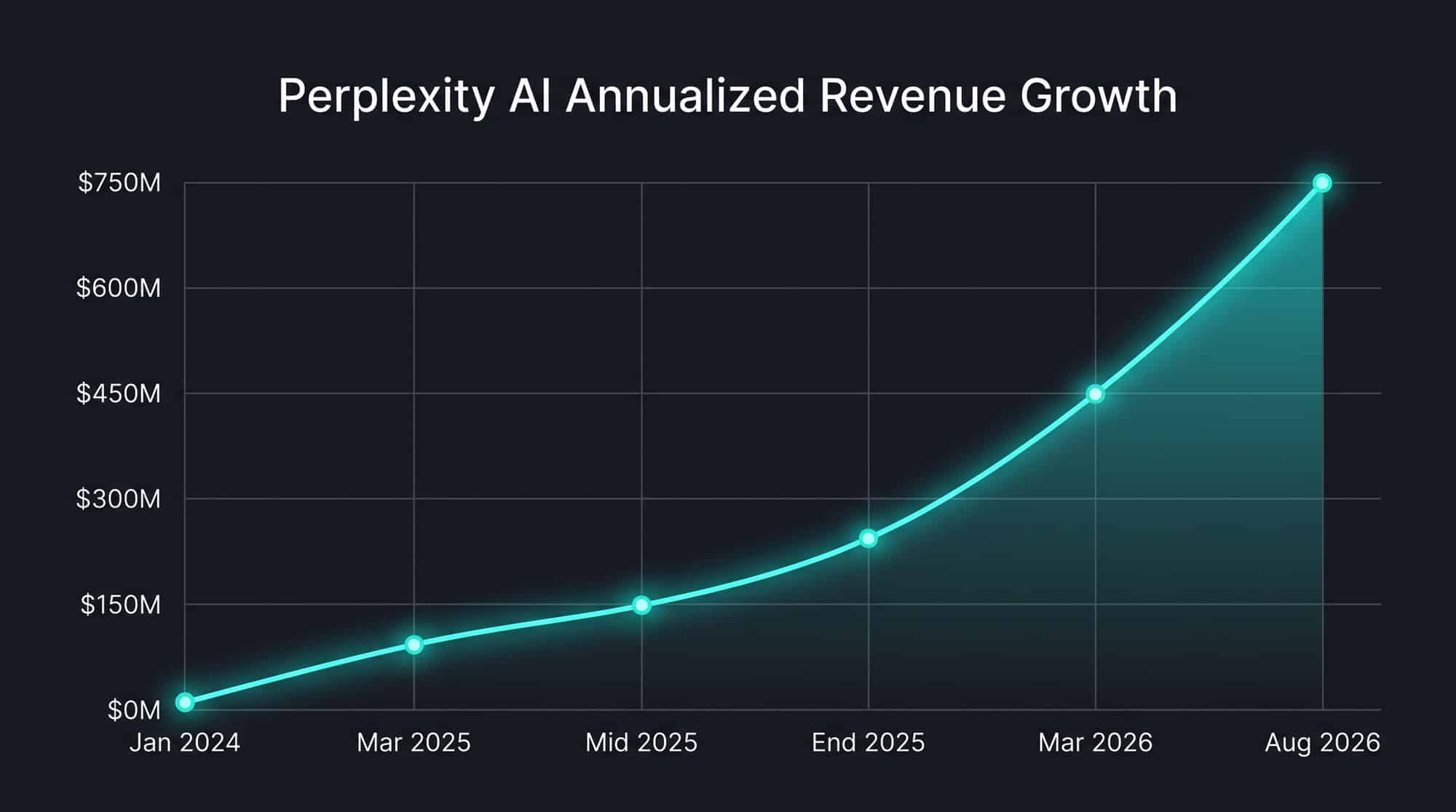
Perplexity’s revenue growth has been extraordinary by any measure. The company crossed roughly $10 million in annualized recurring revenue (ARR) in early 2024, approached $100 million by March 2025, and reached about $148 million by mid-2025. By the end of 2025, ARR stood at approximately $232 million.
Then came the inflection point. In February 2026, Perplexity launched Computer, a cloud-based AI agent designed to automate multi-step professional tasks. The impact was immediate: ARR surged from roughly $300 million to $450 million in a single month, a 50% jump that represented the fastest monthly revenue increase in the company’s history.
By August 2026, annualized revenue had climbed past $750 million, up from less than $250 million at the start of the year. That is a threefold increase in roughly seven months, a pace that outstrips what OpenAI or Anthropic managed at comparable revenue scales.
The revenue trajectory in summary:
- Early 2024: ~10M ARR
- March 2025: ~100M ARR
- Mid-2025: ~148M ARR
- End of 2025: ~232M ARR
- March 2026: $450M+ ARR
- August 2026: $750M+ ARR
Perplexity’s internal target is reportedly $656 million in ARR by the end of 2026, a figure the company appears well positioned to exceed at its current trajectory.
Perplexity Computer: The Agent That Changed Everything

The product driving most of Perplexity’s recent growth is Computer, a cloud-based AI agent that orchestrates up to 19 models in parallel to carry out tasks on behalf of users. Launched in February 2026 for Max-tier subscribers, Computer can handle shopping, summarizing social media feeds, sending emails, conducting web research, and generating code, all triggered by voice or text commands.
Max subscribers receive 10,000 credits per month for agentic tasks, plus a one-time 20,000-credit bonus at launch. When those credits run out, users pay incrementally for additional usage. This usage-based pricing layer, stacked on top of the existing $200/month Max subscription, introduced a more variable and scalable revenue stream.
The strategic significance of Computer extends beyond revenue. It represents a fundamental shift in what AI search means. Traditional search retrieves information for humans. Computer retrieves and acts on information for other AI systems, automating workflows that previously required human attention at every step.
This shift is why Nvidia cares. Each agentic task burns significant GPU compute, making Perplexity one of the most intensive consumers of inference infrastructure. A direct equity stake keeps Nvidia close to a customer that both consumes its chips and generates the kind of usage data that informs what hardware gets built next.
Why Nvidia Keeps Betting on Perplexity
Nvidia’s relationship with Perplexity is not a passive financial investment. It is a strategic alignment that reinforces Nvidia’s position at the center of the AI ecosystem.
There are three layers to the strategy:
- Compute demand: Perplexity’s AI agent workloads are among the most compute-intensive in the industry. Every query, every multi-step task, every parallel model orchestration consumes Nvidia GPUs. Investing in Perplexity is, in effect, investing in demand for Nvidia’s own products.
- Product feedback loop: Perplexity’s usage patterns generate data about how AI agents interact with hardware, data that shapes Nvidia’s chip design roadmap. The company’s Vera CPUs, designed specifically for agentic AI workloads like tool calls, code execution, and data processing, benefit directly from this feedback.
- Ecosystem lock-in: By deepening its financial ties, Nvidia reduces the risk of Perplexity switching to rival inference hardware from AMD, Cerebras, or other emerging chipmakers. It is an insurance policy against customer churn at the infrastructure layer.
Nvidia has pursued a similar strategy across the AI landscape, including its recent acquisition of Hugging Face for $12.9 billion, as well as investments in OpenAI, Anthropic, xAI, Poolside, and Safe Superintelligence. The pattern is consistent: fund the companies that consume the most compute, then benefit from their growth at both the financial and hardware levels.
The Competitive Landscape: Google, OpenAI, and Agent-Native Challengers
Perplexity is not competing in a vacuum. The AI search and agent market is becoming increasingly crowded, with well-funded rivals pursuing different strategies.
Google and OpenAI hold the distribution advantage. Google’s search dominance and OpenAI’s ChatGPT user base give them reach that Perplexity cannot match on scale alone. Both are investing heavily in their own agent capabilities.
Meanwhile, agent-native challengers are emerging. Exa, which raised $250 million at a $2.2 billion valuation in May 2026, is building search infrastructure purpose-built for AI agents rather than humans. Nvidia’s own venture arm, NVentures, participated in Exa’s earlier rounds, suggesting Nvidia is hedging its bets across the agent ecosystem.
You.com is another competitor building agent-focused search tools, while Samsung’s integration of Perplexity into Bixby across an estimated 800 million devices gives the startup a distribution channel that rivals Google’s reach in mobile.
The competitive dynamics raise a fundamental question: is Perplexity building the infrastructure layer that AI agents will depend on, or is it the best-funded contender in a category still being defined? A $30 billion valuation suggests investors believe the former, but the market has not yet settled.
The Path to a 2028 IPO
CEO Aravind Srinivas has been explicit about Perplexity’s public market ambitions. In a June 2026 interview with CNBC, he confirmed that the company is targeting a 2028 IPO, regardless of how the market receives upcoming listings from Anthropic and OpenAI.
“Agnostic of these two companies, we were planning for something in 2028, so that still remains the case,” Srinivas told CNBC.
Chief Business Officer Dmitry Shevelenko reinforced the message to Reuters: “By consistently holding 2028 as our earliest date for an IPO, Perplexity has been able to build a healthy, high-growth business.”
The 2028 timeline gives Perplexity roughly two more years to demonstrate sustainable revenue growth, improve unit economics, and bring the price-to-sales multiple closer to public market norms. At 40 times sales, the current valuation would face significant pressure in a public listing unless revenue continues its current trajectory.
The company also completed a $750 million deal with Microsoft to adopt Azure for AI workloads earlier in 2026, signaling enterprise-grade infrastructure commitments that public market investors will want to see.
Frequently Asked Questions
Is Perplexity backed by Nvidia?
Yes. Nvidia has been a Perplexity investor since the Series B round in January 2024. The chipmaker returned for the March 2024 unicorn round and joined the $18 billion extension in July 2025. The two companies are now in discussions for another investment at a $30 billion-plus valuation.
What is Perplexity AI owned by?
Perplexity AI is a privately held company founded by CEO Aravind Srinivas, Denis Yarats, Johnny Ho, and Andy Konwinski in August 2022. Its major backers include Nvidia, Amazon founder Jeff Bezos, SoftBank Group, NEA, and IVP, among others.
Is Perplexity AI better than ChatGPT?
Perplexity and ChatGPT serve different primary functions. Perplexity specializes in AI-powered search with cited sources, while ChatGPT is a general-purpose conversational AI. Perplexity’s Computer agent focuses on automating multi-step professional tasks, a different use case from ChatGPT’s broader assistant capabilities. The “better” choice depends on whether the user needs search-optimized answers or general AI assistance.
Is Aravind Srinivas a billionaire?
Aravind Srinivas’s net worth has not been publicly confirmed, but given his founding stake in a company now valued at over $30 billion, his equity holding would likely place him in billionaire territory on paper. Forbes and Bloomberg have not yet published verified estimates.
What is Perplexity’s annualized revenue?
As of August 2026, Perplexity’s annualized revenue has surpassed $750 million, up from less than $250 million at the start of the year. The growth has been driven primarily by the launch of Perplexity Computer, a cloud-based AI agent, and the company’s shift to usage-based pricing.
What This Means for the AI Industry
The Nvidia-Perplexity talks are more than a funding story. They reflect a broader shift in how the AI industry is organizing itself around the agent paradigm. Search is no longer just about answering questions for humans. It is becoming the infrastructure layer that autonomous AI systems use to retrieve, process, and act on information.
Perplexity’s ability to triple its revenue in seven months by pivoting from search to agents validates the thesis that agentic AI is where the real commercial value lies. Nvidia’s continued investment reinforces the hardware-software feedback loop that is accelerating the entire ecosystem.
Whether Perplexity can sustain this growth, justify a 40x revenue multiple, and execute a successful 2028 IPO remains to be seen. But the company has already demonstrated something important: the transition from AI search to AI agents is not a future prediction. It is happening now, and it is happening fast.


