
Open the door of almost any microwave on sale in the US and you will find the same thing people found in 1967: a glass plate spinning on a spindle. The magnetron inside, the vacuum tube that generates the microwaves, is a direct descendant of radar transmitters built during World War II. For nearly six decades, the appliance has survived on one trick, blasting fixed 2.45 GHz energy into a metal box while a motor rotates your dinner to average out the cold spots.
Japan’s appliance makers decided that was not good enough. Over the past decade, Panasonic, Sharp, Balmuda, and a Tokyo startup called DENBA have quietly rebuilt cooking from first principles: removing moving parts from the cavity, cooking with steam hot enough to brown food, freezing without rupturing cells, and replacing the magnetron with semiconductor amplifiers that can tune their own frequency. The results are already on shelves, starting with an idea as simple as flattening the bottom of the box.
Why Your Microwave Still Runs on WWII Radar Technology
Percy Spencer discovered microwave heating at Raytheon in 1945 when a chocolate bar melted in his pocket near an active magnetron, and the first commercial Radarange followed two years later. When Amana brought the technology to kitchen counters in 1967, the core architecture was already set: one magnetron, one fixed frequency, and one turntable to compensate for uneven fields.
That architecture has real limits. Consumer ovens operating around 2450 MHz heat food only to a depth of roughly two centimeters, according to RF semiconductor maker Ampleon, so the interior of anything larger warms by conduction alone. And because a conventional magnetron cannot vary its output power, it can only switch fully on or off, which is why “50% power” usually means pulses of full power separated by pauses.
How a Flatbed Microwave Works Without a Turntable
A flatbed microwave removes the rotating glass plate and keeps the food still. The even heating comes instead from a rotating antenna hidden beneath the ceramic floor, which sweeps the microwave pattern across the cavity so every region receives its share of energy over the course of a cycle. Australian consumer group CHOICE describes the mechanism plainly: a rotating antenna under the base distributes the microwaves while your dish stays where you put it.

Panasonic has pushed the concept furthest with its 3D Antenna Technology, used in models like the NN-SF57RM sold in Japan. Instead of simply spinning one emitter, the system moves the antenna through multiple dimensions and adjusts its rotation speed to shape the field for whatever is inside. The same company’s inverter circuitry supplies genuinely continuous low power rather than pulsed bursts.
Sensors complete the package. Panasonic’s Genius Sensor line samples humidity inside the cavity many times per second and infers how the food is cooking, adjusting time and power automatically; Japanese-market models advertise dozens of sensing points feeding that logic. The practical upshot is that the machine watches steam output rather than guessing from a timer.
Flatbed vs. Turntable: Which Design Wins?
For most households the honest answer is that sensors matter more than geometry, but each layout has distinct strengths. CHOICE’s lab testing of more than 40 microwaves found flatbed models scoring between 80 and 92 percent for cooking performance, while turntable models spanned a wider range from 69 to 96 percent, meaning the best performers overall still spin.
| Feature | Flatbed Microwave | Turntable Microwave |
|---|---|---|
| Moving parts in cavity | None (antenna is sealed beneath floor) | Glass plate and spindle |
| Dish size and shape | Rectangular dishes fit fully | Corners must clear the plate |
| Cleaning | Wipe the smooth floor | Remove plate, clean spindle groove |
| Typical performance range* | 80–92% | 69–96% |
| Price spread* | AU$200–389 | AU$49–3,199 |
*Ranges from CHOICE’s tested models, May 2025.
The trade-off is choice: far fewer brands sell flatbed designs, so shoppers who want a specific size or budget often end up back on a turntable. CHOICE’s advice is to prioritize sensor cook functions, auto-defrost quality, and door visibility before obsessing over the plate.
Superheated Steam: Browning Food With Water Hotter Than Boiling
Ordinary steam tops out at 100 degrees Celsius, hot enough to cook gently but powerless to brown anything. Sharp’s Healsio ovens solve this by superheating the vapor well beyond that point, with temperature ranges reaching roughly 300 degrees Celsius depending on model. At those temperatures steam stops being a soft blanket and starts behaving like a searing medium.
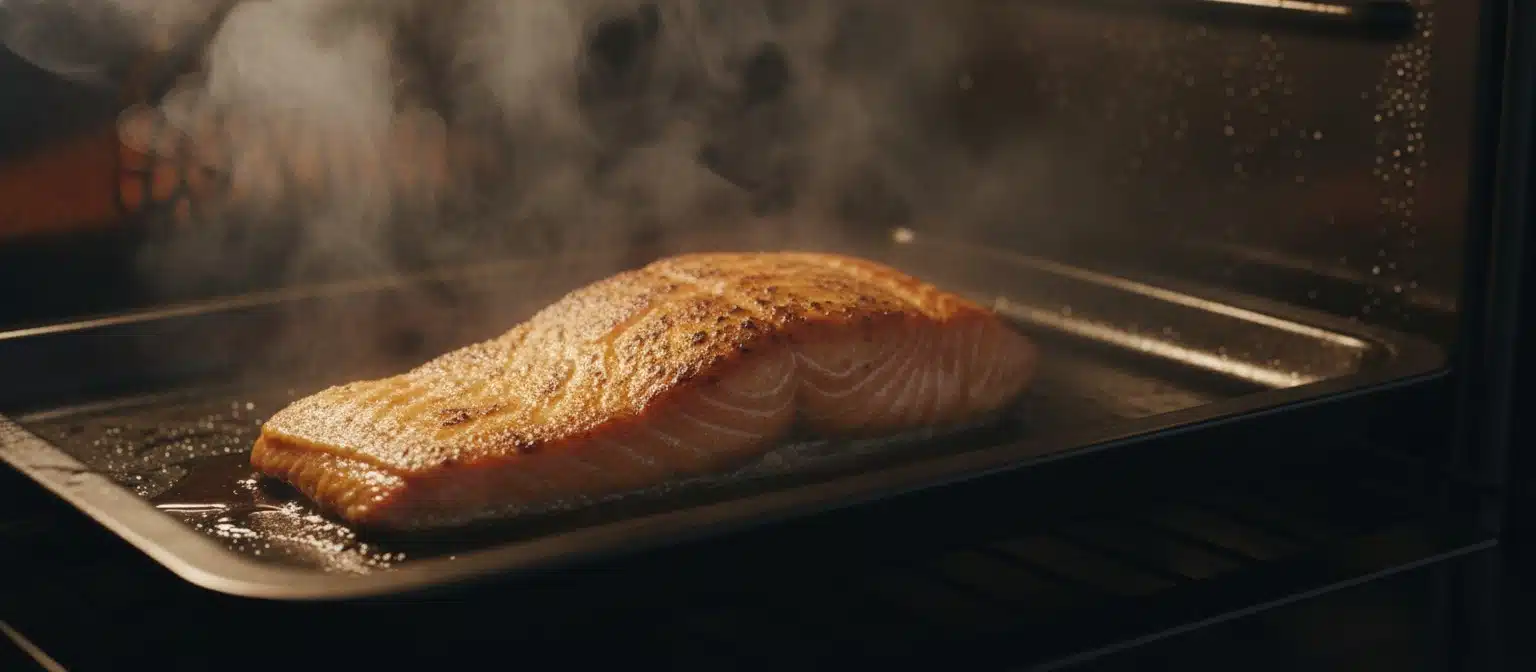
The physics explains why reviewers keep describing juicy interiors under crisp surfaces. Steam condensing onto food transfers heat far faster than dry air of the same temperature, so surfaces reach browning temperatures quickly while moisture loss stays low. Because the cooking medium is water vapor, there is no radiant element scorching the outside before the center thaws, and excess fat simply renders away and drips off rather than frying in its own grease. Food scientists are now engineering hybrid systems around this combination, including a microwave-steam pressure method that crisps fries with far less oil.
Sharp sells countertop versions of this technology in the United States, including the Superheated Steam Countertop Oven, which testers have praised for producing crispy-crust pizza and broiled chicken without drying them out. In Japan the larger Healsio water ovens are mainstream appliances, available from several manufacturers in sizes up to 30 liters, and recent models add AI-assisted menus that pick steam programs automatically.
The Steam Toaster Resurrecting Leftovers
Balmuda took the same insight and shrank it into a toaster. Before each cycle you pour exactly five cubic centimeters of water into a reservoir, about a teaspoon. The heater first flashes that water into steam, which envelops the bread and locks moisture into its interior; only then does the element ramp up to toast and brown the outer surface.
The five modes map to different bread styles, from sandwich loaves to baguettes, with oven mode offering 350, 400, or 450 degrees Fahrenheit without water. Day-old bread emerges tasting rebaked rather than reheated, which explains why the product became a cult object in Japanese kitchens long before it reached Western shelves. It is a small machine solving a small problem, executed with obsessive precision.
Electric Fields That Freeze Without Damage
Freezing ruins texture for a familiar reason: as water crystallizes, it forms sharp ice spikes that puncture cell walls, and the juices leak out on thawing. Tokyo company DENBA attacks the problem inside the freezer itself. Its systems apply a high-voltage electrostatic field, in the thousands of volts at negligible current, to the space around the food. According to the company’s technical materials, the field makes water molecules resonate slightly, encouraging smaller, rounder ice crystals that do not destroy cell structure.
The company sells commercial freshness-preservation and thawing equipment built on this single-pole electric field principle, and independent studies of electromagnetic and electric-field freezing do report reduced drip loss compared with conventional freezing. What remains unproven publicly is the scale of the benefit: claims circulating online of up to 95 percent reductions could not be traced to peer-reviewed data, so treat specific percentages with caution. The direction of the research, however, is consistent: gentler ice means juicier food.
Solid-State RF: Retiring the Magnetron
The deepest change is happening inside the box itself. Solid-state cooking replaces the magnetron with transistor-based RF power amplifiers, the same family of semiconductors that drives cellular base stations. Unlike a magnetron, which offers only on and off, an amplifier can vary its power continuously, shift frequency within licensed bands such as 915 MHz and 2.45 GHz, and control phase across multiple antennas.
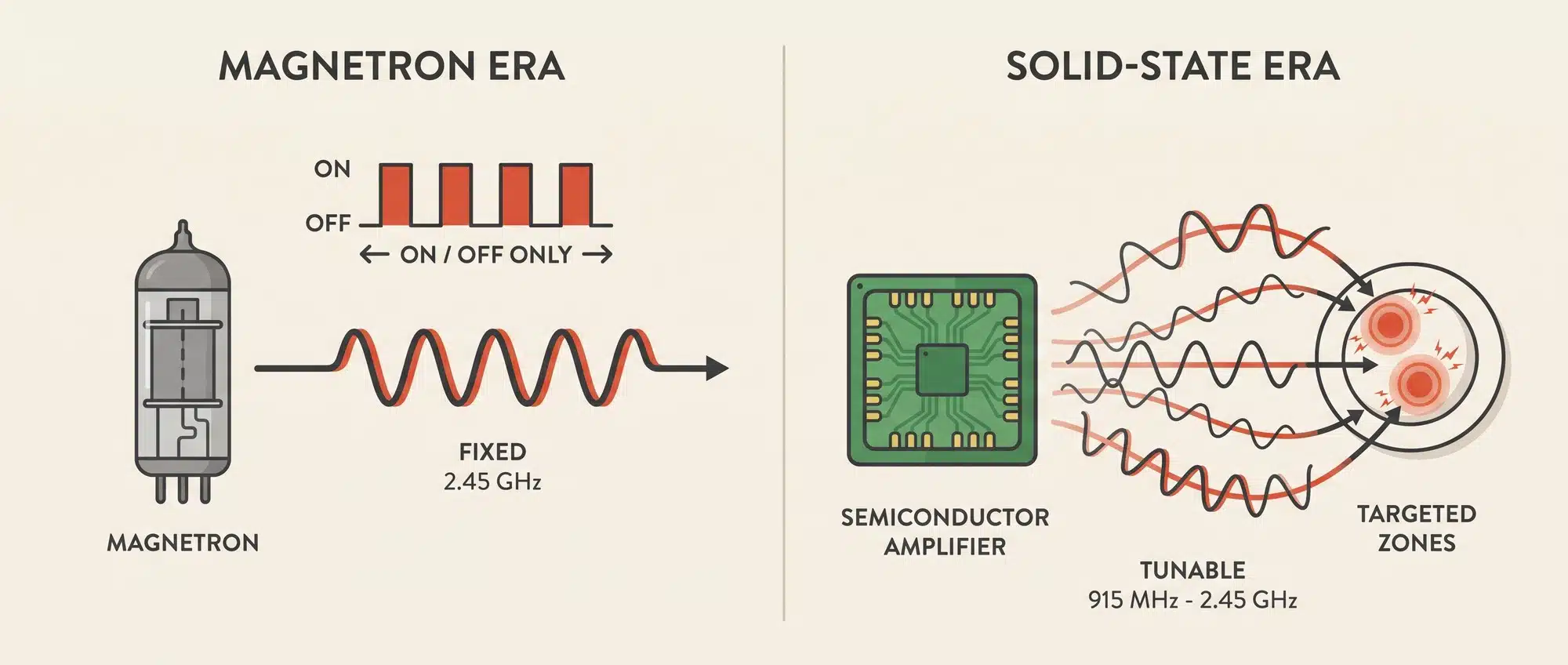
Tunability matters because different foods absorb different frequencies differently. By sweeping frequencies and reading how much energy reflects back, a solid-state oven learns what is inside and adapts in real time. Miele demonstrated the potential dramatically with its Dialog oven, built on technology from Israeli firm Goji Food Solutions: the oven cooked fish pressed into the center of a block of ice while leaving the ice frozen by steering energy precisely into the fish. Miele claimed cooking up to 70 percent faster than conventional methods and priced the Dialog at 7,990 euros, though regulatory differences have kept it out of the US market.
Component suppliers, including Ampleon and NXP, now ship reference designs aimed squarely at kitchen appliances, and industry analysts expect prices to fall as volumes grow. The engineering case is compelling: no fragile filament, no high-voltage supply, no degradation over years of use, and closed-loop feedback that measures cooking rather than guessing at it. What is missing is a mass-market price tag.
The Common Thread: Every Fix Starts With Water
Look across these five technologies, and one pattern emerges. Each one succeeds by managing water and energy more precisely than the appliances it replaces:
- Flatbed microwaves move the energy instead of the food, sweeping fields past stationary water molecules.
- Superheated steam uses water as a precise heat-delivery fluid, hot enough to brown yet gentle enough to hydrate.
- The steam toaster spends five centiliters of water protecting the moisture already inside bread.
- Electric-field freezing reshapes water crystals so cells survive the trip below zero.
- Solid-state RF reads how food absorbs energy at each frequency and tunes itself accordingly.
None of these ideas required inventing new physics. They required treating the kitchen appliance as a precision instrument rather than a heated box, a philosophy Japanese engineering culture has applied to rice cookers since induction-heating models debuted in 1988. The microwave stayed primitive because nothing forced it to evolve; competitors have now supplied the pressure, joining a broader wave of smart kitchen appliances reshaping how kitchens cook and use energy.
Frequently Asked Questions
Do flatbed microwaves work well?
Yes. Independent testing by CHOICE found flatbed models scoring between 80 and 92 percent for cooking performance, comparable to or better than typical turntable models, with the added benefits of full rectangular dishes and easier cleaning.
Which is better, a flatbed or a turntable microwave?
For large dishes and easy cleaning, choose a flatbed. For maximum choice of brands and price points, a turntable remains fine, especially for simple reheating. Experts emphasize sensor quality matters more than the plate.
Are Panasonic flatbed microwaves any good?
Panasonic pioneered consumer flatbed designs and pairs them with inverter power supplies and humidity-sensing automation, making its models among the most technically complete flatbeds available.
What is the difference between steam and superheated steam?
Steam at atmospheric pressure cannot exceed 100 degrees Celsius. Superheated steam has been heated beyond that point, in some ovens to around 300 degrees Celsius, giving it enough energy to brown and crisp food like a grill while retaining steam’s moisture-friendly heat transfer.
What are the disadvantages of steam ovens?
They require filling and emptying water tanks, need periodic drying cycles to prevent buildup, cost more than equivalent convection ovens, and compact models may lack the height for large roasts.
When will solid-state microwave ovens reach consumers?
Premium products like Miele’s Dialog already exist in Europe, and component makers continue to cut costs, but widespread affordable models remain a few product generations away.
Conclusion
The microwave earned its place on the counter by being fast, not by being good. Japan’s appliance engineers looked at the spinning plate, the fixed-frequency tube, and the freezer full of frost-bitten dinners and treated each as a solvable engineering problem. Flatbed cavities, superheated steam, steam-injected toasting, electric-field freezing, and tunable RF amplifiers all exist today, at prices ranging from accessible to aspirational.
The next time your leftovers emerge soggy-edged and ice-crusted, remember that the fix is not a better timer. It is better control of water and energy, and that revolution is already shipping.

