
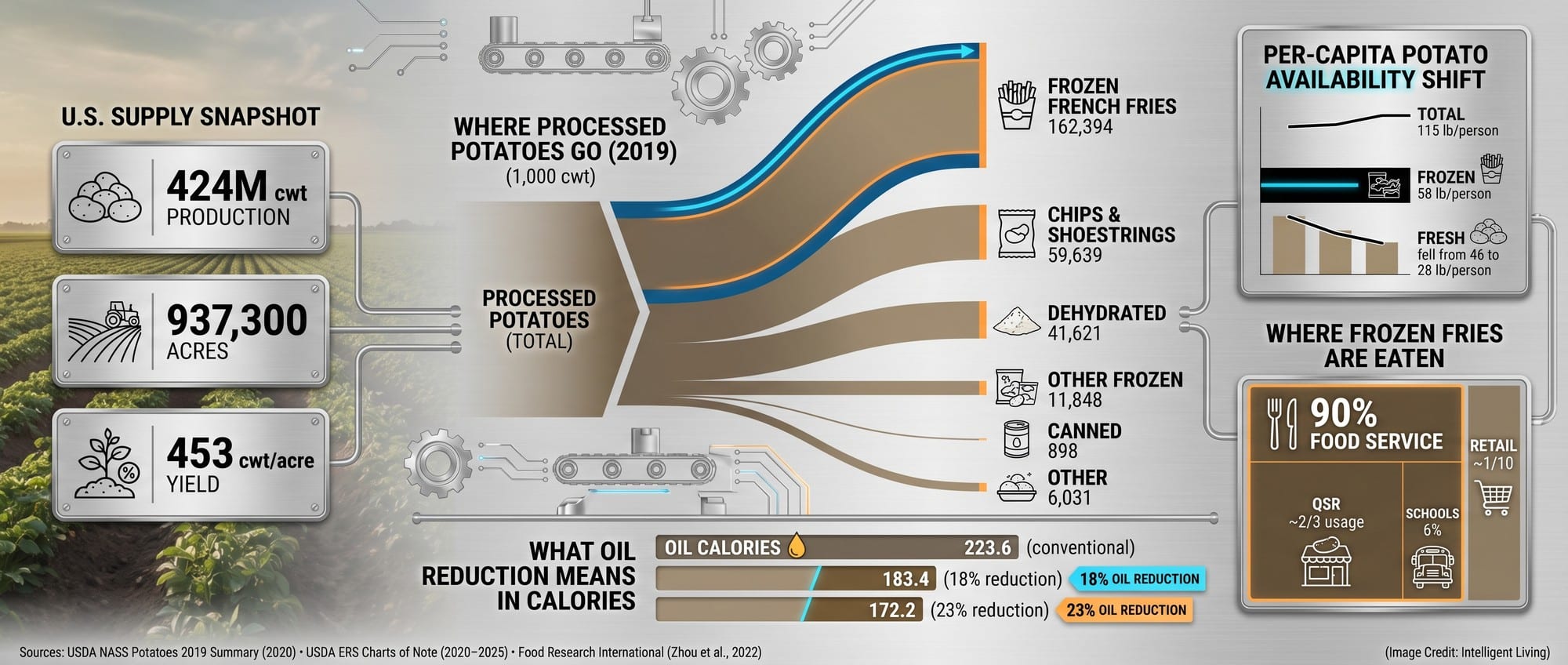
French fries sit at a strange intersection of cravings and engineering. That perfect crispy shell depends on rapid moisture loss and heat transfer, yet that same porous architecture often invites excess oil to settle inward. Consumer data shows that in the United States, frozen potato products—mostly fries—average about 58 pounds per person. Such staggering demand highlights why even minor reductions in oil absorption now drive major industrial innovations.
Commercial potato processing depends on precise thermodynamic modeling to balance flavor with consumer health. While older methods struggle to replicate traditional mouthfeel, breakthroughs in microwave frying allow us to manipulate vapor production. Engineers now control how water exits the starch network, effectively preventing capillary action from pulling grease into the center of the fry.
Retrofitting a commercial fryer represents a deeper engineering challenge than a simple component swap. Achieving true efficiency demands that we rethink how energy moves through the delicate architecture of a potato slice. Volumetric heating provides a unique lever, allowing processors to maintain high-speed throughput while significantly lowering the caloric density of one of the world’s most popular snacks.
The Science of Microwave Frying: Why Vapor Production Changes Everything
Hybrid Frying Mechanics: Integrating Microwaves into Commercial Lines
A University of Illinois summary describing the microwave-frying approach outlines a typical processing setup:
- Blanching slices to prepare the starch.
- Salting for flavor and surface prep.
- Frying in soybean oil at roughly 180 degrees Celsius.
Forget home-cooking tricks; these hybrid processing models act as a high-level technical blueprint for the next phase of commercial potato processing. Research teams treat 2.45 GHz and 5.8 GHz as engineering knobs rather than trivia. The microwave stage is not meant to replace hot oil; it is meant to shape what happens inside the food before oil has a chance to occupy newly opened pores.
Core Metrics: Key Findings from the French Fry Breakthrough
- Coverage: Mainstream fryer breakthrough reports have already pushed this story into the global conversation.
- Measurement: Researchers have documented measured internal steam peaks that illustrate exactly how pressure serves as a barrier to oil entry.
- Modeling: Validated data points toward modeled efficiency gains in scenarios where endpoint moisture is matched.
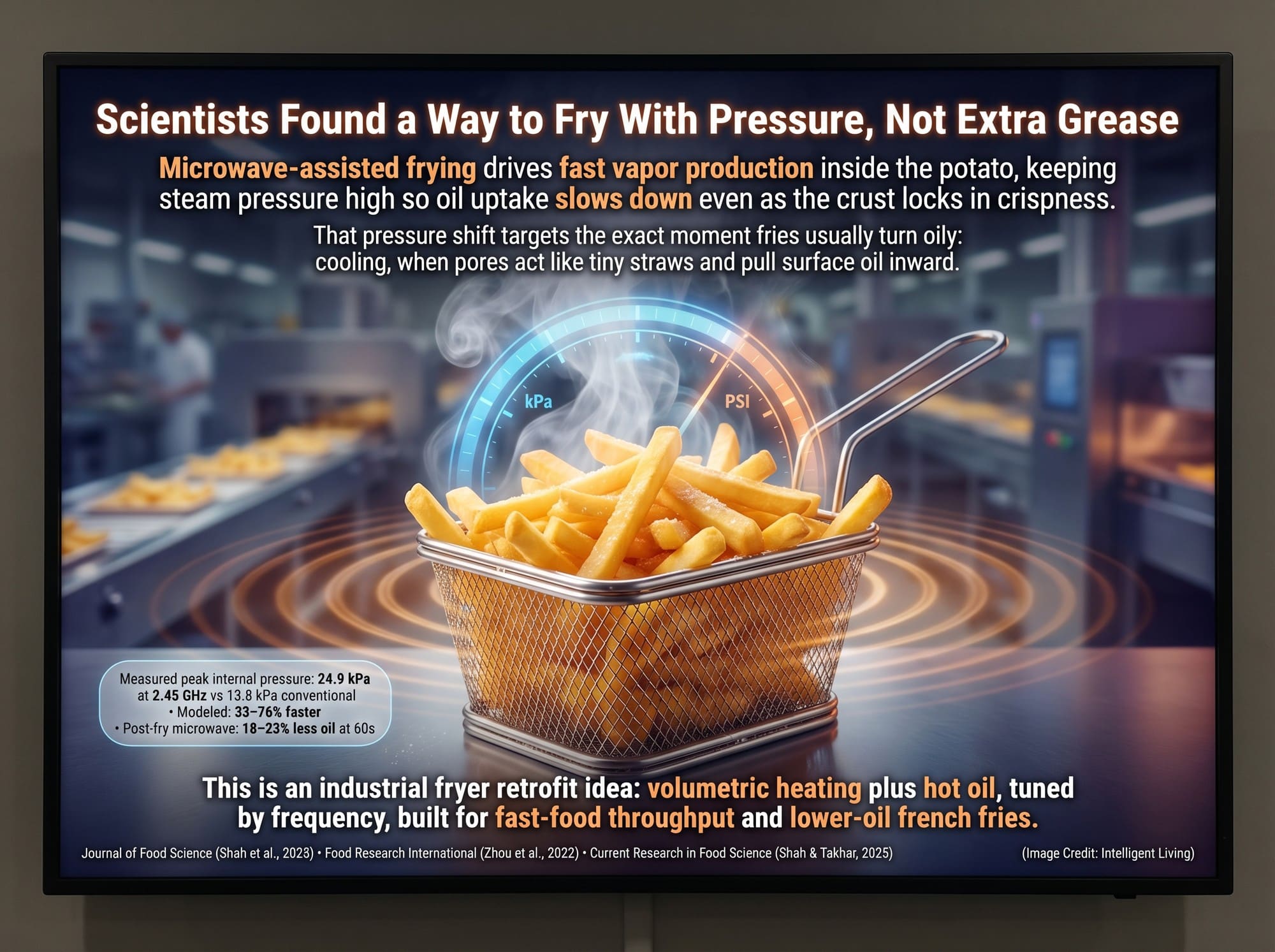
- Core claim: Microwave energy creates internal steam pressure that acts as a physical shield, stopping oil from flooding newly opened pores.
- Practical intent: Hybrid microwave plus oil heat is framed as a path to keep crispness while lowering oil uptake.

Controlling Oil Uptake in Porous Starch Networks with Volumetric Heating
Why Fries Get Greasy (The “Tiny Straws” Problem)
Potatoes are porous starch networks. Intense heat causes water inside those pores to vaporize and escape rapidly, carving out channels that function like microscopic straws. As steam leaves, internal pressure can drop relative to the surrounding hot oil, pulling grease inward.
Crucially, absorption occurs at multiple stages. In researchers’ recent porous food tomography, scientists describe oil uptake as pressure-driven and emphasize how cooling can create a favorable gradient for oil absorption. Crucially, as the fry cools, steam condenses and creates a vacuum that oil quickly replaces.
Diners often face a familiar disappointment when fries that look perfect at the counter turn soggy during the ride home. This happens because cooling changes pressure gradients, allowing surface oil to move inward. Operationally, proper frying temperature control is one of the simplest levers for reducing greasy outcomes before any new hardware enters the picture.
How Microwaves Change the Physics Inside a Fry
Volumetric heating allows microwave energy to penetrate the core directly, bypassing the slow crawl from surface to center. Interior heating accelerates vapor production deep within the starch network, maintaining positive internal pressure precisely when oil is most likely to infiltrate. When gauge pressure is higher, oil is less likely to be forced into pores that have just been emptied by escaping water.
In the measurement study, the fiber-optic sensing measurements show substantially higher peak gauge pressure under microwave conditions. Researchers reported a peak near 24.9 kPa at 2.45 GHz, a sharp contrast to conventional frying, which hovered around 13.8 kPa. The same paper reports higher peak sample temperatures under microwave frying and notes differences in texture behavior depending on frequency. Crispness is not just dryness; it is the structure that forms as moisture leaves.

Industrial Scale-Up Potential: Validating Thermodynamic Modeling and Hybrid Systems
Empirical Sensing Results: Measuring Internal Steam Pressure Peaks
Empirical sensing work provides the best defense for this theory, revealing a mechanism that is both straightforward and difficult to dismiss: pressure and temperature changes that plausibly alter how oil migrates. Internal pressure dynamics act as a gatekeeper for the potato’s architecture. This force helps decide whether oil remains on the surface or moves inward through capillary action.
A 2025 open-access study using synchrotron tomography data proves that these findings apply to all porous foods. Scientists are discovering that any starch network subjected to high-heat immersion faces identical pressure-driven challenges. Researchers describe oil uptake as pressure-driven and emphasize how cooling can create a favorable gradient for oil absorption, which aligns with what operators notice when fries sit for even a few minutes.
Advanced Modeling Results: Predicting Oil Migration and Moisture Loss
Scientific simulations now predict exactly how moisture, pressure, and oil content evolve during the process. The hybrid transport simulation reports ranges such as shorter frying time and lower oil content at matched endpoint moisture. Frequency directly dictates penetration depth. Consequently, identical wattage levels yield wildly different results based on food geometry and how effectively the electromagnetic field couples with the potato.
Secondary Lever Analysis: Post-Frying Microwave Treatment Benefits
Processing literature also supports the idea that microwaves can be used as a lever after frying. A 2022 study in Food Research International reports that a short post-frying microwave step reduced oil content in controlled experiments, with the outcome depending on timing and frequency. Operators must monitor treatment windows with extreme precision, as even a few extra seconds can trigger localized dark spots that ruin a batch’s visual appeal.
The Retrofit Question: Could Fast-Food Lines Actually Use This?
Engineering Nontrivial Hardware: Managing Microwave Attenuation in Bulk Oil
Commercial success depends on retrofitting continuous fry lines rather than developing countertop gadgets. Engineering feasibility hinges entirely on the complex behavior of microwave energy as it passes through hot oil and porous food. In the reported measurements, authors found that bulk oil attenuation was not a limiting factor, which is a crucial engineering detail for any hybrid design.
Lowering oil uptake slashes ingredient expenses and improves nutrition labels, while shorter cycles boost processing throughput, provided texture remains consistent at full speed.
Field Distribution Strategy: Avoiding Hot Spots in Moving Food Systems
Microwave heating at scale can create edge hot spots or cold pockets because field distribution is hard to predict in moving, irregular foods. A technical overview of industrial microwave applications explains why commercial systems rely on tuned applicators and conservative safety margins.
Busy drive-thru kitchens operate in a high-stakes environment where every second counts. While a minor temperature drift can instantly turn fries from crisp to limp, just a handful of seconds can irreversibly darken their color. Taming these fluctuations becomes the primary challenge when integrating secondary energy sources into high-speed industrial fryers.
Indoor Air, Aerosols, and the High-Heat Work Environment
In high-volume kitchens, ventilation and aerosol control matter more than most people expect, because cooking plumes can carry fine droplets and breakdown products into the air. Indoor measurements suggest primary organic aerosol data accounts for roughly half of the emissions found in high-volume kitchens, which is why airflow and filtration choices can change how a space feels after a fry rush. A room-by-room guide to optimizing kitchen airflow captures why hot oil is chemistry moving through a space rather than just a smell problem.
Future Processing Pathways: Where Hybrid Microwave Systems will Appear Next
Seven Industrial Pathways for Microwave-Assisted Food Processing
- Quick-Service Retrofits: Restaurant chains could pilot microwave-assisted modules to reduce oil uptake on high-volume fries.
- Frozen Processing Lines: Producers may tune hybrid steps for consistent texture while supply pressure grows, especially as agricultural storage timelines shorten in some regions under warming trends.
- Snack Manufacturing: Chips and starch snacks where oil pickup drives cost and texture may test similar pressure-focused processing.
- Post-Fry Microwave Modules: A short microwave stage after frying could become a bolt-on option for specific products.
- Digital Twin Controls: Coupled physics models can be integrated into process controls to predict hot spots and texture endpoints, especially when digital process mapping is used to track moisture, pressure, and oil transport across settings.
- Cross-Category Spillover: Breaded proteins and plant-based items that struggle with oil absorption may benefit from tuned volumetric heating.
- Consumer-Grade Products, Later: Countertop devices that blend volumetric heating with crisping stages are conceivable, but the current work is framed around specialized equipment.
Nutrition and Safety Realities: Beyond Simple Oil Reduction
Caloric Density vs. Nutritional Value: Interpreting the New Label
Trimming oil percentages certainly improves the nutrition label, but a lower calorie count isn’t a total health transformation. Simply reducing grease doesn’t offset the long-term impact of a poor dietary pattern.
Acrylamide Mitigation: Essential Standards for High-Heat Cooking
High-temperature cooking also has a chemistry axis: acrylamide can form in starchy foods. Regardless of whether a fryer uses microwaves, established starchy food safety standards emphasize several practical mitigation strategies:
- Soak potato slices before frying to reduce starch.
- Avoid refrigeration of raw potatoes to prevent sugar buildup.
- Cook fries to a golden yellow rather than a dark brown.
Maintaining these standards ensures safety even as new heating technologies emerge.
Packaging and PFAS Restrictions: The Environmental Exposure Layer
“Healthier cooking” has an exposure layer that readers increasingly care about. Maine’s 2026 rules on intentionally added PFAS include food contact categories such as cookware and air fryers, which is why PFAS sales restrictions for kitchen products keep appearing in shopping decisions.
Even packaged snacks carry their own exposure quirks, including how friction and handling can shed particles from materials. A report on microplastic particles from opening chip bags reminds us that food risk conversations often extend beyond the ingredient list.
Dietary Habits: The Role of Ultra-Processed Defaults in Health
Routine habits like late-night convenience and stress eating often turn a simple side choice into a dietary staple. This behavior is central to the metabolic appetite response, which explores how ultra-processed defaults impact our long-term health.
2026 Industrial Outlook: Tracking Pilot Programs and Throughput Optimization
Operational Tells: Identifying Success in Commercial Pilot Runs
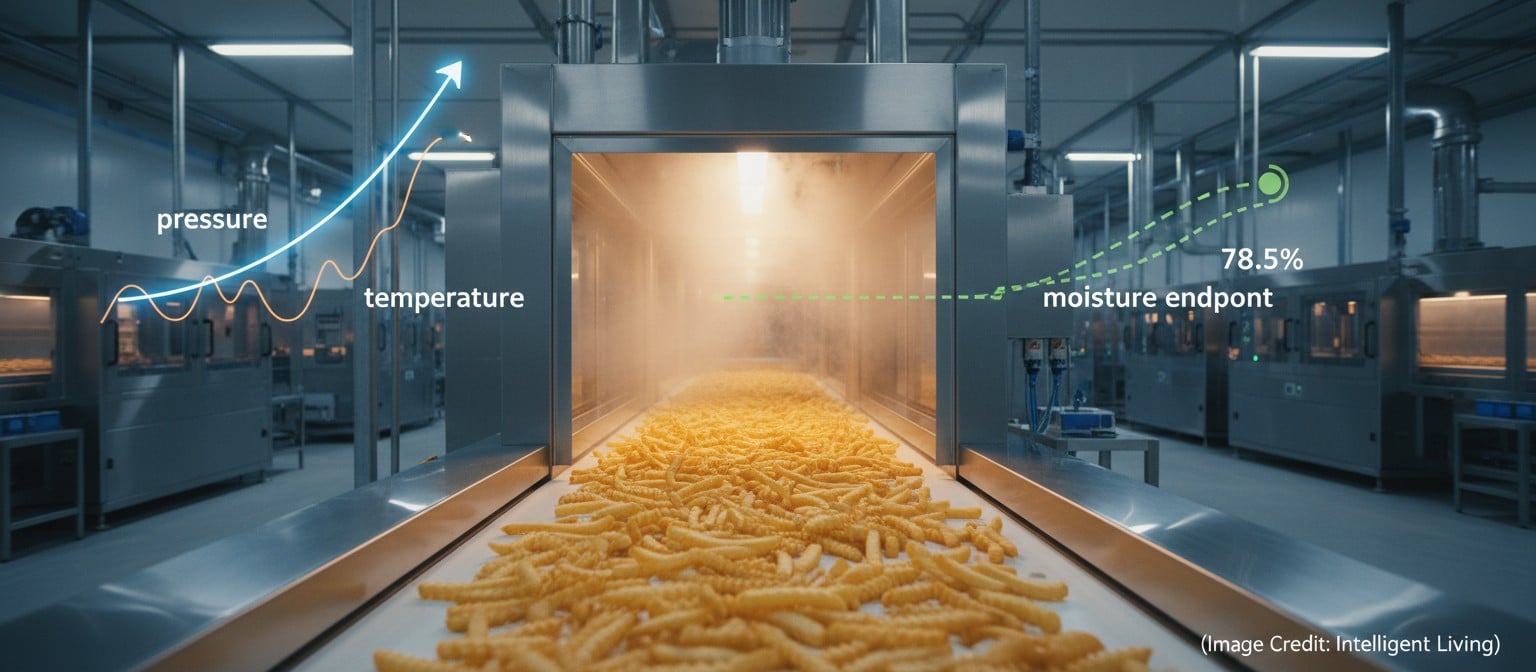
Watch for pilot announcements from major fry producers or quick-service chains as the first sign of success. These reports will likely detail texture consistency, oil uptake, and throughput across long industrial runs. Identifying success often comes down to uniformity maps. These charts reveal if the field distribution can remain stable as the technology moves from isolated lab rigs to massive production conveyors. A short roundup of the fryer research pipeline hints at the long-term potential for these systems.
A systems angle worth tracking provides extra context. When food waste falls, emissions fall, and small operational changes can compound. A practical primer on industrial waste reduction underscores why industrial efficiency stories matter outside the plant.
Finalizing the Fryer Retrofit: Future Outlook for Low-Oil Processing
Researchers are finally untangling a long-standing culinary contradiction: the very channels that create that satisfying crunch are the same ones that invite grease to settle in. By using microwave energy to shift internal steam dynamics, engineers now have a plausible route to preserve texture while lowering oil uptake.
The ultimate test lies in the fast-food environment. Maintaining processing throughput during a peak fry rush without creating hot spots is the final hurdle. If industrial systems master this pressure-driven defense, the resulting oil uptake reduction will reshape nutrition labels for the global snack market.
FAQ: Understanding the Impact of Hybrid Frying Technology
How does microwave steam pressure prevent oil absorption?
Internal vapor production creates positive pressure that physically blocks oil from entering the porous starch network during the frying cycle.
Will a fryer retrofit change the taste of the fries?
No, the hybrid method focuses on internal thermodynamics while the surrounding hot oil locks in the traditional surface crust and flavor.
Can these hybrid systems handle high processing throughput?
Industrial designs prioritize uniform field distribution to ensure consistent quality even when the line is running at maximum capacity.
Is this technology available for home kitchen use?
Current research focuses on commercial fryer retrofit modules for high-volume processing rather than consumer-grade countertop appliances.
What is the primary benefit of lowering oil uptake?
Cutting oil absorption slashes ingredient expenses while simultaneously extending the shelf life and improving the nutritional profile of the final product.


