
Siberia’s summertime methane emissions have more than doubled since 2010. That is the core finding of a peer-reviewed study published in August 2026 in the journal Science, which estimates that growing-season methane emissions across the region rose by 12.0 ± 1.9 million metric tons between 2010 and 2023, an average increase of about 5% per year.
What stands out is not just that emissions rose, but how they rose. The Yenisei River, cutting north through central Siberia, marks a sharp boundary between two climate regimes, and both are now producing more methane for different reasons. West of the river, warmer and wetter conditions are thawing permafrost and feeding methane-producing microbes. East of it, hotter and drier weather is driving wildfires that release methane and destabilize frozen ground.
The stakes are global. Methane is short-lived but far more powerful than carbon dioxide while it lasts, and the study projects that under continued high warming, Siberia’s extra output could offset roughly one-fifth of the human-caused methane reductions nations would need to meet their climate targets by 2050. Below is what the research found, how the team measured it, and where the uncertainty remains.
What the Study Found
The work was led by the Institute of Atmospheric Physics at the Chinese Academy of Sciences, with collaborators at the University of Edinburgh and the UK’s National Centre for Earth Observation. The team reconstructed 14 years of Siberian methane emissions by combining satellite readings with ground-based measurements, then modeled where the gas was coming from and why.
- Two mechanisms, one river: thawing wetlands and microbes drive the rise in the west, while wildfires drive it in the east.
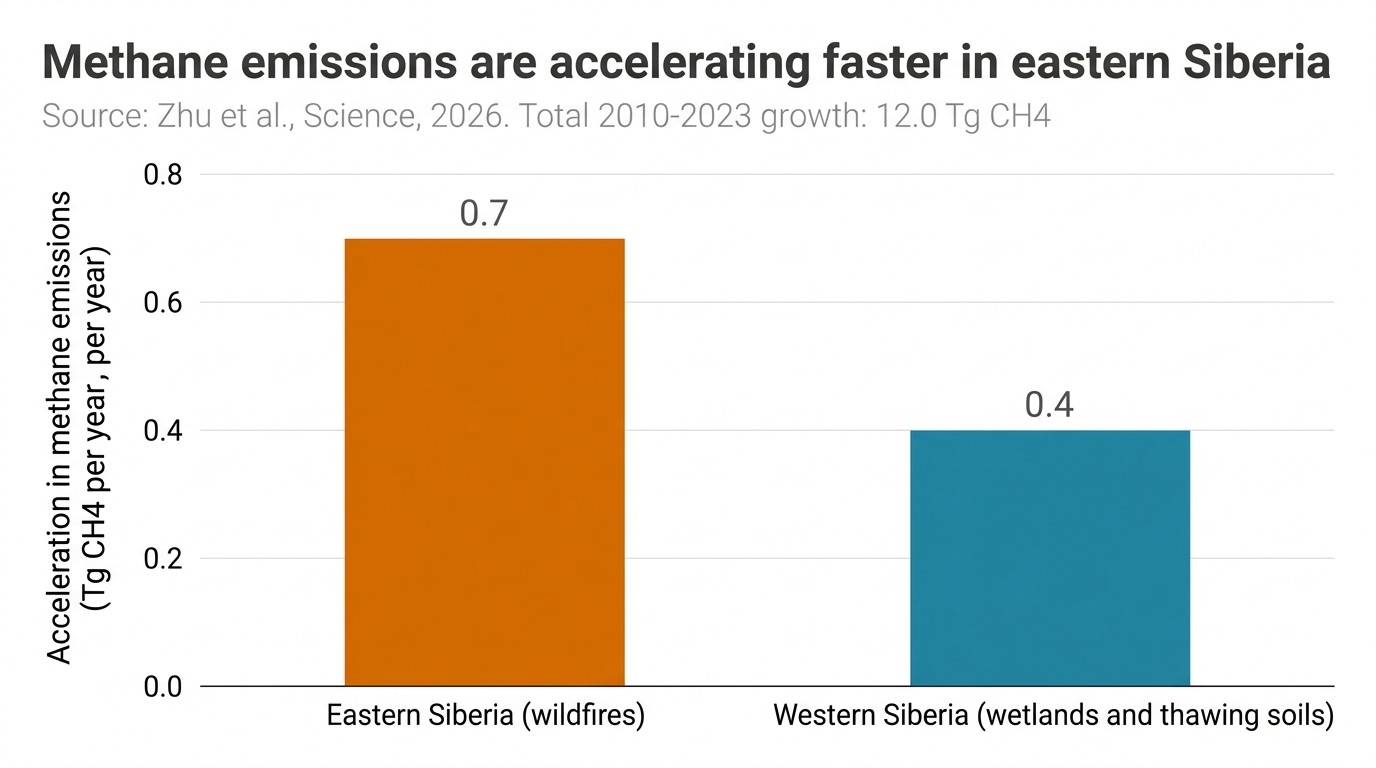
- The east is gaining faster: fire-driven emissions are increasing roughly twice as quickly as wetland emissions.
- An Arctic outlier: Alaska and Canada did not show a comparable rise over the same years.
- Bigger and more sustained than expected: researchers anticipated an increase, but not one this large or this persistent.
The table below lays out the study’s central numbers.
| Measure | Finding |
|---|---|
| Study period | 2010 to 2023 |
| Growth in growing-season methane emissions | 12.0 ± 1.9 million metric tons (12 teragrams) in total |
| Average annual increase | About 5% per year |
| Share of the global rise in wetland methane emissions | About 92% |
One River, Two Very Different Problems
The Yenisei is more than a geographic landmark in this study. It marks where two atmospheric patterns meet, and those patterns are steering Siberia toward two separate methane futures. Researchers describe the result as two distinct climate regimes: wetter conditions on one side, drier on the other, each with its own way of unlocking carbon that has been frozen for millennia.

West of the Yenisei: Wetter Ground, Busier Microbes
Western Siberia is influenced by what climatologists call the Scandinavian pattern, a circulation setup that carries more heat and moisture from the North Atlantic into the region as the planet warms. The result is a warmer, wetter landscape where permafrost thaws, soils become waterlogged, and microbes break down ancient organic matter into methane, a process known as methanogenesis.
That pathway added about 0.4 teragrams of methane per year, each year, over the study period. Siberia holds roughly 46% of the Northern Hemisphere’s permafrost, which makes it one of the largest stores of frozen carbon on Earth and a store that is already thawing decades ahead of schedule in other parts of the Arctic.
East of the Yenisei: Drier Ground, Bigger Fires
Eastern Siberia sits under a different influence: the Arctic Oscillation, which shifts air pressure between the Arctic and the middle latitudes. Climate change is pushing that system toward persistent high-pressure blocks, which bring heat waves, thinner cloud cover, and more fire-friendly conditions.
Wildfires in the east added about 0.7 teragrams of methane per year, each year, making it the faster-growing of the two sources. Fires also strip away the vegetation and soil that insulate permafrost, which can accelerate thaw and expose still more carbon. The study projects that eastern Siberia will dominate the region’s future increase because it is warming faster and burning more often.
How Scientists Measured Methane Without Ground Access
Siberia is vast, remote, and, since 2022, difficult for many Western scientists to reach. That rules out most traditional on-the-ground monitoring. The team worked instead from the top down, using Japan’s GOSAT satellite, which measures methane in the atmosphere, along with ground stations and rare tall-tower monitors inside Siberia.
Those observations fed a technique called methane flux inversion. Instead of adding up individual sources on the ground, the model starts with what the atmosphere shows and works backward to estimate the emissions underneath. By combining data streams, the researchers narrowed their uncertainty to roughly 10%, a meaningful improvement for a region that has been one of the biggest gaps in the global methane budget.
Researchers on the study also point to a monitoring gap: Arctic coverage is patchy and uneven, and without denser, continuous observation, it is hard to describe the processes at work, let alone design policies around them.
Siberia’s emissions mostly occur in spring and summer, when sunlight returns and satellites can see the surface, which is why the study focuses on the growing season.
Why Methane Matters More Than Its Size Suggests
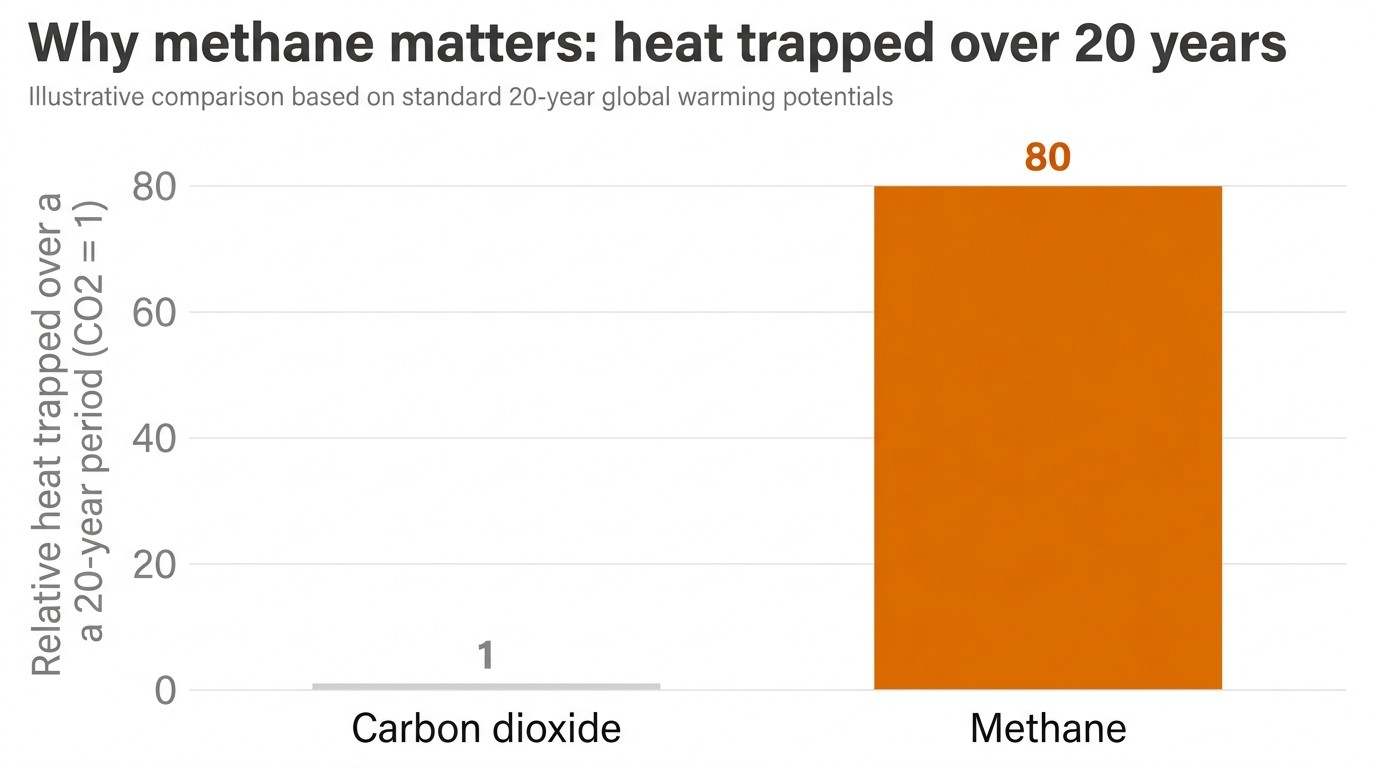
Methane does not linger in the atmosphere the way carbon dioxide does; most of it breaks down within about a decade. But while it is there, it traps roughly 80 times more heat than carbon dioxide over a 20-year window. That combination of intensity and brevity is why methane is viewed as one of the fastest ways to slow near-term warming.
Context matters here. Siberia accounts for only about 5% of global methane emissions, and human activities remain the largest driver of the overall increase, with fossil fuel production among the biggest contributors. Yet Siberia is becoming one of the fastest-growing natural sources on the planet, which is what makes a sustained regional trend worth tracking.
Independent scientists who reviewed the study for the UK Science Media Centre described the work as high quality and highlighted its use of satellite data to capture a hard-to-measure region.
What It Could Mean by 2050
The study’s most consequential projection concerns what happens next. Under a high-emissions scenario, the researchers estimate that Siberia’s methane output could rise by an additional 25 million metric tons per year by 2050, and that the increase could offset about 20% of the human-caused methane cuts that would be needed to meet climate targets. It is the kind of feedback risk researchers have flagged for years, with evidence that thawing permafrost could double greenhouse gas emissions.
Human methane is the target of a formal global effort: more than 150 countries signed the Global Methane Pledge in 2021, committing to cut emissions from sources such as oil wells, landfills, and livestock by at least 30% below 2020 levels by 2030. Natural emissions from Siberia sit outside that accounting, which is exactly why they can quietly erode the math.
The relationship between temperature and emissions is not a straight line. The analysis suggests emissions rise slowly at first and then accelerate as heat extremes become more common, a pattern that raises the risk of what researchers call an overshoot effect: warming triggers extra natural emissions, which drive still more warming, pushing actual temperatures above what models would otherwise project.
Three factors will shape how much of that projection comes true:
- How fast the Arctic keeps warming. The size of the response tracks the size of the warming, so pace matters more than any single heat record.
- How much vegetation is left to burn. Fires need fuel, and repeated burning changes what grows back, which makes the eastern trend harder to extrapolate.
- How quickly human methane emissions fall. Faster cuts mean less warming pressure on the Arctic in the first place.
Two caveats keep the picture honest. First, the increase reported so far is small relative to global and projected emissions, so the finding is not evidence of an unstoppable surge today. Second, the projections depend on emissions scenarios that may or may not play out. The signal, in other words, is the trend, not a single doomsday figure.
Are Siberia’s Exploding Craters Connected?
People searching for Siberian methane emissions often land on footage of the giant craters that have opened up on the Yamal and Gyda peninsulas. Those craters are a separate phenomenon from the diffuse emissions described in this study. Researchers generally link them to methane building up beneath the surface in thawing permafrost and then releasing suddenly, though the exact mechanism is still debated. Both stories point to the same underlying instability: frozen ground that is no longer reliably frozen.
Frequently Asked Questions
Is Siberia’s methane release a climate tipping point?
Not yet, and scientists are careful with the term. A tipping point implies a self-sustaining shift that cannot be reversed on human timescales. What this study documents is a fast, sustained increase with the potential to accelerate. That is a warning sign, not proof that a threshold has been crossed.
How much of global methane comes from Siberia?
Siberia contributes roughly 5% of global methane emissions. The region’s importance lies less in its current share than in its trajectory: it is growing faster than almost any other natural source, and it holds an enormous carbon reserve that could release far more if warming continues.
Why is methane a bigger deal than carbon dioxide in the short term?
The two gases work on different clocks. Methane traps far more heat while it is in the atmosphere, but it also clears out quickly, so cuts to methane tend to show up in the temperature record much sooner than cuts to carbon dioxide. That speed is the argument for treating it as a near-term lever rather than a long-term one.
Could these emissions slow down if warming slows?
In principle, yes. The mechanisms identified in the study are temperature-driven, so less warming means less thaw, less microbial activity, and fewer extreme fire seasons. That is why researchers frame methane cuts as a way to buy time rather than a substitute for reducing carbon dioxide.
The Bottom Line
The most important insight in the new research is structural: Siberia does not have one methane problem; it has two, separated by a single river. Wetlands and microbes are driving the slower rise in the west, while fire and thaw are driving a faster one in the east. Both are being driven by rising temperatures, and neither shows signs of leveling off.
“Siberia’s vast permafrost carbon store is a sleeping giant,” said Paul Palmer, a professor in the School of Geosciences at the University of Edinburgh and a co-author of the study. “Continued warming risks waking up a much larger source of greenhouse gases.”
For now, the measured increase remains small against global totals, and the projected offset applies to the high-warming scenarios the study modeled. But the direction of travel is clear, and it points to a region the world can no longer afford to monitor only from a distance.

