Permafrost In Canadian Arctic Is Thawing 70 Years Earlier Than Predicted

Date:

Climate change is happening faster than predicted. A scientific expedition by a team from the University of Alaska Fairbanks has revealed the startling truth that the permafrost in the Canadian Arctic is thawing 70 years earlier than expected. What they witnessed and recorded is evidence that the global climate crisis is quickly accelerating at a shocking rate.

Mackenzie River, CanadaIn merely a decade of hot summers, the upper layers of giant subterranean ice blocks (that had been frozen solid for millennia) were completely destabilized. The researchers were astounded by how quickly and how dramatically the change occurred. “What we saw was amazing,” Vladimir Romanovsky, a professor of geophysics at the university, told Reuters. “It’s an indication that the climate is now warmer than at any time in the last 5,000 or more years.”

The team published their findings in the journal Geophysical Research Letters. They took this paper to the United Nations climate negotiations (a meeting of the world’s governments) to inspire action and ratchet up ambitions. Their research offered a further sign of the growing climate emergency.

Melting permafrost near Mould Bay, Canada, 2016.
Partially thawed permafrost near Mould Bay, Canada, 2004.
Melting permafrost near Isachsen, Canada, 2016.
Partially thawed permafrost near Isachsen, Canada, 2005.
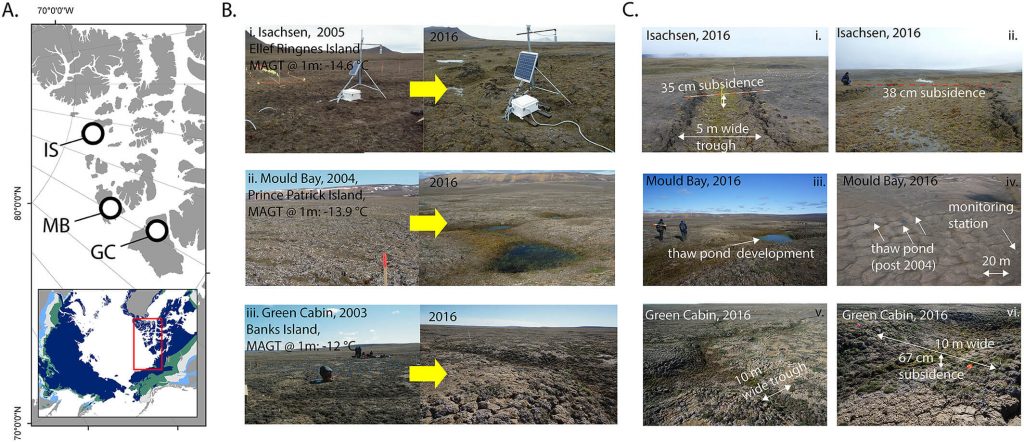
(a) Map of the study area showing permafrost monitoring site locations. (b) Examples of the even terrain at each site at the start of monitoring (2003, 2004, 2005) and the terrain after a decade of monitoring (2016). Thermokarst development was observed at all sites. (c) Examples of thermokarst topography and landforms observed at each site in 2016: (i and ii) subsidence and trough formation at Isachsen, (iii) trough formation and pond development at Mould Bay, and (iv) subsidence and trough formation at Green Cabin. All images are taken from within 500 m of the permafrost monitoring station with the exception of iv which was taken aerially but includes the monitoring station within the frame.
(a) Map of the study area showing permafrost monitoring site locations. (b) Examples of the even terrain at each site at the start of monitoring (2003, 2004, 2005) and the terrain after a decade of monitoring (2016). Thermokarst development was observed at all sites. (c) Examples of thermokarst topography and landforms observed at each site in 2016: (i and ii) subsidence and trough formation at Isachsen, (iii) trough formation and pond development at Mould Bay, and (iv) subsidence and trough formation at Green Cabin. All images are taken from within 500 m of the permafrost monitoring station with the exception of iv which was taken aerially but includes the monitoring station within the frame. (Credit: https://doi.org/10.1029/2019GL082187)

The paper presented the data that Romanovsky and his colleagues had been analyzing since their last expedition to the area in 2016. They said that the landscape was unrecognizable from the pristine Arctic terrain they had encountered during initial visits a decade or so earlier. The beautiful view had dissolved into an undulating sea of hummocks (waist-high depressions and ponds known as thermokarst) and vegetation (before sparse) had begun to grow in abundance within, sheltered from the constant wind.
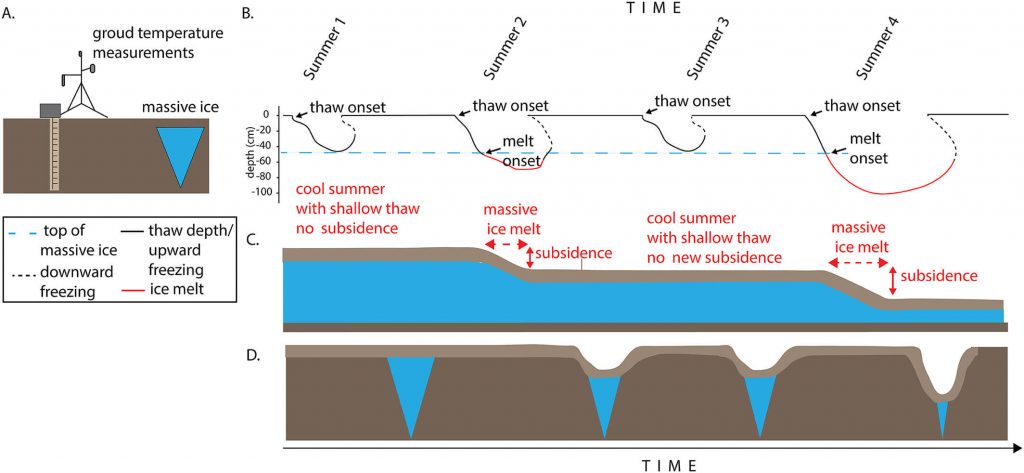
A schematic diagram of how summer thaw leads to rapid ice‐wedge degradation. (a) An illustration of our monitoring station setup and source of ground temperature data in relation to near‐surface massive ice. (b) A conceptual diagram illustrating thaw front dynamics based on measurements taken at our study sites. (c) A cross section of massive ice melt through time showing how protective sediment thickness remains the same despite active layer deepening, leading to cumulative melt throughout the thaw season. (d) A cross section of ice wedge thaw through three summers where the depth of thaw exceeded the sediment overburden above ice‐wedge ice, and one cool summer where no additional subsidence occurs.
A schematic diagram of how summer thaw leads to rapid ice‐wedge degradation. (a) An illustration of our monitoring station setup and source of ground temperature data in relation to near‐surface massive ice. (b) A conceptual diagram illustrating thaw front dynamics based on measurements taken at our study sites. (c) A cross section of massive ice melt through time showing how protective sediment thickness remains the same despite active layer deepening, leading to cumulative melt throughout the thaw season. (d) A cross section of ice wedge thaw through three summers where the depth of thaw exceeded the sediment overburden above ice‐wedge ice, and one cool summer where no additional subsidence occurs. (Credit: https://doi.org/10.1029/2019GL082187)

What is really worrisome is the risk that the rapid thawing of permafrost could release vast quantities of heat-trapping gases. The scientists are concerned it could unleash a feedback loop that would in turn fuel even faster temperature rises.

Louise Farquharson, a postdoctoral researcher and co-author of the study, said:

It’s a canary in the coalmine. It’s very likely that this phenomenon is affecting a much more extensive region and that’s what we’re going to look at next.

The scariest part is, according to models used by the UN-backed Intergovernmental Panel on Climate Change, even if current commitments to cut emissions under the 2015 Paris agreement are implemented, the world is still far from averting the risk that these kinds of feedback loops will trigger.

A cemetery sitting on melting permafrost tundra at the village of Quinhagak on the Yukon Delta in Alaska.

The new paper reinforces the imperative to cut emissions. Their findings serve as a warning that the problem is real and it is much worse than just some ice melting. The sharply higher temperatures would devastate the global south and threaten the viability of industrial civilization in the northern hemisphere.

Jennifer Morgan, executive director of Greenpeace International, said:

Thawing permafrost is one of the tipping points for climate breakdown and it’s happening before our very eyes. This premature thawing is another clear signal that we must decarbonize our economies, and immediately.

Andrea D. Steffen
Andrea D. Steffen
I use the alphabet to paint words that become a beautiful and inspiring image in the reader's mind. I have a Bachelors in Architecture from FAU.

Share post:

Popular

Pollinator Habitat Is Disappearing Faster Than It’s Being Replaced. The Bottleneck Is the Plants Themselves

The awareness problem around pollinator decline has largely been...

Clean Water Solutions: Proven Technologies Bringing Safe Water to Everyone

Access to safe drinking water remains one of the...

AI Reveals Massive Ocean Algae Bloom Is Spreading Across the World’s Oceans

Artificial intelligence has uncovered a dramatic shift in the...

1-Bit LLMs Bring 27B-Class AI to Laptops and Phones

Open-weight language models keep getting larger, but a quieter...