
The AirLoom wind turbine replaces massive steel towers and sweeping three-bladed rotors with an oval loop of vertical wings traveling along an elevated cable track. Developed by Laramie, Wyoming startup Airloom Energy, the system comes with an ambitious headline claim: company materials state it could reduce the levelized cost of energy to one-third of conventional utility wind while cutting wind-farm capital expenses below 25% of standard builds. Yet the project is still transitioning from a kilowatt-scale prototype and a 50-kilowatt pilot test device in Rock River, Wyoming toward a targeted 2027 commercial demonstration, leaving its utility-scale economics and aerodynamic durability unverified in independent commercial operation.
What the AirLoom Wind Turbine Claims to Achieve
Modern utility-scale wind power relies on scale to drive down electricity prices, pushing conventional horizontal-axis turbines to extreme heights that create severe transport and installation bottlenecks. Airloom Energy, led by CEO and former Google executive Neal Rickner and backed by Breakthrough Energy Ventures, argues that shrinking the hardware footprint is a faster route to lowering wind energy cost.
According to company announcements and utility-scale wind design reports, the startup targets three major cost reductions compared to standard multi-megawatt towers:
- Device manufacturing cost: Company figures project the hardware for a 2.5-megawatt system will cost less than 10% of a conventional wind turbine of equivalent rating.
- Total wind farm CAPEX: Airloom Energy estimates total capital expenditure for a full installation will come in at less than 25% of a traditional wind farm.
- Levelized cost of energy (LCOE): By combining cheaper materials with simplified logistics, the company claims it can cut overall LCOE to roughly one-third of conventional utility wind rates.
Even with renewable costs falling below fossil fuels across many global power markets, siting and hauling 100-meter blades remain difficult on rural roads. Airloom Energy states that all components for an entire 2.5-megawatt track wing system can fit inside a single standard tractor-trailer, eliminating specialized heavy-haul convoys and towering cranes. At the time of its funding announcement, Carmichael Roberts of Breakthrough Energy Ventures noted in a press release that the architecture addresses key deployment and cost bottlenecks that have historically restricted where wind farms can be built. Those cost projections, however, currently rest on company engineering models rather than audited utility power purchase agreements.
How the Track Wing Wind Turbine Design Works
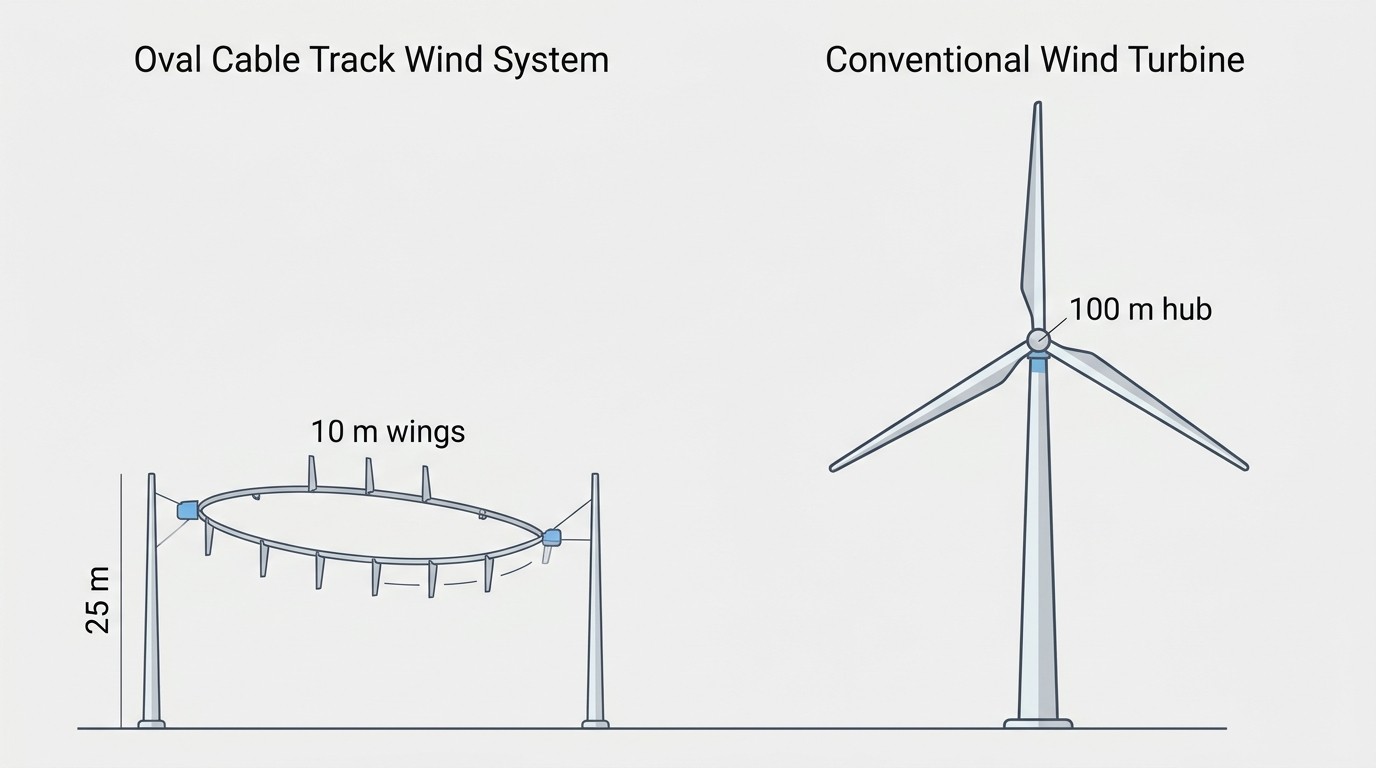
To evaluate whether a closed loop can compete with a standard rotor, it helps to examine how a wind turbine works when converting moving air into electricity. Both traditional rotors and the AirLoom wind turbine rely on aerodynamic lift. Instead of mounting three huge blades to a central hub, the track wing wind turbine design arranges multiple 10-meter (33-foot) vertical wings along a tensioned cable loop suspended on poles roughly 25 meters (82 feet) tall.
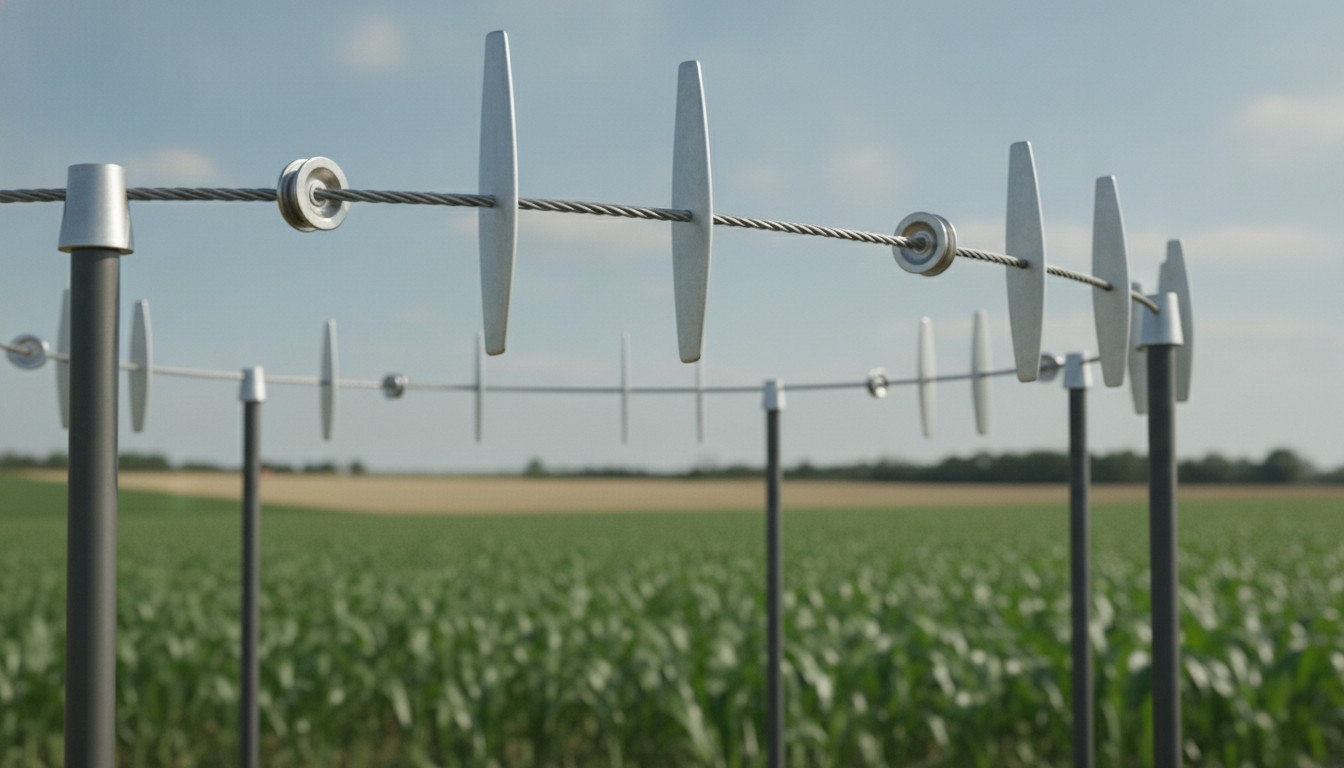
As wind flows across the oval track, the vertical airfoils generate lift and pull the cable around the circuit like a horizontal sailboat tacking across the breeze. At the ends of the oval, the wings pivot to change their angle of attack for the return pass, keeping the cable moving in one continuous direction. A power takeoff mechanism connected to the linear motion of the track drives standard generators to produce electricity.
Based on technical coverage and specifications outlined on the Airloom Energy development roadmap, a planned 2.5-megawatt commercial unit will stretch roughly 400 meters long and 36 meters wide. While engineers have tried to solve logistics hurdles through telescopic wind turbine concepts or modular towers, Airloom abandons the high single-mast format altogether in favor of low-profile poles and tensioned cables that can be installed on working farmland with minimal concrete foundations.
| Feature | AirLoom 2.5-MW Concept (Company Specs) | Conventional Utility HAWT Baseline |
|---|---|---|
| Architecture | Oval cable track with moving vertical wings | Three-bladed rotor on a single tall tubular tower |
| Structure Height | Roughly 25 m (82 ft) support poles | Typically 80 m to 120+ m hub height |
| Blade / Wing Length | 10 m (33 ft) vertical wings | 50 m to 80+ m composite rotor blades |
| Footprint Shape | 400 m long by 36 m wide oval loop | Single concrete pad with wide spacing between towers |
| Transport Requirement | One standard tractor-trailer per 2.5-MW unit | Multiple oversized-load trucks and specialized cranes |
| Verification Status | 50-kW pilot phase; 2.5-MW commercial demo targeted for 2027 | Decades of commercial bankability and verified LCOE data |
Physics Check: Why the Betz Limit Still Applies
Whenever a new wind hardware configuration emerges, from a motionless rooftop wind device to a conventional vertical axis wind turbine, its performance is governed by fluid dynamics. Some early promotional phrasing around the AirLoom system has pointed to better physics or suggested the loop converts kinetic energy into mechanical energy more efficiently. In strictly physical terms, no open-air wind device is exempt from the Betz limit.
Formulated in 1919, the Betz limit proves that any wind energy converter in an open airflow can capture at most 59.3% of the kinetic energy in the wind. If a device extracted 100% of the energy, the air would stop moving entirely behind the blades and block fresh wind from entering the swept area. Because the AirLoom wind turbine extracts energy using aerodynamic lift from open air currents, the 59.3% ceiling applies to its swept window just as strictly as it does to a three-bladed rotor.
Staying closer to the ground also introduces a well-documented meteorological trade-off. According to NREL wind energy research, wind speeds generally increase and become less turbulent at higher altitudes due to reduced surface friction, a phenomenon known as wind shear. Because power available in the wind scales with the cube of wind speed, operating at 25 meters typically exposes wings to slower, gustier air than a hub sitting 100 meters up. Additionally, while the company suggests that multiple track loops can be spaced closely together, independent wake-modeling data has not yet confirmed how much downstream energy loss occurs when dozens of 10-meter wings travel in front of one another along a 400-meter track.
What Is Actually Proven vs. Still Unverified
Separating verified engineering milestones from forward-looking commercial goals clarifies where the AirLoom wind turbine stands today. In 2023, the company built and operated a kilowatt-scale prototype that confirmed the mechanical feasibility of running vertical airfoils around a tensioned cable loop to generate power. Moving beyond that proof of concept, the team broke ground on a 50-kilowatt pilot test facility in Rock River, Wyoming, designed to validate power curves and capital cost assumptions across 2025 test operations, alongside a high-profile showcase at CES 2026. Funding disclosures cite roughly $13.75 million plus defense department contracts supporting the pilot build-out.
Even with those tangible steps, the gap between a 50-kilowatt test loop and a 2.5-megawatt utility installation is substantial, representing a fifty-fold jump in power rating. Several critical benchmarks remain unverified by independent third parties:
- Measured power curves and capacity factor: Public, third-party audited generation figures from the 50-kilowatt Wyoming pilot have not yet been published.
- Long-term mechanical wear: Unlike a traditional rotor with one main bearing, a cable track involves continuous mechanical motion across pulleys, cable guides, and wing-pivoting hardware exposed to dust, ice, and high wind loads.
- Maintenance and operations (O&M) costs: Even if initial wind turbine cost drops sharply, frequent replacement of moving track cables or rollers could raise lifetime electricity costs.
- Commercial timeline: Airloom Energy targets a commercial demonstration around 2027, meaning full utility-scale bankability remains several years away.
Costs, Materials, and Footprint: What to Verify Next
The clearest advantage of the AirLoom architecture lies in supply chain simplicity rather than aerodynamic magic. Standard horizontal-axis blades require massive fiberglass molds, specialized factories, and expensive cranes. By contrast, Airloom uses 10-meter airfoils, standard steel poles, and commercial wire rope that can be mass-manufactured in existing industrial plants and delivered by standard freight trucks.
For utilities and agricultural landowners evaluating the technology between now and the planned 2027 commercial demonstration, verification will come down to three practical metrics. First, engineers will need to see how the annual energy production per hectare of a 400-meter ground loop compares against a single tall turbine tower occupying a fraction of the surface length. Second, winter durability testing in Wyoming will need to show that icing and grit do not degrade the track bearings. Third, independent financial audits will need to confirm whether lower upfront hardware prices survive the addition of long-term maintenance costs.
Frequently Asked Questions
Is the AirLoom wind turbine proven at utility scale?
No. As detailed above, testing has reached only the 50-kilowatt pilot stage, with the 2.5-megawatt system still a targeted 2027 demonstration.
Can the AirLoom track wing design beat the Betz limit?
No. As covered above, the 59.3% ceiling applies to any open-air device using lift, including this one. Its hoped-for edge is cheaper manufacturing, transport, and installation, not different aerodynamics.
How does the AirLoom wind turbine reduce wind energy cost?
Through logistics, not aerodynamics: standard poles, cables, and 10-meter wings instead of oversized blades and heavy cranes. The one-third LCOE and sub-25% CAPEX figures above remain company estimates awaiting independent data.
Ultimately, the AirLoom wind turbine offers a pragmatic engineering rethink of wind logistics by trading tower altitude for mass-producible track hardware. If the Rock River pilot and upcoming 2027 commercial demonstration prove that a high-speed cable loop can endure years of harsh weather without heavy maintenance, the design could open up low-profile wind sites where giant cranes cannot go. Until independent generation and durability figures arrive, however, the promise of utility wind power at one-third the cost remains an intriguing engineering hypothesis waiting on field data.

