
Building autonomous software agents and specialized coding tools forces engineering teams into a tight operational bottleneck. General-purpose foundation models often stumble when selecting external tools, chaining multi-step system actions, or generating hardware-specific code for non-standard software ecosystems. Huawei OpenPangu 2.1-Pro enters this landscape as a targeted update focused on agent orchestration, domain-specific coding, and inference efficiency rather than raw parameter scaling alone.
Listed on the Huawei Cloud Model-as-a-Service (MaaS) platform on November 15, 2026, the model targets developers working across Huawei’s hardware and software stack while positioning itself within the broader China open-weight AI ecosystem. However, separating what is currently live on managed cloud APIs from what is publicly downloadable as open weights is essential for engineering teams evaluating the release.
What Launched on Huawei Cloud MaaS
According to a November 2026 launch report, Huawei Cloud introduced openPangu-2.1-Pro on its MaaS platform with upgrades concentrated across three engineering tracks: agent development, AI coding, and inference optimization. Rather than launching as an isolated research checkpoint, the model is structured as a production endpoint designed to feed directly into Huawei’s developer toolchains.
The platform provides a preset API alongside operational guardrails required for enterprise workloads, including configurable rate limits, token usage statistics, and real-time service monitoring. Huawei also plans to integrate the 2.1-Pro model directly into three of its core productivity and development suites:
- AgentArts: An environment for building, orchestrating, and deploying autonomous enterprise agents.
- CodeArts: A software development pipeline for code generation, review, and continuous integration.
- OfficeAce: A workplace productivity suite aimed at document processing and administrative automation.
By debuting the model through a managed API first, Huawei allows enterprise teams to test openPangu open weights agents coding workflows without provisioning dedicated bare-metal clusters immediately.
Agent Architecture and Tool Invocation Upgrades
Autonomous agents fail most frequently at the boundary between natural language reasoning and structured action. When an agent must decide which external application programming interface (API) to call, format the parameters accurately, and interpret the returned payload, small errors compound across multi-step workflows.
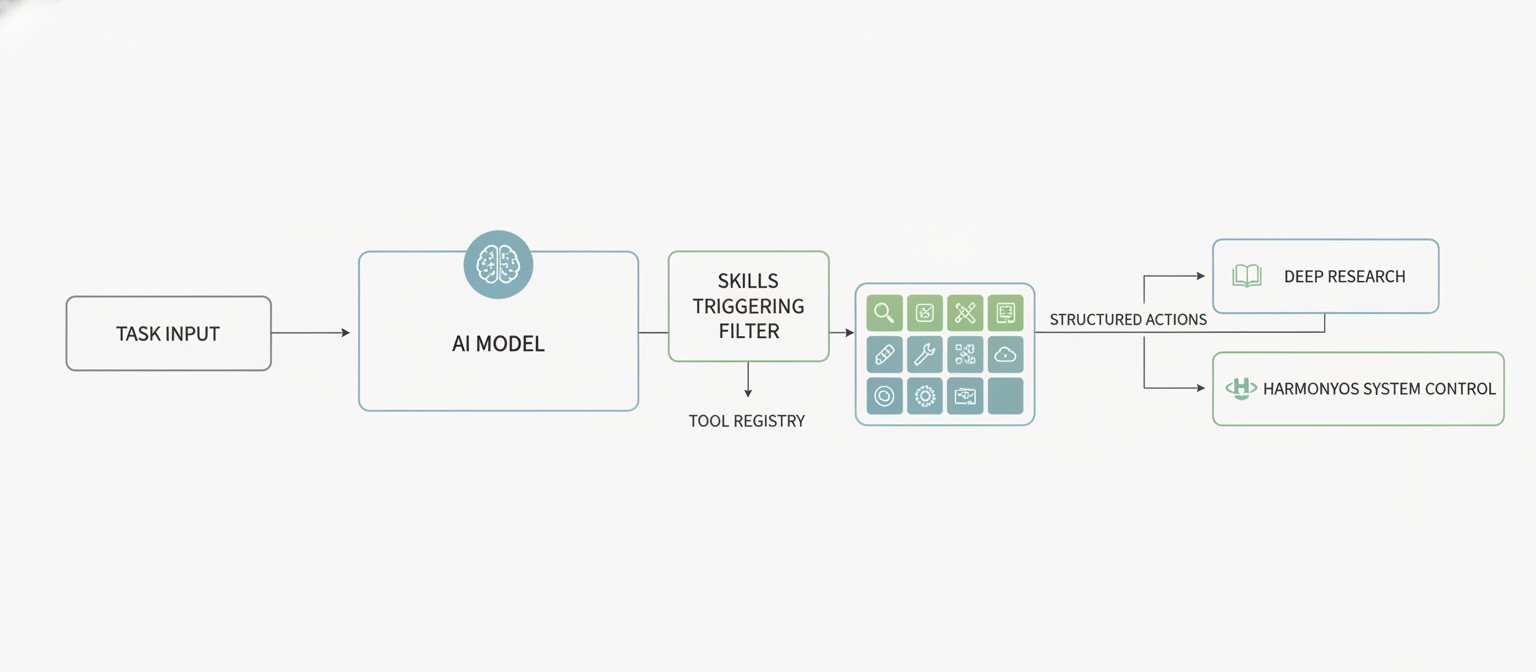
To reduce these failure rates, Huawei trained openPangu-2.1-Pro on more than 100,000 specialized domain data samples tailored for agent orchestration. This fine-tuning dataset specifically optimizes two core mechanisms:
- Skills Triggering: Identifying the exact threshold during a conversation or task loop when the model must stop generating plain text and invoke an external capability.
- Tool Selection and Invocation: Picking the right tool from a crowded registry and emitting valid, schema-compliant calls without hallucinating arguments.
In practical deployments, these updates target two primary workloads: deep research and HarmonyOS system control. Deep research requires an agent to decompose a broad prompt into iterative search queries, cross-reference retrieved documents, and synthesize long-form outputs. HarmonyOS system control places the model directly in charge of operating system settings, inter-application routing, and device-level execution across Huawei’s native environment.
Coding Upgrades for ArkTS and Ascend Operators
General coding assistants perform well on widely indexed languages like Python, JavaScript, and C+, where public repositories offer billions of lines of training examples. Performance drops sharply when developers target newer or hardware-coupled ecosystems where public training corpora remain sparse. Teams exploring how an AI coding agent operates inside proprietary stacks often hit this data wall first.
Huawei OpenPangu 2.1-Pro addresses this constraint by specializing in two high-priority territories inside its native software stack:
- HarmonyOS ArkTS Application Development: ArkTS is the TypeScript-based primary application programming language for HarmonyOS. Because it relies on specific declarative UI paradigms and state management rules, generic models frequently output deprecated syntax. The 2.1-Pro update tunes its code generation directly to ArkTS frameworks and native application lifecycles.
- Ascend Operator Generation Workflow: Running neural networks efficiently on custom silicon requires low-level compute kernels, known as operators, that map mathematical matrix operations directly to hardware execution units. Writing and debugging Ascend operators manually demands specialized hardware knowledge. The 2.1-Pro coding pipeline assists engineers in generating and optimizing these operator workflows.
Focusing on ArkTS and Ascend operators turns the model into an internal multiplier for developers migrating applications to HarmonyOS or tuning workloads for Huawei’s neural processing architecture.
Inference Optimization and Cloud MaaS Pricing
Deploying large models for interactive coding and multi-turn agent loops introduces severe latency and cost pressures. An agent executing ten sequential tool calls re-processes its growing conversation history on every step, causing compute bills and response times to climb rapidly. One secondary report on the MaaS release notes cites a 512K-token context window with function calling, prefix caching, and OpenAI- and Anthropic-compatible endpoints; treat that as unverified until Huawei’s own release notes are readable, since the primary launch report does not confirm it.
On the engineering side, openPangu-2.1-Pro incorporates key-operator optimization and full inference-chain tuning. Streamlining the most compute-heavy mathematical kernels alongside the memory transfers between pipeline stages yields higher token throughput across typical enterprise deployments.
This throughput optimization pairs with aggressive Huawei Cloud MaaS open source model pricing, particularly for workloads that reuse context through prompt caching:
- Standard Input Tokens: 0.8 yuan per million tokens.
- Standard Output Tokens: 3.2 yuan per million tokens.
- Cache-Hit Input Tokens: 0.016 yuan per million tokens.
The 0.016 yuan cache-hit tier represents a 50-fold cost reduction compared to standard uncached input tokens. Because coding assistants repeatedly send the same codebase context and autonomous agents repeatedly pass identical system instructions and tool definitions, aggressive context caching directly offsets the steepest cost bottleneck in agentic engineering.
Open Weights Status: Verified Facts vs. Unverified Details
While the “openPangu” branding designates Huawei’s open-weight model family, engineering teams must distinguish between commercial cloud API readiness and local self-hosted availability. Understanding the new bottleneck in running open weights requires clear visibility into model weights, architecture specs, and hardware compatibility before committing infrastructure budgets.
At launch, external AI model release trackers confirm that the downloadable weights for openPangu-2.1-Pro have not yet been uploaded to the official openPangu Hugging Face repository. Furthermore, Huawei did not release a technical report or standardized academic benchmark evaluations alongside the November 15 MaaS listing.
As a result, several foundational specifications remain unverified for the 2.1-Pro iteration:

- Parameter Count and Architecture: Total and active parameter counts for 2.1-Pro have not been disclosed.
- Context Window Length: The maximum token context supported by the 2.1-Pro checkpoint remains unconfirmed.
- Benchmark Scores: No third-party or vendor evaluation metrics on standard coding or agentic leaderboards were published with the launch.
- Hardware Compatibility and Licensing: The specific license text for 2.1-Pro and whether the weights can be compiled to run on third-party accelerators, such as Nvidia GPUs, remain unverified until the repository goes live.
How 2.1-Pro Fits Alongside OpenPangu 2.0-Pro
To understand the trajectory of the openPangu line, engineers can examine its immediate predecessor, openPangu-2.0-Pro, which shipped with full weights, inference code, and a technical report on July 31, 2026. According to a technical breakdown of the 2.0-Pro release, that foundational model established a massive Mixture-of-Experts (MoE) baseline trained entirely on Huawei Ascend 910B processors.
In an MoE design, the network divides its weights into specialized sub-networks and routes each incoming token to only a small fraction of those experts. This allows the model to retain the broad knowledge base of a massive network while keeping the per-token compute cost equivalent to a much smaller model. For 2.0-Pro, Huawei paired roughly 505 billion total parameters with just 18 billion active parameters per token across a 512K context window, trained on approximately 34 trillion tokens.
The earlier 2.0-Pro release also established Huawei’s licensing precedent under the OPENPANGU MODEL LICENSE v1.0, which requires attribution and explicitly bars usage within the European Union. Whether 2.1-Pro inherits the exact 505B MoE architecture and geographic licensing restrictions of 2.0-Pro or introduces a resized architecture for faster agent inference will only become clear once the public repository updates.
| Specification / Feature | openPangu-2.0-Pro (Verified) | openPangu-2.1-Pro (Verified Status) |
|---|---|---|
| Release / Listing Date | July 31, 2026 (Weights and Technical Report) | November 15, 2026 (Huawei Cloud MaaS Listing) |
| Architecture and Total Parameters | Mixture-of-Experts (MoE), about 505B total | Not yet disclosed |
| Active Parameters per Token | About 18B active | Not yet disclosed |
| Context Window | 512K tokens | Not yet disclosed |
| Training Dataset and Hardware | About 34T tokens on Huawei Ascend 910B | 100,000+ specialized agent data samples; hardware undisclosed |
| Core Functional Focus | General enterprise foundation model | Agent skills/tool invocation, ArkTS and Ascend operator coding, inference throughput |
| Cloud MaaS Pricing (per 1M tokens) | Not specified in 2.1-Pro launch documentation | 0.8 yuan input / 3.2 yuan output / 0.016 yuan cache-hit input |
| Public Weights and License | Released under OPENPANGU MODEL LICENSE v1.0 (EU use barred, attribution required) | Not yet uploaded to Hugging Face; license text pending |
Frequently Asked Questions
Is OpenPangu 2.1-Pro really open weights?
It sits in Huawei’s open-weight family, but the 2.1-Pro files were not yet on Hugging Face at launch. Only the MaaS API was verified live.
What agent tasks does it target?
Deep research workflows and HarmonyOS system control, via improved skills triggering plus tool selection and invocation. Planned integration: AgentArts and OfficeAce.
What coding tasks does it support?
HarmonyOS app development in ArkTS and Ascend operator generation workflows, alongside standard workflows in CodeArts.
How much does MaaS inference cost?
See the pricing section above: 0.8 yuan input and 3.2 yuan output per million tokens, with 0.016 yuan cache-hit input. The chart shows the three tiers side by side.
Can it run on Nvidia GPUs?
Compatibility with Nvidia GPUs is currently unverified. Because the model weights, inference scripts, and technical report for 2.1-Pro have not yet been released for local download, Huawei has only verified deployment through its managed Huawei Cloud MaaS API.

