
China’s pattern of releasing downloadable AI model weights has sparked a louder debate than most licensing announcements ever do. Standard protocols for monitoring open-weight model releases treat API-only systems as closed to ensure comparisons stay consistent across labs and years.
Open-weight releases provide functional artifacts for builders to run, fine-tune, and deploy. That deployment generates operational feedback, and the feedback shapes the next iteration. A manufacturing team that measures downtime, a startup that tracks user churn, and a local IT department that watches latency all create signals that benchmark leaderboards cannot fully capture.
Detailed analysis in this article breaks down what “open” actually means in modern AI, why China’s open-weight ecosystem can compound through industrial deployment, and why many U.S. firms still prefer closed, API-only access as a form of protection.

Key Insights: The Global Shift toward Open-Weight AI Models
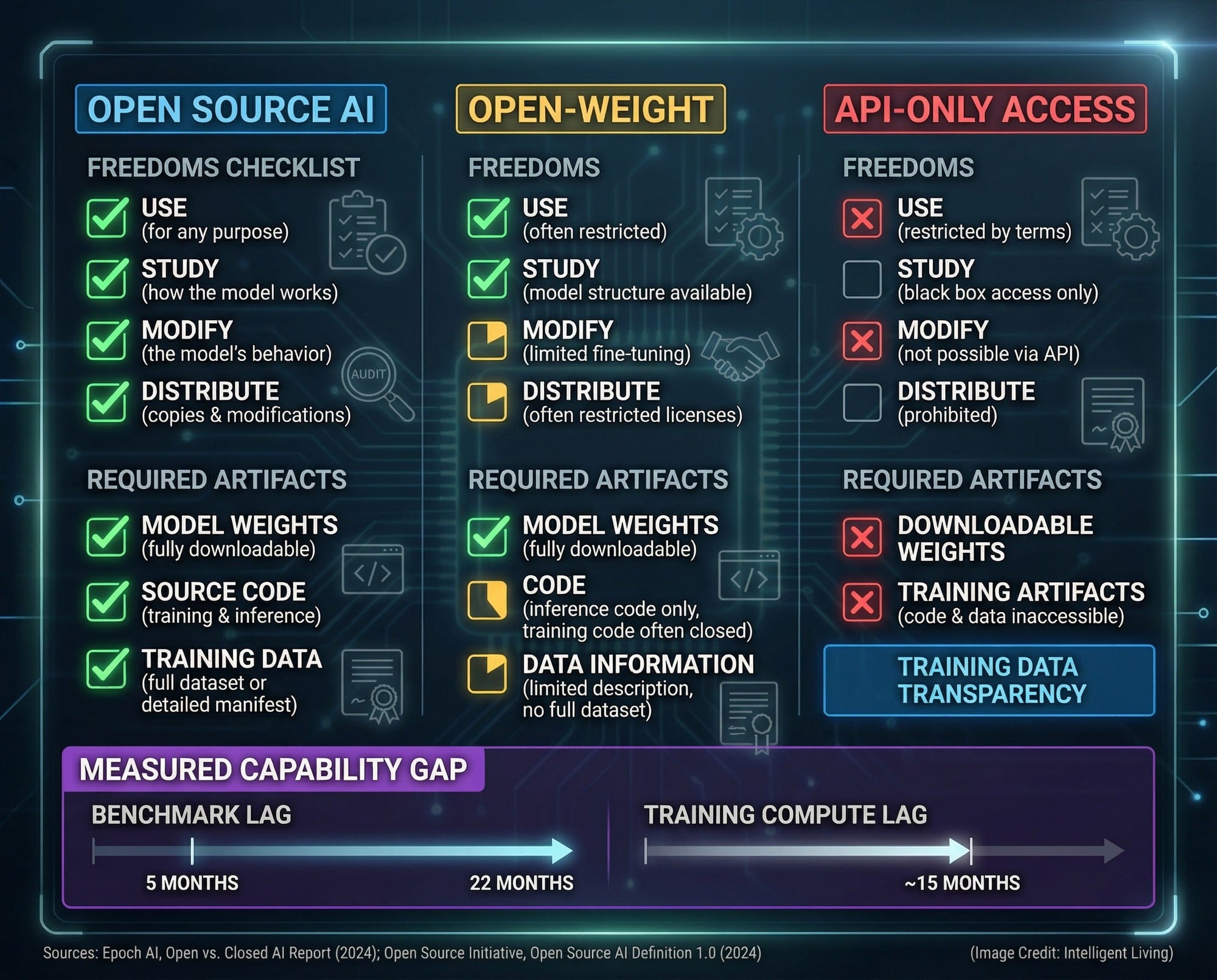
- “Open-weight” usually means model weights are downloadable, while training data and the full training pipeline may remain private, which is why evolving standards for training data transparency remain central to open-source governance.
- The U.S. open-weight policy fact sheet prioritizes risk monitoring over blanket restrictions for widely available weights.
- China’s recent surge features permissive DeepSeek R1 technical documentation detailing how specific artifacts were published under MIT licenses.
- Reuse signals such as fine-tunes, forks, and derivative models show where builders spend time, while public text-generation download metrics reveal which models are currently being adopted at scale.
Analyzing AI Access: Open-Source, Open-Weight, and API-Only Models
The term “open” carries significant ambiguity across the modern AI landscape. In software, open source has a strict meaning tied to rights, transparency, and reuse. In AI, open weight is a common middle category, and API-only access is the controlled-access model most people interact with every day.
Defining the Open-Source AI Baseline for Enterprise Procurement
Procurement teams often rely on these baselines to evaluate long-term viability. Establishing a clear standard ensures that organizations can manage shifting technical and financial requirements effectively, aligning with the core open-source AI criteria that demand more than just a downloadable file.
- Auditability allows for thorough security and compliance reviews.
- Re-hosting capabilities prevent vendor lock-in during budget shifts.
- Maintenance autonomy ensures stability when original vendors pivot.
A stable software supply chain depends on these factors to avoid treating AI as a temporary experiment.
Evaluating Transparency Gaps in Modern Open-Weight AI Releases
Headlines often label models as ‘open’ despite significant operational restrictions. Some releases provide weights but not the training data, evaluation pipeline, or full reproducible recipe. Others ship under licenses that limit who can use the model, where it can be deployed, or what kinds of commercial activity are allowed.
Challenges of AI Model Weights without Full Pipeline Reproducibility
Weight files alone rarely enable independent rebuilds. Validating behavior is possible, yet teams struggle to reproduce results without the original training recipe and dataset lineage. Regulated sectors require deep transparency, providing auditors with verifiable evidence that exceeds basic performance claims.
Impact of Restrictive Licensing on Open-Weight AI Distribution
Licensing can also introduce practical limits. MiniMax’s H3 video model, for instance, ships open weights under a community license that explicitly excludes the US, EU, UK, and South Korea from local deployment. The Open Source Initiative has pointed to multiple examples where broad distribution still fails open criteria, including why the Llama license fails open-source criteria even when weights are easy to obtain. Google’s August 2026 release of TimesFM-3 follows the same pattern: a 330M-parameter time-series foundation model whose inference code ships under Apache 2.0 but whose pretrained weights now carry a non-commercial license, blocking production self-hosting and third-party mirrors. Alibaba’s DAMO RADAR medical imaging model arrived in September 2026 with the same split: Apache 2.0 code alongside non-commercial weights. Alibaba’s image generation team followed days later: Qwen Image 2.1’s research-only license replaced the Apache 2.0 terms of its predecessor, even as its 7B visual generation component posted vendor benchmark scores above Nano Banana 2.0.
Critical Due Diligence Factors for Corporate AI Procurement
Enterprise reviewers often favor Apache 2.0 Qwen weight licensing because these standard software norms are easily recognized. However, due diligence typically extends to deeper operational factors:
- Comprehensive provenance checks for training data.
- Consistent update cadences to ensure security.
- Downstream redistribution rights for enterprise scaling.
Thorough vetting transforms a simple license check into a strategic deployment plan.
API Models and the Control Trade
Operational trade-offs define the buyer’s experience. While API use reduces infrastructure burdens to shorten production time, it also introduces residency constraints and rate limits that require urgent management during scaling.
China’s Two-Loops Flywheel: Accelerating the Industrial AI Ecosystem
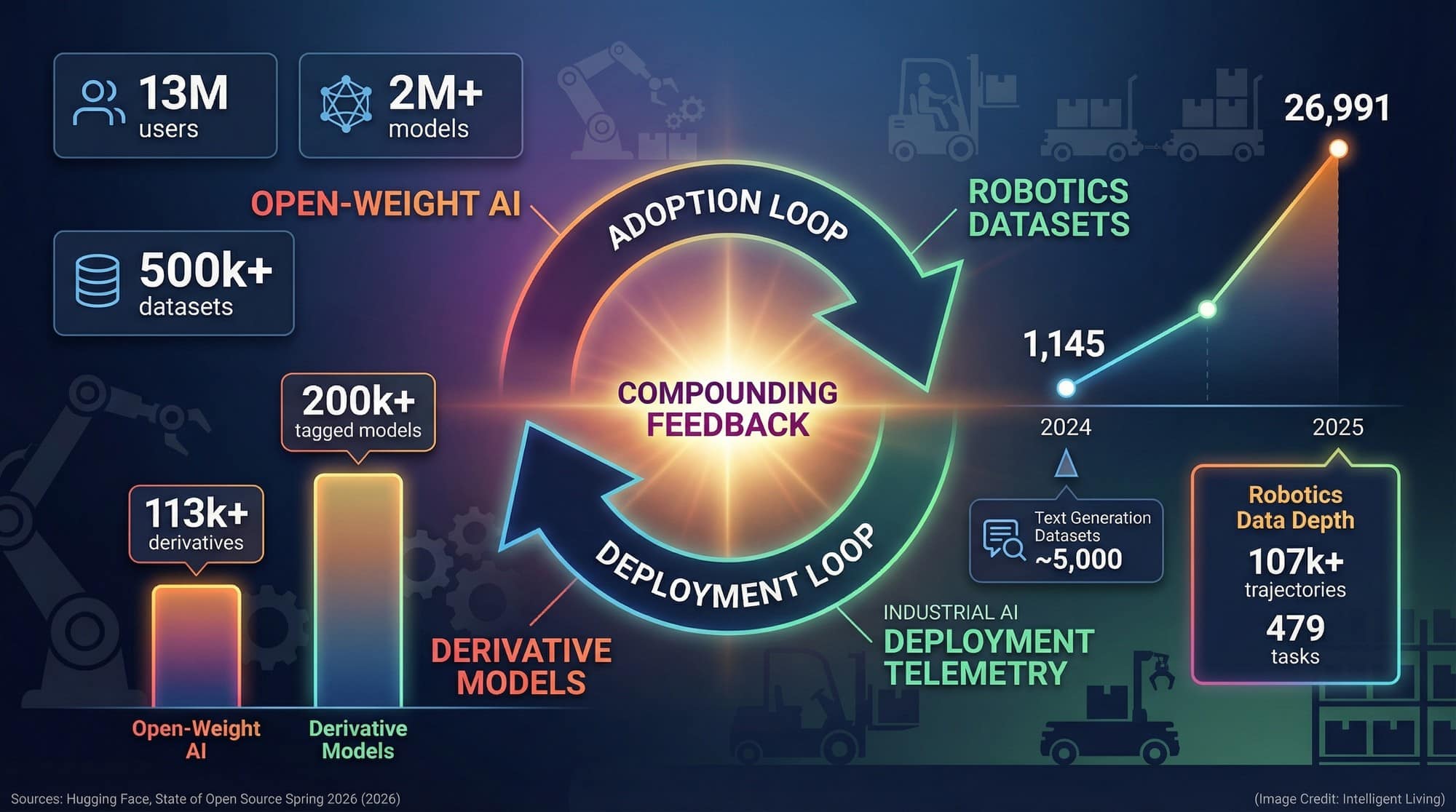
A useful way to understand China’s open-weight push is a “two-loops” framework. The digital loop describes how distribution accelerates adoption and iteration. The physical loop describes how large-scale deployment generates real-world data that improves models and products. Research on the Chinese industrial AI flywheel suggests that adoption and deployment reinforce each other in compounding cycles.
Digital Loop: Distribution, Derivatives, and Developer Momentum
When weights are available, builders can fine-tune for local language, industry vocabulary, compliance constraints, or low-latency inference. Open weight provides a functional framework for these environments, prioritizing industrial utility over theoretical debate.
Fine-Tunes Turn General Models into Product Fit
Fine-tuning adapts general models to specific tasks using minimal compute and localized datasets. This efficiency allows developers to customize behavior without the massive overhead of training from scratch.
A logistics startup, for example, might refine a base model on shipment exceptions. The primary benefit often shifts from improved writing quality to faster triage and reduced internal ticket bouncing.
Small Multimodal Models Multiply Use Cases
Compact multimodal releases also widen adoption because they run on modest hardware and handle mixed inputs like text and images. Developing efficient multimodal vision-language models enables lightweight visual QA and document workflows on modest hardware.
Physical Loop: Deployment, Telemetry, and Product Iteration
Industrial environments generate mundane yet critical signals. Synchronizing workflows with model behavior through error cluster analysis turns static deployment into an adaptive, continuous learning system.
Why the Two Loops Compound
The flywheel effect comes from cycle time. Distribution widens adoption. Adoption creates more training signals, integrations, and deployment lessons. Those lessons feed the next generation of tools.
Permissive local reasoning model distribution accelerates experimentation by defining packaging and constraints in builder-friendly language.
Scaling Open-Weight AI: Navigating Hardware Constraints and Ecosystem Growth
Operational incentives solidify as hardware availability dictates strategic choices. Hardware access shapes what kind of training is repeatable, and ecosystem reuse shapes how quickly models turn into products.
Compute Constraints Change the Strategy Space
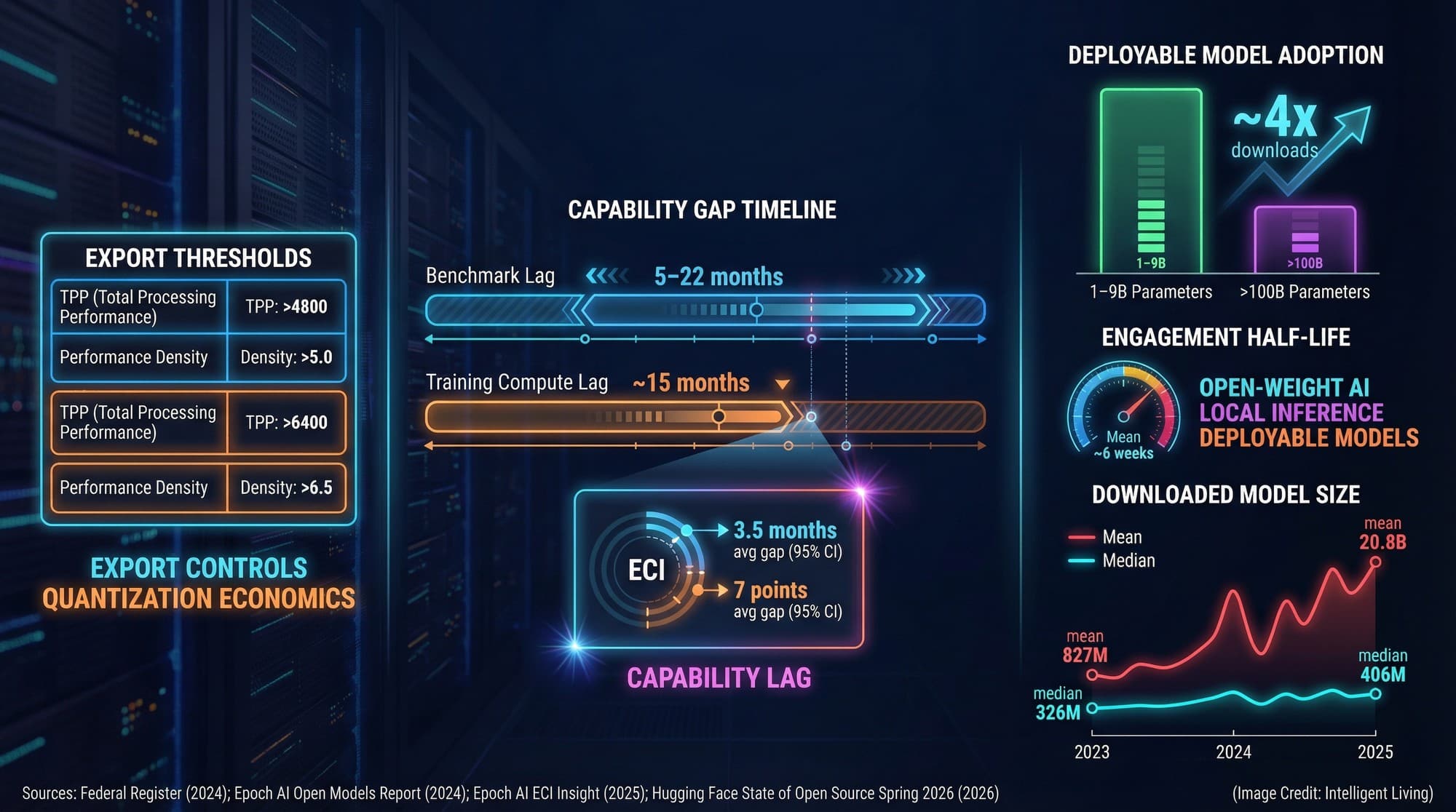
Compute is not just a technical input; it is a strategic constraint. When access to the most advanced accelerators is tightened, the returns to massive centralized training can shift. That pressure makes efficiency, diffusion, and local execution more valuable.
Managing Advanced Computing Export Controls and Semiconductor Limitations
Compliance requirements within U.S. advanced computing export rules dictate which categories of capability face the most operational friction. When a training run is harder to scale or harder to repeat, teams often push more effort into inference efficiency, fine-tuning, and downstream deployment improvements that deliver product value without another frontier-scale retrain.
Utilizing BIS regulatory summaries ensures that technical terminology remains consistent with official oversight updates.
Strategic Advantages of Local Inference Within Compute-Constrained Environments
Strategic oversight of these variables secures operational boundaries and maximizes local hardware performance. Decision-makers often evaluate the following criteria to ensure operational stability:
- Data residency requirements that restrict cloud calls.
- Latency targets that cannot tolerate round trips.
- Workloads where domain fine-tuning matters more than general benchmarks.
Adopting low-precision FP8 scaling shifts the economics of deployment toward cheaper, more sustainable inference.
New portable GPU supercomputing hardware makes local execution plausible for teams previously reliant on cloud infrastructure.
Ecosystem Gravity: Why Derivatives and Tooling Compound Over Time
Raw capability alone does not ensure a base model’s success; victory depends on the speed of ecosystem adoption. Available tooling, templates, and deployment recipes significantly lower the cost for future builders.
What Derivative Counts Actually Measure
Derivative models are adapted versions of a base model, typically created through fine-tuning, quantization, or architecture changes. Monitoring developer ecosystem reuse trends provides a meaningful signal for where builders are investing their time.
A practical advantage shows up in tooling inheritance. A builder who starts from a tested recipe can skip the slowest phase, then spend time on integration, evaluation, and deployment edge cases that actually affect users.
Quantization as a Deployment Lever
Implementing standard low-bit quantization allows modern stacks to unlock larger models on existing hardware while managing throughput. In practice, quantization shifts three levers at once:
- Memory footprint that determines what fits locally
- Inference speed that affects cost and latency
- Accuracy drift that must be measured on the real task
Optimizing for long-context processing on consumer GPUs ensures that small, efficient models remain powerful for day-to-day use. Deploying highly compressed model variants changes the adoption curve by maintaining usable performance for production workloads.
Why Many U.S. Models Stay Closed: Monetization and Risk Control
Release strategy is not only about capability. It is also about pricing power, accountability, and who carries the operational risk.
The Monetization Split: API Rents vs Open Distribution
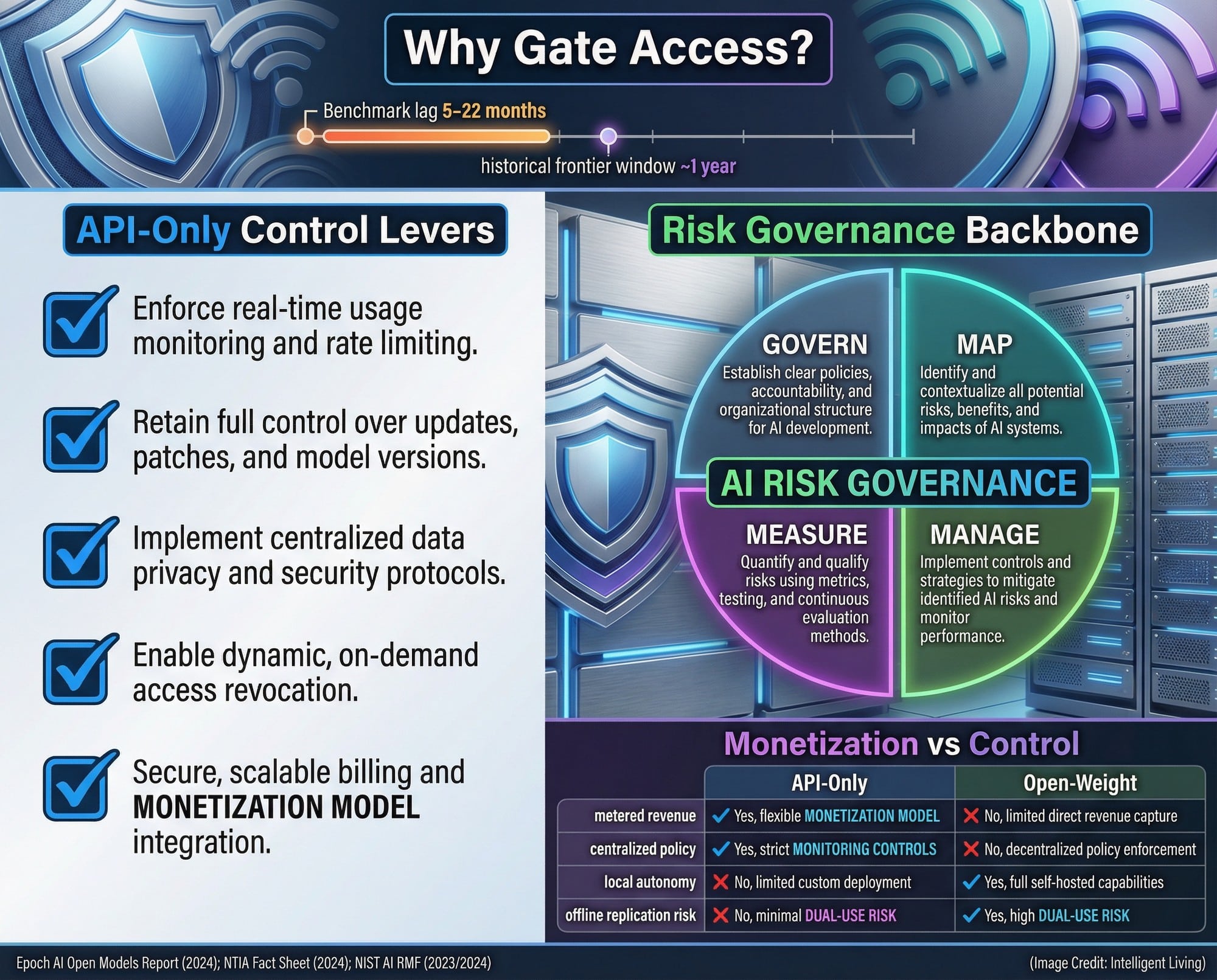
Business model incentives are a large part of why “open” looks different across countries and companies. API firms sell controlled access, which is easier to meter and easier to manage. Open-weight ecosystems often monetize indirectly, through hosting, integration, enterprise support, hardware partnerships, and downstream applications.
Why Some Firms Keep Models Closed
Moats created by closed models offer distinct advantages during procurement. Organizations often choose their path based on competing priorities:
- Managed services provide speed and dedicated support contracts.
- Local weights offer autonomy and predictable infrastructure costs.
Organizational control preferences, rather than ideological conflicts, dictate this strategic divergence.
How Open-Weight Can Monetize Indirectly
Open distribution can still support revenue. Hosting, fine-tuning services, compliance logging, and optimized inference stacks can become the monetization layer, even when base weights are public.
Treating widely available AI weights as innovation drivers allows organizations to manage governance tradeoffs while scaling distribution. Competitive dynamics in the fragmented LLM market suggest that vendor ecosystems now operate through competing modes of integration.
Evaluating Safety Protocols and Liability in Open-Weight AI Systems
Auditable open-weight systems offer customization but remain vulnerable to bad-faith modifications. Practical risk management focuses on the ability to apply safeguards and respond immediately to misuse.
Why Downloadable Weights Expand the Misuse Surface
Maintaining controlled AI model access reduces the risk of downstream actors modifying weights for harmful purposes. Downloadable weights also remove platform guardrails that come with hosted systems. Abuse detection, throttling, and rapid revocation are easier in an API environment.
How Risk Mitigation is Being Formalized
Developing dual-use AI risk mitigations involves threat modeling and red-team testing to ensure robust organizational safety.
Common threats include:
- High-throughput phishing campaigns.
- Scalable financial fraud automation.
- Targeted social engineering at scale.
Using a standardized AI risk framework helps organizations document accountability and establish clear incident response plans.

Practical Implications for Global AI Builders and Enterprise Strategy
The practical question for most organizations is not “open or closed.” It is “what mix is safe, affordable, and strategically sane.” Open-weight models can lower vendor lock-in and unlock customization, but they also move responsibility onto the operator.
What this Means for Real Builders and Businesses
Primary Decision Factors for Local Inference and Hybrid AI Architectures
A practical checklist usually starts with data sensitivity, latency, budget, and compliance requirements. Implementing offline AI educational tools provides a predictable environment for sensitive or connectivity-limited environments.
Procurement and Governance Checklist
Before adopting any model, check licensing terms, provenance clarity, expected update cadence, and what happens if a vendor changes pricing or access. Evaluating optimized 8-bit quantization workflows helps procurement teams connect precision formats to specific cost-per-token requirements.
Advanced agentic coding and tool-use patterns provide a reference point for newer open-weight capabilities in the developer stack. Z.ai’s recent GLM-5.3 release demonstrates this pattern, achieving frontier coding benchmarks through post-training scaling while maintaining an open-weight approach. Tencent’s Hy4 preview follows the same playbook, pairing frontier-adjacent coding scores with a clean Apache 2.0 release, as detailed in our Tencent Hy4 preview benchmarks.
Reality Check: This is Not a Binary China vs. U.S. Story
China’s ecosystem represents a complex reality rather than a binary rivalry. Official messaging emphasizes collaboration and removing international AI technology barriers as a primary strategic priority.
Recent research on Chinese AI policy suggests that the ecosystem is highly diverse and cannot be reduced to a single model family.
Where the Strategies Overlap
U.S. companies can release open-weight models while keeping frontier systems behind APIs. Chinese companies can publish weights while holding back certain data, tooling, or deployment pipelines. Both ecosystems contain mixtures of openness and control because different layers of the stack carry different risks.
What Convergence Looks Like
As more organizations demand autonomy, local inference, and predictable cost, open-weight models become more attractive. As more institutions demand safety controls, audit trails, and accountable operation, controlled access remains compelling. Over time, more teams may treat “hybrid by default” as a normal architecture rather than an exception.

Conclusion: The Next Competitive Battleground is Not Just Benchmarks
Establishing consistent AI openness definitions helps separate legacy software assumptions from modern hardware-specific realities. Benchmarks still matter, but they do not capture the full contest. The deeper competition is about who can deploy models widely, collect meaningful operational signals, and iterate products inside real constraints.
Long-term success depends on maintaining a functional open-weight AI adoption flywheel across real-world industrial deployments. Future leadership depends on more than just model parameters; it requires the infrastructure and incentives necessary for continuous improvement within real-world environments.
Strategizing Open-Weight AI: Common Industry Questions
1. Is open-weight the same as open source?
No. Open-weight grants access to model weights for local execution but often keeps training data and full reproducible pipelines private.
2. Why does China prioritize open-weight distribution?
Distributing weights lowers adoption friction, encourages downstream experimentation, and generates vast deployment data for faster iteration.
3. Why do U.S. firms prefer API-only models?
API access centralizes control over safety monitoring, protects intellectual property, and maintains a direct monetization channel.
4. How do export controls impact AI training?
Restrictions on high-end compute shift the focus toward inference efficiency, quantization, and local optimization on consumer-grade hardware.
5. When is local inference the better choice?
Local deployment is ideal when data residency, low latency, or predictable infrastructure costs are prioritized over general cloud access.


