
Only a year ago, the phrase ‘small language model’ often implied a compromise—a trade-off between hardware accessibility and actual reasoning depth. In 2026, that boundary has collapsed. Chinese AI research teams are now shipping compact architectures that don’t just mimic their larger counterparts; these architectures outpace larger counterparts in deployment flexibility and context retention. Such evolution suggests that the future of intelligence depends less on sheer size and more on intimate, hyper-efficient performance.
Consider how a startup now runs exhaustive document audits on a single office workstation, effectively bypassing massive cloud fees. The same dynamic is now reaching research labs, with HP pre-installing an offline AI model for scientific research from a Peking University spin-off.
Current developments represent a live shift toward utilizing MIT-licensed local reasoning models for private, long-context workflows, ensuring that sensitive data remains exactly where it belongs: on your device.
The current momentum isn’t about a single breakthrough but a structural alignment across the industry. As efficiency becomes the primary competitive axis, the focus is moving toward how these systems are being right-sized for the real world. Instead of chasing upward scale, researchers now prioritize engineering models that scale downward without sacrificing essential strength.

China’s 2026 Momentum in High-Context Small Language Models
Key Technical Facts About Chinese Small LLMs in 2026
- Next-generation sub-billion-parameter models now ship with ultra-long context windows. These long-context LLMs are engineered specifically for full reports, massive codebases, and complex multi-document analysis.
- Mixture-of-Experts (MoE) designs maintain high total capacity by activating only a fraction of parameters per token. This sparse activation pathway significantly reduces compute load without compromising the model’s reasoning depth.
- Quantization is moving beyond “good enough” compression toward calibration-free methods that better preserve accuracy at low bit widths.
- Operating overhead continues to drop as smaller models and intelligent scheduling maximize every expensive GPU cycle to drive down costs.
- Open infrastructure accelerates iteration, even as data provenance and model-governance questions become harder to ignore.
How Common Is This in 2026?
Release Cadence Signals a Structural Shift
The rapid release cadence across Chinese AI research teams suggests this evolution is a structural shift rather than a niche optimization trend.
During the 2026 Lunar New Year period, Reuters described a Spring Festival model-release wave where multiple Chinese teams competed on context length, inference cost, and practical deployment constraints. When multiple firms align on identical engineering priorities within weeks, it signals a profound structural transformation rather than a series of isolated experiments.
Why Efficiency Became the Default Strategy
Efficiency defines modern model development. Rather than chasing trillion-parameter scales, teams prioritize refining architectures that maximize performance per watt.
Refining architectures directly triggers substantial inference cost reduction, a topic explored in depth in our analysis of why Chinese AI models are so much cheaper than their Western counterparts, reflecting how LLM market share is fundamentally shaped by infrastructure and power constraints.
The Practical Trigger: Private Summaries at Scale
Consider how a product manager now evaluates if local AI assistants can summarize thousands of pages of regulatory documents without sending sensitive files to external servers.
When a smaller model maintains a vast working memory, the privacy and cost calculations shift simultaneously. Localized processing allows organizations to maintain strict data sovereignty while leveraging advanced intelligence.
The New Baseline: Small Models with Huge Context
A Sub-Billion Model with a Near-Million-Token Memory
The Qwen3.5-0.8B specifications on the official Hugging Face model page reveal a native 262,144 token context window. Impressively, this architecture supports an extensible ceiling approaching one million tokens.
Such massive context distinguishes a model that merely skims pages from one that retains an entire policy manual or technical archive during complex analysis.
Why Right-Sized Models Are Winning Workflows
The same idea shows up in compact multimodal releases where “bigger is better” stops being the default assumption. For example, vision-language models in the 4B to 8B range are being positioned around usable throughput, stable latency, and predictable cost rather than raw scale.
What Long Context Changes for Everyday Work
Graduate students scanning a year’s worth of research and compliance officers auditing contracts now prioritize context capacity and memory efficiency over raw parameter counts.

The Efficiency Stack: Architecture, Quantization, and Inference Cost Reduction
Layer 1 of the Efficiency Stack: Architecture that “Shrinks” Compute
Sparse Activation Keeps Capacity High
At the architectural level, Mixture-of-Experts (MoE) routing has revolutionized the architectural landscape. Alibaba Cloud’s Qwen3.5 technical overview details a flagship configuration containing 397 billion total parameters, with only 17 billion activated during a single forward pass. Instead of lighting up the entire network for every token, the system routes each input through specialized expert modules.
To understand deployment reality, focus on active parameters rather than total parameters. Active parameters are the part of the model that actually consumes compute and moves data through memory for a given token. When only a small slice is active, you shrink the per-token cost without shrinking overall model capacity.
MoE Became a Blueprint, Not a Curiosity
Selective activation slashes compute load—yet it preserves every ounce of representational capacity.
Large-scale expert routing gained widespread attention after architectures such as the Switch Transformer’s Mixture-of-Experts approach proved how sparse activation scales effectively.
In practice, MoE is also a coordination problem. A router has to pick which experts fire, and the system has to keep those experts balanced so one GPU does not become a hotspot while others sit idle.
That load-balancing challenge is part of why early work like the sparsely gated Mixture-of-Experts layer emphasized both routing and operational constraints.
Routing Adds Overhead that Engineering Has to Tame
Instead of eliminating bottlenecks, sparse activation merely shifts them. Because experts often reside on different devices, routing introduces additional communication and memory movement overhead.
The “shrinking” effect stays real, but it depends on engineering details like expert parallelism, router stability, and avoiding pathological routing patterns.
A relatable scene shows up inside many AI teams: an engineer watches a utilization dashboard where one accelerator is pegged, others are half idle, and the fix is not “buy more GPUs” but “route smarter and balance better.” That is where architecture becomes deployment.
When the Unit of Competition Becomes the Rack
The broader deployment environment matters too. When hardware access is constrained, scale shifts from per-chip superiority to system engineering. One visible signal is the focus on 800VDC rack power designs using GaN components, where the unit of competition moves from a single GPU to an entire rack.
The same rack-level thinking shows up in how domestic stacks are packaged and cooled. When systems are built as integrated pods, the performance story becomes a blend of routing, networking, and thermal design, which becomes clearer when observing liquid-cooled supernodes that scale from hundreds to thousands of accelerators.
Layer 2: Quantization as the New Deployment Superpower
Quantization Turns Memory Into a Deployment Lever
Quantization solves memory limitations by encoding weights in fewer bits, effectively squeezing high-capacity models into standard VRAM. Weight encoding ensures larger architectures fit into existing RAM budgets without sacrificing essential parameters.
Bit width serves as a literal deployment lever. Using fewer bits per number reduces the bytes stored and moved, translating into lower latency and power consumption when hardware kernels are properly optimized. The extreme end of that spectrum is now shipping, with 1-bit and ternary models squeezing a 27B-class system onto a laptop. A practical way to think about the “shrink” is to track what gets smaller during deployment:
- Weights: the stored parameters that define the model.
- Activations: intermediate values created during inference.
- KV cache: the memory that stores key and value tensors so the model can attend back over previous tokens.
That last point matters because long context can turn the cache into the dominant memory cost. When a model is expected to hold hundreds of thousands of tokens, cache efficiency becomes a core part of the “small model, huge context” story.
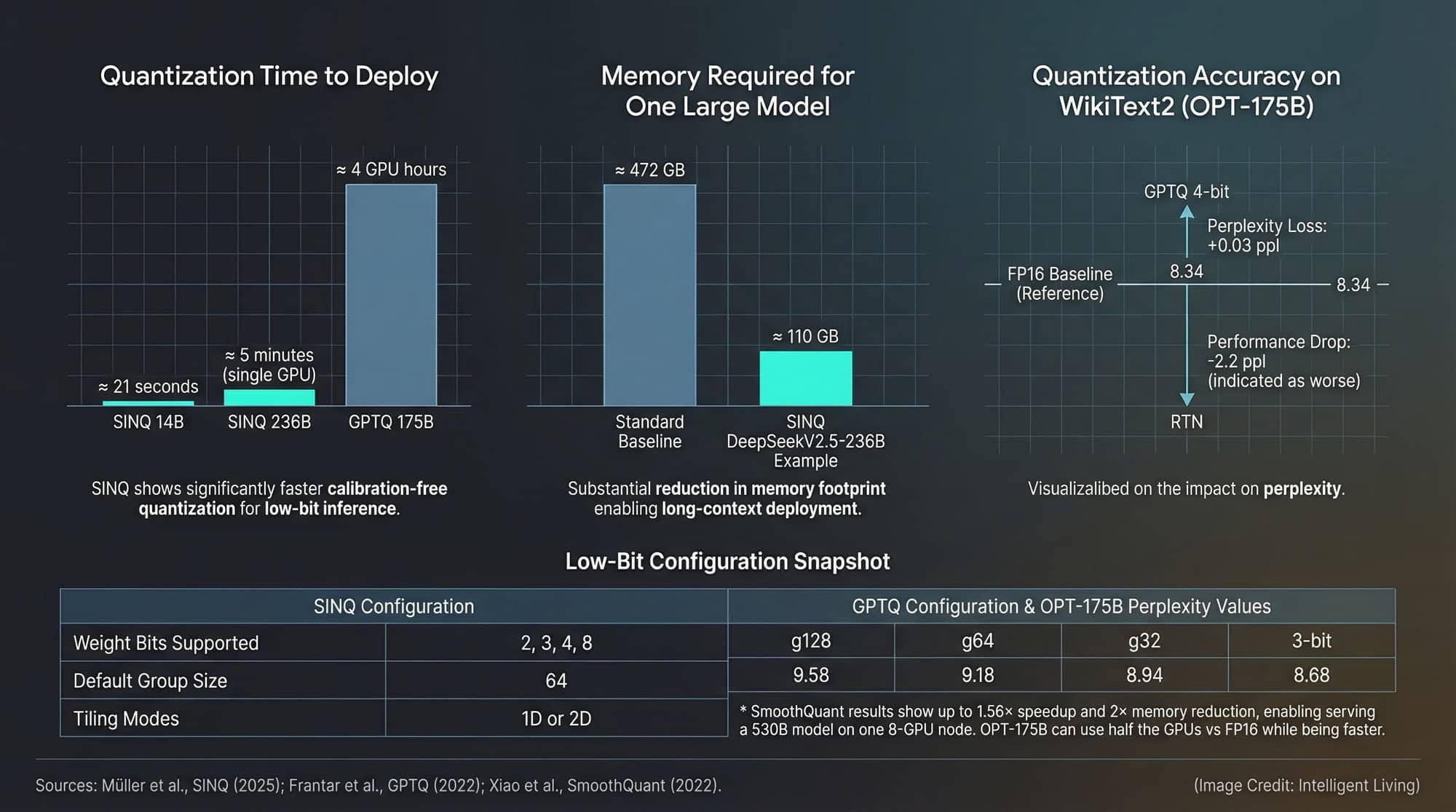
Calibration-Free PTQ and Why SINQ Matters
The SINQ paper on calibration-free post-training quantization introduces dual-axis scaling combined with Sinkhorn-style normalization. This approach effectively reduces quantization error without requiring large calibration datasets.
In simpler terms, it rescales weight matrices in two directions so numerical outliers do not distort the entire low-bit conversion.
For operators, the benefits are immediate: compressed models serve more users per GPU, thrive on cheaper hardware, and maintain stability across long context windows.
The SINQ reference implementation includes workflow notes and example runtimes that treat compression like a repeatable deployment step.
A common builder moment looks like this: an “out of memory” error appears on a workstation during a long document task, the model is quantized, and suddenly the same workflow fits into the hardware budget. In many teams, that single moment is what turns quantization from theory into habit.
Outliers and Why Activation Quantization is Hard
Weights are often easier to compress than activations because activations can contain extreme outliers that break low-bit representations. That is why techniques such as SmoothQuant’s activation-outlier smoothing focus on shifting quantization difficulty away from activations and into weights through a mathematically equivalent transformation.
This is also part of a broader race to make low-bit deployment feel routine, including widely used 4-bit flows such as GPTQ-style post-training quantization that helped normalize “small hardware, big model” expectations.
Low-Bit Toolchains are Becoming Standard
A parallel story is how this shift gets translated for builders who are not living inside papers.
One example is Huawei’s open-source quantization approach, which enables cheaper inference hardware through mathematical normalization and scaling.
Tooling maturity is part of what makes this trend common. Tencent’s AngelSlim compression workflows package multiple quantization strategies into a unified approach, reflecting how fast the ecosystem is normalizing low-precision deployment.
How Far Low-Bit Can Go in Practice
Extreme low-bit deployment is also entering mainstream experimentation. A Tencent Cloud developer note on 2-bit model deployment constraints frames why aggressive quantization can work for certain local workloads while still running into hardware and accuracy tradeoffs.
FP8 as the Bandwidth Middle Ground
A nearby efficiency lever sits between classic quantization and full architecture changes: low-precision floating point. FP8 microscaling reduces bytes moved through memory and fabric, a point illustrated by using FP8 microscaling as a cheaper inference pathway, where the engineering story is fundamentally about bandwidth, not slogans.

Layer 3: Shrinking the Hardware Bill With Token-Level GPU Pooling
Token-Level Scheduling Makes GPUs Behave Like a Shared Utility
Architecture and quantization reduce model-level costs, but serving infrastructure remains critical.
The SOSP ’25 Aegaeon token-level autoscaling paper describes a method for pooling GPU resources.
System algorithms allocate these resources in fine-grained slices during output generation instead of reserving full accelerators per request.
Reported results include a 97 percent reduction in autoscaling overhead and a reduction from 1,192 GPUs to 213 GPUs in a beta deployment.
Most models experience bursty or sporadic demand; dedicating full accelerators to these workloads results in massive idle waste.
Where the Savings Come From
True efficiency doesn’t stem from a single structural tweak. Pooling integrates a comprehensive set of optimizations that collectively transform hardware utilization. These adjustments ensure that even modest hardware can handle demanding long-context workflows:
- Higher Utilization: Minimizing idle GPUs that remain ‘allocated’ but unused.
- Reduced Fragmentation: Allowing mixed workloads to share capacity effectively.
- Rapid Right-Sizing: Enabling models to scale without long provisioning delays.
Why Bursty Demand Punishes Static Allocation
A familiar workplace scenario illustrates the inefficiency of static allocation:
- Departmental Assistants: A company might deploy multiple agents used heavily for a week and then barely touched.
- Resource Pinning: Without pooling, each assistant pins hardware regardless of activity.
- Shared Utility: Token-level scheduling ensures the fleet behaves like a shared utility.
Latency and Tail Risk Still Matter
More sharing introduces new engineering tradeoffs. Token-level scheduling has to protect tail latency, avoid thrash when many models spike at once, and prevent “noisy neighbors” from starving smaller workloads.
The paper’s premise is that these tradeoffs can be engineered so utilization gains outweigh overhead, but the core lesson is that cheaper inference comes from system design, not just smaller weights.
Packaging and Memory Supply Chains Reward Efficiency
This is also where supply chain constraints quietly shape the software stack. When advanced chip packaging bottlenecks like CoWoS limits how many high-end accelerators can be assembled and shipped, efficiency improvements translate into real availability.
Memory pressure compounds the same problem, especially as HBM and DDR5 supply chain constraints raise the value of any technique that reduces bandwidth and cache footprint.
What 82 Percent Savings Really Means
A simple way to see why this matters is to imagine a mid-size platform with ten separate assistants, each peaking at a different hour. In that world, a headline-grabbing 82 percent GPU reduction claim around pooled serving is not just a number; it is the difference between scaling a feature and shelving it.
Open Infrastructure, Distillation Frictions, and Deployment Flexibility
The Open Flywheel… and the Shadow-Copy Problem
Storage as a Hidden Ceiling
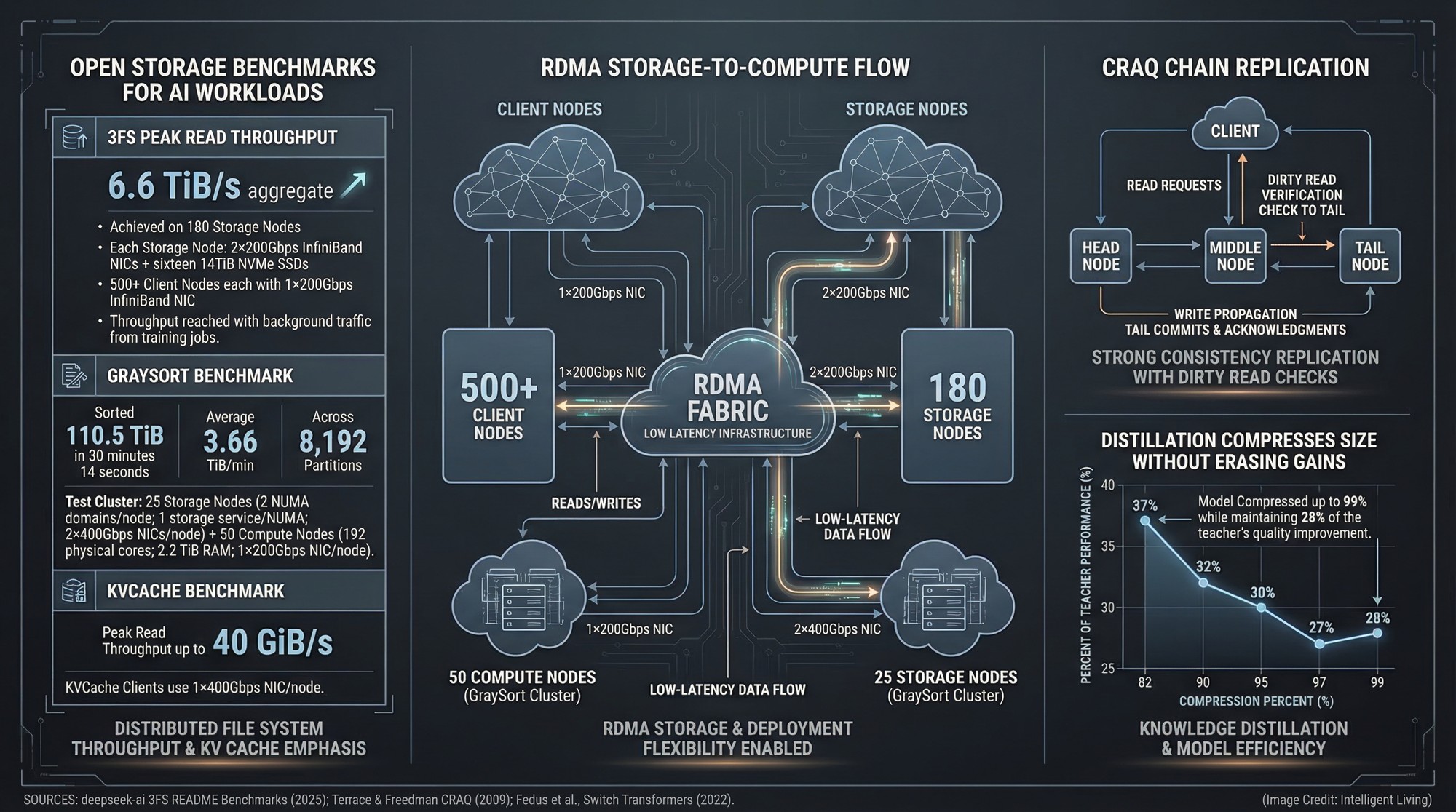
Efficiency gains extend beyond model architecture into storage infrastructure. DeepSeek’s public 3FS codebase implements the Fire-Flyer File System, which is optimized to sustain large AI workloads across modern SSDs and RDMA networks.
RDMA moves data with minimal CPU overhead, ensuring the cluster operates as a unified accelerator rather than a series of servers waiting on storage. When context windows grow and training sets get larger, the storage path becomes a first-order limit.
Keeping Expensive Compute Fed
Design choices like disaggregated storage tighten that pipeline, as seen in the Fire-Flyer 3FS architecture, which translates these choices into real-world performance gains.
To make replication scale without turning one node into a read bottleneck, 3FS references ideas rooted in CRAQ chain replication with apportioned queries, which spreads reads across the chain while preserving strong consistency.
A Relatable Failure Mode
A relatable failure mode happens in real training runs: loss curves look fine, GPU utilization looks fine, and then the entire job slows because storage is saturated or metadata becomes hot. In that moment, “file system design” stops sounding abstract.
Distillation as a Technique, and as a Dispute
Distillation stands as a legitimate machine learning technique where smaller models learn to mimic the behavior of larger counterparts. This process, rooted in knowledge distillation principles, drastically accelerates small-model capability and reasoning depth.
Distillation pairs perfectly with long-context deployment; smaller, distilled models are inherently easier to secure in private environments.
Disputes Emerge
Disputes emerge when teacher outputs are collected in contested ways, and Reuters reported distillation allegations involving DeepSeek as a signal that capability transfer is now also a legal and geopolitical surface.
Why Governance Now Shapes Deployment
Structural friction sits alongside the efficiency stack. Open innovation accelerates capability diffusion, while licensing, data provenance, and safety governance often lag behind.
As small models become easier to run anywhere, these frictions stop being abstract arguments and start influencing what can be deployed in regulated environments.
A Common Organizational Reality
A common organizational reality is that the question becomes, “Can we prove what trained this model and how it was produced?” When the answer is unclear, teams fall back to simpler, slower options even if the technology is available.
What “Local Intelligence Becomes Normal” Changes Next
The Stack That Makes Small Models Feel Big
Developers integrating sparse activation, intelligent quantization, and shared hardware pooling have created a stack that makes small models feel undeniably big.
When small language models handle massive context windows, activate only relevant expert pathways, compress weights into low-precision formats, and share GPU resources dynamically, the cost barrier to AI deployment drops sharply. That is the central shift of 2026.
Local AI Becomes a Default Option
Local intelligence becoming normal implies more than convenience. It can mean tighter data sovereignty, lower latency, and broader experimentation across industries that previously could not justify the infrastructure bill.
It is increasingly shaped by compact mini AI supercomputers designed for desk-side inference and private workflows.
The Next Constraint is Not Only Compute
At the same time, the economics lens is spreading from model design into silicon and systems.
Inference-focused accelerators are being built around tokens-per-watt, a pattern visible in how inference economics are shaped by power, bandwidth, and vertical integration.
The Long-Term Shift
Shrinking LLMs without sacrificing power isn’t a paradox; it’s the result of a coordinated engineering strategy that synchronizes architecture, compression, and scheduling. The models may be smaller. The implications are not.

Frequently Asked Questions About Efficiency and Long-Context LLMs
How can a model under one billion parameters handle over 250,000 tokens?
Innovative hybrid memory mechanisms and optimized KV caches allow these compact models to process massive datasets without traditional RAM bottlenecks.
What role does Mixture-of-Experts play in efficiency?
The architecture routes tokens through specialized sub-modules, activating only 5–10% of total parameters per request to save energy while maintaining reasoning power.
Is quantization safe for high-accuracy technical tasks?
Yes, newer calibration-free strategies like SINQ stabilize low-bit weights, preserving numerical precision even during complex mathematical or coding workflows.
How does token-level GPU pooling lower infrastructure costs?
Sharing GPU slices across multiple requests in real-time eliminates idle waste and can reduce total hardware requirements by up to 82%.
Can these small models run on standard consumer hardware?
Absolutely. Through 4-bit and 2-bit quantization, million-token context models can now fit within the VRAM limits of modern desktop workstations and laptops.


