
In mid-2026, a developer running an AI-powered code review pipeline faces a stark choice. Route 50 million tokens through Anthropic’s Claude Opus 4.8, and the monthly bill lands at roughly $5,000. Route the same workload through DeepSeek V4 Flash, and the cost collapses to about $28. That is not a typo; it is a 178-fold difference, and it explains why an estimated 61% of traffic on OpenRouter, the largest independent model router, now flows to Chinese-built models despite 47% of users being American.
The price gap between Chinese and Western AI models has become the defining economic story of artificial intelligence in 2026. DeepSeek, MiniMax, Kimi (Moonshot AI), Qwen (Alibaba), and MiMo (Xiaomi) consistently price their frontier-grade models at 10 to 60 times less than equivalent offerings from OpenAI and Anthropic, and in some tiers, the gap exceeds 200 times. That rule now has a notable exception, though: Alibaba’s updated Qwen3.8 Max flagship now costs more per task than several American models it trails, a first for a Chinese frontier model. For the most part, however, this is not a temporary promotion or a loss-leader strategy. It reflects structural cost advantages built into every layer of the Chinese AI stack, from silicon to software to state policy. That same price pressure is now arriving from outside China, with Singapore-based Agnes AI releasing Agnes 2.5 Pro Beta in August 2026 at $0.10 per million input tokens and $0.30 per million output tokens, undercutting even the cheapest entries in the table above.
Understanding why requires looking past the headline price tags and into the engineering, economics, and strategic choices that have reshaped the global AI market in under two years. One emerging factor is China’s domestic chip revolution: startups like DFSX are now fielding AI accelerators built on mature 14nm nodes that bypass expensive advanced lithography and imported HBM, pointing to hardware cost advantages that could widen the price gap further.
The Price Gap: Just How Much Cheaper Are Chinese Models?
To grasp the scale of the divergence, consider the verified list prices for flagship-tier models as of July 2026, compiled from each provider’s official API pricing page. All comparisons are against DeepSeek V4 Flash pricing directly from the DeepSeek platform, not through resellers. For a complete comparison across over 30 models, including Grok, Nemotron, GLM, and Muse, see our full LLM API pricing guide:
| Model | Input (per 1M tokens) | Output (per 1M tokens) | × V4 Flash Input | × V4 Flash Output |
|---|---|---|---|---|
| MiMo V2.5 (Xiaomi) | $0.14 | $0.28 | 1.0× | 1.0× |
| DeepSeek V4 Flash | $0.14 | $0.28 | 1.0× | 1.0× |
| MiMo V2.5 Pro (Xiaomi) | $0.435 | $0.87 | 3.1× | 3.1× |
| DeepSeek V4 Pro | $0.435 | $0.87 | 3.1× | 3.1× |
| MiniMax M3 | $0.30 | $1.20 | 2.1× | 4.3× |
| Qwen 3.7 Plus (Alibaba) | $0.40 | $1.60 | 2.9× | 5.7× |
| Kimi K2.7 Code (Moonshot) | $0.95 | $4.00 | 6.8× | 14.3× |
| GPT-5.6 Luna (OpenAI) | $1.00 | $6.00 | 7.1× | 21.4× |
| Gemini 3.5 Flash (Google) | $1.50 | $9.00 | 10.7× | 32.1× |
| Claude Sonnet 5 (Anthropic)* | $2.00 | $10.00 | 14.3× | 35.7× |
| GPT-5.6 Terra (OpenAI) | $2.50 | $15.00 | 17.9× | 53.6× |
| Claude Opus 4.8 (Anthropic) | $5.00 | $25.00 | 35.7× | 89.3× |
| GPT-5.6 Sol (OpenAI) | $5.00 | $30.00 | 35.7× | 107.1× |
| Claude Fable 5 (Anthropic) | $10.00 | $50.00 | 71.4× | 178.6× |
* Claude Sonnet 5: introductory pricing of $2/$10 through August 31, 2026; standard pricing of $3/$15 from September 1. The MiniMax M3 is shown at the <512K tier. All prices verified in July 2026.

These are not outliers. Chinese models occupy the entire bottom half of the pricing spectrum, and the gap widens at higher capability tiers. When you compare DeepSeek V4 Flash against GPT-5.6 Sol, both positioned as frontier models, the output price differs by a factor of 107. And the gap reaches its extreme at the premium tier: Claude Fable 5 charges $50 per million output tokens, nearly 180 times DeepSeek V4 Flash. Even comparing peer models on similar coding benchmarks, the gap remains 3 to 10 times.
But the headline prices understate the real-world savings. Chinese providers offer aggressive prompt caching discounts: DeepSeek bills cache-hit input tokens at just $0.0028 per million, a 50-fold reduction from the already-low cache-miss price. Western providers offer caching too, but at much shallower discounts. Anthropic’s Claude Opus 4.8 cache reads cost $0.50 per million, 178 times more than DeepSeek’s equivalent. For a full breakdown of how caching works across every provider, see our LLM API pricing comparison.
So what makes these prices structurally possible? The answer spans six interconnected layers.
Mixture-of-Experts: The Architecture Behind the Savings
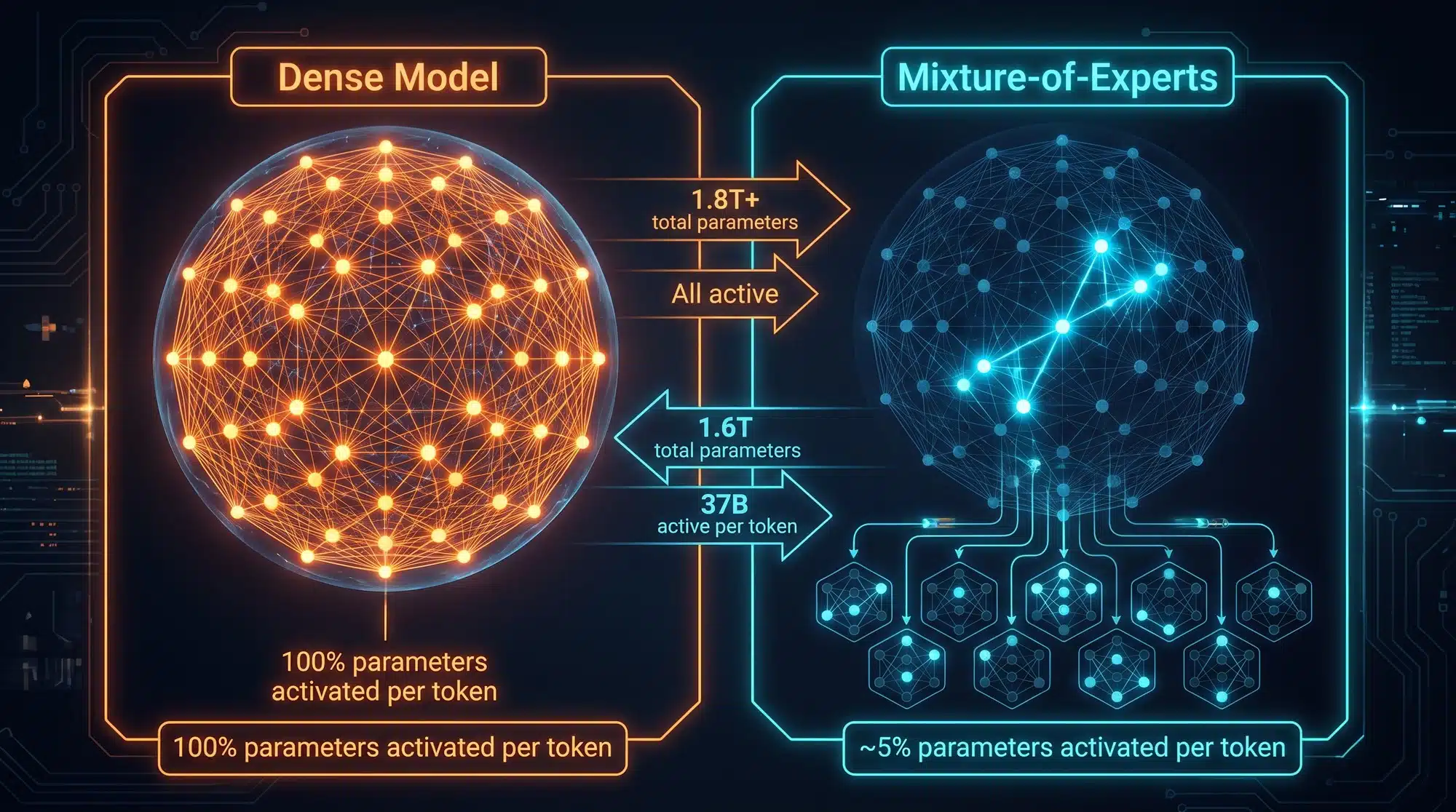
The single largest contributor to the price gap, arguably accounting for roughly 60% of it, is a design choice called Mixture-of-Experts (MoE). In a traditional dense transformer model, every single parameter in the network participates in generating every single token. A dense model matching the capability of today’s frontier systems would need to activate well over a trillion parameters for each word it produces. The compute cost scales with total model size.
MoE breaks this relationship. Instead of one monolithic neural network, an MoE model contains dozens or hundreds of specialized “expert” sub-networks. For any given token, a routing mechanism selects only a small subset of experts to activate, typically 5 to 8 out of potentially hundreds. DeepSeek V4, with an estimated 1.6 trillion total parameters, activates only around 37 billion per token. That means roughly 97.7% of the model sits idle for any single token it generates.
The result is a model with the knowledge capacity of a giant neural network but the inference cost of a much smaller one. DeepSeek’s MoE models achieve benchmark scores within single-digit percentages of GPT-5.6 Sol on evaluations like MMLU-Pro while consuming approximately 2.2% of the floating-point operations per token that a comparable dense model would require.
Importantly, MoE is not exclusive to Chinese labs. OpenAI and Google both use MoE architectures in their frontier models. But Chinese teams, particularly DeepSeek, have pushed the efficiency frontier further with innovations in how those experts are selected and balanced. Their auxiliary-loss-free load balancing mechanism uses learned bias terms rather than penalty functions to route tokens evenly across experts, preserving model quality while reducing wasted computation.
Multi-Head Latent Attention and KV Cache Compression
MoE explains why Chinese models use fewer FLOPs per token. Multi-Head Latent Attention (MLA), and the hybrid compressed attention that evolved from it, explains why they need dramatically less memory to serve each request.
In a standard transformer, every token the model generates must attend to every previous token in the conversation. To avoid recomputing everything from scratch, the model stores “Key” and “Value” vectors, mathematical representations of past tokens, in a structure called the KV cache. This cache grows linearly with both the number of tokens and the number of attention heads, and at DeepSeek V4’s native 1-million-token context window, it becomes the single biggest bottleneck in inference hardware.
Earlier DeepSeek models (V2 and V3) addressed this with MLA, which compresses the KV cache across the attention-head dimension, storing a compact latent representation instead of full-sized vectors for each head. V4 takes a fundamentally different approach, compressing along the sequence-length dimension, where the real growth happens.
The architecture, detailed in DeepSeek’s technical blog, uses three complementary attention mechanisms layered throughout the network:
- Compressed Sparse Attention (CSA): Groups roughly four consecutive tokens into a single compressed KV entry using softmax-gated pooling with a learned positional bias. A lightweight indexer then selects the most relevant compressed blocks for each query. This reduces the number of KV entries the model must search through by 75%.
- Heavily Compressed Attention (HCA): Aggressively compresses up to 128 tokens into a single entry, creating a cheap global summary that every query can attend to densely. Because the compressed sequence is so short, dense attention becomes computationally negligible.
- Sliding Window Attention (SWA): Maintains uncompressed, razor-sharp attention over the most recent 128 tokens, ensuring the model never loses precision on immediate context.
The combined effect is dramatic. In a 1-million-token scenario, DeepSeek V4 Pro requires only 27% of the inference FLOPs and 10% of the KV cache memory compared to its V3.2 predecessor. V4 Flash drops these numbers to 10% and 7% respectively. Against a standard grouped-query attention architecture of the kind Western labs typically deploy, V4’s KV cache footprint is roughly 2% of the original. This means a server that could handle one concurrent user at 1M tokens with a conventional architecture can handle roughly fifty with DeepSeek V4 Flash, and the cost per user divides accordingly.
Context Caching: The 99% Discount Hiding in Plain Sight
Architectural efficiency explains the base price. But much of the real-world cost advantage comes from something that happens after the first API call: context caching.
In many real-world AI workloads, such as customer support chatbots, code assistants, and document analysis pipelines, a significant portion of the input tokens are identical across requests. A system prompt describing the assistant’s behavior, a large codebase loaded as context, or a set of company policies: these are sent repeatedly, often thousands or millions of times per day.
Prompt caching recognizes this redundancy. When identical prefix tokens are detected across multiple requests, the model reuses the previously computed KV cache entries instead of recomputing them from scratch. The provider only charges for the cache lookup, not the full computation.
All major providers offer caching, but the economics differ massively:
| Model | Cache-Miss Input | Cache-Hit Input | Cache Discount |
|---|---|---|---|
| MiMo V2.5 (Xiaomi) | $0.14/M | $0.0028/M | 98% |
| DeepSeek V4 Flash | $0.14/M | $0.0028/M | 98% |
| MiMo V2.5 Pro (Xiaomi) | $0.435/M | $0.0036/M | 99.2% |
| DeepSeek V4 Pro | $0.435/M | $0.003625/M | 99.2% |
| MiniMax M3 | $0.30/M | $0.06/M | 80% |
| GPT-5.6 Sol (OpenAI) | $5.00/M | $0.50/M | 90% |
| Claude Opus 4.8 (Anthropic) | $5.00/M | $0.50/M | 90% |
A 90% discount sounds generous, and it is, until you compare it to 98% or 99.2%. For a workload with a 90% cache-hit rate processing 100 million input tokens per day, GPT-5.6 Sol costs roughly $95 per day on cached input alone. DeepSeek V4 Flash costs $0.53. That is the difference between $34,675 and $193 per year, for the exact same volume of cache-hit tokens.

DeepSeek’s superior cache economics stem directly from its compressed KV cache architecture. When your KV cache is 2% the size of a conventional implementation, storing and retrieving cached entries costs proportionally less. The architectural efficiency compounds into pricing efficiency. This also explains why DeepSeek’s own API is significantly cheaper than accessing the same model through OpenRouter; resellers add their own infrastructure costs and margin on top of every token, including cache hits, but they cannot replicate the hosting provider’s native cache infrastructure at the same cost.
Training Efficiency: Frontier Models for Millions, Not Billions
The inference cost story starts at training time. A model that costs less to train can be priced closer to its marginal inference cost without needing to recoup billions in research expenditure.
DeepSeek V3’s final training run consumed approximately 2.788 million H800 GPU-hours. At roughly $2 per GPU-hour on the spot market, that works out to about $5.6 million, though DeepSeek itself has suggested the actual cost was lower due to in-house optimizations. For comparison, Anthropic CEO Dario Amodei has stated that training frontier models now costs “on the order of $1 billion,” and OpenAI’s training budgets reportedly run into the hundreds of millions.
Several techniques drive this efficiency:
- FP8 mixed-precision training: DeepSeek was among the first labs to train a frontier-class model end-to-end in 8-bit floating point rather than the industry-standard 16-bit. Using half the numerical precision halves the memory footprint and nearly doubles the computational throughput. Western labs are now adopting FP8, but DeepSeek’s early lead gave them a multi-year efficiency head start.
- Multi-token prediction: Instead of generating only the next token, DeepSeek models produce 2 to 4 tokens simultaneously during training. This forces the model to learn richer representations from each training example, extracting more signal from fewer tokens.
- Aggressive data curation: DeepSeek trained V3 on 14.8 trillion carefully filtered and deduplicated tokens. Meta’s Llama 4, by contrast, consumed over 40 trillion tokens. Better data means fewer training steps, which means fewer GPU-hours. Chinese labs invested heavily in data quality pipelines, filtering, deduplication, and curriculum design, rather than simply scaling raw token counts.

Moonshot AI’s Kimi K2 was reportedly trained for just $4.6 million, a figure that, if verified, represents roughly 0.5% of what a comparable Western frontier training run might cost. Moonshot has since pushed that efficiency playbook into context pricing: its Kimi K2.8 Preview rollout opened a 1M-token context window to every Kimi Code membership tier in September 2026. The open secret is that efficient training architecture is a choice, not a constraint, and Chinese labs made it early.
The Hardware Equation: Sanctions, Domestic Chips, and Cheaper Compute
US export controls were designed to limit China’s access to cutting-edge AI chips. They have had the opposite of their intended effect on inference costs.
Restricted to NVIDIA H800 and H20 chips, deliberately hobbled variants of the H100, Chinese AI labs could not simply throw more compute at the problem. They had to innovate on efficiency. The H20, for example, delivers roughly 80% of the H100’s raw FLOPS but identical memory bandwidth (4 TB/s). For inference, where memory bandwidth, not raw compute, is the binding constraint, the H20 is nearly as capable as the H100. And because these restricted chips are less desirable globally, Chinese cloud providers offer them at $0.80 to $1.20 per GPU-hour, compared to $3 to $5 per GPU-hour for H100 instances on AWS.
Meanwhile, Huawei’s domestically produced Ascend series has matured rapidly. The Ascend 950PR, released in early 2026, competes credibly with the H100 for inference workloads, and DeepSeek has been integrating Ascend hardware into its serving infrastructure. Because these chips are manufactured through China’s domestic semiconductor supply chain, they are not subject to US export pricing dynamics, and the Chinese government negotiates bulk rates for AI infrastructure that Western competitors cannot match.
Under China’s AI infrastructure-sharing policy, companies can receive 20% to 40% permanent discounts on compute used for inference. These are not one-time subsidies but structural price reductions built into long-term contracts with state-backed data centers. Western cloud providers, operating on commercial margins in competitive markets, have no equivalent mechanism.
Cheap Power, State Backing, and Lower Labor Costs
The popular narrative that Chinese AI benefits from universally cheap electricity is partly wrong and partly right; the distinction matters.
China’s average industrial electricity price sits in roughly the same range as the United States. But under its “Eastern Data, Western Computing” policy, AI workloads are deliberately routed to data centers in western provinces, Inner Mongolia, Ningxia, Gansu, Guizhou, where renewable energy is abundant and prices are radically lower. Solar power in these hub zones costs as little as 0.19 yuan per kilowatt-hour (about 2.7 US cents), compared to 0.43 yuan in eastern industrial regions. By concentrating AI inference in the cheapest-energy zones in the world’s largest renewable-energy market, Chinese providers achieve power costs that no Western data center cluster can replicate.

China added 370 GW of solar and 117 GW of wind capacity in 2025 alone, roughly two-thirds of all global renewable additions. The country also controls more than 80% of every stage of solar panel manufacturing, from polysilicon to finished modules. It builds the energy infrastructure for AI inference faster and cheaper than any other nation, and it routes AI workloads directly to the resulting surplus.
Labor costs create an additional, persistent advantage. A senior machine learning scientist in the United States commands $400,000 to $700,000 in total compensation. The equivalent role in China pays $100,000 to $250,000. DeepSeek operates with roughly 150 researchers, less than half the headcount of comparable Western labs, while MiniMax reached a $32 billion market capitalization with just 385 employees, with an average age of 29.
Finally, China’s AI industry operates within a policy environment that treats AI leadership as a national strategic priority. The State Council’s AI Plus initiative targets 70% AI penetration in key economic sectors by 2027 and 90% by 2030. Government procurement preferences, state-backed compute infrastructure, and coordinated industrial policy create demand certainty that lowers the risk of capacity investment, and risk-adjusted cost of capital flows through to lower prices.
Open Weights: Pricing for Adoption, Not Profit Margins
The final piece of the puzzle is strategic, not structural: Chinese AI labs deliberately price at or near marginal cost because they are competing for developer ecosystems, not quarterly earnings.
Open-weight releases, where model parameters are published freely for anyone to download, modify, and deploy, have become the default strategy for Chinese frontier labs. Alibaba’s Qwen models have spawned over 113,000 derivative models on Hugging Face. DeepSeek’s repositories have accumulated more than 85,000 GitHub stars. Chinese models accounted for 41% of all Hugging Face downloads in 2025, the year China passed the United States in monthly downloads on the platform.
This is a strategic choice that only works from behind. A lab defending premium pricing on proprietary models, as OpenAI and Anthropic do, cannot rationally give away its intellectual property. A lab without those margins loses nothing by open-sourcing and gains the world’s developer community as a distribution channel. This is an open-weight ecosystem advantage that proprietary US labs cannot replicate.
The effect is a flywheel: open weights drive adoption, adoption creates tooling and integration ecosystems, ecosystems create switching costs for developers, and those switching costs lock in demand that justifies further infrastructure investment. Each turn of the flywheel makes the next cycle cheaper, faster, and harder for closed-source competitors to disrupt.
This also explains the aggressive, sustained price war within China itself. ByteDance slashed its Doubao model prices by 63% in mid-2025. Alibaba cut Qwen-Long by 97% to 0.0005 yuan per thousand tokens. DeepSeek ran a 75% promotional discount on V4 Pro through May 2026 and then announced a permanent 75% price cut in June. With dozens of domestic competitors vying for market share in the world’s largest AI market, prices have been driven down to levels that make Western pricing look, as one analyst put it, “like legacy enterprise software from the 1990s.”
Why Direct API Access Costs Less Than OpenRouter
A practical question many developers encounter: why does DeepSeek’s own API charge less than accessing DeepSeek models through OpenRouter? The answer illuminates an often-overlooked layer of AI economics.
OpenRouter functions as a model router and reseller; it aggregates dozens of independent providers behind a single API endpoint. Importantly, it does not simply proxy requests to DeepSeek’s official servers. Instead, it routes to whichever provider is hosting the model at the best combination of price, speed, and availability. Many of these providers run the open-weight DeepSeek models on their own infrastructure, often in the United States or Europe, which is precisely why some developers use OpenRouter in the first place: they get access to Chinese-built models without sending data to China.
This rerouting has pricing implications. Each third-party provider incurs its own GPU hosting costs and adds its own margin, and OpenRouter layers its own markup on top. The result is that DeepSeek V4 Flash through OpenRouter typically costs more than going directly to DeepSeek’s official API, even when the headline per-token rates look similar. The gap widens dramatically with prompt caching. DeepSeek’s native API bills cache-hit input at $0.0028 per million tokens, a 98% discount enabled by its custom ShadowRadix prefix caching system. Third-party providers cannot replicate this caching pipeline; it is tightly integrated with DeepSeek’s own serving infrastructure, including hardware-specific optimizations for Huawei Ascend and NVIDIA H800 clusters. Every layer of abstraction between you and the original model adds latency and cost, and for cache-heavy workloads, that difference multiplies across millions of tokens.
The rule of thumb for cost-sensitive developers is straightforward: if you are doing high-volume inference with consistent prompt patterns, go direct to DeepSeek’s official API for the lowest possible cost. If you need multi-model routing, geographic flexibility, or want to keep data outside China, the OpenRouter markup is the price of those benefits, and for many production workloads it is well worth paying.
The OpenRouter markup may be worth paying; the free tier for some models through OpenRouter can also be an attractive option for experimentation. Either way, the markup is the price of abstraction, and abstraction always costs something.
The Tradeoffs: Speed, Privacy, and Reliability
No analysis of Chinese AI pricing is complete without acknowledging what those lower prices buy and what they do not.
Inference speed: Chinese models, particularly those running on domestically produced chips, tend to be slower on large-context and high-throughput workloads than American systems powered by purpose-built inference hardware from companies like Groq and Cerebras. A March 2026 US-China Economic and Security Review Commission report documented that while Chinese models cost one-sixth to one-quarter as much as comparable American systems, they also generate tokens more slowly in high-throughput scenarios. For latency-sensitive applications, real-time voice assistants, and interactive coding tools, this speed gap can erase the cost advantage in practice.
Benchmark reliability: Independent auditors, including those from LMSYS and Artificial Analysis, have consistently revised downward the benchmark claims published by Chinese AI labs. This does not mean the models are bad; they are genuinely competitive, often within single-digit percentage points of Western flagships on rigorous third-party evaluations, but it does mean the self-reported numbers should be treated with caution.
Data privacy and jurisdiction: When using a Chinese provider’s official API, your data is processed on infrastructure that falls under Chinese law, which mandates government access to data on domestic servers. For applications handling sensitive personal data, healthcare records, financial information, or anything subject to GDPR, this may rule out direct API access regardless of price. However, because most Chinese models are released as open weights, organizations can self-host them on their own infrastructure or through non-Chinese cloud providers, keeping data entirely within their jurisdiction of choice, a path not available with proprietary Western models like GPT-5.6 or Claude.
Ecosystem maturity: The tooling, documentation, client libraries, and support infrastructure around Chinese models, while improving rapidly, remains thinner than what OpenAI and Anthropic provide. Developer experience friction, inconsistent API formats, Chinese-language error messages, and variable rate limits can consume the time savings that cheaper tokens theoretically create.
Content filtering: Chinese models apply content restrictions aligned with Chinese regulations. For most commercial and technical use cases, these filters are unobtrusive. But developers working on politically sensitive topics, journalism, or applications touching on Chinese government policy should expect truncated responses or refused prompts.
These tradeoffs matter, and they explain why the optimal strategy for many organizations is not “switch everything to Chinese models” but “route strategically.” Use Chinese providers for high-volume, cost-sensitive, non-sensitive workloads (code generation, data extraction, and summarization) and reserve Western models for tasks where quality, speed, or compliance are non-negotiable.
Frequently Asked Questions
How much does DeepSeek cost?
DeepSeek’s API uses usage-based pricing. V4 Flash, the most popular tier, costs $0.14 per million input tokens and $0.28 per million output tokens at standard rates, with cache-hit input tokens at just $0.0028 per million. V4 Pro costs $0.435 per million input and $0.87 per million output, matching MiMo V2.5 Pro at identical price points, both roughly 3× the cost of Flash. The web and mobile chat interfaces remain free to use.
Is DeepSeek actually free?
The DeepSeek chat application (web and mobile) is free for conversational use. The API, what developers use to integrate DeepSeek into their own applications, is paid, but at rates that are among the lowest in the industry. Some models are also available at no cost through OpenRouter’s free tier for low-volume experimentation.
Are Chinese AI models as good as GPT-5 or Claude?
On rigorous third-party benchmarks, Chinese frontier models trail Western flagships by an estimated six to nine months in raw capability, but the gap has narrowed dramatically. MiniMax M2.5 scored 80.2% on SWE-Bench Verified, nearly identical to Claude Opus 4.8 at 80.8%, at one-seventeenth the price. For the majority of common workloads, coding, summarization, data extraction, and translation. Chinese models deliver comparable quality. For cutting-edge reasoning, agentic planning, and tasks requiring the highest reliability, Western flagships still hold an edge.
What are the main Chinese AI companies building LLMs?
The key players include DeepSeek (known for cost-efficient, open-weight models and architectural innovation), Alibaba’s Qwen (the most widely forked open-weight model family), Moonshot AI’s Kimi (long-context specialist), MiniMax (strong in multimodal and voice, publicly listed), Zhipu AI’s GLM (multilingual focus), and ByteDance’s Doubao (dominant in China’s domestic market). Xiaomi’s MiMo series is a newer entrant gaining traction for competitive pricing.
Which country is leading in artificial intelligence?
The United States maintains a lead in frontier model capability, talent concentration, and capital deployment. But China leads in AI adoption velocity, cost efficiency, open-weight ecosystem development, and the speed at which models transition from research to production. BCG’s 2026 analysis described a bifurcating landscape: the US leads on capability, and China leads on accessibility and affordability. The practical outcome is that more developers worldwide are choosing Chinese models for day-to-day work, even as the most advanced reasoning tasks remain dominated by US labs.
Conclusion
The 90% to 95% price gap between Chinese and Western AI models is not a marketing tactic. It reflects a genuine structural delta: architectures that activate 2% of parameters per token, KV caches that occupy 2% of the memory, chips that cost a fraction as much per GPU-hour, electricity routed to the cheapest renewable zones on Earth, and a strategic commitment to open-weight distribution that treats developer adoption as more valuable than per-token margin.
Western labs are responding. OpenAI’s GPT-5.6 Terra offers GPT-5.6-level performance at half the price. Anthropic introduced introductory pricing on Claude Sonnet 5 through August 2026. Google’s Gemini Flash models have become more aggressively priced. The competitive pressure is real, and it is compressing margins across the industry, exactly as Chinese labs intended.
But the structural advantages will not disappear. China controls the solar manufacturing supply chain, the cheapest inference hardware, and the policy environment most conducive to pricing at cost. The cost gap may narrow from 50-fold to 10-fold as Western labs adopt MoE, FP8 training, and more aggressive caching, but it will not close. For developers and businesses building on AI infrastructure, that means one thing: understanding the Chinese AI stack is no longer optional. It is the difference between a competitive cost structure and one that bleeds money by the token.


