
Two AI assistants dominate the conversation in 2026: Google’s Gemini and OpenAI’s ChatGPT. But with GPT-5.6 landing in July, Gemini 3.7 Flash arriving on August 13, and both vendors cutting API prices within five weeks of each other, the ground has shifted twice in six weeks. Benchmarks, pricing, agentic capabilities, and raw speed all tell a more nuanced story than any headline can capture.
This Gemini vs. ChatGPT guide cuts through the noise with independent benchmark data from Artificial Analysis, direct comparisons across coding, writing, research, and image generation, and a clear framework for choosing the right assistant for your specific workflow. No fluff—just what matters.
- GPT-5.6 Sol leads on intelligence (61 AA Index at max) and coding (80 Coding Agent Index), best for complex reasoning
- Gemini 3.7 Flash dominates on throughput (~340 tok/s, roughly 3x faster) and multimodal input, scoring 56 on the same index for a fraction of the price
- Both sides cut API prices in August: Sol is now $4/$20 per 1M tokens on promotion, 3.7 Flash is $0.75/$3.75 until December 31, 2026
- Subscription ladders now mirror each other at about $20 for the mid tier and $100 or $200 for 5x and 20x usage
- Your choice depends on whether you need depth, throughput, or ecosystem integration
At a Glance: Gemini 3.7 Flash vs. GPT-5.6
Before diving into benchmarks and use cases, here is the executive summary of how these two AI ecosystems compare in late August 2026.
The short version:
- Peak reasoning: ChatGPT, by a five-point margin on the Intelligence Index
- Throughput and cost: Gemini, at roughly a third of Terra’s blended token price
- Multimodal input: Gemini, with native video and speech alongside text and images
- Creative writing: ChatGPT, still the more natural prose partner
- Lowest entry price: Google AI Plus at $4.99 per month
- Ecosystem: whichever suite you already work in, because that matters more than benchmarks now
What They Have in Common
Before diving into the differences, it is worth noting how much ground these two assistants share in 2026. Both can generate and edit text with high fluency, write and debug code across dozens of programming languages, analyze uploaded files including PDFs, spreadsheets, and images, and search the web for real-time information. Both support voice conversations, offer canvas-style interfaces for collaborative editing, and let you build custom AI assistants—Gems on Gemini, Custom GPTs on ChatGPT. Both also support long context windows of up to 1 million tokens, allowing you to process entire books, lengthy codebases, or extensive research archives in a single conversation.
The choice between them is no longer about basic competence. It is about which ecosystem, which workflow, and which trade-offs align with how you work.
| Feature | Gemini 3.7 Flash | GPT-5.6 Sol |
|---|---|---|
| Release Date | August 13, 2026 | July 9, 2026 |
| Intelligence Index (AA) | 56 (high) / 53.5 (medium) / 51 (low) | 61 (Sol, max) / 57 (Terra) / ~53 (Luna) |
| Context Window | 1M tokens | 1M tokens |
| Output Speed | ~340 tok/s | ~70 tok/s (reasoning) |
| Top-Tier Pricing | Free / AI Pro $19.99/mo / AI Ultra from $99.99/mo | Free / Plus $20/mo / Pro from $100/mo |
| API Cost per 1M tokens (input/output) | $0.75 / $3.75 intro, $1.50 / $7.50 standard | $4 / $20 (Sol promo) / $2 / $12 (Terra) / $0.20 / $1.20 (Luna) |
| Multimodal Input | Text, image, video, speech | Text, image |
| Best For | High-throughput agents, Google ecosystem, multimodal and video workflows | Complex reasoning, coding, deep research, creative writing |
Performance Benchmarks: How They Stack Up
The most reliable independent source for AI model comparison is the Artificial Analysis Intelligence Index, which aggregates results across reasoning, coding, agentic work, and knowledge evaluations. Here is how Gemini 3.7 Flash and GPT-5.6 compare across key benchmarks.

| Benchmark | Gemini 3.7 Flash | GPT-5.6 | What It Measures |
|---|---|---|---|
| AA Intelligence Index | 56 (high reasoning) | 61 (Sol, max) / 57 (Terra) | Overall capability across reasoning, coding, knowledge, agentic tasks |
| Terminal-Bench 2.1 | 85.8% | 88.8% (Sol) / 87.4% (Terra) | Command-line workflow and terminal use |
| Coding Agent Index | Not published | 80 (Sol, leads) | Autonomous coding with agentic harnesses |
| DeepSWE v1.1 | 65.3% | 72.7% (Sol) / 69.6% (Terra) | Long-horizon software engineering |
| FrontierCode 1.1 | 43.6% (leads) | 41.3% (Terra) | Production code quality |
| HLE-Verified | 53.6% (leads) | 51.1% (Terra) | Multidisciplinary expert reasoning |
| AutomationBench | 30.4% (leads) | 23.6% (Terra) | Enterprise workflow automation |
| GDP.pdf | 34.0% (leads) | 24.7% (Terra) | Real-world document knowledge work |
| Output Speed | ~340 tok/s | ~70 tok/s (Sol) / ~115 (Terra) | Sustained generation throughput |
The story has changed since July. GPT-5.6 Sol still leads on raw intelligence and the hardest agentic coding benchmarks, but Gemini 3.7 Flash has closed the gap to five points on the Intelligence Index, 56 against 61 for Sol at max effort, while running at roughly three times the output speed. Against Terra, the closer competitor, 3.7 Flash sits one point behind at 56 versus 57, and leads outright on FrontierCode, HLE-Verified, AutomationBench and GDP.pdf.
One caveat keeps that reading honest: these are not matched operating points. Sol at max reasoning and 3.7 Flash at high reasoning are different effort settings, and a head-to-head at those extremes flatters whichever vendor chose the more generous configuration. The pattern holds across the range anyway. OpenAI still owns the ceiling; Google now owns most of the curve beneath it.
Speed & Efficiency: Gemini’s Killer Advantage
Benchmark scores matter, but speed determines how an AI assistant feels in daily use. Google positions 3.7 Flash as its efficiency workhorse, and Artificial Analysis measured it at roughly 340 tokens per second, the fastest of the 188 models it tracks, against a class median near 69 tok/s. That is about three times the sustained generation rate of GPT-5.6 Terra, and roughly five times Sol running at full reasoning depth.
The more useful metric is end-to-end task time. With high reasoning enabled, 3.7 Flash completes an average Intelligence Index task in 1.7 minutes, about 40% faster than Terra’s roughly 2.4 minutes, which places it on the Pareto frontier for intelligence versus time. For real-time applications such as AI Mode in Google Search, agentic loops that chain many short calls, or high-volume document processing, throughput is the decisive factor, and Gemini wins it outright.
Time to first token is where the picture inverts, and it is the detail most comparisons skip. At high reasoning, 3.7 Flash has a median of about 9.8 seconds before the first token appears, against a class median of roughly 2.9 seconds. Drop it to low reasoning and that falls to about 0.74 seconds. GPT-5.6 Terra replies in roughly 3 seconds. If your workload is many short interactive exchanges where perceived responsiveness matters more than total generation time, that initial pause is the cost of Gemini’s throughput advantage.
GPT-5.6 Sol, by contrast, trades both speed measures for depth. Its max-reasoning mode can take significantly longer per response, but the output is more carefully structured and less prone to error on complex technical topics. For deep research, multi-step coding, or analytical writing, the wait is often worth it.
The choice between speed and depth remains the central trade-off, now with a twist: Gemini 3.7 Flash gives you tunable reasoning levels that let you buy back latency at low effort for about $0.16 per task, while OpenAI’s Fast mode on Sol delivers up to 2.5x faster responses at twice the price. Both vendors now sell speed as a setting rather than a model.
Memory & Personal Intelligence
How each assistant remembers you and your context across conversations has become a major differentiator in 2026.
ChatGPT features persistent memory that learns from your conversations over time—preferences, writing style, recurring topics, and important details—and applies that context across sessions without requiring you to repeat yourself. Users have granular control over what is remembered and can delete specific memories or wipe the memory entirely at any time.
Gemini goes a step further with its Personal Intelligence feature, which can automatically pull context from your Gmail, Google Photos, YouTube history, and Google Search activity after you opt in. This means Gemini can answer questions like “What was the restaurant we visited last month?” or “Find that email about the contract renewal” without needing you to upload or paste anything. However, this feature is currently US-only and requires enabling it through your Google account settings, which raises important privacy considerations for users outside the United States or those who prefer stricter data boundaries.
Both systems allow you to turn memory features off, but GPT-5.6’s reasoning depth means that even without persistent memory, it can infer context more effectively from a single detailed prompt. For users who regularly switch between complex projects, Gemini’s persistent data integration provides a frictionless experience that ChatGPT cannot fully replicate without manual context-setting. Anthropic has taken a different approach with Claude’s unified memory across chat and Cowork, prioritizing topic-based transparency and privacy-first defaults over deep ecosystem integration.

Agentic AI & Automation
The next frontier of AI assistance is agentic—the ability to not just answer questions but execute multi-step tasks autonomously.
ChatGPT currently holds the lead here with a more mature agentic ecosystem. OpenAI’s ChatGPT Agent can control desktop applications, browse the web through the Atlas browser, and execute complex multi-step workflows like organizing files, filling out forms, or managing calendars. The combination of GPT-5.6’s reasoning depth and Codex’s coding agent harness makes ChatGPT significantly more capable for autonomous software engineering and complex task chains.
Gemini’s agentic capabilities are evolving rapidly. Google’s Antigravity harness enables Gemini 3.7 Flash to coordinate across multiple tools simultaneously, and the Gemini Enterprise Agent Platform is available for business users. On the benchmark front, 3.7 Flash leads every model tested on AutomationBench, Google’s private enterprise-workflow evaluation, at 30.4% against 23.6% for GPT-5.6 Terra and 10.7% for Claude Sonnet 5. It scores 47.9% on OSWorld 2.0 computer use, close behind Terra’s 50.2%. Google has also introduced Project Mariner and Gemini Computer Use, bringing desktop control features to the Gemini ecosystem, though these are not as broadly available as ChatGPT’s agent offerings.
ChatGPT still leads on the hardest long-horizon agent tests, including Agents’ Last Exam, where 3.7 Flash scores 26.3% against 33.3% for Claude Sonnet 5 and 28.0% for Terra. For individual users, ChatGPT’s agents are more immediately useful today. For enterprise teams already in Google’s ecosystem, Gemini’s agent platform integrates naturally with existing workflows and data sources, and it now costs far less per completed task.
Coding & Development
For developers, the coding comparison has become a three-way contest between model capability, tooling ecosystem, and cost.
GPT-5.6 Sol paired with OpenAI’s Codex harness tops the Artificial Analysis Coding Agent Index at 80 points, leading across all three frontier evaluations, DeepSWE, Terminal-Bench v2, and SWE-Atlas-QnA. According to OpenAI’s GPT-5.6 announcement, its Terminal-Bench 2.1 score of 88% puts it comfortably ahead of the field. For complex, multi-file refactoring, debugging legacy codebases, or autonomous pull request generation, GPT-5.6 in Codex is the current state of the art.
Gemini 3.7 Flash, however, is the stronger value play and wins outright on production code quality. In Google’s comparison set it leads FrontierCode 1.1 at 43.6%, ahead of Terra’s 41.3% and Claude Sonnet 5’s 42.7%, and it tops the WebDev Arena leaderboard at 1588 Elo. It reaches 65.3% on DeepSWE v1.1 and 85.8% on Terminal-Bench 2.1, within two points of Terra, and posts 97.0% on long-context GDM-MRCR at 128k plus 90.7% on the Harvey legal benchmark. Google’s Antigravity harness lets the model coordinate across multiple tools and services simultaneously.
The practical difference for a developer choosing in August 2026 is budget as much as capability. On a blended workload, 3.7 Flash runs near $1.35 per million tokens against roughly $4.00 for Terra, so the same coding agent loop can be run several times for the same spend. For the majority of everyday coding tasks, whether writing functions, debugging errors or explaining code, both models perform at a level that makes the choice largely personal. The gap widens only on the hardest problems, where GPT-5.6 Sol’s deeper reasoning pulls ahead.
Writing, Research & Content Creation

For writers, researchers, and content creators, the two assistants take distinctly different approaches.
ChatGPT remains the stronger creative writing partner. Its outputs tend to be more natural, more engaging, and better attuned to tone and voice. For long-form content, storytelling, and marketing copy, it produces text that requires less editing to feel human. GPT-5.6’s enhanced reasoning also improves factual accuracy in research-oriented writing, with better citation behavior and source attribution than earlier versions.
Gemini excels at research-heavy workflows. Its integration with Google Search means it can pull real-time information and cite sources with greater reliability. The Deep Research feature—available on Pro and Ultra plans—can produce comprehensive multi-source reports on complex topics in minutes. For Google Workspace users, Gemini’s ability to draft in Docs, summarize in Gmail, and prepare presentations in Slides makes it the more natural fit for productivity-focused writing.
Both models support canvas-style interfaces for collaborative editing, and both offer custom AI assistants (Gems for Gemini, Custom GPTs for ChatGPT) that can be tailored to specific writing styles or research domains.
Image Generation & Multimodal Capabilities
This category has seen the most dramatic shift in 2026. Gemini 3.7 Flash is natively multimodal, processing text, images, video and speech input as a core capability rather than an afterthought. On Google’s published evaluation set it leads every comparable model on LVBench long-video understanding at 85.4%, against 78.9% for GPT-5.6 Terra and 68.5% for Claude Sonnet 5, and it scores 84.5% on CharXiv chart reasoning without tools, rising to 88.7% with search and code execution. It also tops long-context retrieval at 97.0% on GDM-MRCR v2 at 128k, ahead of Terra’s 93.5%. That combination makes it the default choice for workloads that ingest video, scanned documents or screenshots at volume.
Google’s Nano Banana Pro image generator produces high-quality visuals with strong character consistency and text rendering, and it is available at no extra cost on paid Gemini plans. Gemini also generates full video through Veo 3.1, a capability that ChatGPT can no longer match following the discontinuation of Sora in April 2026.
ChatGPT’s image generation through GPT-Image-2.5 Flare and Sunburst remains excellent, especially for detailed illustrations, complex compositions and text-accurate designs, but it lacks video generation entirely. Because 3.7 Flash reads video and audio natively, you can drop a screen recording or a meeting capture into the same turn and ask questions about it, a workflow ChatGPT still requires you to pre-process. If your work is primarily text-to-image the generators are close enough that ecosystem membership should decide. If your work involves understanding visual media at scale, Gemini is the more capable tool.
Pricing & Plans: What You Actually Pay in August 2026
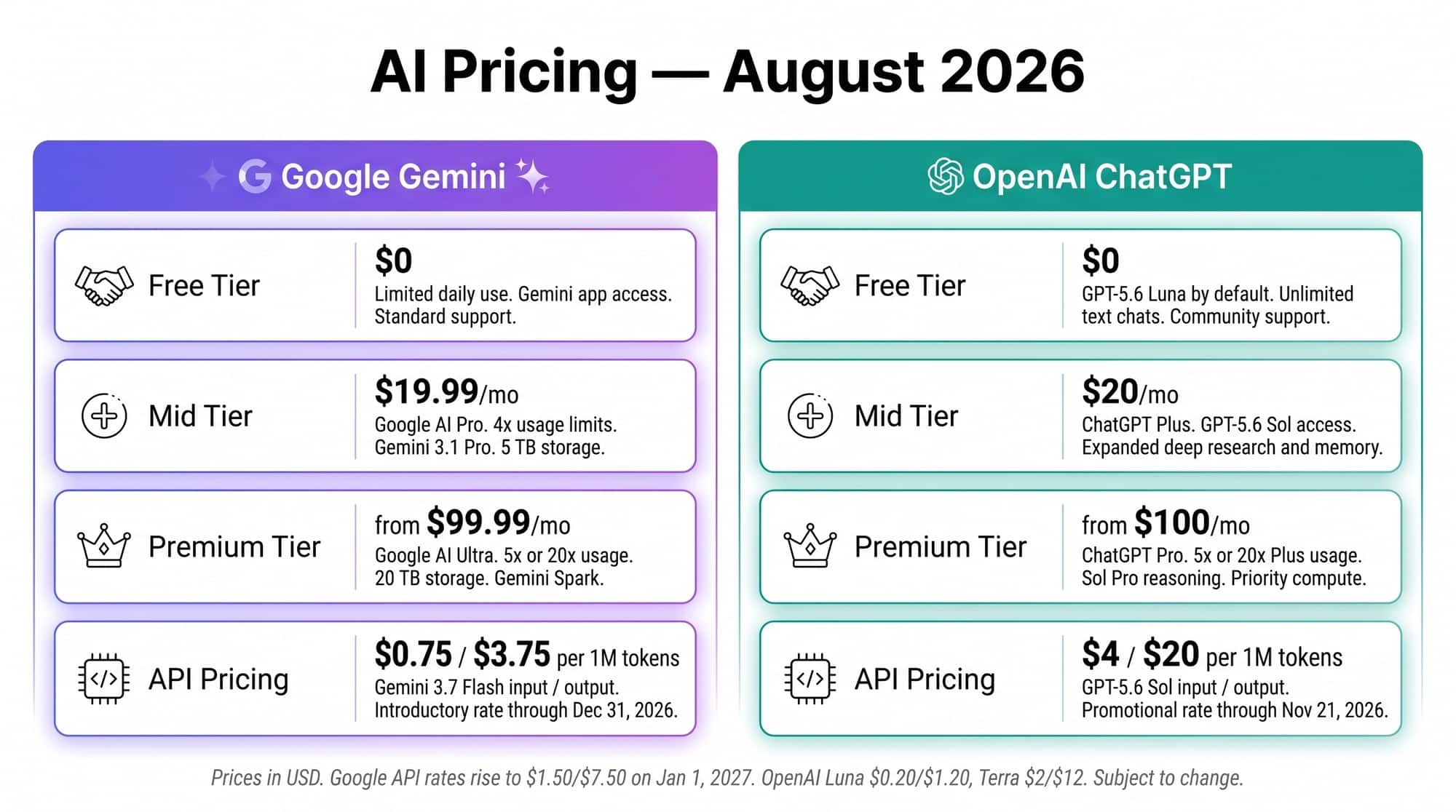
Subscription pricing has been stable for months. API pricing has not. Google repriced its Flash tier on August 13, OpenAI cut Luna and Terra on July 30, then cut the flagship Sol tier on August 21. Here is the full picture as of late August 2026.
The short version, by platform:
- Cheapest way in: Google AI Plus at $4.99/mo, down from $7.99 in June, with 400 GB of storage
- Best mid-tier value: effectively a tie, Google AI Pro at $19.99 versus ChatGPT Plus at $20
- Top tier: both now sell 5x and 20x usage multiples, Ultra at $99.99 and $199.99, Pro at $100 and $200
- Cheapest API: GPT-5.6 Luna at $0.20/$1.20 after an 80% cut, then Gemini 3.7 Flash at $0.75/$3.75
- Deepest reasoning per call: GPT-5.6 Sol, now $4/$20 on a promotion that ends around November 21
Consumer Subscriptions
| Plan | Price | What You Get |
|---|---|---|
| ChatGPT Free | $0 | GPT-5.6 Luna by default since August 6, unlimited text chats, limited tools |
| ChatGPT Go | $8/mo | More uploads, images and voice, longer context |
| ChatGPT Plus | $20/mo | GPT-5.6 Sol with a reasoning-depth slider, custom GPTs, expanded Deep Research |
| ChatGPT Pro | $100 or $200/mo | Same features, different capacity: 5x Plus usage at $100, 20x at $200, plus Sol Pro reasoning |
| Gemini Free | $0 | Gemini app with limited Flash and Pro access |
| Google AI Plus | $4.99/mo | 2x free limits and 400 GB storage, after Google halved the price and doubled storage in June |
| Google AI Pro | $19.99/mo | Gemini 3.1 Pro at 1M context, Deep Research, 5 TB storage, YouTube Premium Lite, Gemini Spark |
| Google AI Ultra | $99.99 or $199.99/mo | 5x Pro usage at $99.99, 20x at $199.99, Deep Think, 20 TB storage, YouTube Premium, Antigravity access |
Both vendors now use an identical 5x/20x structure at the top of their ladders, which makes the bundles rather than the headline price the deciding factor. Google AI Ultra includes 20 TB of storage and YouTube Premium, bundling neither ChatGPT Pro nor Claude Max attempts. ChatGPT Pro buys more capacity on a stronger reasoning model. Note that OpenAI confirmed all of its August cuts touched only pay-as-you-go API usage and purchased credits, so included usage on Plus, Pro and Business did not change.
API Pricing: Three Cuts in Five Weeks
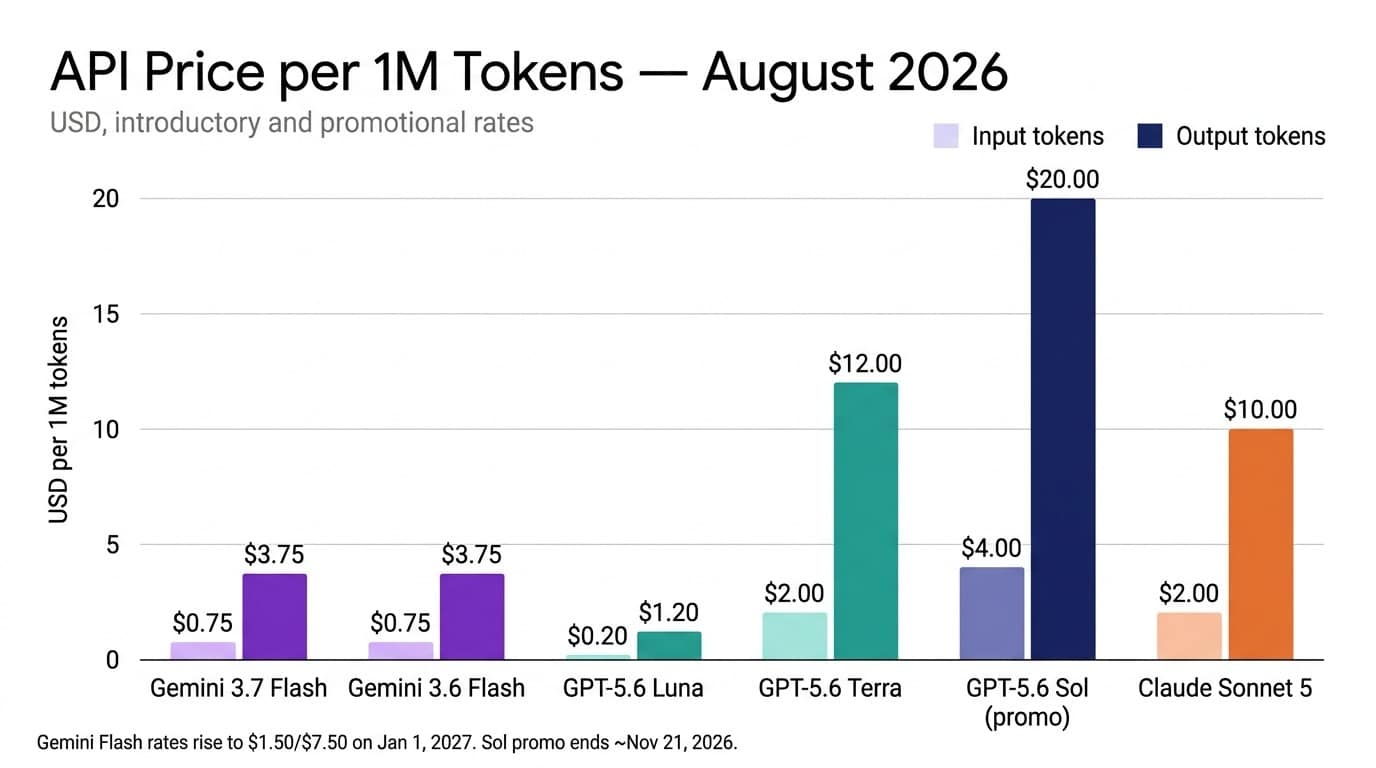
| Model | Input per 1M | Output per 1M | Notes |
|---|---|---|---|
| Gemini 3.7 Flash | $0.75 | $3.75 | Introductory rate through December 31, 2026 |
| Gemini 3.7 Flash, standard | $1.50 | $7.50 | Applies from January 1, 2027 |
| Gemini 3.6 Flash | $0.75 | $3.75 | Repriced to match 3.7 Flash in August |
| GPT-5.6 Sol | $4.00 | $20.00 | Promotional, down from $5/$30, through at least November 21, 2026 |
| GPT-5.6 Terra | $2.00 | $12.00 | Cut 20% from $2.50/$15 on July 30 |
| GPT-5.6 Luna | $0.20 | $1.20 | Cut 80% from $1/$6 on July 30 |
During the promotional windows, Gemini 3.7 Flash costs about one-fifth of GPT-5.6 Sol on both input and output, and roughly a third of Terra’s blended rate. Cached input widens the gap further, at $0.075 per million tokens on 3.7 Flash against $0.40 on Sol. On a typical 80/20 input-to-output workload, Artificial Analysis puts 3.7 Flash near $1.35 blended per million tokens, against $4.00 for Terra and $3.60 for Claude Sonnet 5.
The Pricing Catch Nobody Mentions
Two details turn these headline discounts into genuine trade-offs, and they point in opposite directions.
The first is duration. Sol’s $4/$20 is a three-month promotion expiring around November 21, and 3.7 Flash’s $0.75/$3.75 expires on December 31 when Google’s standard $1.50/$7.50 takes over. Budgeting for Q1 2027 means pricing against the standard rates, not the launch ones. At those standard rates, a Sol that has returned to $5/$30 is only about 1.6x more expensive per blended token than Gemini’s Flash tier, not five times.
The second is verbosity. Gemini 3.7 Flash is cheap per token but uses a lot of them, averaging roughly 37,000 output tokens per benchmark task, about 40% more than 3.6 Flash. That is why Artificial Analysis measures its actual cost per task at $0.40 on high reasoning, $0.26 on medium and $0.16 on low, rather than the near-zero figure a $3.75 output rate might suggest. The practical rule is to compare cost per completed task on your own workload, not list price per million tokens.
Enterprise pricing for both platforms remains custom-quoted, with admin controls, SSO, data retention policies and compliance certifications. Neither vendor has a clear advantage at that tier, and the decision still comes down to existing infrastructure, Google Workspace versus Microsoft 365.
Other AI Assistants Worth Considering
While Gemini and ChatGPT dominate the conversation, as detailed in our coverage of the LLM market share landscape, several other models have reached frontier-level capability and are worth evaluating depending on your needs.
| Model | AA Intelli Index | Best For |
|---|---|---|
| Claude Opus 4.8 | 56 | Long-context analysis, writing quality, reliable performance |
| Claude Fable 5 | ~60 (top) | Highest intelligence, knowledge work, agentic tasks |
| DeepSeek V4 Pro | 44 | Open-source, cost efficiency, 1M token context |
| Grok 4.5 | 54 | Real-time data, competitive coding agent performance |
Claude Fable 5 currently holds the top position on the Artificial Analysis Intelligence Index at approximately 60 points, one point ahead of GPT-5.6 Sol, with a particular edge in AA-Briefcase knowledge-work tasks. However, it is not as widely available as Gemini or ChatGPT. DeepSeek V4 Pro remains the most compelling open-source alternative, offering competitive performance at significantly lower cost for developers willing to self-host.
Which One Should You Choose?
There is no universal winner—the right assistant depends entirely on your priorities. Here is a quick decision guide based on common use cases.
| If You Are… | Choose ChatGPT When… | Choose Gemini When… |
|---|---|---|
| Developer / Engineer | You need deep multi-file refactoring, Codex harness, or autonomous PR generation | You want fast iteration, API orchestration, or tool-heavy agentic workflows |
| Writer / Content Creator | You prioritize creative storytelling, tone nuance, and long-form narrative quality | You need research-heavy writing with real-time sources and Google Workspace integration |
| Student / Researcher | You need step-by-step reasoning through complex problems or detailed explanations | You want fast answers, multimodal study aids, and the ability to process long documents |
| Visual Creator | You need detailed image generation with strong text rendering (GPT-Image-1.5) | You want image, video, and music generation in one tool with the best multimodal understanding |
| Business / Enterprise | You are on Microsoft 365 and need third-party integrations and API flexibility | You are on Google Workspace and want native AI inside Docs, Gmail, Sheets, and Slides |
| Casual / Everyday User | You want the broadest ecosystem of custom GPTs and plugin-like tools | You use Android, Google Search, and Gmail daily and want AI integrated everywhere |
Frequently Asked Questions
Which AI is better than ChatGPT?
Several models match or exceed ChatGPT on specific dimensions. Gemini 3.7 Flash is faster and stronger on multimodal tasks. Claude Fable 5 leads on overall intelligence benchmarks. DeepSeek V4 Pro offers comparable reasoning at a lower cost. The answer depends entirely on the use case—no single model wins across every category.
Is Gemini 100% correct?
No AI model is 100% accurate. Gemini 3.7 Flash shows significant improvement over its predecessors on factual accuracy evaluations, though it still fabricates information at measurable rates. While significantly better than its predecessor, it still fabricates information at measurable rates, particularly on niche or ambiguous topics. Always verify critical information, regardless of which assistant you use.
Which AI is more powerful than Gemini?
On the Artificial Analysis Intelligence Index, several models outperform Gemini 3.7 Flash, including GPT-5.6 Sol (61 vs 56), Claude Fable 5 (~60), and Claude Opus 4.8 (56). However, Gemini 3.7 Flash leads in speed (~340 tok/s), multimodal video understanding (85.4% LVBench), and enterprise automation (30.4% AutomationBench). The definition of “powerful” depends on whether you prioritize raw intelligence, speed, or breadth of capabilities.
Why is Gemini considered the best AI?
Gemini’s strongest argument is not raw benchmark performance but integration and accessibility. It is the default AI assistant across Google’s ecosystem, built into Search, Android, Chrome, Gmail, Docs, and Workspace. Combined with its speed advantage (roughly 3x faster than frontier competitors) and native multimodal support (text, image, video, and speech), Gemini offers the most seamless, low-friction AI experience for users already embedded in Google’s ecosystem.
Conclusion
As explored in our analysis of how 2025’s AI milestones powered the 2026 revolution, there is no single “best” AI assistant, only the right one for your workflow. GPT-5.6 Sol leads on pure intelligence, coding depth, and complex reasoning, making it the choice for developers, researchers, and anyone whose work demands maximum analytical rigor. Gemini 3.7 Flash wins on speed, multimodal breadth, ecosystem integration, and cost efficiency, making it the natural pick for daily productivity, creative iteration, and users embedded in Google’s world.
The good news is that both are exceptional products, and the gap between them continues to narrow with each release. Try both free tiers, run your own tests with your actual tasks, and let your workflow, not the benchmark scores, be the deciding factor.


