
Concrete structures deteriorate through a combination of chemical reactions, environmental exposure, and mechanical stress that compounds over time. Understanding the mechanisms that drive this degradation is the foundation of any repair strategy that delivers lasting results. This article breaks down the science behind concrete failure, the technologies that restore structural capacity, and the factors that separate a temporary fix from a permanent solution.
What Causes Concrete to Deteriorate Over Time?
Concrete degradation rarely stems from a single cause. Most structural damage results from overlapping chemical, physical, and environmental processes that weaken the material progressively. Identifying the specific degradation mechanism at play is the first step toward selecting a repair approach that addresses the root problem, not just the visible symptoms.
To preserve a structure’s long-term performance, the diagnostic and repair process needs to account for every active degradation pathway. Companies like Freyssinet pair root cause analysis with proven restoration techniques, providing structural concrete repair contractors who address the full scope of deterioration rather than patching isolated symptoms. That combination of assessment and execution is what separates repairs that hold for decades from those that fail within a few years.
In addition to traditional restoration, modern materials science has introduced innovative solutions. For instance, self-healing concrete consumes CO2 to automatically seal microcracks before they can expand, presenting a promising pathway for sustainable infrastructure.
How Does Carbonation Weaken Reinforced Concrete?
Carbonation occurs when carbon dioxide from the atmosphere penetrates the concrete surface and reacts with calcium hydroxide in the cement matrix. This reaction lowers the pH of the concrete from around 12.5 to below 9, which strips the protective alkaline layer surrounding steel reinforcement. Once that passivation layer is lost, the embedded steel becomes vulnerable to corrosion.
Corroding reinforcement expands in volume, generating internal tensile stresses that crack and spall the surrounding concrete. The process is self-accelerating: cracks from early corrosion allow more CO2 and moisture to reach deeper reinforcement layers, which accelerates further deterioration. Structures in urban environments with higher CO2 concentrations tend to carbonate faster than those in rural settings.
The Role of Chloride Ingress in Structural Damage
Chloride ions from de-icing salts, seawater, or industrial chemicals penetrate concrete through capillary absorption and diffusion. When chloride concentration at the reinforcement level exceeds a critical threshold, it initiates pitting corrosion on the steel surface, even when the concrete’s pH remains relatively high.
Chloride-induced corrosion is particularly aggressive because it creates localized anodic sites on the reinforcement, producing deep pitting rather than uniform surface corrosion. This makes the damage harder to detect visually and more dangerous structurally. Coastal bridges, parking garages exposed to road salts, and marine infrastructure face the highest risk from this degradation pathway.
Freeze-Thaw Cycles and Their Impact on Concrete Integrity
Water trapped in concrete pores expands by approximately 9% when it freezes. Repeated freeze-thaw cycles generate cumulative hydraulic pressure inside the pore structure, which fractures the cement paste from within. The result is surface scaling, internal microcracking, and progressive loss of compressive strength.
Air-entrained concrete resists freeze-thaw damage better because the microscopic air voids act as pressure relief chambers during ice formation. Structures built without adequate air entrainment, or those where the air void system has been compromised by age or poor mixing, are significantly more susceptible to this type of deterioration.
How Do Engineers Assess Concrete Damage Before Repairs Begin?
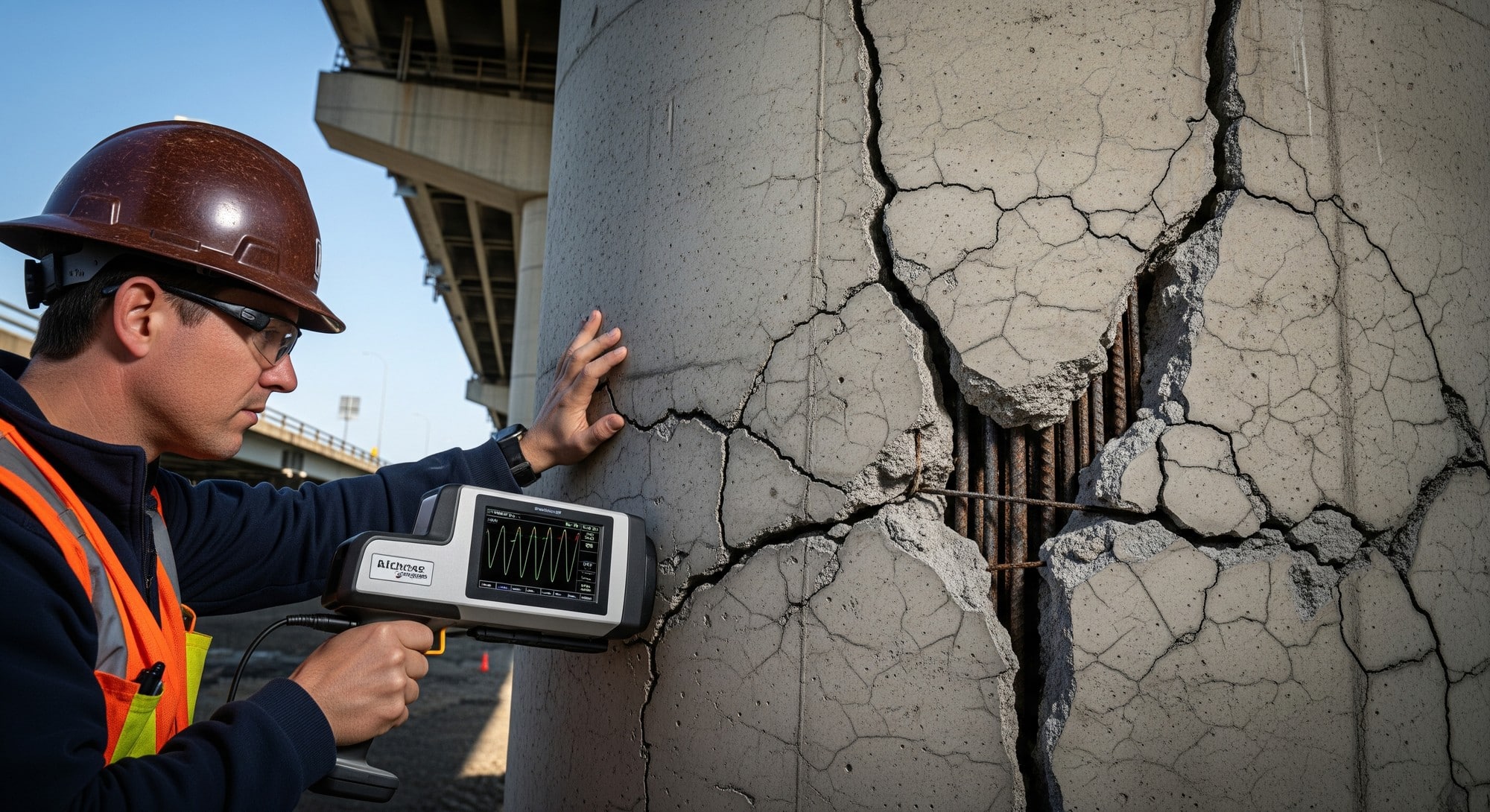
Accurate assessment determines whether a repair will last 5 years or 50. Jumping straight to patching visible damage without understanding the underlying condition of the structure often leads to premature failure of the repair itself. A systematic diagnostic process maps the type, extent, and cause of deterioration so the repair strategy targets the actual problem.
Non-Destructive Testing Methods for Concrete Structures
Non-destructive testing (NDT) allows engineers to evaluate internal concrete conditions without removing material. Half-cell potential mapping detects areas of active reinforcement corrosion by measuring voltage differences across the concrete surface. Ground-penetrating radar (GPR) identifies voids, delamination, and rebar location at depth.
Rebound hammer tests provide a quick estimate of surface compressive strength, while ultrasonic pulse velocity measurements reveal internal cracking and density variations. Combining multiple NDT methods produces a more complete picture of structural health than any single test alone.
Why Root Cause Analysis Determines Repair Longevity
A repair that treats symptoms without addressing the cause will fail again. If chloride contamination caused reinforcement corrosion, patching the spalled concrete without extracting chlorides or installing cathodic protection leaves the underlying corrosion mechanism active. The new repair material will crack and debond within a few years.
Root cause analysis involves testing concrete samples for chloride content, carbonation depth, sulfate levels, and alkali-silica reactivity. These results guide the selection of repair materials, protective treatments, and long-term maintenance strategies that match the specific degradation mechanism at work.
What Makes a Concrete Repair Method Structurally Durable?
Durability in concrete repair depends on material science, not just workmanship. The repair material must bond to the existing substrate, match its thermal and mechanical properties, and resist the same environmental stressors that caused the original damage.
Material Compatibility and Bond Strength
The repair material and the host concrete must behave as a single composite system under load. Mismatched elastic moduli create stress concentrations at the repair interface, which leads to debonding and cracking. Repair mortars with stiffness values close to the original concrete’s distribute loads more evenly across the repaired zone.
Thermal compatibility matters just as much. If the repair material expands and contracts at a different rate than the substrate, daily and seasonal temperature swings generate shear stress at the bond line. Over hundreds of thermal cycles, this differential movement can separate even a well-applied repair from the parent concrete.
How to Repair Mortars and Polymer Systems Restore Load-Bearing Capacity
Cementitious repair mortars restore the concrete cross-section and transfer structural loads back through the repaired area. High-performance formulations achieve compressive strengths exceeding 40 MPa within 28 days, matching or surpassing the original concrete specification. Fiber-reinforced variants add tensile capacity and crack resistance to the repair zone.
Polymer-modified systems, including epoxy and polyurethane resins, serve a different function. Low-viscosity epoxy injections fill fine cracks and restore monolithic load transfer across fractured sections. Polyurethane grouts seal active water leaks and stabilize void substrates. Each system addresses a specific failure mode, and selecting the wrong one compromises the repair’s structural contribution.
Surface Preparation: The Step That Defines Repair Success
The bond between repair material and substrate is only as strong as the surface it adheres to. Contaminated, weak, or poorly profiled surfaces cause the majority of premature repair failures, regardless of how high-quality the repair material is.
Hydrodemolition vs. Mechanical Removal
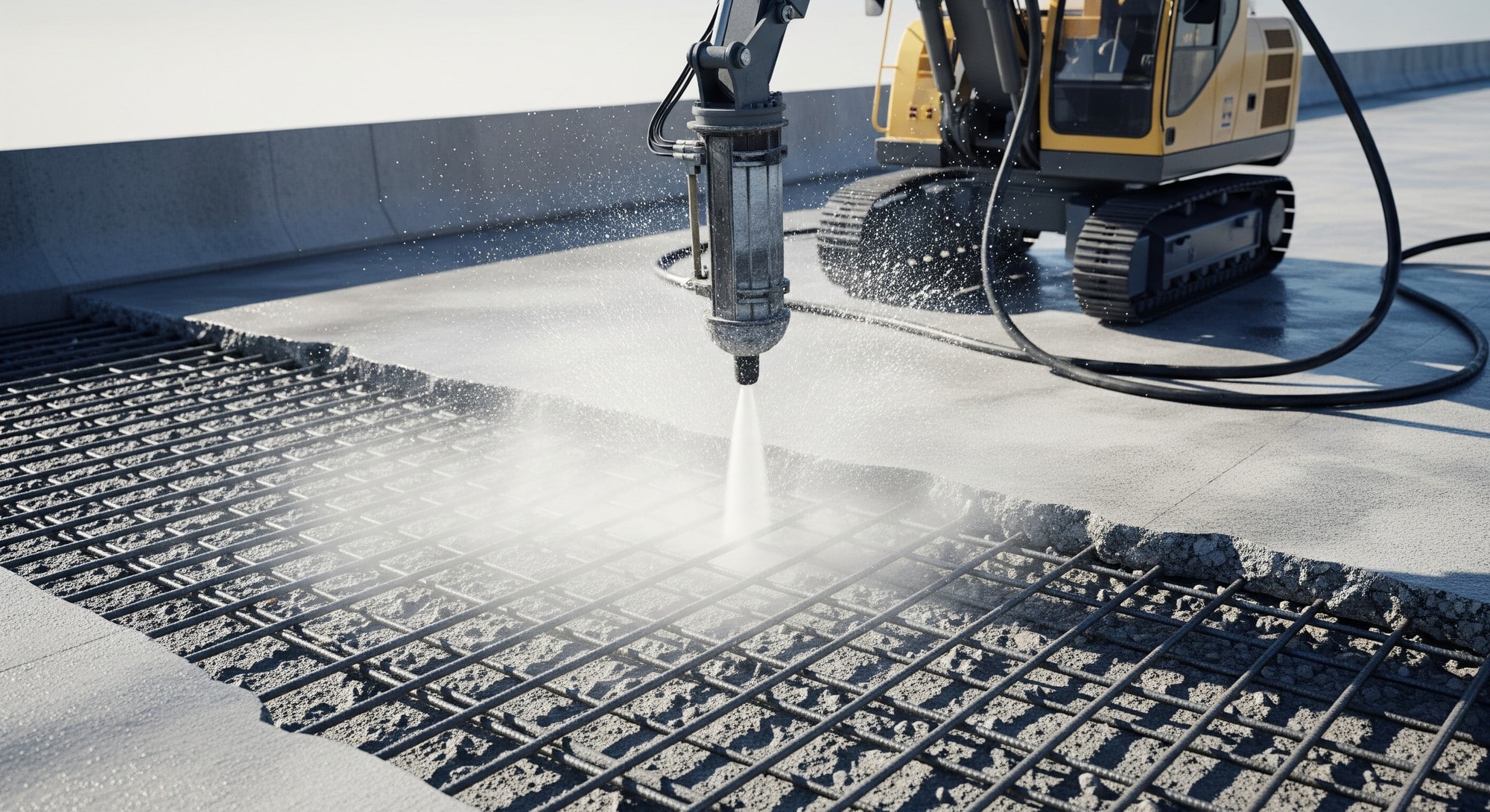
Hydrodemolition uses high-pressure water jets (up to 42,000 PSI) to remove deteriorated concrete while leaving sound material and reinforcement undamaged. The water selectively breaks down weakened cement paste around aggregates, creating an irregular, clean surface with excellent mechanical interlock for new material.
Mechanical methods like pneumatic breakers and milling machines work faster on large areas but generate vibration that can introduce microcracks into the remaining concrete. These microcracks weaken the bond zone and create pathways for future moisture ingress. For structures where long-term durability is the priority, hydrodemolition produces a superior substrate.
Substrate Profiling for Optimal Adhesion
The International Concrete Repair Institute (ICRI) defines concrete surface profiles (CSP) on a scale from 1 to 10, with higher numbers indicating rougher textures. Most structural repair mortars require a CSP of 5 or higher for reliable adhesion. Thin coatings and sealers perform best on smoother profiles in the CSP 2 to 3 range.
Matching the surface profile to the repair material is a technical decision, not a cosmetic one. An overly smooth surface reduces mechanical bond area, while an overly rough profile can trap air and prevent full contact between the repair material and substrate.
How Does CFRP Strengthening Extend the Life of Aging Concrete?
Carbon Fiber Reinforced Polymer (CFRP) adds structural capacity to concrete elements without significant weight or dimensional changes. This makes it a practical solution for structures that need to carry higher loads, meet updated code requirements, or compensate for section loss caused by corrosion.
Carbon Fiber Reinforced Polymer Applications in Structural Repair
CFRP sheets and laminates bond to the tension face of beams, slabs, and columns to increase flexural and shear capacity. Column wrapping with CFRP provides confinement that increases both compressive strength and ductility, which is particularly valuable for seismic retrofitting applications.
The material’s high strength-to-weight ratio means a 1.4 mm thick CFRP laminate can provide the same tensile reinforcement as a significantly thicker steel plate. This eliminates the need for heavy lifting equipment and reduces installation time compared to traditional steel plating methods.
Load Redistribution and Long-Term Performance Gains
CFRP strengthening redistributes load paths within the repaired structure. A beam with corroded bottom reinforcement, for example, transfers tensile forces through the externally bonded CFRP system instead of relying on compromised steel bars. This restores the original load-carrying mechanism and, in many cases, increases capacity beyond the structure’s initial design specification.
Long-term performance depends on the quality of the adhesive bond and the protection of the CFRP system from UV exposure and mechanical damage. Protective coatings and fire-resistant overlays extend the service life of CFRP applications in exposed environments.
Protective Systems That Prevent Recurring Concrete Damage
Repairing concrete without addressing the environmental exposure that caused the damage in the first place is a short-term strategy. Protective systems create barriers against the specific agents of deterioration, extending the interval between maintenance interventions.
Anti-Carbonation Coatings and Hydrophobic Impregnation
Anti-carbonation coatings form a physical barrier on the concrete surface that limits CO2 diffusion into the cover zone. Acrylic and polyurethane-based coatings are the most common options, providing both carbonation resistance and aesthetic versatility for architectural concrete surfaces.
Hydrophobic impregnation takes a different approach. Silane and siloxane-based treatments penetrate the concrete pore structure and create a water-repellent lining without forming a visible surface film. This reduces capillary absorption of dissolved salts, slows carbonation, and protects against freeze-thaw damage while allowing the concrete to retain its breathability and original appearance.
Cathodic Protection for Reinforced Concrete
Cathodic protection (CP) is the only repair-compatible technology that can stop active chloride-induced corrosion without removing contaminated concrete. Impressed current systems apply a small electrical current through embedded or surface-mounted anodes, which shifts the electrochemical potential of the reinforcement below the corrosion threshold.
Sacrificial anode systems offer a lower-maintenance alternative for localized repairs. Zinc anodes installed in repair patches protect the reinforcement in the transition zone between new and old concrete, where incipient anode corrosion is most likely to develop.
What Role Does Structural Health Monitoring Play After Repairs?
Monitoring repaired structures provides early warning of performance changes that visual inspections cannot detect. This shifts maintenance from a reactive model, where damage must become visible before action is taken, to a proactive model based on measured data.
Sensor-Based Systems for Ongoing Condition Assessment
Embedded sensors measure strain, temperature, humidity, and corrosion potential at critical locations within the structure. Fiber optic sensors can monitor strain along the full length of a beam or column, detecting load redistribution patterns that indicate developing problems.
Wireless sensor networks transmit data to centralized platforms without the need for physical wiring, which simplifies installation on large or complex structures. Real-time dashboards allow engineers to track trends and set automated alerts when readings exceed predefined thresholds.
Data-Driven Maintenance Planning for Repaired Structures
Continuous monitoring data replaces assumptions with measurements when planning future maintenance. Instead of scheduling inspections based on fixed time intervals, asset managers can prioritize interventions based on actual condition indicators. This reduces both unnecessary maintenance costs and the risk of undetected deterioration.
Historical monitoring data builds a performance record for the repair system itself, documenting how different materials and methods perform under real-world conditions over time. This feedback loop improves material selection and repair design on future projects.
Key Factors When Selecting a Concrete Repair Strategy
Selecting the right repair strategy requires balancing technical requirements, project constraints, and long-term performance goals. A repair that works for a parking garage in a northern climate may not suit a coastal bridge or an industrial facility exposed to chemical attack.
Exposure Class, Load Requirements, and Service Life Goals
The structure’s exposure class defines which degradation mechanisms are most likely and which protective measures are necessary. A structure in an XC3 carbonation exposure class needs different material specifications than one in an XS2 submerged marine environment.
Load requirements determine whether the repair is cosmetic, structural, or strengthening. Cosmetic repairs restore appearance, structural repairs restore original capacity, and strengthening repairs increase capacity beyond the original design. Each category calls for different materials, surface preparation standards, and quality control procedures.
When Surface Repairs Are Not Enough for Structural Deficiencies
Surface patching addresses localized spalling and cosmetic damage, but it cannot restore capacity lost to deep section reduction, severed reinforcement, or widespread internal cracking. When NDT results show that deterioration extends beyond the cover zone or that reinforcement has lost significant cross-sectional area, the repair strategy must include structural strengthening.
CFRP wrapping, external post-tensioning, and supplemental reinforcement are all options for restoring or increasing structural capacity. The choice depends on the type of structural deficiency, access constraints, and whether the structure must remain operational during repairs.

Frequently Asked Questions About Long-Lasting Concrete Repairs
What Is the Average Lifespan of Professional Concrete Repair?
A professionally executed concrete repair can last 20 to 50 years depending on material selection, surface preparation quality, and the severity of environmental exposure. However, the concrete repair industry faces a persistent challenge: independent studies, such as the landmark CONREP analysis, show that over 50% of concrete repairs fail within 10 years, and up to 75% fail within a decade if the root causes are not addressed. This high failure rate highlights why modern, scientific diagnostic procedures and proper substrate preparation are critical. Repairs that include protective coatings or cathodic protection systems tend to reach the upper end of the durability range because they address the underlying electrochemical and physical causes of deterioration, rather than just patching visible symptoms.
How Do Environmental Conditions Affect Repair Material Selection?
Temperature, humidity, and chemical exposure dictate which repair materials will perform reliably over time. Epoxy-based systems lose effectiveness above 60°C, while cementitious mortars require minimum temperatures of 5°C for proper curing. Marine and industrial environments demand materials with high chloride and sulfate resistance to prevent premature breakdown of the repair.
What Is the Difference Between Structural and Non-Structural Concrete Repair?
Structural repairs restore or increase the load-carrying capacity of a concrete element, using materials and methods that contribute to the structural system. Non-structural repairs address cosmetic defects, surface scaling, or minor cracking without changing the element’s ability to carry loads. The distinction determines material specifications, surface preparation requirements, and quality control procedures for the project.


