
The technical landscape has fundamentally shifted as environmental and infrastructure constraints take center stage. Data centers that once focused exclusively on processor speeds now face a relentless physical constraint: the energy grid. As artificial intelligence workloads scale, the primary objective has shifted from masterfully acquiring more accelerators to mastering the conversion of every available watt into usable intelligence.
Developing the Maia architecture allows Microsoft to do more than simply add another chip to its racks; it enables a total redesign of the relationship between hardware and the cloud. Microsoft’s custom AI silicon program, known as the Maia accelerator line, serves as a calculated answer to these pressing energy demands. The vertically integrated strategy aims to maximize inference economics, ensuring that hyperscale operations can thrive even as global energy demands reach unprecedented levels.
This deep dive explores how Microsoft aligns silicon design, Ethernet networking, and control-plane software to solve the industry’s most pressing scarcity. We look beyond the benchmarks to see how vertical integration allows Azure to extract more value from every megawatt, effectively turning power-limited facilities into high-output token factories.
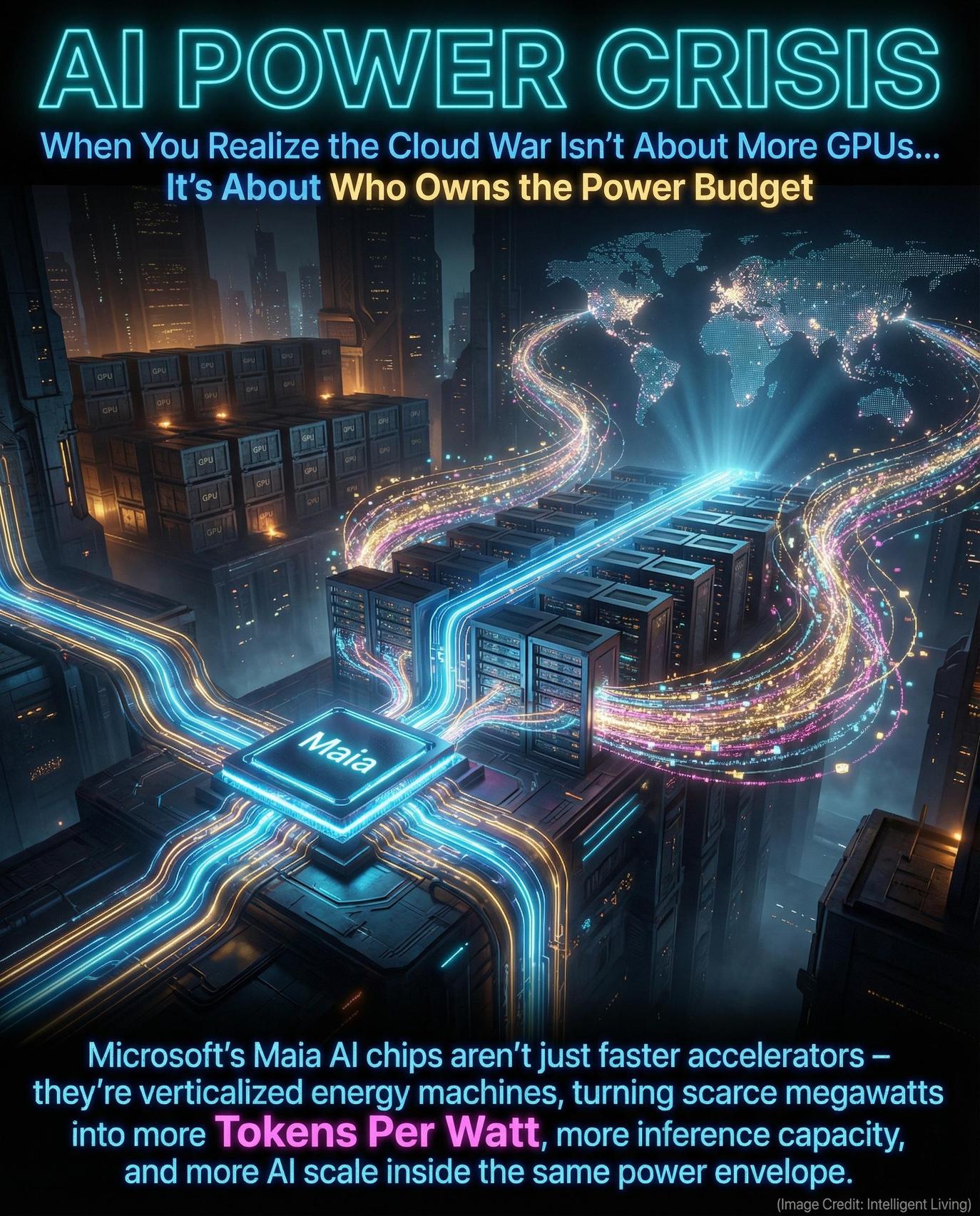
Microsoft Maia AI Chip Quick Facts: Architecture, Power, and Scale at a Glance
Engineering a Custom Foundation for Azure
During the Ignite 2023 conference, Microsoft first detailed its vertical silicon strategy, positioning Maia as part of a broader silicon roadmap alongside its Cobalt CPUs. Let’s examine the technical specifications and architectural milestones that define Microsoft’s current AI silicon roadmap.
Maia is Microsoft’s custom AI accelerator line designed specifically for Azure data centers. The initial announcement framed Maia not as a standalone chip experiment but as a systems-level program integrated directly into Azure infrastructure.
Performance Specs of the Maia 100 and 200 Series
Microsoft built the first-generation Maia 100 on TSMC’s N5 process, leveraging advanced CoWoS-S packaging and chiplet integration to meet early performance targets. Technical documentation confirms that the first-generation Maia chip measures roughly 820 square millimeters and integrates 64GB of HBM2E memory. It delivers roughly 1.8 terabytes per second of bandwidth and was designed for up to 700 watts of thermal design power, though Microsoft has noted it is commonly provisioned closer to 500 watts in deployment scenarios.
The Maia 200 accelerator line, announced in early 2026, serves as a specialized platform for high-scale inference. Microsoft states that it is built on TSMC’s 3-nanometer process and integrates 216GB of HBM3e memory capable of up to 7 terabytes per second of bandwidth, alongside 272MB of on-chip SRAM. The 750-watt TDP and two-tier Ethernet scale-up architecture serve a larger goal: stabilizing inference economics across massive domains.
Microsoft emphasizes that Maia 200 integrates directly with the Azure control plane to handle telemetry, diagnostics, and orchestration. This native integration is central to the company’s broader thesis about improving tokens per watt and tokens per dollar rather than simply chasing peak benchmark scores.

The Cloud’s New Scarcity: Power, Not Compute
Why Data Center Electricity Demand is Accelerating
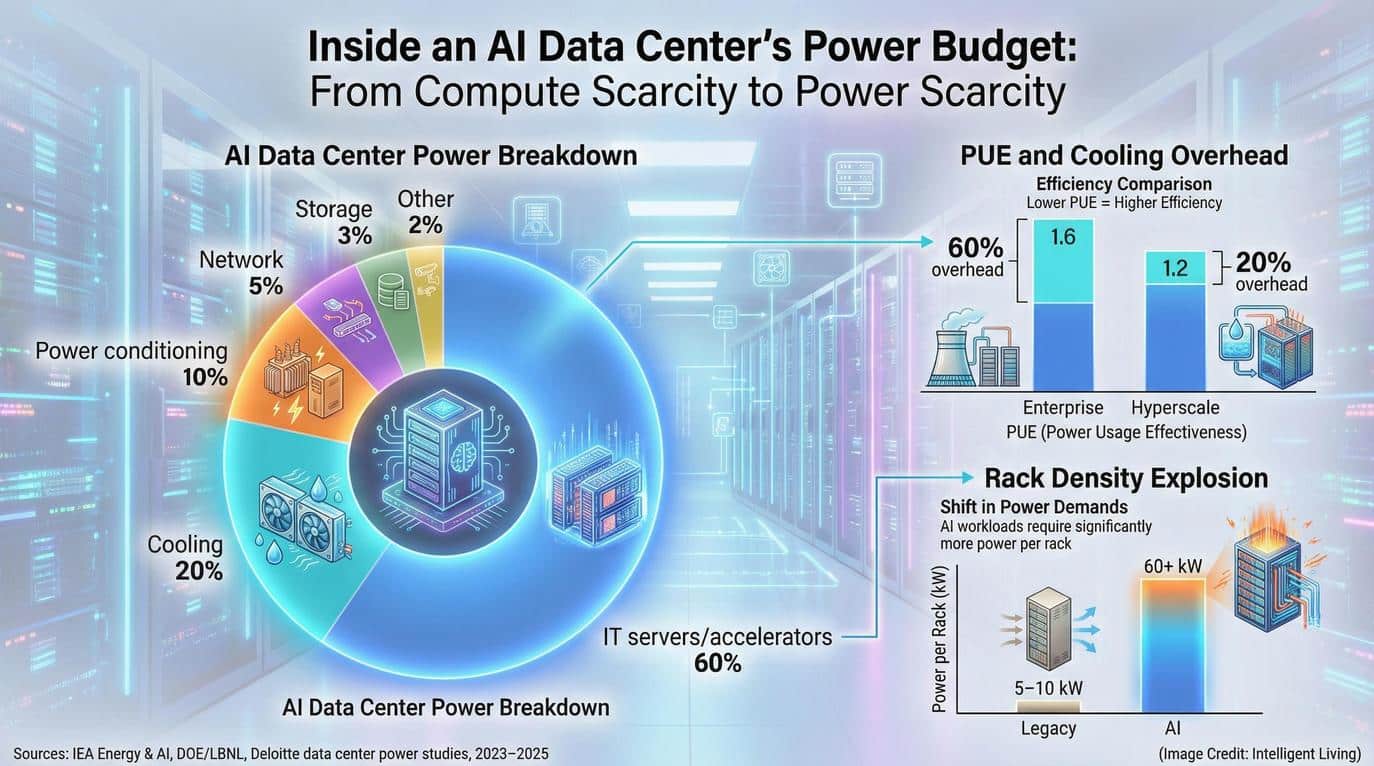
Large language models have overhauled the energy profile of the modern data center. While training demands intense compute bursts, inference requires a steady, high-scale operational load to serve responses around the clock.
Data from the International Energy Agency projects that global AI energy demand will surge this decade, driven largely by workload intensity. At the same time, U.S. Department of Energy analysis of Lawrence Berkeley National Laboratory findings suggests U.S. data center load could double or even triple within just a few years.
Encountering these structural limits necessitates a fundamental shift toward energy-efficient hardware that can handle modern operational loads. A facility might possess ample physical rack space while simultaneously lacking the megawatts required to activate it. When that happens, efficiency becomes more valuable than theoretical peak performance, especially in grid-constrained regions where AI infrastructure and edge-enabled smart cities have to be planned as a single system. A chip that generates more tokens within the same power envelope can effectively increase usable AI capacity without expanding grid connections. Rack-level design is following the same logic, and AMD’s Helion agentic AI rack targets the number of agents a facility can run per watt rather than raw accelerator throughput.
What “Watts-To-Tokens” Means in Plain Terms
In AI systems, a token is a small unit of text processed by a model. When a user asks a question, the model generates tokens sequentially to form an answer. The faster and more efficiently those tokens are produced, as demonstrated in wafer-scale AI systems that push real-time inference to thousands of tokens per second, the better the user experience and the lower the cost per request.
“Watts-to-tokens” describes how many useful tokens per second can be generated per watt of electricity consumed. Multiple factors dictate this efficiency, ranging from memory bandwidth and interconnect speed to the nuances of cooling overhead and hardware utilization.
Accelerators with superior networking efficiency or lower idle time produce more usable tokens per unit of energy, even when raw throughput remains identical. Hyperscalers increasingly prioritize this metric to ensure infrastructure remains viable within finite power envelopes.

What is Microsoft Maia?
Vertical Integration as a Competitive Edge
Microsoft Maia functions as a bespoke solution for hyperscale AI infrastructure, engineered to mesh perfectly with Azure’s unique environment. Unlike general-purpose GPUs designed for broad markets, Maia is tailored to Microsoft’s own cloud environment.
Aligning these layers allows Microsoft to design silicon that reflects Azure’s software stack and operational model. The strategy mirrors what other hyperscalers have pursued with in-house chips, but Microsoft places particular emphasis on vertical integration across silicon, networking, cooling, and control-plane software, closely aligned with Intel 18A foundry access shaping Microsoft’s AI silicon roadmap.
The vertical model empowers Microsoft to co-design every layer of the infrastructure simultaneously. This synchronized engineering approach ensures that components work in harmony rather than as isolated silos.
- Custom accelerator hardware tuned for Azure workloads
- Rack-level power delivery and management systems
- High-efficiency liquid cooling infrastructure
- Ethernet-based scale-up networking fabrics
- Azure control-plane software for scheduling and monitoring
Complementing the Broader Accelerator Ecosystem
Strategic coordination remains essential for maintaining peak performance and energy efficiency at hyperscale. This integration minimizes the friction and inefficiency inherent in heterogeneous environments.
While Maia complements rather than replaces third-party accelerators across the Azure ecosystem, its true value lies in how the hardware has evolved across generations. Examining the first-generation foundation reveals the starting point for this efficiency-first silicon program.
Maia 100 Architecture: Establishing the Foundation for Azure AI Silicon
The Architectural Foundation
Maia 100 established the foundation of Microsoft’s AI silicon effort. Built on TSMC’s N5 process and packaged using advanced CoWoS-S packaging and chiplet integration, it integrates 64GB of HBM2E memory with roughly 1.8 TB/s of bandwidth.
High-bandwidth memory acts as the lifeblood of AI workloads, sustaining the relentless data movement required by large language models. If memory bandwidth becomes a bottleneck, performance drops even if the compute cores themselves are capable of more.
Optimizing arithmetic precision represents just one layer of the energy equation. Microsoft’s technical documentation describes Maia 100 as including tensor processing units optimized for low-precision arithmetic formats. Lower precision reduces energy consumption and increases throughput without significantly impacting model quality in many scenarios. Managing the physical power delivery at the rack level introduces another set of challenges and opportunities for efficiency.
Power Envelope and Rack Integration
Maia 100 was designed for up to 700 watts of thermal design power but is often provisioned closer to 500 watts depending on deployment strategy. That distinction matters.
Microsoft’s Azure blog detailing its silicon-to-systems approach notes that Maia is deployed with custom rack-level power distribution and management systems. These systems dynamically allocate power across accelerators based on workload demands.
Implementing controlled power oversubscription strategies allows a rack to host more accelerators than its nominal peak power rating traditionally supports. In inference-heavy scenarios, workloads may not require maximum sustained power from every device at all times.
Software Portability and Utilization
Efficiency is not just about hardware. It is also about how fully hardware is utilized.
Microsoft has emphasized PyTorch compatibility and Triton integration for Maia 100. Developers can transition workloads to Maia with minimal friction, ensuring that software portability supports immediate deployment.
Idle accelerators consume baseline power while generating zero tokens. At hyperscale, even small improvements in utilization can translate into significant energy and cost savings, a reality now tracked through carbon-aware dashboards merging FinOps and GreenOps strategies.

The Shift Toward Maia 200: Enhancing High-Scale Inference Performance
Why Maia 200 is Inference-Focused
When Microsoft introduced Maia 200 in January 2026, the company framed it explicitly around inference economics. Training stays episodic and concentrated; however, inference demands a continuous stream of energy to handle constant user queries. The training side has its own efficiency story: MAI-Base-2, Microsoft’s 2.8-trillion-parameter base model, ran on 16,000 GB200 GPUs over 38 days at 21% model FLOPs utilization.
Microsoft designed Maia 200 to significantly improve the economics of AI token generation. This architecture mirrors a broader shift toward compact FP8 hardware and efficient inference architectures. Shifting from benchmark-centric marketing toward cost-per-output optimization signals a more mature phase of AI hardware competition.
Memory and On-Chip Resources
Maia 200 integrates 216GB of HBM3e memory, delivering up to 7 TB/s of bandwidth, along with 272MB of on-chip SRAM. Compared to Maia 100, this represents a substantial increase in memory capacity and bandwidth.
Larger memory capacity can reduce the need to distribute a single model across as many devices. Reducing the total number of devices minimizes interconnect operations, which in turn lowers networking overhead and cumulative energy consumption.
On-chip SRAM provides fast local storage for frequently accessed data, reducing trips to external memory and improving both latency and energy efficiency. The same goal of pulling memory closer to compute underpins the development of monolithic 3D AI chips designed for vertical logic stacking and extreme efficiency.
Ethernet Scale-Up and the AI Transport Layer
Optimized Transport for Collective Communication
Proprietary networking fabrics have long been the standard for high-performance clusters, yet they often introduce complexity and cost. Microsoft’s decision to utilize standard Ethernet at hyperscale represents a move toward a more interoperable and energy-efficient transport layer.
One of the most distinctive aspects of Maia 200 is its networking architecture. Microsoft describes a two-tier scale-up network built on standard Ethernet combined with a custom AI Transport Layer and an integrated on-die network interface controller.
Reducing Reliance on Discrete Networking Components
In large AI clusters, networking is no longer a background component. It represents a visible slice of both the power budget and the capital expenditure required for hyperscale growth.
As models expand, accelerators must constantly exchange tensor slices and activations. Every collective operation pushes data through switches, cables, and controllers, adding latency and consuming watts at every step. Integrating the NIC directly on the accelerator and tailoring the transport protocol for AI workloads aims to reduce power consumed by external networking components.
Technical reviews of the Maia 200 architecture describe scale-up domains capable of linking thousands of accelerators, organized to maintain locality for tensor-parallel workloads. Maintaining locality reduces cross-cluster traffic and lowers both latency and energy overhead.
Azure Control-Plane Telemetry as a Performance Lever
High-Granularity Telemetry for Real-Time Monitoring
Maia 200 features native integration with the Azure control plane, bridging the gap between hardware telemetry and cloud orchestration. This means telemetry, diagnostics, firmware management, and workload orchestration are unified within Azure’s existing operational framework.
Control-plane integration enables more granular monitoring of performance, temperature, and reliability. This coordination supports dynamic optimization strategies such as workload shifting, predictive maintenance, and power-aware scheduling.
Scaling Beyond Benchmarks: The Tokens per Watt Thesis
If workloads can be scheduled in ways that avoid thermal hotspots, minimize idle time, and balance power draw across racks, overall tokens per watt can improve without changing the underlying model architecture.
Vertical AI chips in a power-constrained era require more than just raw speed. Coordinated systems where silicon, networking, cooling, and cloud software are engineered together extract more usable AI output from each megawatt of capacity.
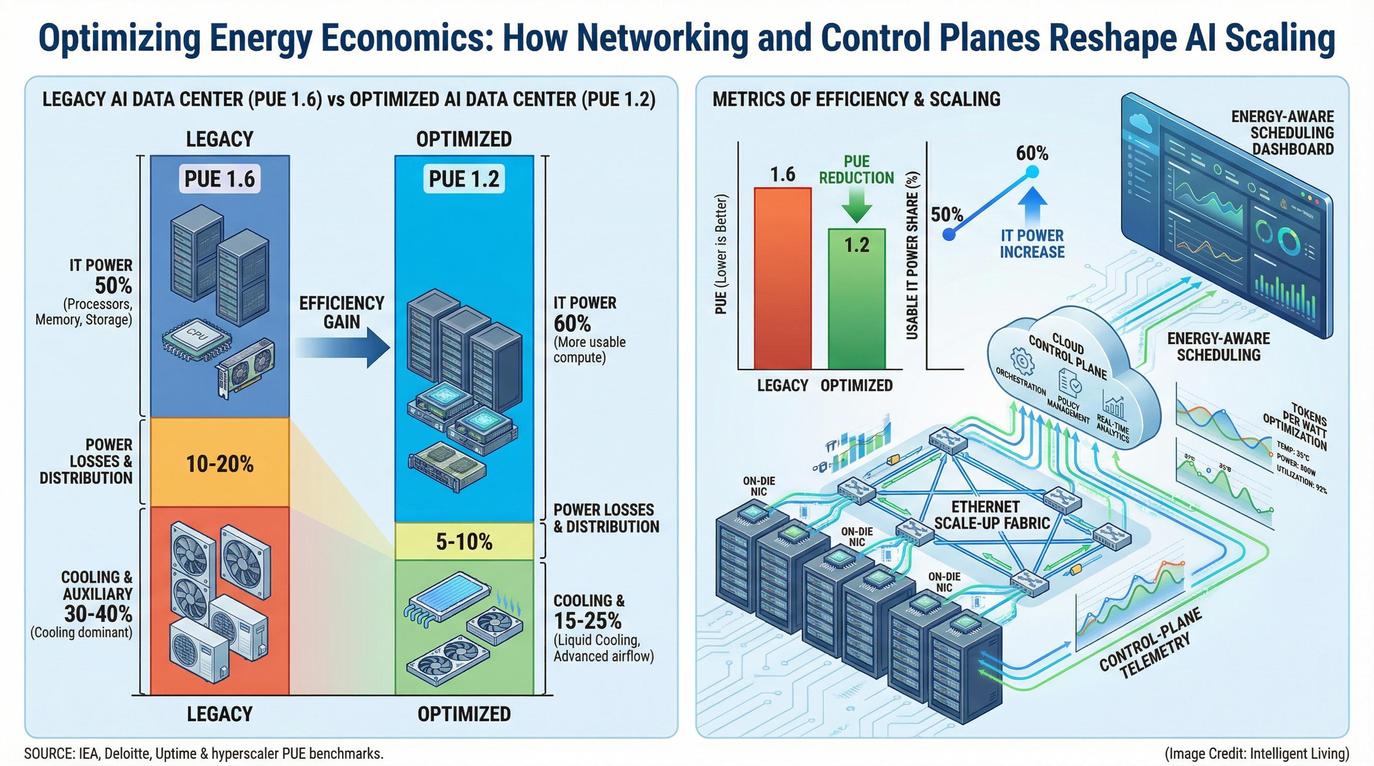
Optimizing Energy Economics: How Networking and Control Planes Reshape AI Scaling
Ethernet Scale-Up: When Networking Becomes the Energy Bill
The Invisible Energy Cost of Tensor Operations
In large AI clusters, networking is no longer a background component. It is a visible slice of both the power budget and the capital budget.
Accelerators must constantly exchange tensor slices and activations as models grow. Every collective operation pushes data through switches, cables, and network interface controllers, adding latency and consuming watts.
On-Die Networking as an Efficiency Multiplier
Maia 200 addresses this by combining a two-tier Ethernet scale-up network, a custom AI Transport Layer, and an on-die network interface controller. Microsoft’s detailed architectural write-up describes scale-up domains that can reach thousands of accelerators while keeping most high-frequency traffic local. Tuning Ethernet for AI collective communication reduces reliance on discrete NICs and trims switching overhead.
At hyperscale, even small reductions in networking overhead directly improve tokens per watt. Ethernet becomes part of the energy bill architects intentionally optimize, not just a generic bandwidth spec.
The Control Plane Accelerator: Utilization Is the Hidden Multiplier
Identifying Utilization Gaps in Modern Cloud Operations
Raw silicon specifications do not determine real-world economics; sustained utilization does.
Data centers must navigate shifting workloads across regions while contending with thermal limits and hardware reliability. Idle or throttled accelerators waste energy without producing value, creating utilization gaps that directly impact energy-aware scheduling. These utilization gaps now directly influence energy-aware scheduling for creative AI workloads.
Predictive Orchestration through Control-Plane Visibility
Because Maia 200 is wired directly into the Azure control plane, telemetry, diagnostics, firmware management, and scheduling live in a single orchestration layer. That visibility allows Azure to steer jobs away from hotspots, fill underused racks, and quarantine unreliable nodes before they drag down cluster-level efficiency.
Even modest utilization gains spread fixed infrastructure and power costs over more generated tokens, lowering cost per inference and improving the effective carbon intensity of AI workloads.
Putting the Math Together: How Vertical Integration Bends Cost Curves
Quantifying the Variables of Energy per Token
Optimizing energy per token requires a holistic view of the data center environment. Several interacting factors dictate the final cost and carbon footprint of every inference request generated at scale.
- Accelerator Power Draw: The base energy required to perform mathematical operations at the chip level.
- Networking and Switching Overhead: The cumulative power lost during data transmission between linked nodes.
- Cooling Efficiency: Measured via Power Usage Effectiveness, this captures the energy used to maintain optimal thermal environments.
- Capacity Utilization: The ratio of active tokens generated versus the energy wasted by idle hardware.
Navigating Future Capacity and Grid Realities
Balancing these four variables creates a comprehensive picture of data center health. Aligning these variables empowers hyperscalers to squeeze every possible bit of intelligence from a restricted energy budget. By addressing both silicon performance and environmental overhead, Microsoft targets a sustainable path for AI growth.
Cooling remains critical. The Uptime Institute notes that Power Usage Effectiveness improvements are incremental rather than transformational. As rack densities climb, advanced liquid cooling and whole-building efficiency strategies, like those mapped in blueprints for modern high-efficiency buildings, become essential to avoid thermal throttling and wasted energy.
Grid constraints still apply. The International Energy Agency projects that data center electricity demand could approach nearly 945 terawatt-hours by 2030. If a hyperscaler can generate more tokens within the same megawatt allocation, whether that power comes from the grid or from gigawatt-class offshore solar farms, it effectively expands usable AI capacity without waiting for new interconnections.
Owning the stack aligns chip design, network topology, cooling, and scheduling around a single metric: lower cost per useful token.

Industry Pressures: Navigating Grid Limits, Supply Chains, and Vertical Inference Strategy
Current Industry Impact: Navigating Grid Constraints and Supply Chain Realities
Reality Check: Custom Silicon Cannot Outrun the Grid
Even with efficiency gains, infrastructure growth faces external limits. A Washington Post analysis of U.S. data center expansion detailed the challenges facing 1-gigawatt-class facilities. These massive projects often collide with turbine backlogs, permitting delays, and aging grid infrastructure.
Some operators are exploring on-site generation and unconventional siting strategies, including data centers hidden in wild environments to manage thermal stress, underscoring how energy has become the central constraint.
Custom accelerators like Maia can reduce the energy required for each inference request. By optimizing the silicon, Microsoft enables higher throughput within existing constraints. Efficiency buys time, but it does not remove the structural challenges of the electrical grid. Cloud providers must still navigate transmission limits and local power availability.
Supply Chain Is Performance: Packaging, Memory, and Capacity Constraints
Performance is also shaped by manufacturing realities. Microsoft’s reliance on advanced packaging technologies has collided with the global CoWoS packaging crunch, making supply a critical performance variable. TSMC has publicly stated in earnings transcripts that it has worked to expand CoWoS capacity, reflecting how demand has strained advanced packaging supply.
Deployment timelines slip and costs escalate whenever packaging or HBM supply tightens. In these volatile periods, foundry diversification and long-term supply agreements transition from background procurement into vital strategic levers.
The economics of AI are shaped not only by architecture but also by who can reliably manufacture and deploy at scale, a dynamic traced in LLM market share analyses that frame cloud competition as a story of two AI empires.
Mastering Inference Economics Through Vertical Integration
Breaking the Power Ceiling of Modern AI Models
The trajectory of the AI industry is no longer a straight line toward larger models; it is a complex curve shaped by energy availability and infrastructure costs. Microsoft’s investment in the Maia program demonstrates that the future of the cloud belongs to those who control the entire stack. Refining how silicon interacts with cooling systems and networking layers allows Azure to handle the continuous, high-volume demands of global inference without succumbing to the limitations of traditional hardware.
While raw throughput will always have its place in marketing, the true winner in the AI arms race will be determined by tokens per watt. As grid constraints tighten and regulatory pressure on data center consumption grows, the ability to generate more intelligence with less electricity becomes a structural advantage.
Long-Term Infrastructure Sustainability
Microsoft is attempting to bend the cost curve for AI by focusing on four distinct pillars of infrastructure optimization. These elements work together to improve tokens per watt and tokens per dollar in a power-constrained market.
- Custom-designed silicon optimized for Azure software
- Ethernet-based scale-up networking for collective communication
- Rack-level power management to avoid thermal hotspots
- Azure control-plane telemetry for predictive orchestration
The integrated architecture targets a structural advantage over providers relying on siloed, off-the-shelf components, marking the first major step toward an energy-centric AI future. Maia represents the first major step toward a future where AI infrastructure is as much about energy management as it is about neural networks.

Frequently Asked Questions About Microsoft Maia and AI Power
As the industry shifts toward specialized silicon, several common questions arise regarding the practical impact of Maia on data center operations and energy economics.
1. How does Microsoft Maia improve AI inference economics?
Maia integrates directly with Azure’s networking and power systems to reduce energy waste. By tailoring the hardware specifically for inference, Microsoft can lower the cost per token compared to general-purpose accelerators.
2. Why is tokens per watt the new standard for AI data centers?
Grid capacity is finite, meaning cloud providers cannot simply add more power at will. Tokens per watt measures how much AI work a system performs within its fixed energy budget, making it the most critical metric for hyperscale efficiency.
3. What role does Ethernet scale-up play in the Maia 200 architecture?
Maia 200 uses a custom AI Transport Layer on standard Ethernet to link thousands of accelerators. This reduces the energy usually lost to complex networking fabrics while maintaining high-speed communication for large models.
4. Can custom AI silicon like Maia eliminate data center power constraints?
While Maia significantly improves efficiency, it cannot create new electricity. It helps cloud providers do more with their existing megawatt allocations, buying time as the industry works on long-term grid upgrades.
5. Does the Azure control plane actually affect chip performance?
Linking Maia directly to control-plane telemetry allows Azure to shift workloads to avoid heat buildup and maximize utilization. This coordination ensures that hardware is rarely sitting idle or wasting energy.


