
Should artificial intelligence always require colossal models and supercomputers? While the common assumption favors massive scale, many useful AI tasks are now efficiently powered by compact models that slash both cost and energy consumption. Alibaba’s latest release, the Qwen3-VL 4B and 8B models with FP8 checkpoints, shows how far a small vision-language model can go when it is carefully engineered for long context, visual reasoning, and practical deployment.
We explore the specifics of the Qwen3-VL release, detailing why FP8 is a critical advancement for speed and energy efficiency, and contrasting these compact solutions with megawatt-scale exascale systems. This analysis tracks ongoing industry shifts in China, the growth of right-sized mini-AI servers, and the crucial convergence of model choices with operational dashboards tracking cost and carbon.
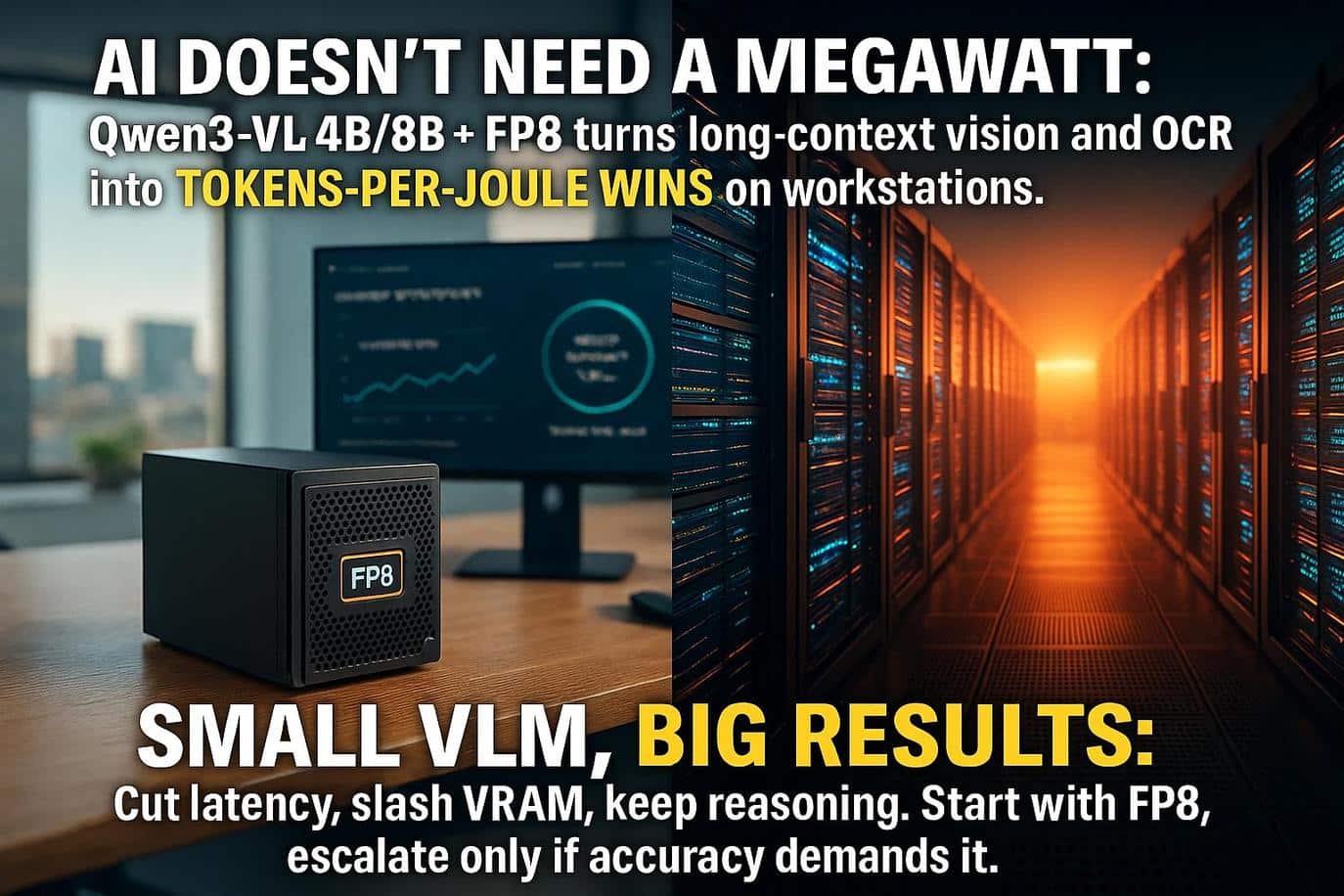
Key Specifications of the Qwen3-VL 4B/8B Release
Before diving into the detailed implications of FP8, it is helpful to understand the core specifications of the Qwen3-VL 4B/8B release. These quick facts summarize the model’s capabilities and target deployment environment for easy reference.
- What dropped: Qwen3-VL dense models at roughly 4.8B and 8.7B parameters, each in Instruct and Thinking variants, plus FP8-quantized checkpoints suitable for low-VRAM serving.
- What they can do: Multimodal understanding across images, documents, and video, with 256K tokens of context that can extend to 1M in the broader family. The Thinking variants apply multi-step reasoning when a prompt is complex.
- Why FP8 matters: FP8 is a low-precision floating format designed to reduce memory movement and boost throughput while preserving accuracy for many workloads. It can lower cost per token and improve energy efficiency compared with FP16 or BF16 in the right pipelines.
- Who should care: Teams that want strong multimodal capabilities without building or renting a megawatt datacenter. These models are candidates for workstations, small clusters, and regional clouds.
These core specifications confirm the model’s focus: delivering highly capable, long-context multimodal intelligence within an affordable, energy-conscious hardware footprint. This positioning directly contrasts with the infrastructure demands of massive exascale systems.

What Exactly Did Alibaba Release with Qwen3-VL 4B/8B FP8?
Qwen3-VL is part of the wider Qwen3 family of open models that span tiny to very large sizes and cover text, vision, and audio. Alibaba’s new release presents dense, compact vision-language models with approximately 4.8 billion and 8.7 billion parameters. Being ‘dense’ means that all parameters remain active during inference, avoiding selective routing found in a mixture-of-experts design. This architectural choice delivers predictable latency and enables simpler deployment, making it ideal for small servers and edge computing systems.
The Qwen3-VL models are released in two distinct modes: Instruct and Thinking variants. The Instruct variant is designed to follow conversational directions directly, while the Thinking variant allocates more internal multi-step logic to break down complex questions before generating an answer. This approach aims to recover some of the reasoning quality associated with larger models without significantly increasing memory requirements.
Long Context and Multimodal Reasoning
According to a Qwen3 technical report on thinking and non-thinking modes, these models offer a truly long context window as a headline capability. The core family supports 256K tokens, with related configurations capable of reaching 1M tokens—a feature extremely useful for analyzing long PDFs, complex multi-image narratives, or full video transcripts. The vision component reads images and video frames, performs robust optical character recognition across many languages, and accurately grounds text to specific objects and regions. It can also follow user interface elements, which helps with desktop or mobile agent tasks.
FP8 Checkpoints for Toolchain Optimization
Alibaba also published FP8 checkpoints for these models, which store weights in FP8 and are specifically intended for toolchains that understand and utilize FP8 kernels. In practice, that means serving with optimized backends such as vLLM or SGLang while standard libraries continue to expand their FP8 support. The practical outcome is lower memory per parameter and higher arithmetic density, two levers that make small models feel fast and affordable.
FP8 Precision: The Key to Faster, More Energy-Efficient AI Inference
Moving tensors between memory and compute units consumes the largest share of time and energy within modern transformer architectures. The FP8 format addresses this by shrinking those tensor sizes. Critically, it still maintains sufficient numerical range for stable training and inference, achieved through careful calibration and scaling techniques. On hardware with FP8-aware tensor cores, the format can increase throughput and shrink memory footprints with minimal impact on quality for many tasks.
Benchmarking Performance and Throughput Gains
Publicly available reports help quantify the gains achieved by using FP8.
Cloud benchmarks on H100 systems show AWS Sagemaker data on FP8 training speed compared with BF16 in well-tuned pipelines. Independent studies on Intel Gaudi2 report higher tokens per second per watt for FP8 inference compared with higher-precision baselines. NVIDIA’s engineering notes further demonstrate FP8 precision’s impact on GPU training throughput across modern GPU platforms.
Across hardware vendors, this pattern remains consistent: FP8 acts as an effective bridge between traditional floating-point formats and aggressive quantization. It successfully unlocks performance headroom without introducing the instability common with very low bit integers.
Compounding Benefits for Compact VLMs
For small multimodal models, FP8 support compounds the benefits of a compact parameter count. Lower precision reduces the working set, so more of the model fits in fast memory, and the system spends less time shuttling data. That is how a 4B or 8B model can deliver responsive long-context reading and image understanding on modest hardware. The same principle is now scaling up, with 1-bit and ternary quantization shrinking 27B-class models to run on laptops and phones.
This efficiency trend also appears in China’s FP8 research and engineering roadmaps for domestic accelerators.
Megawatts vs Megapixels: Exascale AI Compared to Compact FP8 Models
Exascale supercomputers like JUPITER in Europe and Google’s latest AI systems deliver extraordinary throughput for national research, weather, and frontier AI. Furthermore, they operate in the multi-megawatt range, demanding dedicated sites, advanced cooling infrastructure, and long procurement cycles. While that sheer scale is justifiable when a country trains frontier-class models or executes compute-heavy science, it represents a fundamental mismatch for a production team requiring reliable document analysis, video comprehension, or responsive agent control.
Compact FP8 models such as Qwen3-VL 4B/8B embody a fundamentally different design philosophy. They can run on workstations, mini-AI servers, or small regional clusters, enabling them to read long PDFs, translate on-screen elements, and analyze short video clips with timestamps. Latency is predictable because the models are dense, and cost is tractable because FP8 reduces memory and bandwidth pressure.
The key consideration moves beyond the mere impressiveness of exascale: does your specific workload benefit more from proximity, local control, and rigorous power discipline? Many operations would rather keep inference close to users, align runtime with renewable energy windows, and scale horizontally with modest nodes than depend on a single megawatt facility. Hardware choices at the rack level further shape deployment strategies for compact FP8 models.
China’s FP8 Stack: DeepSeek V3.1, GaN Racks, and Qwen3-VL 4B/8B
DeepSeek V3.1: FP8 Microscaling and the China Chip Angle
DeepSeek V3.1 popularized a practical form of FP8 inference that many teams could adopt without rewriting their entire stack. DeepSeek’s approach utilizes calibrated scaling, which allows sensitive layers to maintain stability while the majority of the computational load runs efficiently at FP8. DeepSeek’s work demonstrated that it is possible to lower power and memory pressure while still producing strong results on language and reasoning tasks.
Nvidia Bans, GaN 800VDC Racks, and Whole-Rack Efficiency
Export controls restricted access to Nvidia’s top data center parts inside China. This restriction effectively shifted the design focus from optimizing single chips to engineering whole-rack systems, prompting operators to lean into GaN power electronics and 800 volt direct current distribution to reduce conversion losses and heat. High-voltage buses and efficient rectifiers enable a rack to deliver more usable power to accelerators while minimizing thermal overheads.
Where Qwen3-VL 4B/8B FP8 Fits
These compact FP8 models complement the rack-level engineering push. They significantly reduce memory demands per instance and maintain moderate bandwidth needs, allowing a cluster to efficiently schedule more concurrent jobs without link saturation. The long context window and robust vision pipeline allow these models to do real work on document ingestion, user interface automation, and short-form video analysis. When paired with domestic accelerators and high-efficiency racks, a dense 4B or 8B instance becomes a building block for production systems that value local control, predictable latency, and disciplined power budgets.

Right-Sized Intelligence: What Small FP8 VLMs can do for Everyday Compute
Small VLMs are most effective when the job demands reliable perception, long context, and steady latency, rather than simply chasing peak leaderboard scores; the specific scenarios detailed below demonstrate where Qwen3-VL 4B/8B FP8 inference proves to be the superior fit.
Local Document Intelligence
Teams that process contracts, manuals, or medical notes benefit from keeping data close to home. A workstation or small cluster can host a Qwen3-VL instance that skims long PDFs, extracts tables, and flags sections for human review. Because the FP8 working set ensures higher throughput per dollar, the dense architecture delivers consistent response times. Next-generation DIMMs are now enabling memory-rich desktops, which significantly aids this local processing capability, as demonstrated by new hardware for high-memory mini AI builds.
Screen and GUI Automation
Product support and internal tooling often require models that can follow on-screen elements, read small text, and act with precision. Qwen3-VL tracks interface components and ties them to instructions. That makes it suitable for semi-automated workflows such as filling forms, checking dashboards, or walking a user through a configuration. The model’s compact size allows developers to iterate quickly on features and deploy updates without the need to retrain a colossal Mixture-of-Experts (MoE) system.
Short-Form Video Understanding
Security teams, educators, and field operators rarely need hours of footage analyzed in one pass. Qwen3-VL can index short clips, map text to timestamps, and answer targeted questions about what happened in a scene. FP8 checkpoints help keep frame processing efficient so that a modest node can support multiple concurrent users.
Edge and Regional Nodes
Cities, factories, and labs increasingly prefer regional nodes that respect data residency and resilience. A practical hardware primer on right-sized mini AI supercomputers like DGX Spark and Strix Halo pairs naturally with compact FP8 VLMs.
A compact FP8 VLM fits into these nodes without stressing power and cooling. Operators can schedule heavier inference to take advantage of periods when a region experiences a renewable energy surplus, confident that the model will utilize this window effectively. Urban planners are able to integrate these deployments with initiatives designed to make carbon-smart cities more responsive to both demand and emissions signals, a strategy discussed for carbon-smart cities, AI, and IoT strategies to cut emissions.

From FinOps to GreenOps: Integrating FP8 Models into Carbon-Aware Dashboards
While FinOps successfully taught teams to measure cost for every workload, GreenOps fundamentally extends that practice by measuring carbon impact. The same dashboards that track spend by region and hour can also track kilograms of CO₂ per thousand tokens and show how workload placement, model choice, and precision affect emissions.
These operational dashboards, which currently track spend by region and hour, can be extended to monitor kilograms of CO₂ per thousand tokens, directly showing how workload placement, model choice, and precision impact emissions. This granular data empowers teams to make carbon-aware deployment decisions in real time.
Model Choice is a Climate Choice
Switching from BF16 to FP8 reduces both the bytes moved and the math energy consumed per token in well-calibrated pipelines, an effect that is compounded when selecting a compact dense model. The result is fewer watt-hours per answer without giving up the ability to read long documents or understand images. Making this choice visible on a dashboard empowers teams to adopt a default policy favoring small FP8 models for routine tasks, escalating to larger models only when clear evidence demonstrates their superior value.
Aligning Inference with Clean Energy Windows
Modern schedulers can align non-urgent inference with periods of higher renewable penetration. Given that compact FP8 models have modest power draw, a greater number of instances can be shifted into those clean energy windows without overloading the local feeder or battery system. Over a quarter, that policy results in a measurable reduction in emissions while keeping service quality intact. Residential demand-side programs achieve similar effects at smaller scales, exemplified by UK green homes that successfully ease peak demand on the grid.
Making it Actionable Inside the Tooling
The principle of GreenOps proves effective when teams possess the ability to act directly upon the data provided. Dashboards should expose toggles for model size, precision, and placement. Observability should report tokens per joule and demonstrate when FP8 is providing stability and performance comparable to BF16. A concise runbook allows engineers to determine the optimal time to stick with small models and when a larger model escalation is justified for a specific job requirement.

Optimizing AI’s Footprint: The Final Verdict on Compact FP8 VLMs
The principle that greater size is not inherently better is powerfully demonstrated by Alibaba’s Qwen3-VL 4B and 8B FP8 models. These compact models showcase how combining careful engineering with the correct numeric format can deliver significant multimodal intelligence without requiring a megawatt operational footprint. They read long documents, follow interfaces, and make sense of short video clips while fitting into workstations and small clusters.
This shift signals a crucial inflection point where performance gains are achieved not by scaling parameter counts, but by optimizing the underlying computational efficiency. The broader picture is complex and critically important.
China’s intensive push toward rack-level efficiency, combined with the emergence of domestic accelerators and the increased deployment of right-sized servers, illustrates how software and hardware co-evolve to meet new market demands. FP8 functions centrally within this narrative, serving as a practical, multi-faceted lever that optimizes speed, cost, and carbon efficiency across the entire stack.
With the maturation of GreenOps, model choices will take their place alongside region and time controls on the operations dashboard, firmly establishing compact FP8 VLMs as the logical default for routine everyday work and a benchmark for sustainable AI deployment.
Practical Questions: FP8 Models, GreenOps, and Deployment
Is FP8 reliable enough for production use?
Yes, for many workloads. With proper calibration, FP8 can match BF16 quality while significantly reducing memory and compute requirements.
Can Qwen3-VL 4B/8B run on a single GPU?
In most cases, yes. The FP8 checkpoints and compact parameter count allow single high-memory GPUs or small dual-GPU nodes to serve real tasks efficiently.
When is a very large model still necessary?
Larger dense or MoE models are needed for frontier-level reasoning, high-stakes open-domain Q&A, or complex multi-step planning beyond a smaller model’s scope.
Is a smaller model always cheaper and greener?
Usually, but not always. Gains depend on the serving stack, batch sizes, hardware support for FP8, and the specific workload.
How should GreenOps be integrated in practice?
Add carbon telemetry to existing FinOps dashboards. Make model size and precision a first-class control, starting small and aligning non-urgent inference with clean energy windows.


