
Rice is the most water-hungry staple crop on Earth, and it is also one of the most drought-sensitive. So it is an uncomfortable irony that one of the hormones that helped rice yields climb over the past half century appears to switch off part of the plant’s own drought protection.
That is the conclusion of a new study from the Chinese Academy of Sciences, published in Molecular Plant. A team led by Wang Bing at the Institute of Genetics and Developmental Biology, working with Li Jiayang’s group and the Yazhouwan National Laboratory, found that the strigolactone drought response is inverted from what breeders would want: the hormone acts as a negative regulator of drought resistance in rice. In plain terms, the hormone that helps the plant produce more tillers and more grain also weakens its ability to survive a dry spell.
The researchers traced the effect down to a single chain of four molecular steps, then showed that a rice line with only moderately reduced strigolactone content yielded 36.7% more grain than controls under drought stress. Their results also explain why upland rice, the drought-tolerant cousin of paddy rice, may have already solved part of this problem through natural selection.
Why a Yield Hormone Became a Drought Problem
Strigolactones are not obscure chemistry. They are a family of plant hormones best known for two jobs: controlling how many tillers a rice plant produces and signaling to beneficial fungi in the soil. Because tiller number strongly influences the number of grain-bearing panicles, strigolactone has been a quiet target of rice breeding for decades.
A well-known example is HTD1, a strigolactone biosynthesis gene. A naturally occurring variant of HTD1 in the widely grown Chinese variety Huazhan turned out to be a significant contributor to that variety’s high tillering and high yield, a finding published in Molecular Plant in 2020. In other words, breeders were already tuning this strigolactone drought pathway, sometimes without framing it as hormone work at all.
What was missing was a clear answer about drought. Earlier work had hinted that strigolactones could support drought resistance, which seemed to point the opposite way from the new findings. The Chinese team set out to resolve the contradiction using physiology, biochemistry, and genetics together.
The resolution is a matter of timing. A rice plant that is briefly short of water makes less strigolactone in its roots. That drop is not a failure. It is the plant releasing a brake. When strigolactone levels fall, a defense program switches on, and the plant becomes measurably harder to kill with drought.
Inside the Mechanism: Four Steps, One Rescue Gene
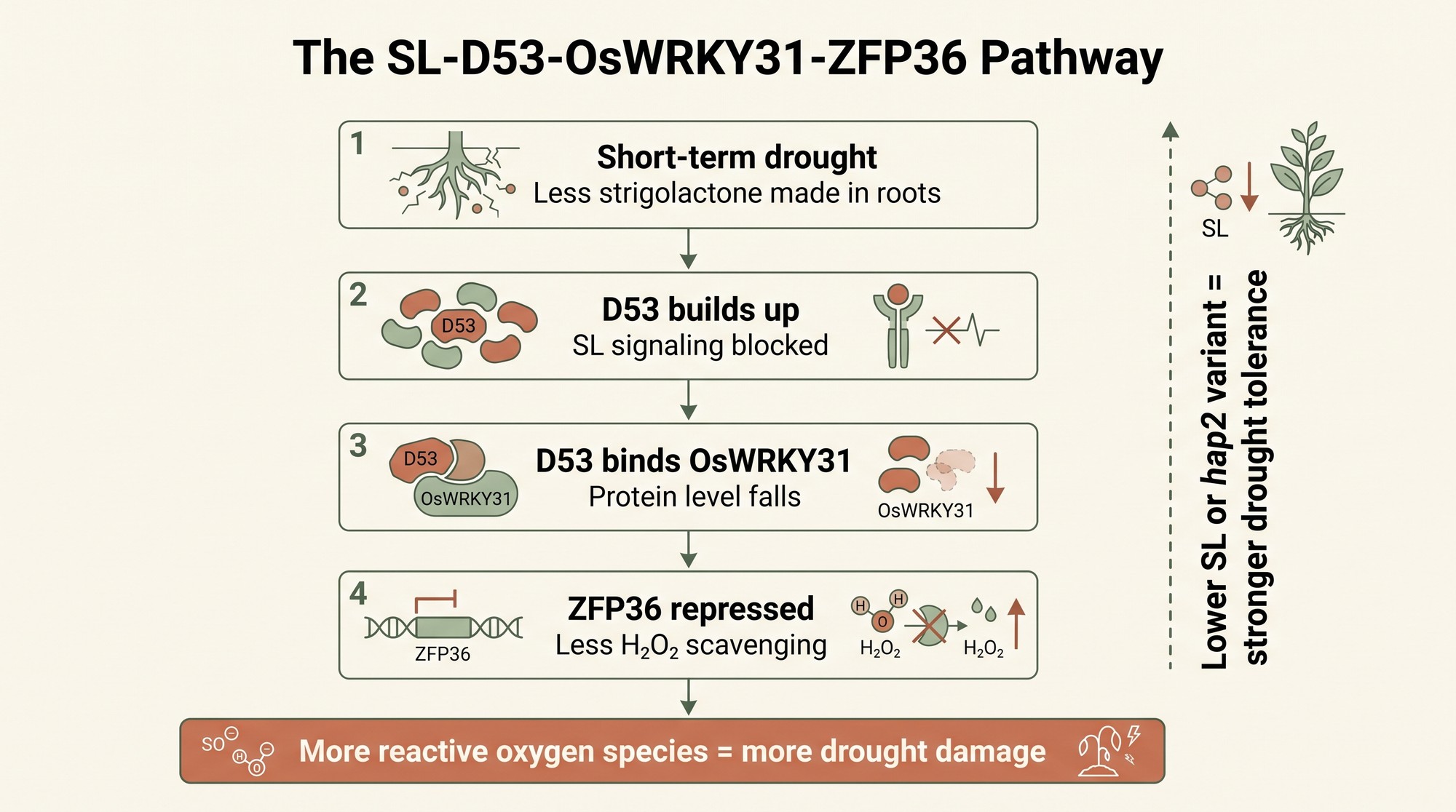
The value of the study is that it names every step between the hormone and the plant’s ability to cope with dry soil. The authors describe it as the SL-D53-OsWRKY31-ZFP36 pathway, and it works like a set of falling dominoes.
- Step one: less hormone. Short-term drought reduces strigolactone synthesis in rice roots, so the hormone’s signal weakens.
- Step two: D53 accumulates. D53 is a repressor protein that strigolactone signaling normally marks for destruction. With less signal, D53 builds up, which further dampens the pathway.
- Step three: OsWRKY31 is suppressed. D53 uses its N-terminal domain to interact with the transcription factor OsWRKY31, and that interaction decreases the amount of OsWRKY31 protein in the cell.
- Step four: ZFP36 gets repressed. OsWRKY31 normally binds the promoter of ZFP36, a zinc finger protein gene, and represses its transcription. Fewer OsWRKY31 proteins means less repression, so ZFP36 can be expressed.
The same chain can be read as a switch that short-term water loss flips in the plant’s favor. The table below sets out what each step does and what happens when the pathway is pushed in the opposite direction.
| Step in the pathway | What happens under short-term drought | Effect on drought survival |
|---|---|---|
| Strigolactone synthesis in roots | Falls | Improves it, because the brake is released |
| D53 repressor protein | Accumulates and blocks SL signaling | Improves it, because signaling is suppressed |
| OsWRKY31 transcription factor | Protein abundance drops after interacting with D53 | Improves it, because the repressor of ZFP36 is weaker |
| ZFP36 zinc finger gene | Expressed, since OsWRKY31 is no longer silencing it | Improves it through hydrogen peroxide scavenging |
| Reactive oxygen species balance | Held in check rather than allowed to spike | Improves it by limiting cellular damage |
ZFP36 is the payoff. The protein it encodes contributes to hydrogen peroxide scavenging and helps keep reactive oxygen species in balance. Reactive oxygen species are normal byproducts of plant metabolism, but under drought they pile up and damage membranes, proteins, and DNA. A plant that clears them quickly survives stress that would otherwise leave it wilted and sterile.
Read the chain in reverse, and the study’s logic becomes intuitive. Activate strigolactone signaling, and D53 is destroyed, OsWRKY31 stays abundant, ZFP36 is silenced, hydrogen peroxide accumulates, and the plant suffers. The team confirmed this in both directions: disrupting strigolactone biosynthesis or signaling raised drought resistance, while activating the signaling pathway or applying the synthetic strigolactone analog GR244DO made plants less drought tolerant.
The 36.7% Yield Gain and What It Actually Measured
The headline number from the study is a 36.7% increase in grain yield under drought stress. It is a genuine and striking result, and it deserves careful framing rather than a victory lap.
The figure comes from a near-isogenic line, a breeding term for a plant that is genetically almost identical to a standard variety except for one small region of the genome. In this case the line carried a specific allele of the strigolactone biosynthesis gene HTD1, labeled HTD1HZ, and it had moderately reduced strigolactone content rather than none at all.
That distinction matters for three reasons:
- It is one set of drought evaluations, not a multi-season, multi-site field trial program. The result has not yet been repeated across years and locations, which is the standard required before a line is considered agronomically proven.
- The line was not empty of strigolactone. It carried a partial reduction, which is precisely why it kept its plant architecture while gaining stress tolerance.
- It also outperformed controls under normal, well-watered conditions. That detail is easy to overlook but is arguably the most useful part of the finding, because a drought gene that costs yield in a good year is a hard sell to any farmer.
Independent context helps calibrate the stakes. A meta-analysis of drought impacts compiled in the OECD’s Global Drought Outlook found an average rice yield loss of 25.4% during drought episodes, with losses below 13% in mild droughts and above 34% in severe ones. A separate 2025 analysis in Science Advances estimated that droughts cut global rice yields by about 8.1% in an average affected year. Against that backdrop, a 36.7% gain in a drought-stressed trial is a large effect, not a marginal one.
Drought also does something more specific than reduce grain number. It lowers the proportion of grains that fill with starch, which is why drought trials track filled grain percentage and thousand-grain weight alongside total panicle count.
Upland Rice Already Found the Answer
The most persuasive evidence in the paper is not a laboratory construct. It is a comparison between two kinds of rice that farmers have grown for generations.
Upland rice is adapted to dry, well-drained soils and is notably more drought tolerant than paddy rice. The researchers compared IRAT109, a drought-tolerant upland variety, with Nipponbare, a standard paddy variety. IRAT109 roots contained significantly less strigolactone, and the gap widened under drought stress.
They then found something more useful for breeders. OsWRKY31 haplotype 2, known as hap2, is enriched in upland rice and has been selected for over the crop’s history. It correlates positively with drought resistance. The reason is written into the DNA: two single nucleotide polymorphisms in hap2 reduce both the transcription and the translation efficiency of OsWRKY31. Less OsWRKY31 protein means less repression of ZFP36, which means better hydrogen peroxide clearance and a harder plant to kill with drought.
This is a different route to the same destination. Instead of lowering the hormone, hap2 weakens the gene that relays the hormone’s suppressive message. That gives breeders two independent dials, and haplotypes like hap2 are attractive because they arise from existing genetic variation rather than from a laboratory edit.
The Breeding Trade-Off Nobody Gets to Skip
Here is where enthusiasm needs a brake. Strigolactone is not a weed. It is one of the hormones that shapes the rice plant’s architecture, and architecture is what determines how much grain a field can hold.
The pathway controls tiller bud outgrowth, and tiller number sets the number of panicles, which in turn sets the number of grains. Suppress strigolactone too aggressively, and a plant may respond by producing more tillers that compete with each other, develop later, and set fewer filled grains. Push further and other traits drift too: the same 2020 work on HTD1 documented lines with more tillers but a reduced seed-setting rate.
The HTD1HZ allele appears to dodge that problem because its activity is “leaky.” It reduces strigolactone enough to partially release the brake on tiller outgrowth while still producing enough hormone for normal panicle development. That is the real lesson of the paper: the useful intervention is a moderate, calibrated reduction, not a knockout.
| Approach | Effect on strigolactone | Likely drought outcome | Likely yield risk |
|---|---|---|---|
| Full knockout of SL biosynthesis | Near zero | Strong drought resistance in controlled tests | High: plant architecture and seed setting can degrade |
| Partial reduction (HTD1HZ near-isogenic line) | Moderate | 36.7% higher grain yield under drought in the study | Low in the tested background, but not yet validated across sites |
| OsWRKY31 hap2 haplotype | Unchanged hormone level | Positive correlation with drought resistance | Lower in principle, since the hormone’s yield role is preserved |
| External strigolactone analog (GR244DO) | Increased signaling | Reduced drought resistance | Not a field strategy; used to confirm the mechanism |
The hap2 route is the most intriguing for that reason. Because it leaves hormone levels alone and instead dulls the downstream repressor, it has a plausible chance of improving drought survival without touching the machinery that breeders spent decades optimizing for yield. That is a hypothesis the paper supports but does not prove in the field, and it is the strongest breeding argument in the study: a route to drought tolerance that leaves the strigolactone pathway’s tillering and yield function largely intact.
Why This Matters Beyond One Crop
Rice feeds nearly half the world’s population, and it is unusually exposed to water shortages because paddy systems depend on reliable flooding. That makes rice’s drought response a food security question rather than an agronomic footnote.
Most drought breeding strategies chase a single added trait: deeper roots, earlier maturity, osmotic adjustment, or reduced transpiration. This study points at something less obvious. A plant’s stress response can be actively held down by hormones that serve other priorities, and releasing that brake may achieve more than adding a new defense, because the defense is already there.
The finding also comes with a real limit on how far it travels. Strigolactone function in drought is species-specific: in rice, pathway mutants show greater drought resilience, while in some other plants, stronger strigolactone signaling has been linked to better tolerance through changes in stomatal density, cuticle permeability, and abscisic acid sensitivity. The authors describe a rice pathway, not a universal rule, which makes wheat, sorghum, and maize the obvious places to test how much of the module carries over. The wider question is whether other hormone-driven yield gains rest on a similar hidden trade-off. Research on RNA demethylation that lifted rice and potato yields raised the same point from another angle: pushing growth harder does not automatically make a crop more resilient.
The Hurdles Between a Paper and a Field
The research used gene editing to knock out strigolactone pathway genes, and the editing improved drought resistance in Nipponbare, Huazhan, and IRAT109. That is a laboratory demonstration, not a commercial product.
Regulation remains a serious obstacle. Under a 2018 European Court of Justice ruling, crops produced with newer gene-editing techniques are regulated as genetically modified organisms in the European Union. The United States takes a lighter, product-based approach under its SECURE rule and exempts many edited crops that contain no foreign DNA. Japan, the United Kingdom, Canada, India, the Philippines, Kenya, and Nigeria have adopted variants of this product-based stance for some categories of edits.
That patchwork means a drought-tolerant rice developed through editing might face a straightforward path to market in one country and a decade of regulatory review in another. Breeding routes that rely on existing variation, such as hap2 or the HTD1HZ allele, sidestep the gene-editing question entirely and can often be moved through conventional crosses.
There is also the honest matter of what the paper does not show. A single near-isogenic line in a drought evaluation is a strong signal, not a guarantee. Multi-season and multi-location trials, testing in different genetic backgrounds, and checks on grain quality and disease response all remain to be done.
Related work on plant stress signaling has already shown that hormones can be used to prime crops for harder conditions, including research suggesting salicylic acid could help plants withstand climate change. The strigolactone finding is a useful counterpart because it identifies a pathway where the goal is to lower a signal rather than add one.
Frequently Asked Questions
What is strigolactone in rice?
Strigolactones are plant hormones that regulate tiller bud outgrowth, shape plant architecture, and signal to symbiotic fungi in the soil. In rice, they strongly influence the number of tillers and therefore the number of grain-bearing panicles, which is why breeders have long cared about the pathway.
Does strigolactone increase or decrease drought tolerance in rice?
According to this study, strigolactone decreases drought tolerance. It suppresses a hydrogen peroxide scavenging gene called ZFP36 through the D53-OsWRKY31 step, so higher strigolactone signaling leaves the plant less able to clear reactive oxygen species during a dry spell.
Is there drought-proof rice?
No. No rice variety is immune to drought, and the lines described in this study are drought-tolerant in a relative sense, meaning they lose less yield than comparable plants under stress. Calling any variety drought-proof would misrepresent both the science and the field reality.
Will reducing strigolactone lower rice yields?
It can if the reduction is too severe. Strigolactone controls tillering and panicle development, so a full knockout can disturb plant architecture and seed setting. The promising result in the study came from a line with a moderate reduction, and that line also outperformed controls under well-watered conditions.
Can farmers use this finding now?
Not yet. The work identifies genes, alleles, and haplotypes for molecular breeding programs, but the near-isogenic line has only been evaluated in the study’s drought trials. Seed for farmers would require multi-site trials, varietal development, and in some cases regulatory approval for edited lines.
What is the OsWRKY31 hap2 variant?
It is a version of the OsWRKY31 gene enriched in upland rice. Two single nucleotide polymorphisms in hap2 reduce how efficiently the gene is transcribed and translated, which lowers OsWRKY31 protein levels, releases repression of ZFP36, and correlates with stronger drought resistance.
The Bottom Line
The discovery is not that rice has a drought gene, but that its drought defense is being held down by a hormone prized for yield. Wang summed up the implication plainly: “The identified genes, haplotypes, and elite alleles offer effective targets and strategies for breeding drought-resistant, water-saving, high-yield rice.”
What makes the finding usable is its precision. The researchers did not simply recommend removing strigolactone. They identified the intermediate steps, found a natural variant in upland rice that works through a different link in the chain, and showed that a moderate reduction in the right genetic background can deliver both drought tolerance and stable yield.
The next few years of field trials will decide how much of that promise survives contact with real farms. For a crop that feeds nearly half the world and drinks more water than almost any other, it is a question worth answering carefully.


