
A team at the University of Surrey has printed flexible perovskite solar mini-modules at just over 18 percent efficiency without using the toxic solvents that printable perovskite inks have depended on for more than a decade. On paper, that efficiency figure is unremarkable. In a factory, it may matter far more than any small-area record.
The research, published in Nano Energy and announced by the university on 15 October 2026, replaces dimethylformamide, N-methyl-2-pyrrolidone, and acetonitrile with an ink built from ethanol and a bio-derived solvent called 2-methyltetrahydrofuran. The team coated the ink at room temperature and dried it with a jet of gas, steps compatible with the roll-to-roll printing used to make newspapers. The finding lands squarely in the part of perovskite solar manufacturing that rarely makes headlines, which is not how efficient a cell can be but whether a production line can be run safely and at scale.
What the Surrey team actually made
Perovskites are crystalline materials that can be dissolved into a liquid ink, coated onto a surface, and dried into a thin film that absorbs sunlight. That is their commercial appeal: unlike silicon, which has to be grown at high temperature and cut from ingots, a perovskite layer can in principle be printed onto flexible plastic or glass in a continuous process.
The Surrey group formulated what they call a significantly reduced-toxicity solvent system, built around ethanol and 2-methyltetrahydrofuran, the latter derived from renewable sources such as farm and forestry waste. A small amount of a milder additive controls how the film forms as it dries. The resulting ink was used to coat mini-modules with active areas up to 11.5 square centimetres, reaching power conversion efficiencies above 18 percent, with the headline result reported as 18.2 percent.
Three process details matter as much as the number:
- Room-temperature coating. The ink is deposited without heating, removing an energy-intensive step from the line.
- No anti-solvent bath. Many perovskite recipes rely on a secondary solvent treatment to force the film to crystallise evenly, a step that introduces yet more hazardous chemicals. Surrey’s ink skips it and dries in a gas jet instead.
- Roll-to-roll compatibility. Bar coating, the lab technique used, is the same family of process as the continuous coating used in industrial printing, and the devices were built on flexible substrates.
The work was led by Surrey with collaborators at the University of Oxford, the University of Cambridge, the Helmholtz-Zentrum Berlin, the MAX IV Laboratory in Sweden and the National Physical Laboratory, and was supported by the Engineering and Physical Sciences Research Council and the EU Horizon 2020 project MUSICODE.
That stability question is the one the wider field has been wrestling with for years. Earlier work on treating perovskite interfaces to make cells more reliable attacked the problem from the encapsulation and materials side; the Surrey paper attacks it from the ink chemistry side, and both are needed before a panel can be sold with a warranty.
Why DMF and acetonitrile are used at all
Dimethylformamide, usually shortened to DMF, is a workhorse of solution-processed electronics. It dissolves lead halide salts and organic precursors exceptionally well, it can be blended with other solvents to tune how quickly a film dries, and it produces smooth, uniform crystals. Acetonitrile plays a similar role in some ink formulations, helping precursors stay in solution and encouraging rapid drying. N-methyl-2-pyrrolidone, or NMP, has also been widely used in the field.
The problem is not performance. It is that these solvents are hazardous to the people who handle them and to the environment around a plant. Under European chemicals regulation, DMF, NMP and dimethylacetamide are listed as substances of very high concern because of reproductive toxicity, and they carry the warning that they may damage the unborn child. Since 12 December 2023, DMF has been subject to restriction in the EU, with exposure limits set at 6 mg per cubic metre by inhalation and 1.1 mg per kilogram of body weight per day through the skin.
In a fume cupboard in a university basement, that is manageable. On a coating line running continuously, it is a completely different proposition.
The number that reframes the whole debate: 90,000 litres
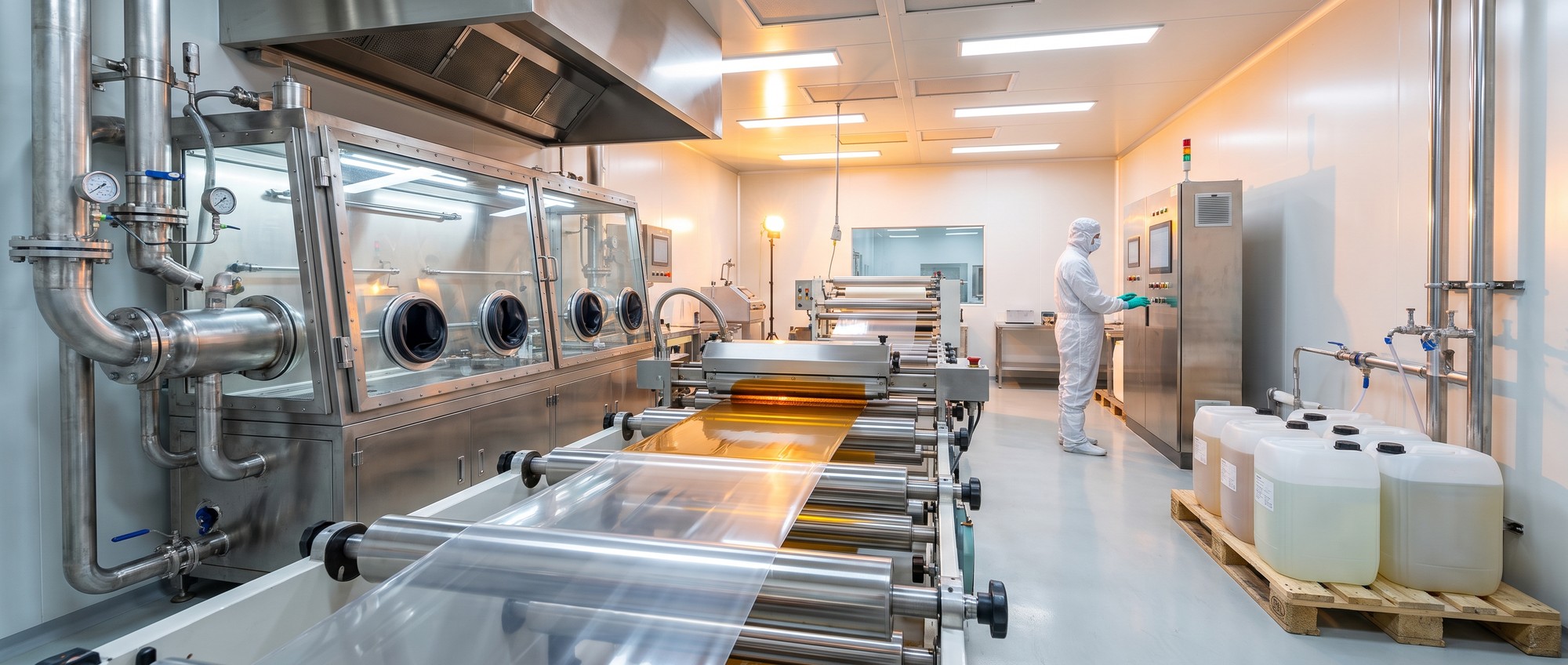
The Surrey release contains one figure that deserves more attention than the efficiency result. Producing a gigawatt of electricity from these perovskite modules can consume more than 90,000 litres of solvent on a single coating line.
To put that in perspective, 90,000 litres is roughly a tenth of an Olympic swimming pool, consumed repeatedly as the line runs. Every litre of it has to be bought, stored, pumped, recovered or disposed of, and every worker who comes near the coating head has to be protected from it. A solvent that is merely annoying in a laboratory becomes an industrial-scale logistics and liability problem.
That single sentence explains why the quiet chemistry in Surrey’s paper is more commercially significant than yet another efficiency headline. The industry does not have a problem making high-efficiency perovskite cells in square millimetres. It has a problem making them economically and safely in square metres.
What replaced the toxic solvents, and why it is hard
Substituting a solvent sounds straightforward until you consider what the solvent has to do. It must dissolve the precursors completely, stay stable in the ink, wet the substrate evenly, and then evaporate at just the right speed. Too slow, and the film dries unevenly. Too fast, and the perovskite crystallises badly, leaving defects that trap charge carriers and cut efficiency.
Ethanol is an obvious candidate on safety grounds: it is widely used, well understood and far less hazardous than DMF. But ethanol alone dries too quickly and dissolves some precursors poorly. The Surrey solution pairs it with 2-methyltetrahydrofuran, a solvent that can be made from agricultural and forestry residues and which helps balance the drying behaviour while keeping the precursors in solution. The small amount of milder additive gives the team fine control over film formation, which is where most solvent substitutions fail.
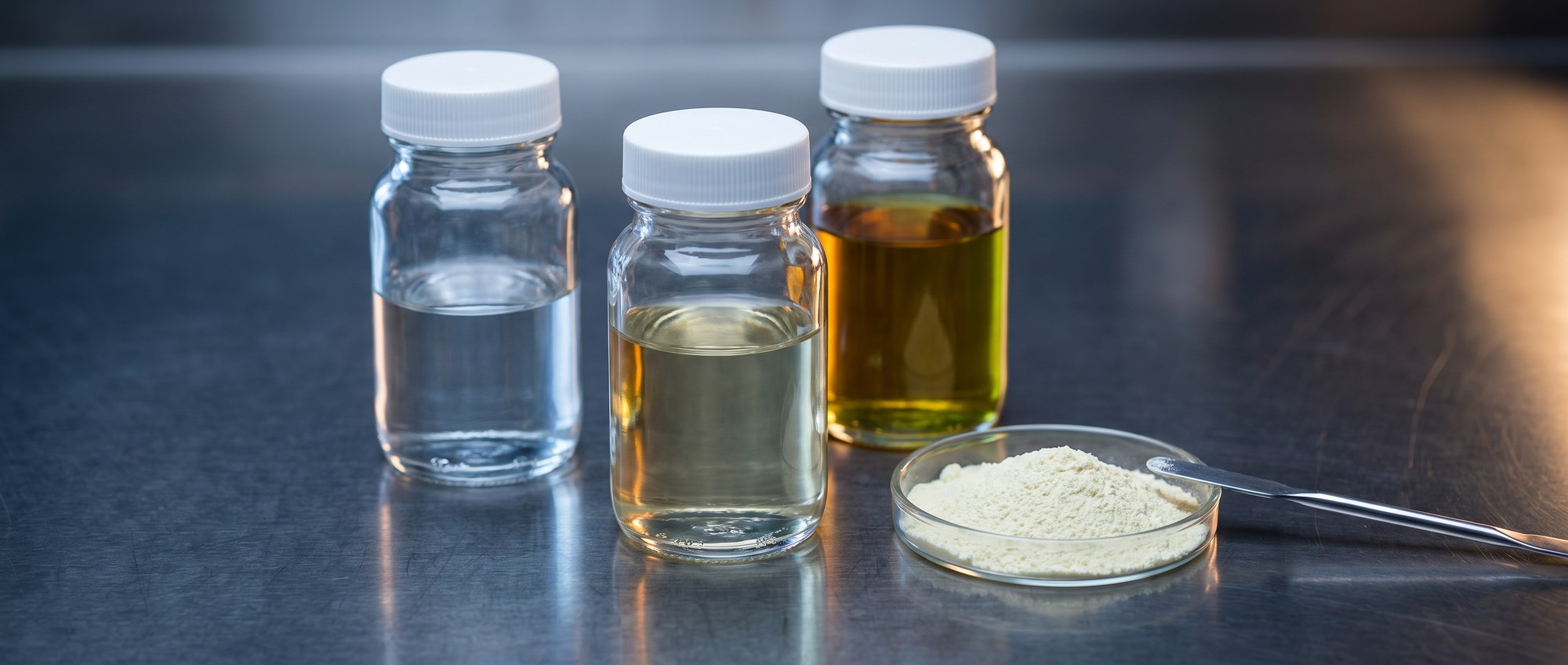
The result is an ink that is not merely less toxic by a small margin but one that removes an entire category of handling infrastructure. As the team’s own framing puts it, simpler solvent chemistry means less solvent handling, less waste treatment and less safety equipment to build and maintain.
This is not the only route being explored. A separate research effort, reported in Science and covered in the comparison below, used gamma-valerolactone, another bio-derived solvent, combined with 2-methyltetrahydrofuran and dimethyl sulfoxide. The convergence on 2-methyltetrahydrofuran across independent groups suggests it is becoming a common building block for greener perovskite inks.
Two studies, two very different claims: a comparison
Surrey’s paper arrived after a much larger demonstration in Science, and the two are easy to misread against each other. They used different coating methods, different module sizes and different certification routes. The table below sets out what each study actually demonstrated.
| Feature | University of Surrey (Nano Energy, 2026) | Wang et al. (Science, 2025) |
|---|---|---|
| Module area | 11.5 cm2 (mini-module, active area) | 7,200 cm2 (full-size module) |
| Reported efficiency | Above 18 percent (18.2 percent headline) | 17.2 percent total-area steady-state |
| Solvent system | Ethanol plus bio-derived 2-methyltetrahydrofuran, small milder additive | Gamma-valerolactone, 2-methyltetrahydrofuran and dimethyl sulfoxide |
| Toxic solvents removed | DMF, NMP and acetonitrile | DMF and comparable hazardous solvents |
| Coating method | Bar coating, roll-to-roll compatible, room temperature | Slot-die coating in ambient air with edge-protection strategy |
| Anti-solvent step | Not required | Surfactant added to stabilise drying at film edges |
| Substrate | Flexible | Rigid module |
| Efficiency certification | Not reported as independently certified | Certified by the US National Renewable Energy Laboratory |
| Reliability testing | Stable under continuous light in lab testing | Passed all IEC 61215 reliability standards, certified by TÜV Rheinland |
| What it proves | Safer ink chemistry works at a mini-module scale | A green ink can survive commercial module size and reliability testing |
The two studies are complementary rather than competitive. Surrey’s contribution is the ink: a formulation that removes three problematic solvents and the anti-solvent step on a process route that can be scaled. The Science paper’s contribution is proof that a greener ink can be pushed through to a commercially relevant module size and survive the reliability standards a product would need to meet. Neither one alone closes the gap to a factory, but together they map out the two halves of the problem.
Why 18.2 percent is not comparable to 17.2 percent
It is tempting to read the table and conclude that Surrey’s smaller module is better because its number is higher. That comparison does not hold, for three reasons.
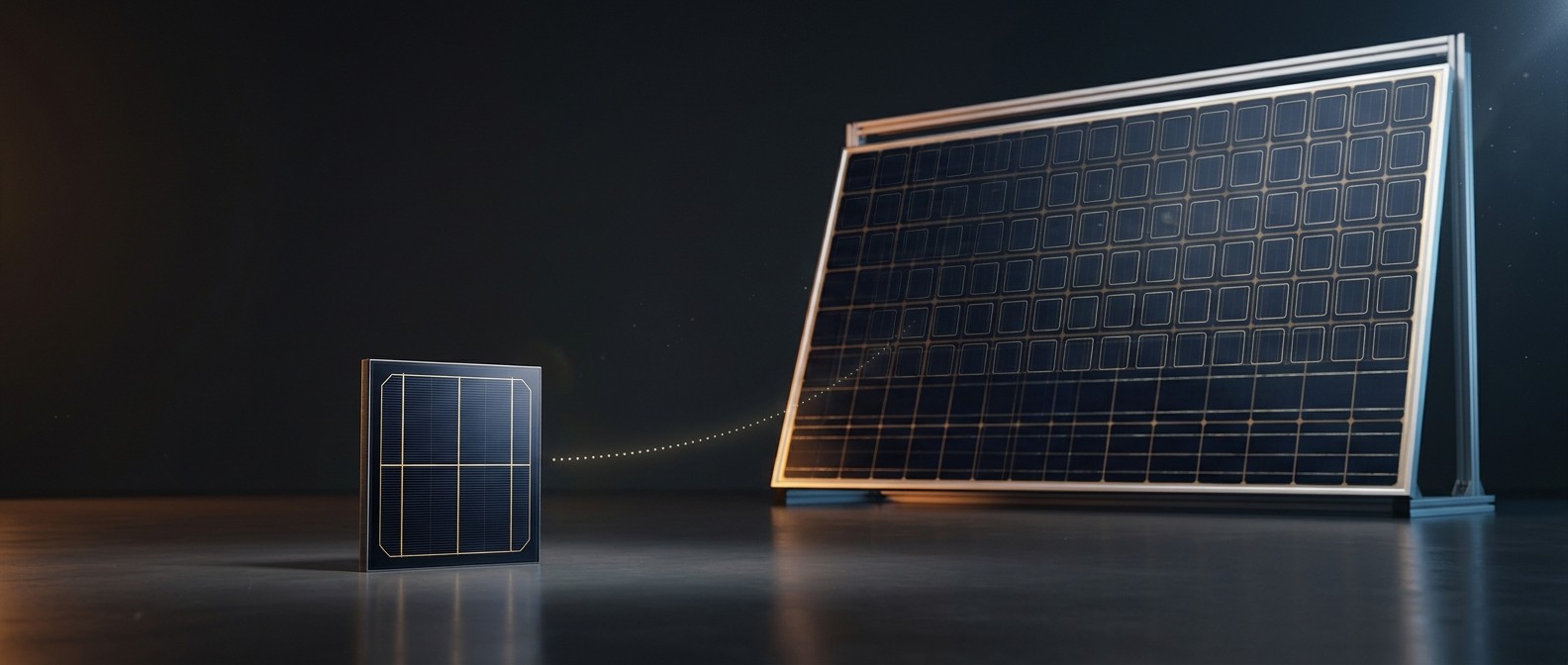
- Area. Surrey’s mini-module is 11.5 square centimetres. The Science module is 7,200 square centimetres, roughly 626 times larger. Efficiency losses grow with area because longer current paths add resistance and because any pinhole or thickness variation covers proportionally more of a large module.
- Measurement convention. The Science figure is a total-area steady-state efficiency, a deliberately conservative measure that includes the inactive gaps between sub-cells. Smaller devices are often quoted on active area only, which flatters the number.
- Certification. The 17.2 percent figure was measured independently by the National Renewable Energy Laboratory, and the module passed the full IEC 61215 suite certified by TÜV Rheinland. Those tests subject a module to damp heat, thermal cycling, mechanical load and humidity freeze. Surrey reports stability under continuous light in laboratory conditions, which is a different and much easier test.
In other words, the lower number belongs to the harder achievement. A realistic reading is that Surrey has shown its safer ink can produce respectable performance at a scale where manufacturability can begin to be assessed, while the Science work has shown that a different green ink can reach a genuinely commercial module size and pass product-level reliability tests. The obvious next step for the Surrey approach is to demonstrate the same chemistry at hundreds of square centimetres with independent certification. That step would make the two lines of work genuinely comparable for the first time.
Why module manufacturing is harder than making a good cell
The gap between a laboratory cell and a factory module is where most solar technologies stall. A record cell might measure a tenth of a square centimetre. A commercial module is several square metres and consists of many sub-cells connected in series, with each connection introducing a small dead area and a small resistance penalty.
The losses compound. Films must be uniform across the full width of the substrate, which becomes harder as the coating head widens. Conductive transparent layers add resistance over longer distances, so current collection has to be redesigned. Edges dry differently from centres, producing defects at the boundary. Reviews of the field have noted that most reported perovskite modules remain under 100 square centimetres and can lose around 30 percent of the efficiency of a comparable small cell.
There is also a whole set of steps that a laboratory cell never needs. The coated film has to be cut into individual cells by laser scribing, wired together through scribed contact channels, then sealed and encapsulated against the weather. Each of those steps adds equipment, yield risk and a way for the process to go wrong at speed.
Fully roll-to-roll fabricated perovskite modules, including printed back electrodes, have been demonstrated under ambient room conditions, which shows the principle works outside a glovebox. What has not yet been shown is that a safer ink performs identically on a line running metres of film per minute.
Green solvent chemistry adds a further constraint, because a safer solvent often behaves differently from the hazardous one it replaces. A formulation that works beautifully on a 1-centimetre slide may fail when the drying front has to travel across 60 centimetres of moving substrate. That is why the Science team’s edge-protection strategy, which used a surfactant to keep evaporation rates consistent near film edges, was as important as its solvent choice.

What this means for perovskite solar panels reaching the market
Readers searching for perovskite solar panels in 2026 will find few consumer products and a growing number of pilot lines. The most advanced is not a panel at all: a 250-metre film-type installation on the roof of a bus terminal at Expo 2025 in Osaka, made by Sekisui Chemical on a roll-to-roll line producing film 30 centimetres wide, with a one-metre-wide line targeted and a 100-megawatt factory planned by 2027. The technology’s route to market is most likely through tandem panels, where a perovskite layer sits on top of silicon to capture more of the solar spectrum. Early optimism about perovskite’s cost and processing advantages was well founded, but the path to market has proven longer than those first predictions suggested.
The solvent question cuts across all of those routes. A manufacturer planning a gigawatt-scale line has to satisfy environmental permitting and worker-safety regulation, and the economics are unforgiving: Silicon module spot prices have sat below 0.30 dollars per watt, while the most detailed cost model for fully roll-to-roll printed perovskite modules puts them at roughly 0.7 dollars per watt. It also has to meet the sustainability criteria of the buyers funding the plant. A process built on reproductive toxins requires enclosed handling, solvent recovery systems, monitoring and insurance. A process built on ethanol and a bio-derived solvent does not remove those requirements, but it shrinks them substantially.
That is why the Surrey result should be read as a manufacturing story. The efficiency number will be surpassed by other groups within months, as it always is in photovoltaics. The demonstration that a high-performing ink can be made without DMF, NMP and acetonitrile, and without an anti-solvent bath, is the kind of result that changes what a factory looks like.
The open questions that remain
Neither study closes the case for perovskite commercialisation, and it is worth being precise about what is still unknown. Field stability and total-cost economics are the two that matter most.
- Field stability. Laboratory stability under continuous illumination is not the same as years of outdoor operation. Field trials in Japan have found that devices hold close to silicon-level performance under light or heat alone but degrade when the two combine, and NEDO’s project manager concedes the degradation mechanism is not yet fully understood. Encapsulation research matters as much as ink chemistry.
- Lead content. Most high-performing perovskites contain lead. A safer solvent reduces manufacturing hazards but does not address what happens to a damaged panel at the end of life, an issue that regulators will eventually force the industry to solve.
- Scale-up of the specific ink. Surrey’s results were obtained on mini-modules. Whether the ethanol and 2-methyltetrahydrofuran formulation behaves identically on a metre-wide roll-to-roll line is untested in the published work.
- Cost. Bio-derived solvents are not automatically cheaper. Volume pricing for 2-methyltetrahydrofuran at an industrial scale will determine whether the safety gain also delivers the cost gain the industry needs.
- Manufacturing yield. Coating a film is one thing; producing millions of square metres at a commercially viable yield is another, and yield data is rarely published at this stage.
These are the questions that separate an impressive paper from a product. The industry has learnt, sometimes painfully, that a promising absorber material is only the beginning of the problem.
Frequently asked questions
Are perovskite solar panels commercially available yet?
Only in limited and specialised forms. Several companies are building pilot and early commercial lines, mostly for tandem products and for applications such as building-integrated photovoltaics. Large-scale retail availability of perovskite panels for residential rooftops is not yet a reality, and the sector is still working through reliability and scale-up questions.
Are perovskite solar cells toxic?
The finished cell is usually encapsulated, but two concerns recur. Many high-efficiency perovskites contain lead, and the traditional manufacturing inks rely on solvents such as DMF and NMP that are classified as reproductive toxins. The Surrey work addresses the second concern directly by removing those solvents from the ink while leaving the lead question to be handled through encapsulation, recycling and, in some research lines, lead-free formulations.
How are perovskite solar cells made?
The perovskite layer is deposited from a liquid ink containing dissolved precursor salts. Common laboratory methods include spin coating, but commercial production is expected to use scalable techniques such as slot-die coating, blade coating and bar coating, often on a roll-to-roll line. After deposition the film is dried and annealed, then sandwiched with charge-transport layers and encapsulation.
Why does efficiency drop when perovskite cells get bigger?
Larger areas introduce longer current paths and more series resistance, demand greater film uniformity, and increase the chance of a defect affecting performance. Modules also contain inactive gaps between sub-cells, which is why total-area efficiency is lower than the active-area figure for the same device.
Will a safer solvent make perovskite panels cheaper?
It could, indirectly. Removing hazardous solvents reduces the need for enclosed handling, solvent recovery, waste treatment and monitoring equipment, and it may simplify permitting. Surrey’s team argues this points towards more compact, resource-efficient and potentially lower-cost manufacturing. Whether that translates into a lower price per watt will depend on solvent prices, yields and the cost of encapsulation.
The bottom line
The perovskite field has spent a decade chasing efficiency records on ever-smaller devices. The more consequential work now happening is less photogenic: reformulating inks, proving processes on wider substrates, and passing the unglamorous reliability standards that determine whether a panel survives twenty years on a roof.
Surrey’s contribution sits firmly in that second category. An 18.2 percent mini-module is not a record, and the paper does not claim one. What it does show is that the toxic chemistry underpinning printable perovskite inks is replaceable without collapsing performance on a process route designed for roll-to-roll production. For an industry that will need to consume tens of thousands of litres of solvent for every gigawatt it builds, that is the kind of breakthrough that actually unlocks a factory.

