
Perovskites are a category of materials with a distinct crystalline atomic structure. Just over ten years ago, scientists found that perovskites are exceptionally good at absorbing light. The discovery set off an overwhelming flow of new research into perovskite solar cells. Since then, the efficiency of those solar cells has increased substantially and now rivals that of conventional silicon cells.
In manufacturing, perovskite cells are superior because they’re much more effortless and require less energy consumption. The light absorber can be made at near room temperature, whereas silicon needs to reach 2,700 degrees Fahrenheit. Perovskite films are also much thinner than silicon wafers (400x thinner), opening up more opportunities for its use and requiring less material overall, making for a potentially cheaper device. However, the stability and reliability of the perovskite cells remain a challenge.
Fortunately, a Brown University research team has developed a treatment for the cells that makes them dramatically more stable and reliable over time while also improving the efficiency with which they convert sunlight into electricity. The innovation is a significant step toward improving the long-term reliability of this emerging clean energy technology.
Nitin Padture, a senior author of the new research and a professor of engineering at Brown University who directs the University’s Institute for Molecular and Nanoscale Innovation, said:
There have been great strides in increasing the power-conversion efficiency of perovskite solar cells. But the final hurdle to be cleared before the technology can be widely available is reliability—making cells that maintain their performance over time. That’s one of the things my research group has been working on, and we’re happy to report some important progress.
In the study, the team demonstrates the treatment described as a “molecular glue” that keeps a critical interface inside cells from degrading.
Part of the issue of stability and reliability lies in the layering required to make a functioning cell. There are at least five distinct layers involved, each performing a different function in generating electricity. Each layer is made from another material, so it responds differently to external forces. Temperature changes during the manufacturing process and service can cause some layers to contract or expand more than others, creating mechanical stresses at the interfaces that can result in layer decoupling. The performance of the cell plummets if the interfaces are compromised.
The team zeroed in on the weakest of the interfaces, which is the one between the electron transport layer that keeps current flowing through the cell and the perovskite film used to absorb light.
Padture said:
A chain is only as strong as its weakest link, and we identified this interface as the weakest part of the whole stack, where failure is most likely. If we can strengthen that, then we can start making real improvements in reliability.
Padture drew on his experience developing advanced ceramic coatings used in high-performance applications, like aircraft engines, as a material scientist for this study phase. He and his colleagues dove into experimenting with compounds known as self-assembled monolayers (SAMs).
He explained:
This is a large class of compounds. When you deposit these on a surface, the molecules assemble themselves in a single layer and stand up like short hairs. By using the right formulation, you can form strong bonds between these compounds and all kinds of different surfaces.
They found that SAM with iodine atom on one side, and silicon on the other, could form robust bonds with the perovskite light-absorbing layer and the electron transport layer. The bonds formed by these molecules fortified the layer interface.
Padture said:
When we introduced the SAMs to the interface, we found that it increases the fracture toughness of the interface by about 50%, meaning that any cracks that form at the interface tend not to propagate very far. So, in effect, the SAMs become a kind of molecular glue that holds the two layers together.
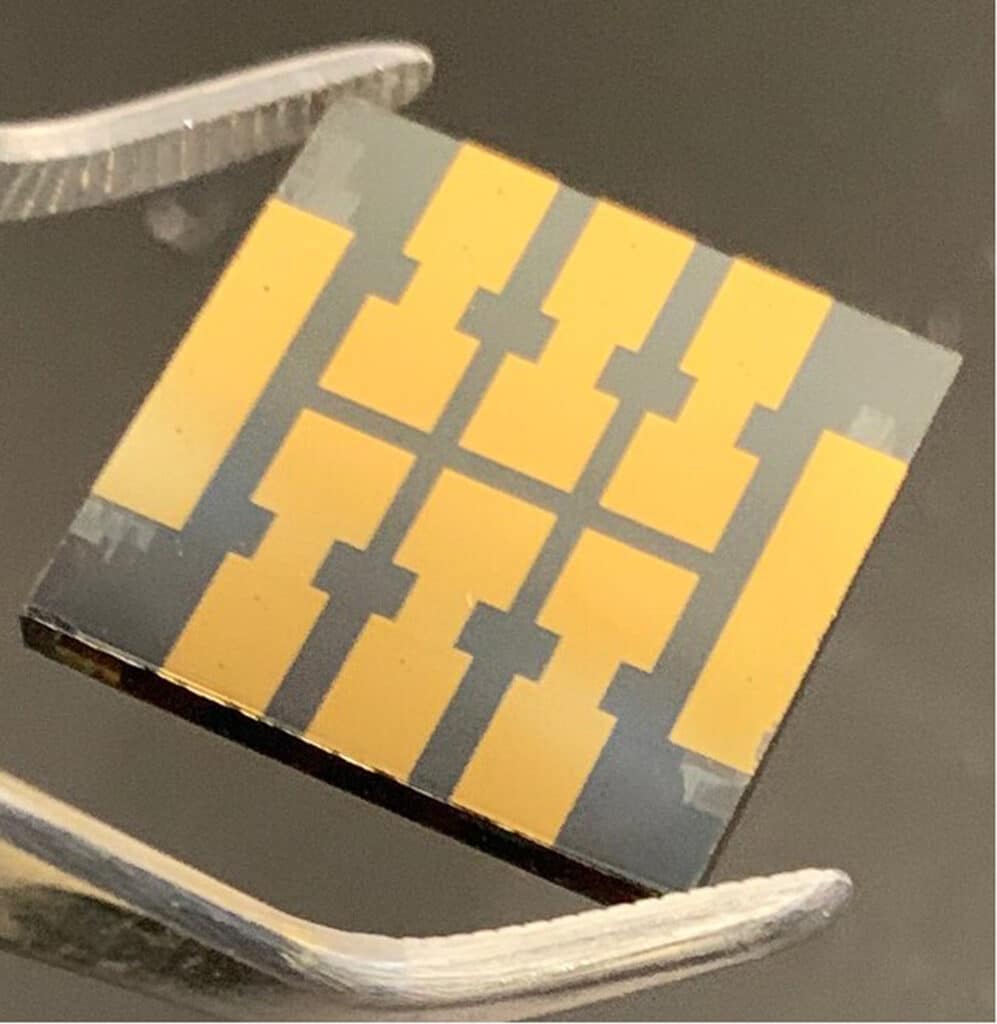
When they tested the solar cell function, they found that the SAMs dramatically increased the perovskite cells’ useful life. The SAM cells made for this study were still going strong after 1,330 hours of lab testing, but the non-SAM cells retained 80% of their initial efficiency for only around 700 hours. The team projected the SAM cells’ 80%-retained-efficiency life to be about 4,000 hours based on these experiments.
Zhenghong Dai, the first author of the research and a Brown doctoral student, said:
One of the other things we did, which people don’t normally do, is we broke open the cells after testing. We saw all kinds of damage in the control cells without the SAMs, such as voids and cracks. But with the SAMs, the toughened interfaces looked good. It was a dramatic improvement that kind of shocked us.
Padture said that perhaps most importantly, the toughness improvement didn’t come at the cost of power-conversion efficiency. On the contrary, the SAMs improved the cell’s efficiency a little. The SAMs eliminated tiny molecular defects that arise when the two layers bond without it.
He said:
The first rule in improving the mechanical integrity of functional devices is ‘do no harm.’ So that we could improve reliability without losing efficiency—and even improving efficiency—was a nice surprise.
The SAMs themselves are made from readily available compounds and are easily applied with a dip-coating process at room temperature. So, the addition of SAMs would potentially add little to the production cost.
The researchers will now build on this success by moving onto the following weakest link until they’ve fortified the entire stack. They will strengthen the interfaces and the material layers themselves.
Padture said:
This is the kind of research that’s required to make cells that are inexpensive, efficient, and perform well for decades.
The U.S. Department of Energy awarded Padture’s research group with a $1.5 million grant to expand its research.


