
Microplastics and nanoplastics have infiltrated drinking water, food chains, and even human tissues, yet practical ways to pull these tiny particles from water remain scarce. Researchers from the VSB-Technical University of Ostrava in the Czech Republic have now demonstrated a living solution: swarms of magnetically steered bacteria that swim together like schooling fish to actively capture and remove plastics from water. Published in ACS Nano and featured on the journal’s cover, the work shows removal rates up to 96 percent for real-world plastics and 77 to 80 percent in actual river, tap, and bottled water.
The Breakthrough at a Glance
Scientists from the Faculty of Electrical Engineering and Computer Science and the CEET Nanotechnology Center at VSB-TUO presented an environmentally sustainable strategy for aquatic micro- and nanoplastic cleanup. The study, led by Martin Pumera, head of the Advanced Nanorobots and Multiscale Robotics Laboratory, and co-authored by Radek Zboril, head of the Materials Envi Lab, was developed within the university’s REFRESH project focused on smart environmental remediation.
- What they built: Living bacterial microrobots, or biobots, based on the magnetotactic bacterium Magnetospirillum magneticum
- How they move: Self-propulsion via bacterial flagella combined with precise steering by an external rotating magnetic field
- Swarm behavior: Under a rotating field the biobots perform three-dimensional collective motion analogous to fish schooling, which stirs fluid and increases particle encounters
- How they clean: The sticky bacterial cell surface adheres to micro- and nanoplastics, which are then retrieved from water by simple magnetic separation within about 30 minutes
- Published: Magnetically Driven Living Microrobot Swarms for Aquatic Micro- and Nanoplastic Cleanup, ACS Nano, July 24, 2025, Vol. 19, No. 30, pp. 27259–27269
How the Living Microrobots Work
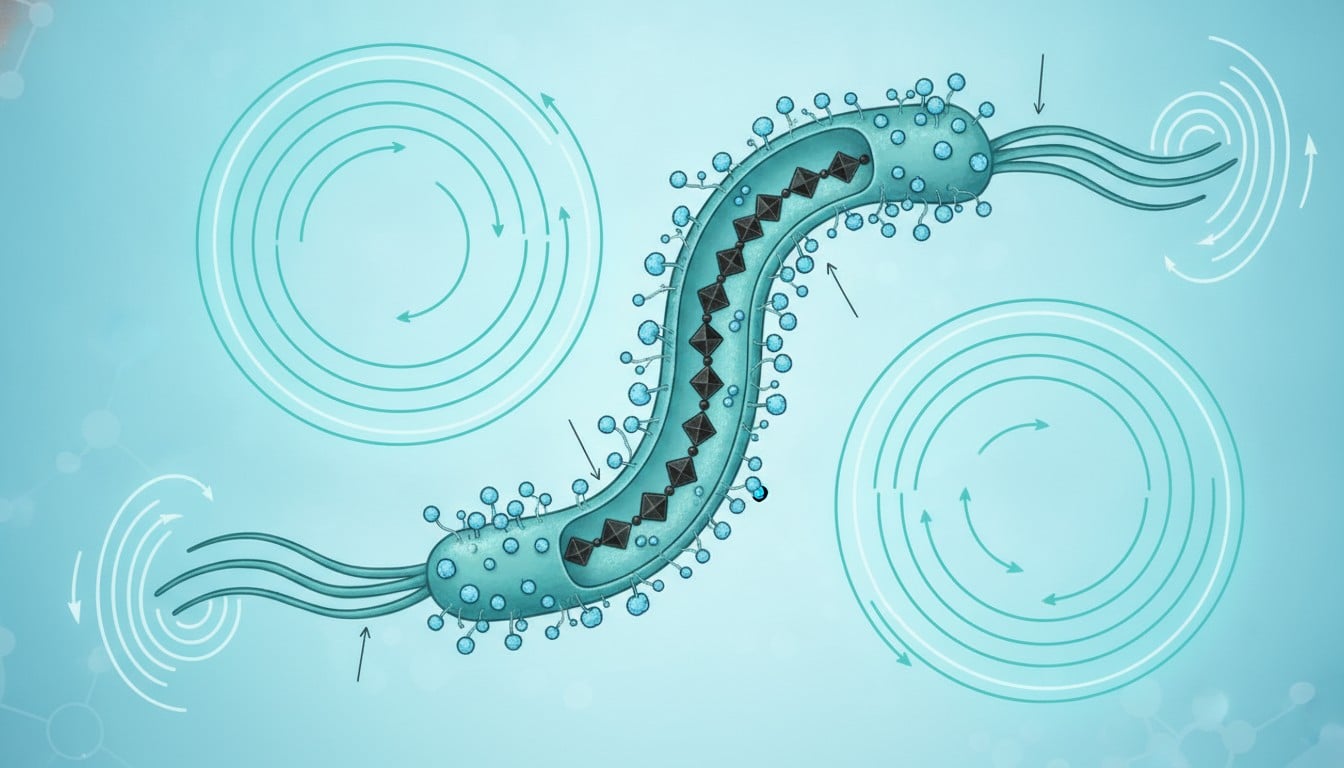
Unlike conventional synthetic microrobots that require fuel or chemical coatings, these biobots are alive and already equipped for navigation. Magnetospirillum magneticum naturally biosynthesizes chains of magnetic nanoparticles called magnetosomes inside its cells. Those internal magnets let the bacteria orient and migrate along magnetic field lines, just as they do in nature to find optimal oxygen levels in sediments.
The VSB-TUO team exploits two complementary properties:
- Autonomous propulsion: Each bacterium swims on its own using flagella, so no external chemical fuel is needed. This makes the system inherently low-energy and biocompatible.
- Magnetic guidance and retrieval: An applied rotating magnetic field directs the swimming direction, triggers 3D swarming, and later allows the entire swarm plus attached plastics to be pulled out of water with a magnet.
- Surface adhesion: The chemical and adhesive properties of the bacterial outer membrane promote spontaneous attachment to polystyrene, polyethylene terephthalate, and other common plastics without additional functionalization.
Once released into contaminated water, the biobots are activated by the rotating field. They assemble into dynamic, circulating swarms that continuously mix the fluid. Plastics colliding with the bacteria stick to their surfaces. After a treatment period, the magnetic field is switched to a collection mode, and the plastic-laden biobots are separated from the cleaned water.
This approach builds directly on the team’s earlier work. In 2023 the same laboratory showed that Magnetospirillum magneticum strain AMB-1 could be magnetically navigated to remove the pesticide chlorpyrifos from water, and in 2024 they demonstrated solar-powered nanorobots that used atomic engineering to control motion for microplastic removal. The new study is the first to combine living magnetotactic bacteria with fish-schooling 3D swarming specifically for micro- and nanoplastic capture.
Why Magnetospirillum magneticum Is Ideal for the Job
Not every bacterium could serve as a microrobot chassis. Magnetospirillum magneticum offers a rare combination of traits that make it unusually suitable:
- Built-in magnetosomes: The species forms well-ordered chains of magnetite nanoparticles enclosed in membranes. These act as an internal compass, giving each cell a stable magnetic dipole without any artificial magnetization step.
- Natural environmental tolerance: As an aquatic bacterium, it remains active in diverse water chemistries, including bottled, tap, and river water, as the study demonstrated.
- High surface adhesion: Its outer membrane chemistry favors binding to hydrophobic polymer surfaces, the same property that helps it interact with organic matter in sediments.
- Biodegradability and sustainability: Because the robots are living cells rather than synthetic particles, they avoid introducing additional persistent materials into the environment and can be controlled and retrieved magnetically.
- Scalable cultivation: The strain can be grown in standard bioreactors, offering a potentially low-cost, renewable source of microrobots compared to lithographically fabricated devices.
As co-author Radek Zboril noted, the nanoparticles allow the bacteria to be externally controlled or retrieved using a magnet, while the cell surface itself promotes attachment to plastic particles, making the organism a highly promising platform for living microrobotic systems.

How Effective Are They? Lab and Real-World Results
Can nanobots really remove microplastics efficiently? The ACS Nano study provides one of the most thorough quantitative answers to date, testing both model particles and plastics derived from actual commercial products.
- Model polystyrene microplastics (1 micrometer): 83 percent removal efficiency under swarming conditions
- Model nanoplastics (50 nanometers): 89 percent removal, showing the system captures even the smallest fraction that conventional filtration misses
- Commercial body scrub microplastics: Up to 96 percent removal, the highest value reported in the study
- PET fragments from plastic water bottles: 60 to 96 percent removal depending on particle type, demonstrating versatility across polymer chemistries
Crucially, the researchers moved beyond ideal laboratory buffers and tested the biobots in real water matrices:
- Bottled water: 80 percent removal
- Tap water: 79 percent removal
- River water: 77 percent removal
Performance remained high despite dissolved organic matter, salts, and other competing constituents, suggesting practical potential for water treatment rather than just proof-of-concept in distilled water. Magnetic separation of the plastic-loaded swarms was completed within 30 minutes in each case.
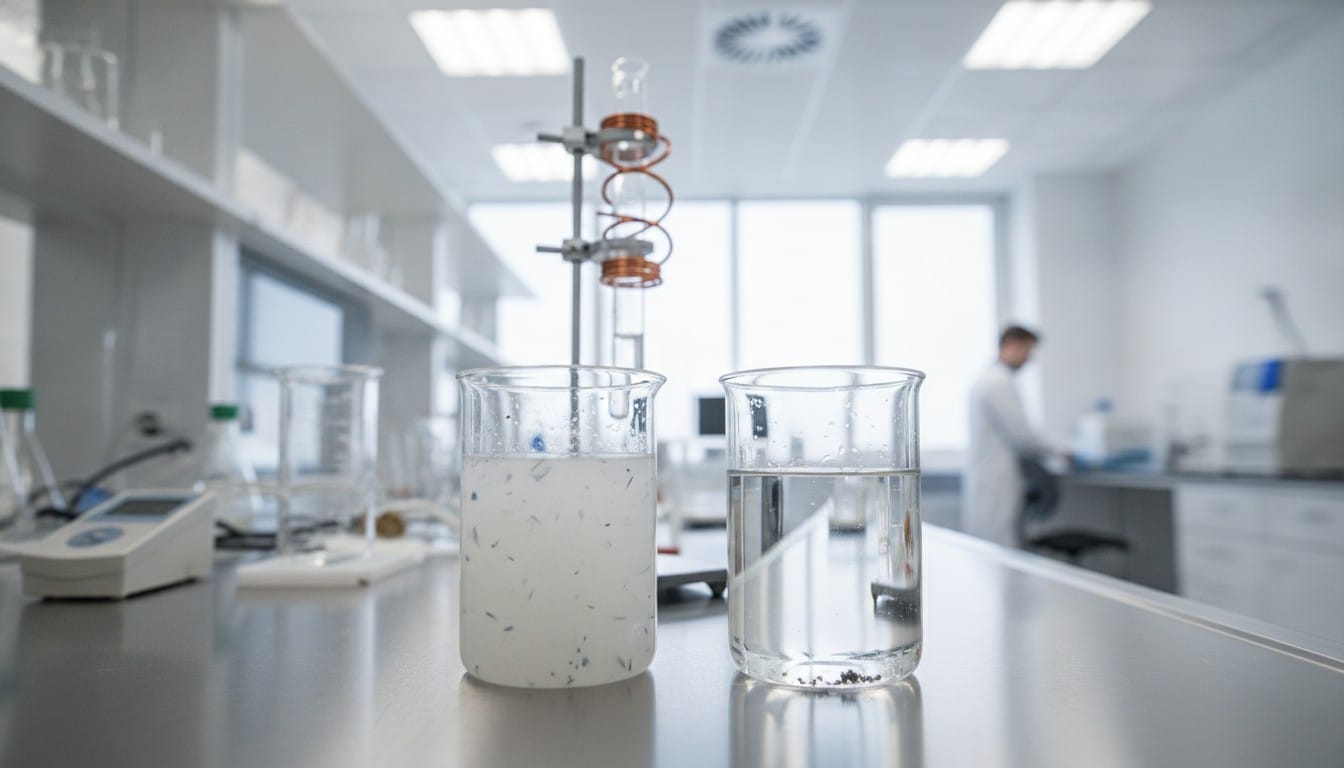
The team also quantified the benefit of swarming itself. Compared to dispersed, non-swarming bacteria, the 3D fish-schooling motion boosted removal efficiency by 6 to 43 percent, with the largest gains for larger microplastics and for plastics with weaker electrostatic attraction to the bacterial surface. The mixing generated by the collective motion increases collision frequency, overcoming diffusion limits that normally hamper passive adsorbents.
Why Fish-Schooling Swarm Motion Matters
At the microscale, water feels viscous, like honey, and particles move mainly by slow diffusion. A single swimming bacterium can only clear plastics in its immediate vicinity. The Czech team’s insight was to use a rotating magnetic field to induce coordinated, three-dimensional circulation similar to a fish school.
This collective behavior delivers three advantages:
- Enhanced fluid mixing: The swarm acts as a living stirrer, sweeping through a larger volume than isolated swimmers and bringing distant plastics into contact range.
- Continuous dynamic capture: Rather than waiting for plastics to settle onto a static filter, the active swarm hunts particles throughout the water column.
- Synergistic efficiency: The study’s 6 to 43 percent improvement directly links swarm motion to higher capture rates, confirming that collective dynamics are not just visually striking but functionally important.

The rotating field provides multimodal control: changing its frequency, plane, and direction lets operators steer the swarm along arbitrary paths, hold it in a vortex for mixing, or drive it to a collection magnet, all without physical contact or added chemicals.
How This Approach Compares to Other Microplastic Cleanup Technologies
Magnetic microrobots are one of several active-cleanup concepts now emerging. Understanding how the living biobot approach fits alongside other strategies helps clarify its strengths and limits.
| Approach | Mechanism | Removal Performance | Energy Input | Key Advantage / Limitation |
|---|---|---|---|---|
| Living magnetotactic biobots (VSB-TUO, ACS Nano 2025) | Magnetospirillum magneticum swarms capture via surface adhesion, retrieved magnetically | 83% for 1 um PS, 89% for 50 nm, up to 96% commercial products, 77-80% in real water | Low (rotating magnetic field only) | Biocompatible, no fuel, works in real water; needs containment and retrieval |
| Photocatalytic magnetic microrobots (Ag@Bi2WO6/Fe3O4) | Light-driven degradation plus magnetic recovery | 98% in 93 seconds under light | Light plus magnetic field | Very fast under illumination; requires light penetration and catalyst stability |
| Polymeric-hand microrobots | Magnetic beads decorated with polymeric hands grasp plastics and bacteria | Effective for simultaneous bacteria and plastic capture in lab tanks | Magnetic field | Selective grasping; more complex fabrication |
| Conventional filtration / membranes | Physical size exclusion | High for large microplastics, poor for nanoplastics | Pumping pressure | Mature technology; fouling and energy cost, misses nanoplastics |
The living biobot strategy stands out for its simplicity. No synthetic coating or light source is required, and the biological synthesis of magnetosomes avoids energy-intensive nanoparticle manufacturing. For a deeper look at non-biological designs, see this previous coverage of a fish-shaped robot that swims to collect microplastics, which uses a different, purely mechanical approach to the same problem.
Challenges and What Comes Next
Despite the promising laboratory results, several hurdles remain before swarms of bacterial microrobots could be deployed in treatment plants, rivers, or lakes.
- Scale-up and containment: Laboratory volumes are milliliters to liters. Treating cubic meters will require larger magnetic actuation systems and protocols to ensure complete retrieval so no bacteria remain in discharged water.
- Biosafety and regulation: Although Magnetospirillum magneticum is not a human pathogen, any release of live microorganisms into drinking water systems would require rigorous safety assessment and regulatory approval.
- Plastic diversity: Real environments contain weathered, biofouled, and mixed-polymer particles of varying sizes and surface chemistries. Further tests on aged ocean plastics and fiber-shaped microplastics are needed.
- Reuse and lifecycle: The current study demonstrates single-cycle capture and magnetic collection. Future work will need to assess whether biobots can be cleaned and reused and what happens to the collected plastic-bacteria aggregates.
The researchers position the work within the REFRESH project at VSB-TUO, which aims to develop integrated, sustainable technologies for advanced water purification. Biological capture is not limited to engineered water-treatment systems: researchers have also reported that a bacterium isolated from kimchi bound nanoplastics and increased their excretion in germ-free mice, but the work remains an early mouse finding rather than a human treatment. Similar biological approaches, such as a sticky bacterial biofilm that captures and sinks microplastics, highlight growing interest in harnessing microbes for cleanup, while earlier magnetic strategies like tiny magnetic springs that dissolve microplastics explored purely synthetic routes. Next steps likely include pilot-scale reactors with programmed magnetic field arrays, testing in wastewater influent, and potential hybridization with photocatalytic or enzymatic degradation so captured plastics can be broken down after collection rather than simply concentrated.
If these challenges are addressed, living microrobot swarms could complement existing treatment trains as a polishing step for nanoplastics that slip through filters, a niche where no efficient solution currently exists.
Frequently Asked Questions
Can nanobots remove microplastics?
Yes, in laboratory and simulated real-water conditions. The VSB-TUO biobots removed 83 percent of 1-micrometer model microplastics, 89 percent of 50-nanometer nanoplastics, and up to 96 percent of microplastics derived from commercial body scrubs. Earlier synthetic designs have reported 98 percent removal in 93 seconds using light-driven catalysts, and underwater drones invented to detect microplastics show related robotic monitoring approaches. Performance depends heavily on particle size, water chemistry, and whether the swarm is actively mixed.
What is the number one source of microplastics?
There is no single global number one source, but major contributors repeatedly identified by environmental agencies include tire and road wear particles, synthetic textile fibers shed during laundering, fragmentation of packaging and single-use plastics, and microbeads from personal care products. The Czech study specifically tested plastics originating from commercial products such as PET water bottles and body scrubs to reflect common consumer sources.
Can you flush microplastics out of your body?
Microplastics that are ingested or inhaled can be excreted in feces to some extent, but research shows particles also accumulate in tissues and blood. No proven medical method safely flushes them from the body. Reducing exposure through filtered water, reduced use of highly shedding products, and improved water treatment is currently considered more effective than attempting detoxification after exposure.
Are Ziploc bags full of microplastics?
Most polyethylene zip bags are not manufactured to contain microplastics, but like all plastic films, they can shed micro- and nanoplastic fragments, especially when heated, scratched, or reused extensively. Studies have detected particle release from everyday plastic packaging and containers, which is one reason technologies that remove plastics from water are gaining attention. Choosing reusable non-plastic alternatives and avoiding heating food in plastic reduces shedding.
Living Robots Offer a Gentler Way to Clean Water
The VSB-TUO team’s magnetically driven bacterial swarms demonstrate that a living system can be both high-tech and environmentally gentle. By combining the natural magnetism of Magnetospirillum magneticum with externally controlled fish-schooling dynamics, they achieved active capture of micro- and nanoplastics across laboratory and real-water conditions without fuels, coatings, or membranes. With 77 to 80 percent removal still achieved in river and tap water and up to 96 percent for commercial product plastics, the approach offers a tangible step toward addressing nanoplastic pollution that current filters struggle to catch. Whether these biobots will scale from beakers to treatment plants depends on solving containment, safety, and lifecycle questions, but as a cover-featured advance in ACS Nano, the concept has put living microrobot swarms firmly on the map for the future of water purification.

