
China’s Photon Matrix laser mosquito killer is moving from viral prototype to mass-produced product. Developer Photon Matrix Lab says production began in August 2026, with the first batch of its LiDAR-guided laser air defense system expected to ship later this month after raising more than $2.7 million on Indiegogo. The device promises to detect and disable mosquitoes in milliseconds without chemicals or traps, but key questions about effectiveness and safety remain unverified by independent testing.
What Is the Photon Matrix Laser Mosquito Killer?
Photon Matrix is a portable mosquito air defense system developed by Photon Matrix Lab Limited, based in Gusu District, Suzhou, and operating as Jim Wong in Changzhou, Jiangsu, China. Unlike a bug zapper that lures insects with ultraviolet light to an electrified grid or a spray that relies on chemical pesticides, Photon Matrix is designed to actively hunt flying insects in midair and disable them with a precision laser pulse.
According to the company, the system combines four technologies to find and eliminate targets:
- LiDAR (Light Detection and Ranging): Continuously scans the air and measures distance to the background. When a small object enters the monitored space, the change in distance creates a candidate target.
- Millimeter-wave radar: Provides an additional detection layer and forms part of the safety architecture, helping scan for larger objects such as people or pets.
- AI-powered vision and tracking: Analyzes candidate targets to determine whether the object fits the expected profile of a mosquito or similar small flying insect.
- Galvanometer-steered laser: Uses tiny, rapidly rotating mirrors to steer a laser beam onto the target in milliseconds. The company says the short pulse disables the insect’s wings, causing it to fall rather than vaporizing it.
The concept echoes the earlier mosquito laser project pioneered by Intellectual Ventures, but Photon Matrix aims to package it as a compact, consumer-grade device for homes, patios, and bedrooms.
Is the Photon Matrix Laser Mosquito Killer Real?
Yes, Photon Matrix is a real project with a physical prototype, live demonstrations, and an active crowdfunding campaign, but it is not yet a proven, widely shipped consumer gadget.
The company launched on Indiegogo as the world’s first portable mosquito air defense, far exceeding its $20,000 goal with more than $2.7 million raised. Videos show the device tracking and firing at mosquitoes inside a test chamber, and CGTN reported on August 16, 2026, that mass production had begun that month, citing the company’s latest Indiegogo update.
However, as noted by independent coverage, the headline performance figures are manufacturer claims rather than results from independent laboratory tests. Photon Matrix has said it will release further testing and safety information, but as of mid-August 2026, the official store still lists the device as a pre-order with shipping expected within 120 days after order confirmation, not as an in-stock retail product.
If you see listings on Alibaba, Amazon Marketplace, or other third-party sites claiming to ship immediately, the company’s official anti-counterfeit notice warns that no genuine units had shipped as of August 9, 2026, and authentic units come only through official channels.
How It Works: From Detection to Kill in 3 Milliseconds
Photon Matrix says the entire cycle from detection to laser pulse takes about 3 milliseconds. Here is the sequence the company describes:
- 1. Scan: LiDAR emits laser pulses and measures the time it takes for each pulse to bounce back, continuously mapping distance to the background within a 90-degree sector.
- 2. Detect: When a flying object enters the scan plane, the change in distance flags a candidate. The system calculates distance, approximate size, and angle relative to the device.
- 3. Identify: AI vision logic evaluates whether the object matches a mosquito profile. Photon Matrix says it can make this determination in approximately 2 milliseconds.
- 4. Aim: Dual galvanometer motors adjust tiny mirrors with high angular precision to steer the laser beam onto the moving target.
- 5. Fire: A short laser pulse hits the insect’s wings to disable flight. The company claims the narrow pulse limits collateral energy while being sufficient to down the insect.
The safety net is equally important. Millimeter-wave radar and vision are described as continuously monitoring for larger obstructions. If a person, pet, or other large object enters the kill zone, the system is designed to disable the laser automatically.

Specifications: Range, Speed, and Kill Rate
The published operating envelope is unusually specific for a mosquito control product. All figures below are company-reported specifications that have not been independently verified:
| Specification | Basic Model | Pro Model |
|---|---|---|
| Effective range | Up to 3 meters | Up to 6 meters |
| Scan angle | 90 degrees | 90 degrees |
| Target identification time | ~2 milliseconds | ~2 milliseconds |
| Total detect-to-fire time | ~3 milliseconds | ~3 milliseconds |
| Maximum kill rate | Up to 30 mosquitoes per second | Up to 30 mosquitoes per second |
| Target size | 2 to 20 millimeters | 2 to 20 millimeters |
| Target speed | Up to 1 meter per second | Up to 1 meter per second |
| Laser type | Class 4 laser (infrared or blue options) | Class 4 laser (infrared or blue options) |
| Key limitation | Largely ineffective against faster insects such as houseflies | |
Do laser mosquito zappers work in the real sense of clearing a room? Lasers can physically disable small insects in a controlled chamber, but effectiveness in an open bedroom or patio depends on line of sight, ambient light, insect speed, and whether mosquitoes are present in the narrow scan plane at all. Until independent testers measure kill rates over nights in real homes, the 30-per-second figure should be treated as a maximum bench rate, not a household outcome.
How Much Does the Photon Matrix Laser Mosquito Killer Cost, and Where to Buy?
Pricing has shifted significantly from the early crowdfunding offers to the current official store.
- Original Indiegogo Basic offer: Approximately $498
- Original Indiegogo Pro offer: Approximately $698
- Current official store Infrared version: $988 including international shipping
- Current official store Blue laser version: $1,088 including international shipping
Both current versions are listed as pre-orders. The store advertises free worldwide shipping, a 12-month limited warranty, and lifetime customer service, with an estimated shipping window within 120 days after order confirmation. The company also opened its official online store alongside mass production, allowing purchases without joining the Indiegogo campaign.
For shoppers searching for a laser mosquito killer on Amazon or looking for a laser mosquito killer turret for sale, the Photon Matrix is not currently an in-stock Amazon retail product. Third-party listings that claim immediate shipment are not recognized as genuine by the manufacturer. For now, official Indiegogo and the company’s direct store are the only authorized purchase channels.
Is It Safe? Laser Classification and Eye Hazard Questions
This is the most important section for any buyer to understand. Photon Matrix uses a Class 4 laser, the highest classification for consumer-visible lasers, capable of causing eye and skin injury from direct exposure or even diffuse reflections at close range if not properly controlled.
Photon Matrix says it mitigates risk with multiple safety layers:
- Millimeter-wave radar and AI vision that continuously check for larger objects and people and shut off the laser when detected
- A narrow, short-duration pulse aimed only at small, slow-moving targets that pass the mosquito profile filter
- An enclosed galvanometer steering system that keeps the beam within the defined scan sector
Despite these claims, several regulatory and verification gaps remain:
- No independent safety certification has been published. The company has not yet posted third-party test reports or approvals from bodies such as the U.S. FDA Center for Devices and Radiological Health, the EU CE laser standard (EN 60825-1), or equivalent Chinese national standards.
- Consumer laser compliance for the U.S. and EU may require additional filings. Western safety standards for consumer laser products often involve emission limits, interlocks, labeling, and access prevention that go beyond a single radar shutoff.
- Performance of the safety shutoff in homes with pets, children, or reflective surfaces is untested publicly. Mirrors, windows, and polished metal can redirect beams unpredictably.
Until independent safety testing and regulatory filings are available, the device should not be considered a plug-and-play appliance for bedrooms with children or pets. Anyone considering a pre-order should wait for published certification documents and third-party safety reviews before use in occupied living spaces.
Photon Matrix vs. Bzigo Iris vs. Traditional Mosquito Control
Not all laser mosquito devices try to do the same job. The Israeli Bzigo Iris takes a notably different approach, and both differ from conventional solutions.
| Feature | Photon Matrix | Bzigo Iris | Traditional Options (Coils, Zappers, Traps) |
|---|---|---|---|
| Method | LiDAR + radar + AI detection, galvanometer-steered laser disables wings | Computer vision + infrared sensing detects mosquito, marks location with low-intensity laser | Chemical repellents, heated vaporizers, UV attraction, CO2 or adhesive traps |
| Kills or locates? | Automatically fires to disable the insect | Does not kill; guides user to the mosquito so they can swat it | Traps or kills chemically or electrocutes on contact |
| Chemical free? | Yes | Yes | Often no (pyrethroids, DEET) except UV traps |
| Price (approx.) | $988 to $1,088 current store | $299 | $15 to $300 depending on type |
| Coverage | 3 to 6 meters, 90-degree sector, slow insects only | Room-scale detection | Area repellence or point trap |
| Verified independently? | Not yet; specs await third-party testing | Commercially sold with demo reviews | Decades of field data |
| Best for | Early adopters seeking automated elimination in a defined zone | People who want to find the single mosquito keeping them awake | Budget-friendly or large-area protection |
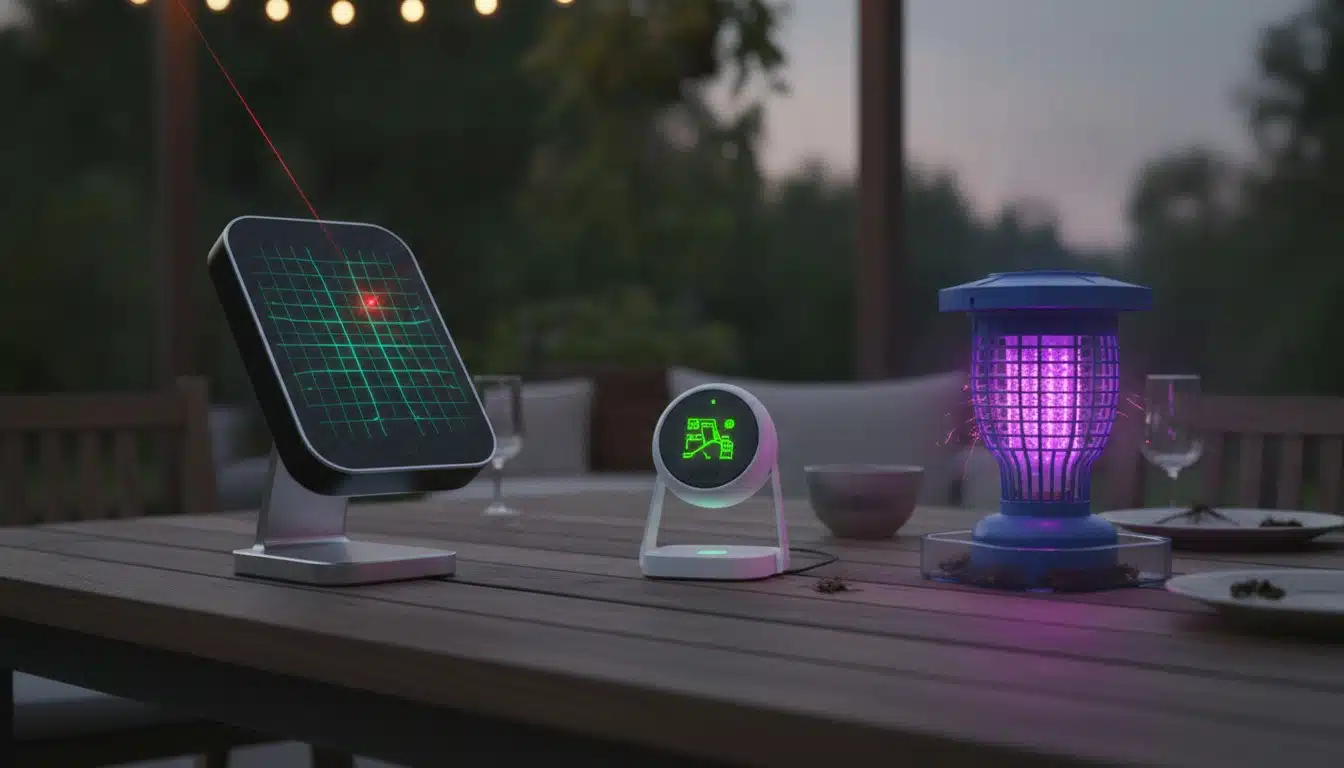
For readers weighing natural options, Intelligent Living has previously covered plants that repel mosquitoes and a surfactant spray for mosquito control without insecticides, both of which address the concern about chemical exposure in a different way and at a far lower price point.
Why China Is Scaling Mosquito Tech Now
Photon Matrix is entering mass production at a moment when China’s mosquito-control market is growing quickly. According to data cited by CGTN via Xinhua, Jinhua in Zhejiang Province exported more than 45 million yuan (about $6.7 million) worth of mosquito-repellent products in the first half of 2025, up 65.1 percent year on year. Industry estimates cited by Xinhua project China’s mosquito-control market could grow from 7.86 billion yuan in 2025 to 12.43 billion yuan by 2030.
The innovation pipeline is already active. During the 2023 Hangzhou Asian Games, China Daily reported that an automated mosquito trapper was deployed in the Asian Games Village, attracting mosquitoes by mimicking human body temperature and breathing before trapping them, while other smart robots used carbon dioxide and ultraviolet light to lure insects. These earlier deployments used physical trapping rather than lasers, showing that the current laser approach is the latest iteration of sensor-driven pest control rather than a sudden breakthrough.
This backdrop matters for buyers. A growing export market means more competition and faster iteration, but also more copycat listings. The genuine Photon Matrix distinction will be verified shipments and published safety data, not just impressive campaign videos.
Frequently Asked Questions
Is it possible to kill mosquitoes with lasers?
Yes, in a technical sense. A focused laser pulse can disable a mosquito’s wings and cause it to fall, which is the mechanism Photon Matrix describes. The physics is not new; the challenge is doing it safely, accurately, and continuously on a tiny, moving target without endangering people, which requires precise sensing, aiming, and fail-safes.
Is the laser mosquito killer real or vaporware?
It is a real hardware project with working prototypes and a funded crowdfunding campaign, now entering mass production in August 2026, according to the developer and CGTN. However, it is still a pre-order product with no published independent performance or safety verification, so consider it a developmental product transitioning to production rather than a mature retail appliance.
How much does the Photon Matrix cost?
Early Indiegogo backers paid about $498 for Basic and $698 for Pro. Current official store prices are $988 for the Infrared version and $1,088 for the Blue version, both including international shipping. Prices include free worldwide shipping and a 12-month warranty, but delivery is estimated to be within 120 days after order.
Where can I buy it, and is it on Amazon?
As of August 2026, the only authorized channels are the official Indiegogo campaign page and Photon Matrix’s official online store. The company states that no genuine units had shipped before mass production began in August, so any Amazon listing claiming immediate stock should be treated as unverified or potentially counterfeit.
Do laser mosquito zappers work better than traps or repellents?
Each has trade-offs. Lasers aim to kill individual insects automatically without chemicals, but coverage is limited to a few meters and a narrow angle, and they struggle with fast-moving insects. UV and CO2 traps can cover larger areas, and repellents deter bites rather than kill. For whole-house protection, most households still combine screens, repellents, and standing-water control, while a laser device would be a supplemental point-defense tool if its safety and efficacy are proven.
Conclusion: Should You Pre-Order a Laser Mosquito Killer?
The Photon Matrix laser mosquito killer moving into mass production is a milestone for automated, chemical-free pest control, and the engineering behind it—LiDAR ranging, millimeter-wave radar, AI vision, and galvanometer laser steering—is genuinely novel for a consumer device. With first units due later in August 2026, the next few months will reveal whether real-world shipments match the campaign’s promise.
For now, the prudent approach is watchful waiting. Look for independent kill-rate tests in real rooms, published laser safety certifications, and early buyer reviews that confirm reliability, false-positive rates, and long-term durability before committing nearly $1,000. If you want immediate, lower-risk relief this mosquito season, consider combining proven measures and natural alternatives while this laser category matures from prototype to proven product.


