
For decades, the standard office looked the same everywhere. Gray carpet, beige cubicles, and buzzing fluorescent lights defined the daily grind. Today, however, a quiet revolution is taking root.
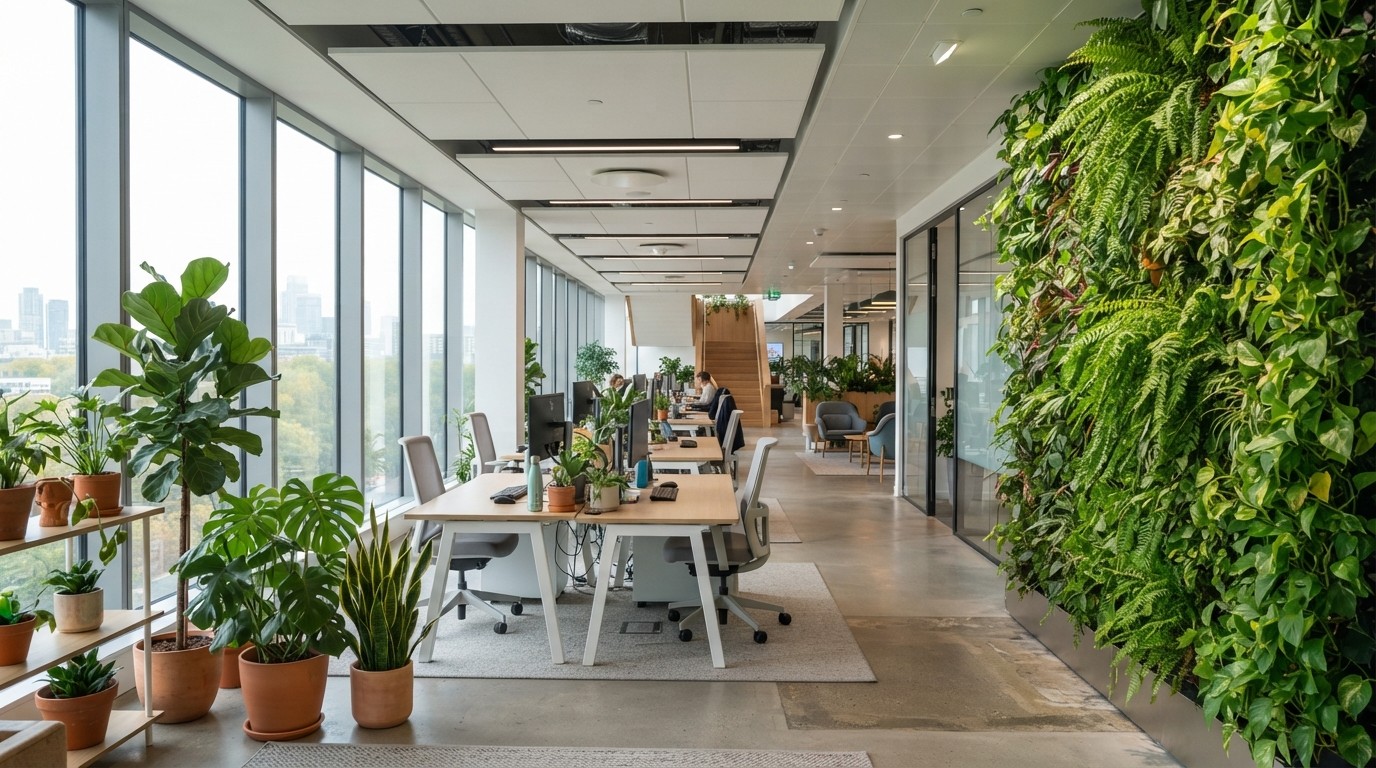
Lobbies now showcase towering fig trees, while lush living walls frame conference rooms. This shift goes far deeper than decoration. In fact, a growing body of research links green interiors to sharper focus, lower stress, and happier teams.
As a result, the very definition of a healthy workplace is changing. The trend has a name: biophilic design. In other words, it weaves living, natural elements into the spaces where we work.
So, what does science actually say? And why are property managers racing to bring the outdoors in?
The Science Behind Biophilic Design
Biologist E.O. Wilson popularized the term “biophilia” in his 1984 book of the same name. The idea is simple: humans carry an innate urge to connect with living things. After all, our ancestors spent most of human history outdoors, not under office ceilings.
Two leading theories explain why nature affects us so deeply. First, psychologists Rachel and Stephen Kaplan proposed Attention Restoration Theory. It suggests that natural scenes gently hold our attention, which lets tired minds recover.
Second, Roger Ulrich’s Stress Reduction Theory argues that nature triggers a fast, automatic calming response. Ulrich’s own landmark 1984 study in the journal Science supports the theory.
Surgical patients with a window view of trees went home sooner than those facing a brick wall. They also needed fewer strong painkillers. Offices are not hospitals, of course.
Still, the same human wiring clocks in at work every morning.
Plants and Productivity: What the Research Shows
Skeptics once dismissed office plants as mere decoration. However, a team including University of Exeter researchers challenged that view in 2014. The team added plants to sparse, “lean” offices in the UK and the Netherlands.
Over the following months, productivity climbed by 15%. Employees also reported greater workplace satisfaction and sharper concentration.
Similarly, the 2015 Human Spaces report surveyed 7,600 office workers across 16 countries. Workers in spaces with natural elements reported 15% higher well-being, 6% higher productivity, and 15% more creativity. Yet 58% of all respondents had no live plants at work.
Even brief glimpses of green seem to help. In a 2015 University of Melbourne study, 150 students paused a dull task for 40 seconds.
Half viewed a city scene with a flowering meadow roof, while the rest saw bare concrete. Afterward, the green-roof group made fewer errors and kept steadier focus.
How Green Interiors Lower Workplace Stress
Productivity tells only part of the story. Equally important, chronic stress drains focus, health, and morale over time. Fortunately, nature appears to help the body bounce back faster.
In a 2020 study, Harvard researchers tested this idea on 100 volunteers using virtual reality. First, participants completed stressful tasks. Then, each person spent six minutes recovering in one of four virtual offices.
One office stayed plain, while the other three added different natural elements. Meanwhile, sensors tracked heart rate, blood pressure, and skin conductance.
Volunteers in the biophilic offices showed consistently better recovery from both stress and anxiety. In fact, the biggest physical changes appeared within the first four minutes.
For busy workers, this suggests that a brief pause near greenery could calm a frazzled nervous system. Admittedly, a virtual office is not a real one, so field research still matters.
Indoor Air Quality: Separating Fact From Hype
The popular idea that plants purify office air began with a 1989 NASA experiment. But NASA tested plants inside sealed chambers, not busy buildings. Real offices swap out their air constantly.
In 2019, Drexel University engineers reviewed a dozen studies spanning 30 years. By their estimate, matching a standard ventilation system would take 10 to 1,000 plants per square meter. Simply put, a few desk plants cannot replace good airflow.
Airflow matters for the mind, too. A Harvard-led study of 24 professionals found cognitive scores rose 61% on low-VOC green-building days, and 101% on low-VOC days with higher ventilation, compared with conventional conditions. When researchers cut chemical pollutants called VOCs and raised outdoor air supply, scores improved across functional domains.
So, are plants pointless for air quality? Not quite. In the Exeter study, workers in greener offices rated their air quality more highly.
Purpose-built green walls also show promise. In 2023, Australian researchers tested a small green wall against gasoline fumes. It removed 97% of the most toxic compounds within eight hours.
Still, the test ran in sealed lab chambers with an industry partner. The smart move, then, is to pair plants with strong ventilation and low-emission materials.
How Property and Facility Managers Are Responding
This evidence has now moved from journals into boardrooms. Hybrid work has pushed employers and landlords to give people real reasons to come in.
Greenery answers that call. In the Human Spaces survey, workers ranked live plants second only to natural light on their wish lists. Moreover, a third of respondents said design would affect their decision to join a company.
Building standards now reflect this shift as well. For example, the WELL Building Standard requires projects to integrate nature before they can earn certification.
Owners are investing heavily, too. In Manhattan, Nuveen poured $120 million into renovating 730 Third Avenue. The upgrade added nature-themed lounges, vegetable plots for employees, and even two beehives.
However, greenery only pays off when someone keeps it thriving. Industry experts warn that poorly planned biophilia often amounts to a token gesture.
For that reason, many facility teams now partner with specialists in commercial interior landscaping. These partners match species to each space’s light, then handle watering, pruning, and seasonal refreshes. Some even offer plant rentals, so buildings can update lobbies without owning a single pot.
Simple Ways to Bring Nature Into Any Workplace
You don’t need a rainforest atrium to see results. Instead, small, consistent choices add up over time. Consider these research-backed steps:
- Prioritize daylight. Arrange desks near windows, and keep blinds open whenever glare allows.
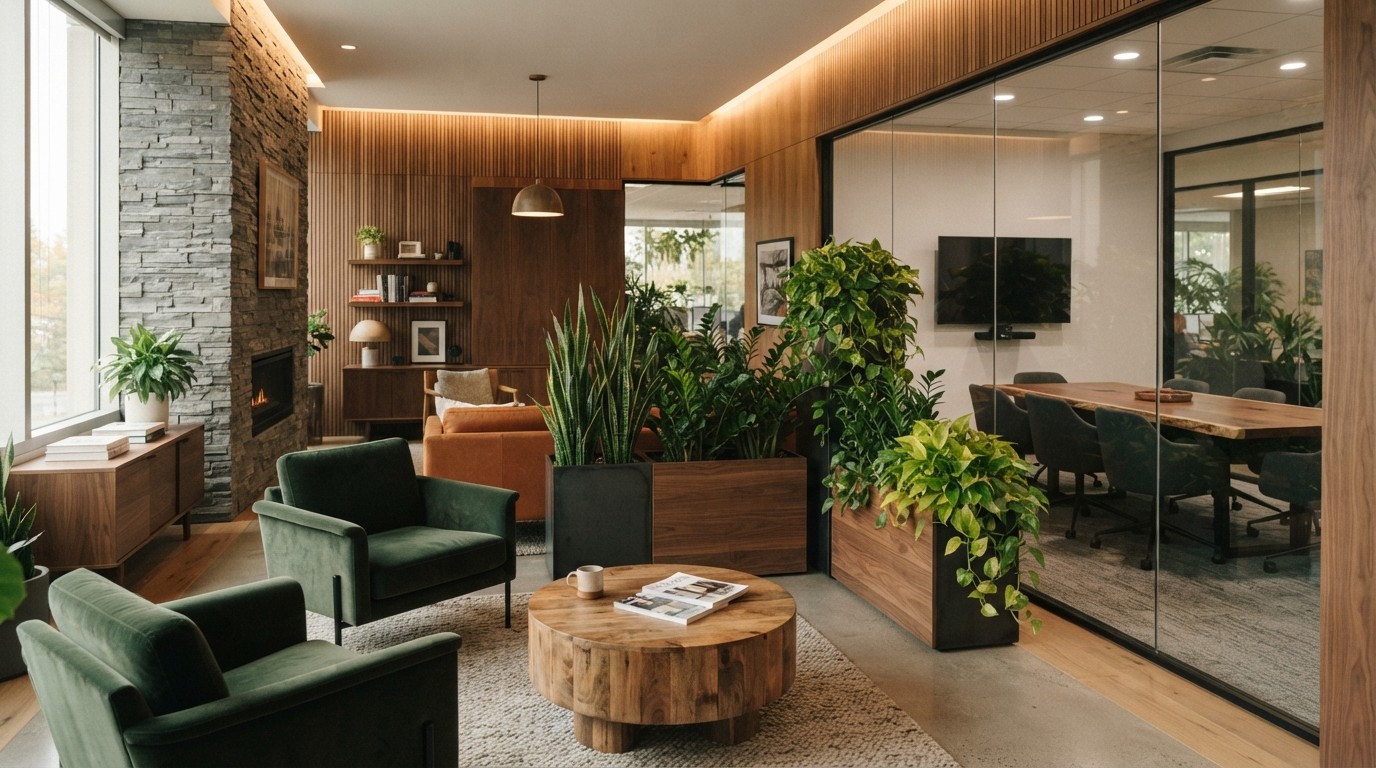
- Choose hardy species. Snake plants, ZZ plants, and pothos, for instance, tolerate low light and occasional neglect.
- Plant in sightlines. Place greenery where eyes naturally rest, such as desks, entrances, and meeting rooms.
- Layer natural materials. Wood and stone echo the outdoors, especially where plants cannot thrive.
- Plan for upkeep. Wilting plants undercut the message, so schedule regular care from day one.
The Future of the Healthy Workplace Is Green
For years, companies judged office health by air filters, fire codes, and ergonomic chairs. Today, the evidence points to something richer. Plants, daylight, and natural textures can sharpen focus, ease stress, and lift morale.
Granted, greenery cannot replace good ventilation. Even so, it makes buildings feel alive, and people notice. In short, a healthy workplace now nurtures both body and mind.


