
Chinese scientists have given robots a new sense inspired by one of nature’s most unusual hunters. Researchers at Xidian University have developed an electric eel sensor that lets machines detect, identify, and locate objects without ever touching them, using a steady electric field created by a specially charged fluoropolymer. Published in the peer-reviewed journal Advanced Materials, the technology could make robots safer, smarter, and far more capable in dark, dusty, or delicate environments where cameras and conventional touch sensors fail.
How Electric Eels Hunt Without Eyes
In the wild, electric eels do not rely on vision to find prey. True eels take an entirely different reproductive path, with scientists only confirming in 2022 how European eels actually reproduce in the Sargasso Sea. They generate a weak electric field around their bodies and continuously monitor it. When a fish, rock, or plant enters that field, it distorts the distribution of electrical charges. Because every material interacts with electricity differently, the eel can read those distortions to locate and characterize objects, even in pitch-black, murky water.
Professor Zhang Weiqiang and his team at the School of Aerospace Science and Technology at Xidian University in Xi’an borrowed that exact logic. As Zhang explained, they did not try to copy the eel’s biology cell for cell. Instead, they adopted its core strategy: establish an electric field, sense perturbations, and extract information.
This bioinspired approach, known as electrolocation, is well documented in weakly electric fish such as electric eels studied by the Smithsonian’s National Zoo. The Chinese team turned that natural radar into a solid-state device that works in air, not water.
The Breakthrough: A Tiny Static Battery
The heart of the new sensor is a corona-polarized fluoropolymer electret. In simple terms, it is a fluoropolymer film that has been charged like a balloon rubbed on hair but engineered to hold that charge for a very long time.
Once charged, the electret acts like a tiny static battery. It maintains a quasi-static electric field around the sensor without needing continuous power or an active transmitter. Zhang described it as an invisible spider’s web stretched around the device. When nothing is nearby, the field holds a stable, predictable shape.
That passive, low-power design is a key difference from most proximity sensors, which must constantly emit infrared light, ultrasound, or electromagnetic pulses. Here the field is always present, ready to be disturbed.
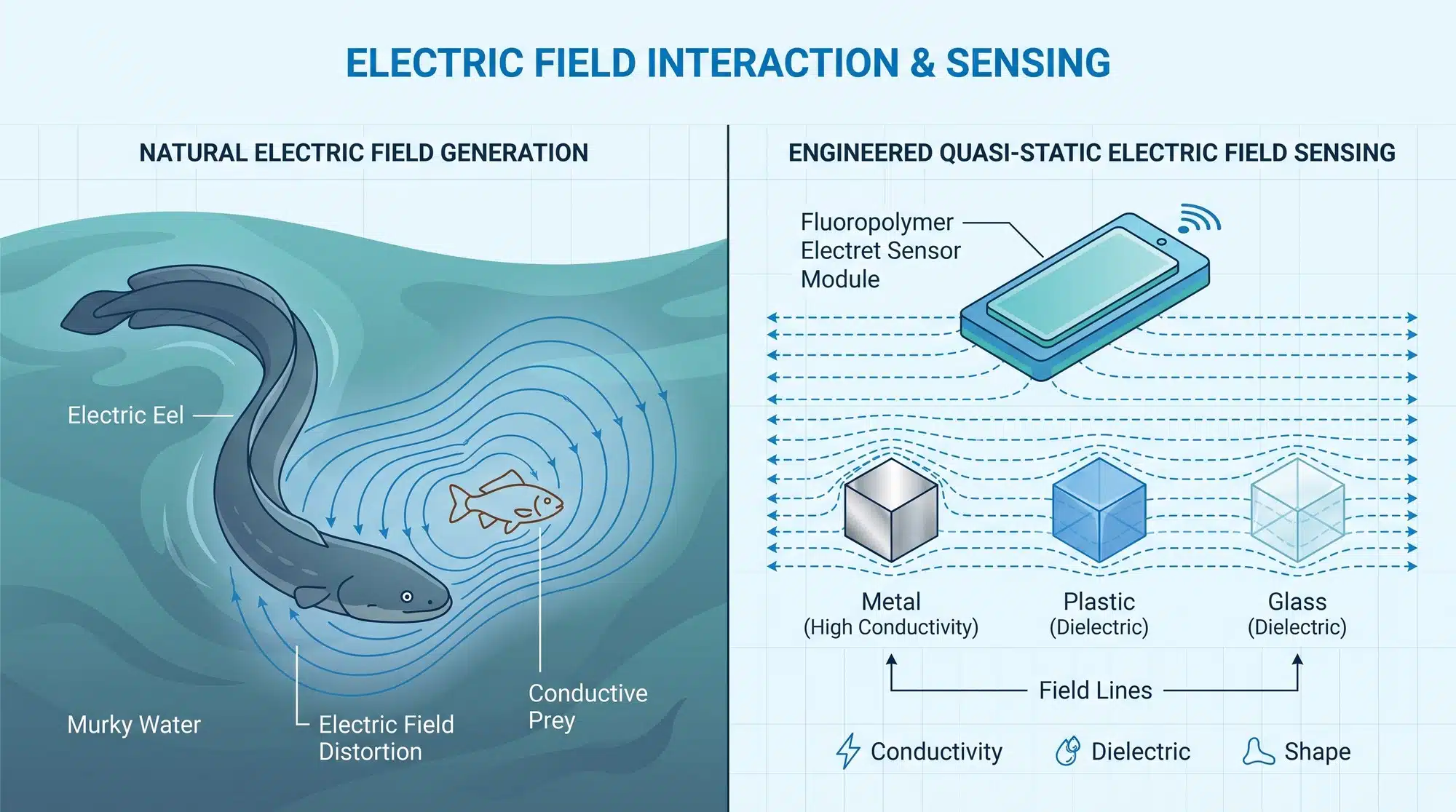
- Material: Corona-polarized fluoropolymer electret, a type of charged plastic that retains charge for months
- Structure: Electret film over a grounded back electrode that measures potential modulation
- Field type: Quasi-static electric field extending into the near-field zone around the sensor
- Power need: No active emission required after initial charging, unlike optical or inductive sensors
How the Sensor Feels Without Touching
When any object moves into the field, whether it is metal, plastic, glass, wood, or even a human hand, its own electrical properties disrupt the field. Conductive objects like metal strongly alter the field because they allow charges to move freely. Dielectric materials like plastics and glass become polarized in the field, shifting it in subtler but still distinct ways. The object’s size and geometric shape also change the pattern of distortion.
Those disturbances induce a measurable voltage change on the sensor’s grounded electrode. The team calls this electrostatic-field perturbated sensing. By analyzing the amplitude and waveform of that signal, the system infers three things at once:
- Electrical conductivity: How easily the material carries charge
- Dielectric properties: How it polarizes in an electric field
- Geometric shape and distance: How large it is, its contours, and how close it is
Different materials leave different electric fingerprints on the signal. The researchers standardized the motion paths of test objects and used feature extraction to classify materials automatically. In lab tests, the system successfully distinguished metals, polymers, glass, and wood without contact, even when objects had the same color or appearance. In a separate study published in Advanced Materials describing the bioinspired electrostatic-field sensor, the authors report that waveform features encode material-dependent signatures and can be combined with machine-learning classifiers for automated identification.
How Sensitive Is It? 1 Volt per 50 Microns
The sensitivity is striking. According to Zhang, a position change of just 50 micrometers, about half the diameter of a human hair, produces a voltage change of about 1 volt, or more precisely 1.05 V per 50 micrometers, as reported in the journal paper. That is sensitive enough to capture a fingertip lightly brushing past without contact.
Durability looks promising as well. After more than 10,000 cycles of approach and withdrawal, the signal response remained stable with no obvious attenuation. The sensing process also does not depend on ambient light and requires no mechanical contact, which avoids wear, contamination, and the risk of damaging fragile objects.
Researchers are still characterizing limits such as maximum detection range and sensitivity to environmental factors like humidity and temperature, but the early results point to a robust near-field perception method that works friction-free.
Why It Beats Cameras and Conventional Sensors
Robots already use many sensing methods, but each has blind spots that this electric-field approach helps cover. Vision systems struggle in darkness, smoke, dust, or when objects are transparent. Inductive proximity sensors mainly detect metals. Capacitive and optical methods often depend on surface reflectivity.
The electret sensor responds to both conductors and insulators, making it a more general material perception tool. Its independence from light and contact gives it an advantage in environments where cameras fail and touch would be risky.
How It Compares to Existing Robot Sensors
The table below summarizes how the new bioinspired sensor stacks up against common robot perception technologies.
| Sensor Type | What It Detects | Needs Light? | Contact Required? | Limitation |
|---|---|---|---|---|
| Bioinspired Electrostatic-Field Sensor (Xidian) | Metals, polymers, glass, wood, human hand; estimates distance and shape | No | No | Near-field range only; environmental stability still under study |
| Vision / RGB Camera | Color, shape, texture | Yes | No | Fails in darkness, smoke, glare; struggles with transparent objects |
| Inductive Proximity Sensor | Metals only | No | No | Cannot detect plastics, glass, or wood |
| Capacitive Proximity Sensor | Conductive and some dielectric materials | No | No | Highly sensitive to humidity and calibration drift |
| Tactile / Force Sensor | Pressure and contact force | No | Yes | Requires physical touch; causes wear and contamination risk |
Unlike these specialized tools, the electret sensor aims to provide a universal, passive near-field sense that complements rather than replaces vision and touch.
Real-World Uses: From Factory Floors to Space Robots
The team envisions several practical directions for this technology, moving beyond the lab toward smart manufacturing and human-machine interaction.
- Automated sorting and recycling: On a conveyor belt, two items may look identical but be made of different plastics. The sensor can distinguish them by their electric fingerprints without contact, enabling accurate material sorting even when color sorting fails.
- Robotic manipulation: A robotic arm equipped with the sensor could sense an approaching object, estimate its proximity and surface condition before contact, and adjust its grip to avoid crushing fragile items.
- Harsh or dark environments: In smoke, dust, darkness, or visually cluttered settings where optical systems degrade, the electric-field sensor continues to function because it does not rely on light.
- Human-machine interaction and prosthetics: The high sensitivity to a human hand could enable touchless gesture interfaces or give prosthetic hands pre-contact awareness of nearby objects.
- Aerospace and equipment monitoring: Drawing on the team’s aerospace background, future applications could include space-robot operations, spacecraft exterior inspections, and safe approach of robotic arms during on-orbit maintenance, where low power, light independence, and non-contact operation are valuable.
This versatility recalls other recent innovations that gave robots new ways to sense touch without direct contact, such as shadow-based sensing, but the Xidian approach uniquely leverages a persistent electrostatic field rather than optics.

What Comes Next
The paper, titled Bioinspired Electrostatic-Field Perturbated Sensing for General Material Noncontact Perception, lists authors from Xidian University’s School of Aerospace Science and Technology and School of Physics, plus collaborators including Zhong Lin Wang, a pioneer in triboelectric devices. The work confirms a laboratory demonstration, not yet an industrial product.
The researchers note that engineering challenges remain before factory or space deployment. They must validate long-term charge retention, packaging, signal robustness in real-world humidity and temperature swings, algorithm generalization across arbitrary object shapes, and performance in vacuum or thermal cycling conditions relevant to aerospace. For now, the sensor provides a compelling new layer of near-field perception that could work alongside vision, infrared, and inductive sensing to give robots a more complete picture of the world just before they touch it.
Frequently Asked Questions
What is the electric eel sensor for robots?
It is a bioinspired electrostatic-field sensor developed at Xidian University that mimics electric eel electrolocation. A charged fluoropolymer electret creates a stable electric field, and nearby objects distort that field in ways the sensor can measure to infer material, shape, and distance without contact.
Which materials can it detect?
Tested materials include metals, polymers such as plastics, glass, and wood. The system distinguishes them by how their conductivity and dielectric properties perturb the field. Even objects with identical appearances but different compositions produce distinct signals.
Does it need to touch the object?
No. The entire principle is non-contact. The object only needs to enter the near-field zone around the sensor. No active emission and no mechanical contact are required, and performance does not depend on ambient lighting.
How far away can it sense objects?
The paper characterizes it as near-field perception. The exact maximum range was not specified in public summaries. Like electric fish, the effect weakens with distance, so it is designed for close-range awareness just before contact, not long-range radar.
How is this different from a regular proximity sensor?
Conventional inductive sensors mainly see metals, and optical sensors need light and reflective surfaces. This sensor passively maintains an electric field and responds to both conductive and dielectric targets, providing broader material coverage while remaining light-independent and wear-free.
Conclusion
By copying the quiet radar of electric eels, Xidian University’s team has shown that a simple charged plastic film can give robots a touchless sense of feel. With its ability to detect tiny movements, identify materials by their electric fingerprints, and operate without light or contact, the fluoropolymer electret sensor fills a gap left by cameras and traditional proximity detectors. While engineering work remains to harden the device for factories and possibly even spacecraft, the demonstration opens a practical path toward safer, more perceptive robots that can sense what they are about to touch before they touch it.


