
Until recently, nobody knew how eels reproduce. On August 14, 2021, TikTok user ColeTheScienceDude published a video named We Don’t Know Where Eels Come From. The user shares information about how little is known about the eel species Anguilla anguilla, also referred to as freshwater eels or the European eel, reproductive cycle.
He says, “We have been to the moon, and yet we still do not know how eels sexually reproduce.” The user then describes more qualities of eels that experts find puzzling, including “If you dissect one and you look inside, you will not find sexual organs,” he added. “We have never observed eels mating in captivity or the wild.”
Most Anguilla anguilla eels lack reproductive organs; however, scientists can bring them to sexual maturity by treating them with hormones. With hormone treatment, eels can be brought together in captivity to reproduce.
In the wild, however, during the last phase of their complex life cycle, they do develop reproductive organs. This final stage is known as the silver stage, and during this stage, the eels’ stomach dissolves before their sexual organs develop. This means the eels die soon after reproducing, which has made the mystery of eel reproduction even more challenging to work out.
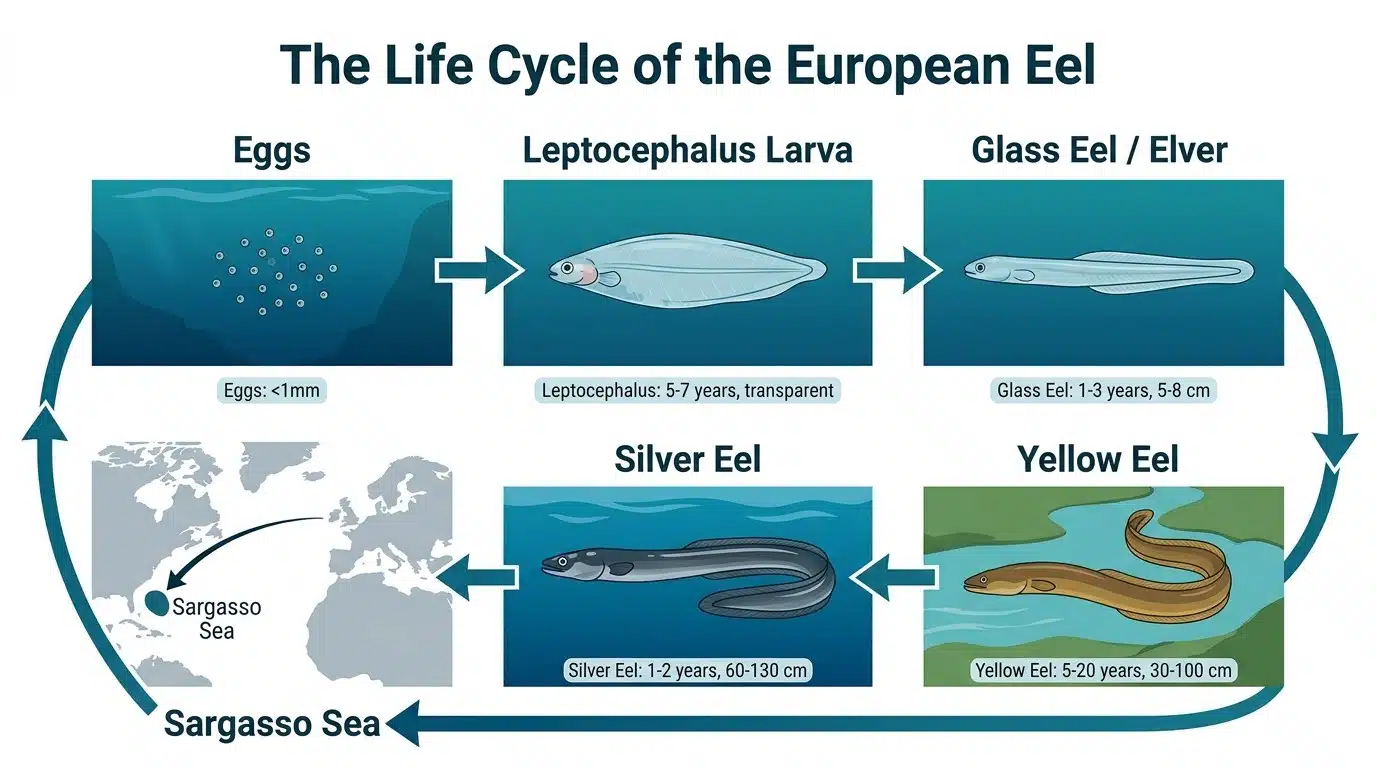
Born in the remote Sargasso Sea, these eels begin life as transparent larvae, resembling tiny leaves with fish heads. Carried by Atlantic currents, they embark on a voyage spanning thousands of miles, eventually reaching the shores of eastern Europe. Here, they transform into bootlace-sized young, known as glass eels or elvers.
As they mature, they settle in shallow coastal seas, undergoing another transformation into yellow eels, marked by a change in color and habitat as they migrate into rivers and lakes. They can stay in these inland waters for decades, silently growing and waiting. Eels aren’t the only creature whose reproductive secrets recently came to light; scientists also finally figured out how millipedes mate, solving another biological mystery that had persisted for decades.
Finally, they enter the silver stage, retracing their paths back to the Sargasso Sea, where their reproductive organs develop, culminating in a life dedicated to this ultimate journey.
The First Direct Confirmation of a Crucial Stage of the Eels’ Life Cycle
After decades of speculation, researchers have successfully tracked European eels back to their breeding grounds in the Sargasso Sea, following their journeys thousands of kilometers along one of nature’s most incredible animal migrations.
Scientists are ecstatic because this is the first confirmation of a long-suspected stage of the eels’ life cycle, which was proposed about 100 years ago. Fish biologist Kim Aarestrup from the Technical University of Denmark, the study’s author, stated on Twitter that “eels have piqued the curiosity of scientists for millennia.”
The North Atlantic Ocean’s Sargasso Sea is where eels congregate to breed, yet until recently, no eels or eggs have been discovered. “For the first time, we followed eels to their spawning grounds,” added Aarestrup.
First Eel Larvae
In the early 1920s, a Danish biologist named Johannes Schmidt found eel larvae in the Sargasso Sea. This was a long way from where eels live in Europe and Africa, where they reside in freshwater, estuaries, and along the coasts.
Schmidt’s findings, published in 1923, predicted the next century of research to comprehend how eels reproduce, summarizing his efforts as “disappointment alternating with encouraging discoveries and periods of rapid progress with others during which the solution of the problem seemed wrapped in deeper darkness than ever.”
Since then, researchers have been trying to determine the precise location of the eels’ breeding grounds. This endeavor has proven challenging due to the various obstacles that eels must overcome, including weirs, dams, habitat loss, pollution, and overfishing.
Moreover, the effort is increasingly urgent due to the dramatic decline in European eel populations since the 1980s, marked by a staggering drop of over 95% in the number of glass eels arriving at European coasts. The species is now highly endangered, facing multiple threats that complicate conservation efforts.
Key Challenges
- Migration Barriers: Dams and other man-made structures block essential migration routes, disrupting the natural life cycle of eels and preventing them from reaching crucial habitats.
- Illegal Trading: The illegal trade of glass eels, driven by high demand for rearing in fish farms, further exacerbates the problem. These practices not only reduce the wild populations but also undermine legal conservation efforts.
Addressing these challenges requires a coordinated approach that includes stricter enforcement of trade regulations and innovative solutions to allow safe passage for migrating eels.

How the Scientists Followed the European Eels
European eels travel between 3,100 and 6,210 miles (5,000 to 10,000 kilometers) to breed at sea, and then their larvae float back to land and the safer environment of rivers. The researchers behind this recent discovery used satellite tags to follow 26 female European eels as they navigated the final phase of their incredible journey southwest from the Azores, the volcanic archipelago of the North Atlantic Ocean west of Portugal. Previous studies revealed that eels from across Europe congregate in the Azores before heading for the Sargasso Sea.
In 2018 and 2019, the eels were captured from the Azores islands, tagged with removable satellite trackers, swabbed for DNA tests, and released back into the Atlantic Ocean. With their satellite trackers still attached, six eels arrived at the Sargasso breeding grounds months later; data from 15 other eels were gathered along the route. The most significant distance measured in a straight line was 1,410 miles (2,275 kilometers).
“Their journey will reveal information about eel migration that has never been known before,” explained Ros Wright, a fisheries biologist at the UK Environment Agency who led the study.
It is still being determined how eels reach the Sargasso Sea or how long their breeding season lasts. However, the eels in this study’s swimming speed, which averaged 6.8 kilometers (4.2 miles) per day, and the length of their marathon voyage, which lasts more than a year, indicate that these long-distance travelers must undertake a meticulous migration. Wright and his colleagues wrote in the study:
“Rather than make a rapid migration to spawn at the earliest opportunity, European eels may instead make a long, slow spawning migration at a depth that conserves their energy and reduces mortality risk. This timing would enable the completion of their reproductive maturation before they arrive at the spawning area.”
“It’s also incredible to know they go way deeper than 1,000 meters on the way!” tweeted James Maclaine, senior fish curator of the UK National History Museum. That is plummeting more than 3,280 feet into complete darkness!

The Anguillidae family consists of approximately 15 distinct species of eels. These eels are characterized by their elongated, snake-like bodies. Many of these species embark on migrations, moving between oceanic environments and inland freshwater habitats at various stages of their life cycles.
Questions Remain
However, questions remain about the timing and navigation of the eels across thousands of kilometers of open water to reach the Sargasso Sea.
They may detect Earth’s magnetic fields, similar to how Chinook salmon (Oncorhynchus tshawytscha) return to the identical stream where they hatched. Other possibilities include sensing olfactory cues, tracking ocean currents, or observing temperature fronts.
This new study completes the map of eel migrations, placing the Azores at the forefront of conservation efforts to prevent the eels’ decline, even though it may take some time to untangle those strands.
José Manuel N. Azevedo, a fish ecologist at the University of the Azores and study author, concluded:
“This discovery emphasizes the role of the Azores in the life cycle of eels. It will help scientists and conservationists to push for measures to restore eel habitats across the archipelago.”
The findings were published on October 13, 2022, in Scientific Reports.
Do Eels Have Reproductive Organs?
Yes. Eels do have reproductive organs, though they hide them so well that for most of human history no one could find them. Female European eels (Anguilla anguilla) carry ovaries, while males carry testes, but both remain in an immature, barely visible state for the five to twenty years the animal spends in freshwater rivers and estuaries. Only when an eel begins its oceanic migration to the Sargasso Sea do those gonads mature, swell, and become functional. This delayed maturation is the single biggest reason the eel’s reproduction went unsolved for millennia.
The Ancient Mystery of Missing Organs
The lack of visible organs fooled some of history’s greatest minds. Aristotle, after extensive dissection of Mediterranean eels, concluded in the fourth century BCE that the animals had no sex organs at all and therefore must arise “from the entrails of the earth,” spontaneously generated from river mud. Pliny the Elder offered a competing theory: that eels were born from particles rubbed off adult bodies against riverbed rocks. Neither guess was absurd for the time, because every eel a Greek or Roman naturalist opened was a yellow eel, and yellow eels genuinely do not show reproductive structures.
Even Sigmund Freud, long before he founded psychoanalysis, spent the summer of 1876 in Professor Carl Claus’s zoology laboratory in Trieste obsessively dissecting hundreds of European eels in a hopeless search for testes. He later described the experience as “the first impulse for my later scientific passion,” though the eels gave up none of their secrets. That would not change for another century.
The 1777 Discovery of Eel Ovaries
The breakthrough came in 1777 from Italian biologist Carlo Mondini, who finally identified the female eel’s ovary in dissected specimens. Mondini’s work was refined a few years later by a young medical student who would become one of the most influential biologists of the nineteenth century: the German anatomist Martin Rathke, working in 1838, identified the male testis. For the first time in recorded history, science could say with certainty that eels do have reproductive organs.
What those organs looked like, however, depended entirely on the life stage of the eel examined. In freshwater yellow eels, the gonads sit as thin, ribbon-like ridges along the body cavity and are nearly invisible to the naked eye. It was not until biologists began examining silver eels, the final migratory stage, that the gonads became conspicuous, packed with eggs or sperm and accounting for a substantial share of the animal’s body weight. By the 1890s, biologists had finally observed the last metamorphosis of an eel into its sexually mature silver form, with sex organs “glaringly present,” as the Smithsonian notes.
How Do Eels Mate?
Eels mate by external fertilization in the open ocean. Females release millions of eggs directly into the water column, and males release sperm into the same water. Fertilization happens externally, outside the body of either parent. This is the same broadcast-spawning strategy used by many open-ocean fish, including cod and tuna, but it has never been directly observed in European eels, because the spawning takes place in the deep, poorly studied waters of the Sargasso Sea, more than a thousand meters below the surface.
The Spawning Ritual
What researchers have inferred about the actual mating event is fragmentary, mostly drawn from closely related Japanese eels (Anguilla japonica) whose spawning has been observed in captivity and from sonar studies of spawning columns. Adult eels, once they reach the Sargasso Sea, appear to congregate in vertical spawning columns. Females release between two and ten million eggs per individual into the water; males immediately release sperm. Fertilized eggs hatch within a few days into the transparent, leaf-shaped leptocephalus larvae that ride the Gulf Stream back toward Europe, completing the circle of the eel’s life.
The spawning season itself is still uncertain. The most widely cited window is late winter to early spring, and the species is semelparous: every adult eel breeds only once, then dies. The polygynandrous mating system means both sexes mate with multiple partners during a single spawning event, a strategy that maximizes genetic diversity in the offspring.
The Sargasso Sea Spawning Grounds
Larval surveys consistently show the smallest European eel leptocephali, some as small as twelve millimeters and less than twenty days old, in a broad swath of the Sargasso Sea bounded roughly by latitudes twenty degrees to thirty degrees north and longitudes fifty degrees to seventy degrees west. A 2019 study found recently hatched larvae scattered across an area up to two thousand kilometers wide, confirming that spawning happens across an expansive region within a single season rather than at a single fixed point.
The 5,000 to 10,000 kilometer journey European silver eels make to reach this spawning area is the second longest recorded migration of any bony fish, behind only the Pacific bluefin tuna. Individual eels swim at speeds between three and twelve kilometers per day and may take anywhere from forty days to more than a year to arrive, depending on where in Europe or North Africa they started.
Captive Breeding: The 2025 Wageningen Breakthrough
Closing the life cycle of the European eel in a tank has been called the “holy grail” of eel aquaculture, and as of 2025 researchers at Wageningen University and Research in the Netherlands are closer than ever. Their Eel Reproduction Innovation Centre, working under the public-private partnership LARVitAAL, has been trying to mature European eels in captivity and raise the offspring through every larval stage since 2016. In August 2025, they announced a substantial milestone.
“All our eels mature and we manage to get 75 percent of the females to lay eggs which produce thousands of healthy larvae,” said Arjan Palstra, senior researcher of the Animal Breeding and Genomics group at Wageningen. The breakthrough came from a combination of hormone treatments to induce sexual maturation in adult broodstock eels, artificial insemination, and improved hatchery conditions paired with experimental larval diets.
The catch is the missing link every captive eel program has hit: the metamorphosis from leptocephalus larva into glass eel has never been achieved in a tank. Without that transformation, no captive population can sustain itself, and the global eel farming industry still depends entirely on catching wild glass eels. Wageningen researchers are now testing new larval diets and environmental triggers in hopes of closing the final gap. If they succeed, it would end the need to harvest wild juveniles for restocking and aquaculture, easing one of the heaviest pressures on a critically endangered species.
Frequently Asked Questions
Do scientists know how eels reproduce?
Yes. Scientists finally confirmed how European eels reproduce in October 2022, when a team led by Danish fish biologist Kim Aarestrup published satellite tracking data in Scientific Reports showing that 26 tagged silver eels successfully reached the Sargasso Sea to spawn. Females release millions of eggs into the water; males release sperm to fertilize them. The actual mating event itself has still never been witnessed in the wild, which makes it the next great eel mystery to solve.
Why are eels such a mystery?
Eels were a mystery for roughly 2,500 years because their reproductive organs stay tiny and undeveloped throughout the long freshwater phase of their life. Aristotle, who dissected hundreds of Mediterranean eels, never found sex organs and concluded that eels arose spontaneously from river mud. Sigmund Freud, before he became a psychologist, famously dissected hundreds more in 1876 looking for testes and found nothing. The truth only emerged in stages, with Italian biologist Carlo Mondini finally identifying female eel ovaries in 1777 and Martin Rathke describing testes in 1838.
Do scientists know where eels came from?
Yes. Eels come from the Sargasso Sea, a two-million-square-kilometer region in the central North Atlantic Ocean bounded by ocean currents rather than by land. Danish biologist Johannes Schmidt proved this between 1904 and 1922 by trawling the Atlantic and showing that the smallest, youngest eel larvae occur only in the Sargasso, with progressively larger larvae closer to Europe. The 2022 satellite study confirmed that adult European eels migrate to that same region to spawn.
What do eels do when mating?
Based on closely related Japanese eels and indirect sonar evidence, adult European eels gather in vertical spawning columns once they reach the Sargasso Sea. Females release between two and ten million eggs into the water column, and males immediately release sperm that fertilizes the eggs externally. The adults die shortly after spawning, and the eggs hatch within days into transparent leptocephalus larvae that drift back toward Europe on the Gulf Stream.
Do eels reproduce asexually?
No. All available evidence shows that eels reproduce sexually, with external fertilization in the open ocean. There is no documented case of parthenogenesis or any other form of asexual reproduction in Anguilla anguilla or any of its close relatives, although some other animals such as the 24,000-year-old bdelloid rotifer can. The species is gonochoristic, meaning individuals are either male or female and do not change sex during their lifetime.
How do eels reproduce in the wild?
In the wild, eels reproduce through a single, fatal spawning migration. After five to twenty years living as yellow eels in European rivers and estuaries, they transform into silver eels: their eyes enlarge, their skin turns metallic, their digestive system shuts down, and their gonads mature. They then swim 5,000 to 10,000 kilometers across the Atlantic to the Sargasso Sea, where they spawn and die. The fertilized eggs hatch into larvae that take one to three years to drift back to European shores.
How do eels reproduce without reproductive organs?
Eels do not actually reproduce without reproductive organs, they just hide them until the right moment. Throughout the entire freshwater phase, the gonads sit as thin, undeveloped ridges inside the body cavity and are nearly impossible to see without a microscope. They only swell, fill with eggs or sperm, and become visible during the final silver eel stage, when the animal is already committed to its oceanic spawning migration. That delayed maturation is what made eels seem organless for millennia.
Do electric eels have reproductive organs?
Yes. Electric eels (Electrophorus electricus) do have reproductive organs, but they are anatomically unrelated to true eels. That distinction has not stopped bioengineers from studying their cells; researchers recently borrowed the electric eel’s voltage mechanism to build an eel-inspired sensor that lets robots feel without physical contact. Electric eels are actually a type of knifefish in the order Gymnotiformes, not members of Anguillidae. They reproduce sexually through external fertilization much like other knifefish, with females laying eggs and males fertilizing them. Their reproductive biology is far less studied than that of the European eel, in part because electric eels live in murky Amazonian floodplains where direct observation is even harder than in the open Atlantic.


