
Researchers at Argonne National Laboratory have built a hybrid material that uses sunlight, air, and water to produce hydrogen peroxide, one of the world’s most widely used disinfectants and industrial oxidants. The layered nanosheets are only about 200 nanometers thick, roughly 500 times thinner than a human hair, and they combine a synthetic semiconductor with a light-harvesting biological membrane to generate more than five times as much hydrogen peroxide as the semiconductor alone.
Why Hydrogen Peroxide Is Hard to Make Cleanly
Hydrogen peroxide (H2O2) looks like a clean chemical because it breaks down into water and oxygen after use. It is used everywhere from wound care and household disinfectants to paper bleaching, textile whitening, and microelectronics cleaning.
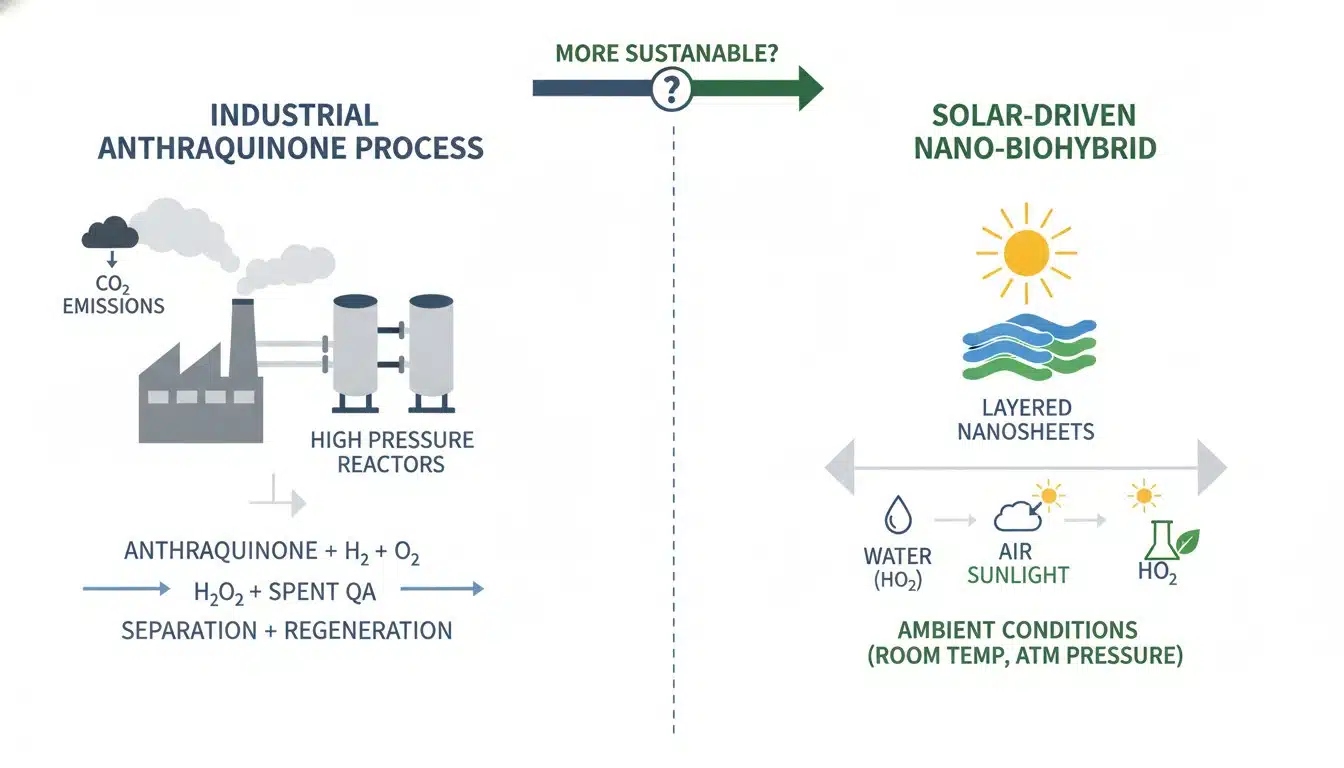
Making it is not clean at all. More than 95% of the global supply, over 4.3 million metric tons per year, is still produced by the anthraquinone process. That industrial route requires hydrogen derived from natural gas, high-pressure hydrogenation reactors, oxidation steps, and energy-intensive distillation. Energy and emission audits estimate the conventional route generates about 0.25 moles of CO2 for every mole of H2O2, adding up to roughly 1.3 million metric tons of CO2 per year globally.
That centralized, fossil-fueled model also means the oxidant must be shipped as a concentrated, reactive liquid to paper mills, wastewater plants, farms, and hospitals, adding cost, storage risk, and transport emissions. Emerging solar-driven approaches aim to flip that logic: produce dilute, usable peroxide on-site from ambient sunlight, oxygen from air, and water.
What Argonne Built: A Layered PM-BiOCl Biohybrid
The new system was developed by a team led by the U.S. Department of Energy’s Argonne National Laboratory, with collaborators at Japan’s Photon Science Innovation Center and Tohoku University. The work, featured on the cover of the Journal of the American Chemical Society, uses a design strategy called nanoarchitectonics.
Nanoarchitectonics uses nanoscale building blocks to assemble functional architectures, often inspired by living systems. As Argonne postdoctoral appointee and lead author Jinhyeong Jang noted, the approach sits alongside artificial intelligence and quantum information science as a defining technology of the 21st century, and it can be used to tune living systems for functional purposes.
The material itself is built from layered nanosheets about 200 nanometers thick. Each sheet forms a hybrid interface of two components:
- Bismuth oxychloride (BiOCl): a synthetic, layered semiconductor known as a photocatalyst.
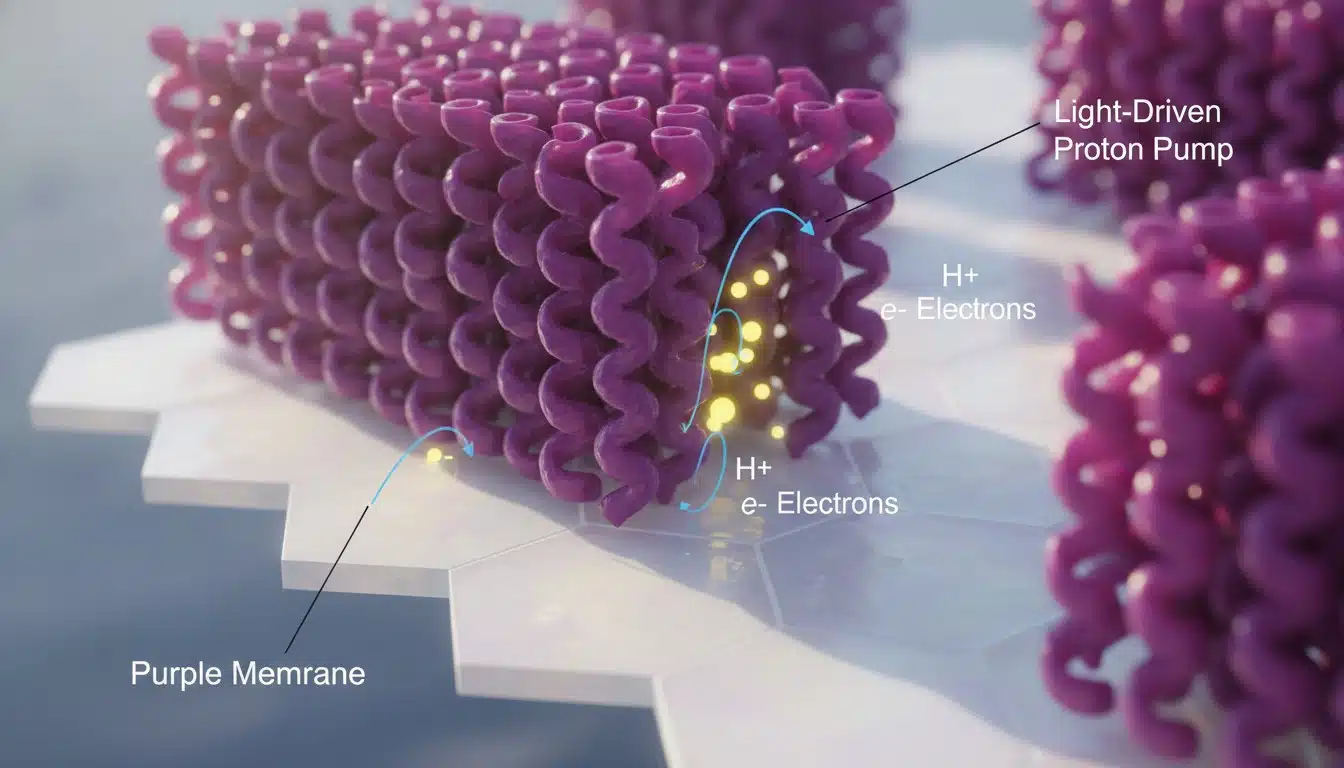
- Purple membrane (PM) patches: a naturally occurring, light-absorbing biological membrane derived from salt-loving microorganisms called halophilic archaea.
The team fabricated the nanosheets at Argonne’s Center for Nanoscale Materials (CNM), a DOE Office of Science user facility, and characterized them with the CNM’s advanced electron microscopy tools. Co-authors include Elena Rozhkova, Yuzi Liu, and Jianguo Wen at Argonne; and Haruki Meguro and Tetsuya Nakamura at the Photon Science Innovation Center and Tohoku University.
How It Works: A Biological Solar Panel Driving a Semiconductor
Both components are impressive on their own. Many semiconductors like BiOCl can catalyze reactions under light, and purple membranes are exceptionally robust, neatly organized biological devices that act as natural light-driven proton pumps. But simply mixing them does not create efficient catalysis.
The key, according to Argonne scientist Elena Rozhkova, is designing their interface to guide how charge moves and to drive a specific chemical reaction.
When light shines on the PM-BiOCl hybrid:
- The purple membrane acts like a biological solar panel, capturing light energy.
- It drives the movement of protons and electrons at the interface with BiOCl.
- That interfacial charge transfer helps the semiconductor reduce dioxygen (O2) from air while oxidizing water, forming hydrogen peroxide through a selective two-electron and two-proton transfer process.
The selectivity matters. Photocatalysts can either partially reduce oxygen to hydrogen peroxide (the desired two-electron pathway) or fully reduce it to water (a wasted four-electron pathway). By modulating the photogenerated charge-carrier dynamics of the archaeal subcellular fractions, the hybrid keeps more electrons available for the peroxide-forming reaction instead of losing them to recombination as heat.
Five Times More Peroxide at Ambient Conditions
Under illumination at ambient temperature and pressure, the PM-BiOCl hybrid nanosheets produced over five times more hydrogen peroxide than BiOCl alone, according to Argonne’s announcement.
The team emphasized two practical advantages:
- Ambient operation: The reaction runs under mild conditions without high-pressure reactors.
- Inexpensive, abundant materials: The system uses only sunlight, air, water, and low-cost, earth-abundant components, unlike industrial routes that require hydrogen feedstock and complex catalytic systems.
As Rozhkova explained, doing the same reaction industrially would require high energy input and more complex catalytic systems. The carefully designed nano-bio interface shows how mild, sunlight-driven conditions can direct chemistry that normally demands harsh industrial infrastructure.
| Feature | Conventional Anthraquinone Process | New PM-BiOCl Nano-Biohybrid |
|---|---|---|
| Inputs | Hydrogen from natural gas, anthraquinone carrier, O2, high-pressure H2 | Sunlight, O2 from air, water |
| Energy conditions | High temperature, high pressure, distillation | Ambient temperature and pressure |
| Carbon footprint | ~0.25 mol CO2 per mol H2O2; ~1.3M tons CO2/year globally | No fossil hydrogen; solar-driven |
| Production model | Centralized plants + long-distance shipping of concentrated peroxide | Potential on-site, decentralized synthesis |
| Co-products | Waste organics requiring regeneration | Value-added chemicals from ethylene glycol (see below) |
| Performance benchmark | Industrial standard for >95% of global supply | >5x H2O2 vs BiOCl alone in lab tests |
Bonus Chemistry: Turning Ethylene Glycol Into Value
The system does not just make peroxide. In parallel with dioxygen reduction, it oxidizes ethylene glycol, a low-cost industrial chemical, into higher-value products, including glycolaldehyde, glyoxal, and formic acid.
That dual-function design is an example of using multiple parts of a catalytic reaction to add value, rather than treating the oxidation half-reaction as waste. Formic acid, glycolaldehyde, and glyoxal are used as intermediates in chemical manufacturing, so coupling them to peroxide formation improves the overall atom economy and economics of a solar chemical cell.
This approach aligns with broader efforts in solar-powered peroxide production, where researchers aim to generate oxidants exactly where they are needed, from water treatment to disinfection, without shipping hazardous concentrates.
Why Nanoarchitectonics Could Reshape Green Chemistry
Nanoarchitectonics is more than a fabrication trick. By assembling nanoscale building blocks into layered architectures, researchers can tune optoelectronic and catalytic limitations that hold back bare semiconductors, such as rapid electron-hole recombination and poor selectivity.
Argonne’s study explicitly presents the approach as leveraging the photogenerated charge-carrier dynamics of archaeal subcellular fractions to modulate the limitations of semiconductors. In practical terms, the biological patch trains the semiconductor to do one job well.
Jang noted the versatility extends beyond peroxide: “Nanoarchitectonics is a versatile, exciting approach that can be applied to a variety of challenges, such as making fertilizer and fuel components.”
If scaled into thin films or floating leaf-like devices, similar hybrids could sit on reservoirs, irrigation ponds, or coastal lagoons and continuously generate dilute peroxide for sanitation, advanced oxidation processes, or pollutant removal, working alongside other light-driven platforms like photothermal-photocatalyst sheets that produce clean energy and water. Portable versions could also support disaster-response clinics and off-grid communities, an idea already explored with portable electrolytic disinfectant generators that need only electricity, water, and air.
Challenges remain before any product leaves the lab, including maintaining stability under fluctuating sunlight and water chemistry, preventing peroxide decomposition, and controlling concentration within safe limits. But the demonstration that a purple membrane-semiconductor interface can steer a selective two-electron oxygen reduction under ambient conditions marks a clear step toward decentralized, renewably powered chemical manufacturing.
Frequently Asked Questions
How can scientists make hydrogen peroxide with sunlight?
Sunlight energizes a photocatalyst that transfers electrons to oxygen from air and drives a selective two-electron reduction that combines oxygen and water into H2O2. The new Argonne hybrid uses a purple membrane to capture light and BiOCl nanosheets to perform the catalysis at the nano-bio interface.
Can you turn water into hydrogen peroxide?
Yes, but you need both water and oxygen. Photocatalytic systems use water as the proton and electron source and oxygen from air as the oxidant, converting them into H2O2 under light without fossil feedstocks. The PM-BiOCl hybrid does this in one step under ambient conditions.
Where does hydrogen peroxide come from naturally?
Small amounts are produced naturally in cells, including human immune cells that generate H2O2 to kill pathogens, and in the atmosphere through photochemical reactions. Industrially, however, almost all supply is synthetic, made by the anthraquinone process.
Do humans naturally produce hydrogen peroxide?
Yes. Human cells produce low levels of H2O2 as a signaling molecule and as part of immune defense. Enzymes tightly control its concentration because at high levels they become reactive oxidizers that can damage tissues.
What is photocatalytic hydrogen production vs photocatalytic peroxide production?
Both use light-driven catalysts, but they target different reactions. Photocatalytic hydrogen production splits water to make hydrogen gas, while photocatalytic peroxide production partially reduces oxygen to make H2O2. The latter requires strict control to favor the two-electron pathway.
What is the most common catalyst used in photocatalysis?
Titanium dioxide is historically the most studied photocatalyst, but newer materials like bismuth oxychloride, carbon nitrides, and covalent organic frameworks are now optimized specifically for peroxide selectivity, light absorption, and stability in real water.
Why don’t doctors use hydrogen peroxide on wounds as much anymore?
At the concentrations sold for household use, hydrogen peroxide can damage healthy tissue and slow wound healing, so clinicians now prefer saline or more targeted antiseptics for deep wound care, even though dilute peroxide remains useful for surface disinfection.
What can decompose hydrogen peroxide and how long does it last?
Heat, light, dust, metals, and the enzyme catalase rapidly decompose H2O2 into water and oxygen. In soil, dilute peroxide typically breaks down within hours to a few days depending on organic matter and microbial activity, which is why stabilization and prompt use matter for solar-made peroxide.


