
As floods become more frequent and destructive, one invention is helping honeybees stay above water. The Beekon hive system is a buoyant, modular beehive that automatically floats when floodwaters rise and settles back down when they recede, protecting entire colonies without requiring a beekeeper to be on site. Created by Canadian mechanical designer Konrad Borowski, the system is made from recycled plastic and designed to work with the frames beekeepers already use.
What Is the Beekon Hive System?
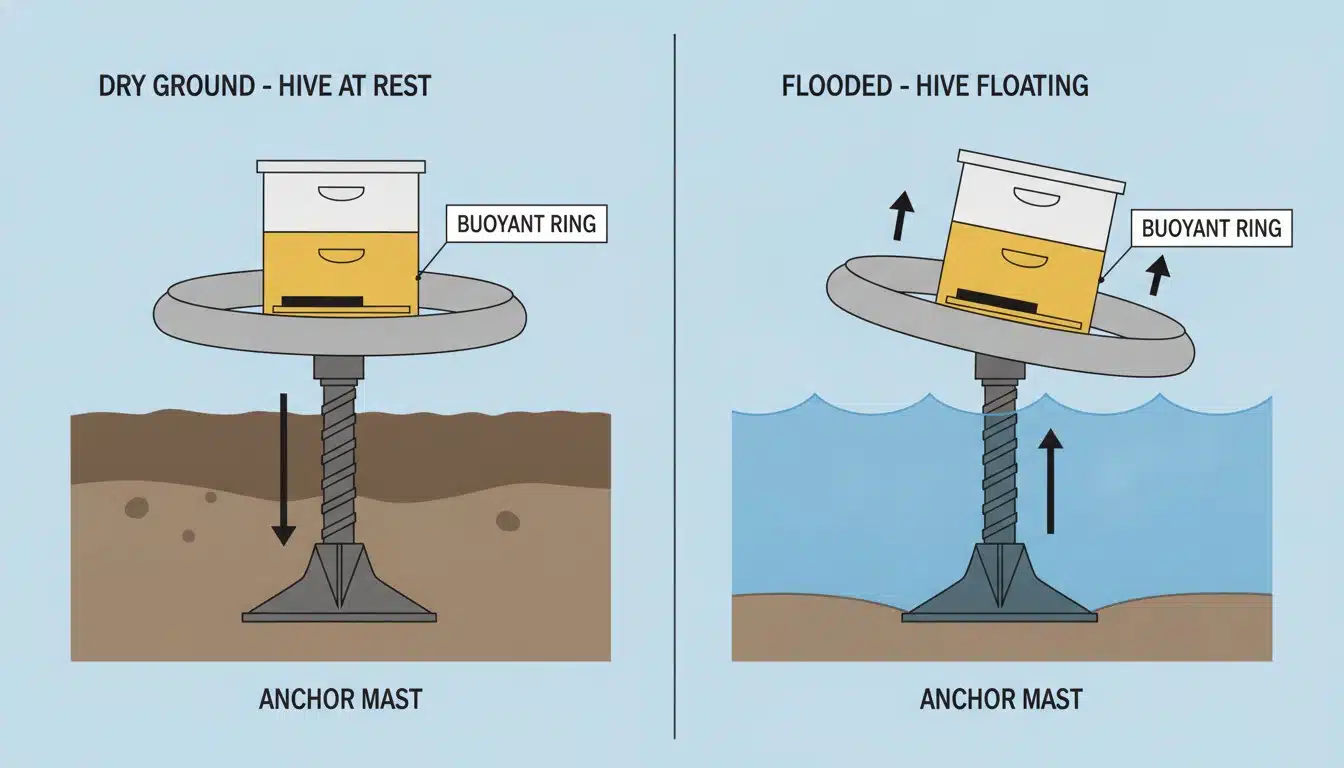
The Beekon hive system is the first beehive engineered to survive flooding in what its creators call a naval setting. Unlike a traditional wooden box that sits directly on the ground or a stand, Beekon is a floating platform built around a central mast anchored into the earth.
Think of it as a lifebuoy wrapped around a vertical pole. The buoyant ring supports the hive body, while the mast keeps it in place. When water rises, the hive rises with it. When water falls, the hive returns to its resting position. No electricity, pumps, or emergency relocation are required after installation.
According to Beekon, the system is fully modular and multi-nest capable, scalable to forecasted flood levels and water table depths, and designed to withstand aggressive currents through its curved hull. Internal rails host conventional top-bar frames, so beekeepers can line each super with standard Langstroth, Warré, Dadant, or other common frames. As the team puts it: same bee spacing, same happy bees, with new resilience.
How the Floating Lifebuoy Design Works
The core idea is deliberately simple: if water is the problem, buoyancy is the solution.
- Central anchor mast: A metal rod is driven securely into the ground and acts as a fixed guide rail.
- Buoyant ring platform: A lightweight, hollow structure made from fully recyclable HDPE provides lift, similar to a dock float or life preserver.
- Self-activating lift: As floodwater rises, the platform slides up the mast, keeping brood, honey stores, and the queen above the waterline.
- Automatic return: As waters recede, the hive lowers itself back to ground level, allowing foragers to resume normal activity without colony stress from transport.
This self-activating approach solves a critical practical gap. Beekeepers often cannot reach apiaries during storms, and moving colonies on short notice is costly and disruptive to the hive’s thermoregulation and orientation. Fixed elevation platforms help with minor nuisance flooding but can be overtopped in severe events. Beekon is designed to scale with the flood itself rather than betting on a fixed height.
The design has received a United States patent for a buoyant modular beehive apparatus and requires no integrated electronics to float, keeping installation and maintenance low. The system is also described as energy-integration ready, with the option to add solar panels via the mast for future data collection and off-grid monitoring.
Why Traditional Wooden Hives Fail in Floods
The stationary wooden beehive has been the standard for more than 200 years, and for most of that time it worked. That standard is no longer holding up against today’s climate.
Wood absorbs water rapidly. In a flood, a traditional hive can saturate, become unstable, and sink or tip, drowning bees and fouling brood. Even in near-misses where water does not fully submerge the colony, lingering dampness creates conditions that invite pathogens.
| Feature | Traditional Wooden Hive | Beekon Hive System |
|---|---|---|
| Flood response | Remains fixed; relies on human relocation or raised stands | Floats automatically along anchored mast |
| Material | Wood, which absorbs moisture | Recycled HDPE plastic, moisture resistant |
| Pathogen risk when wet | Higher risk for Varroa mites and hive beetles in damp wood | Reduced moisture retention helps limit favorable conditions for mites and beetles |
| Human intervention needed | Yes, often urgent and costly during storms | No, self-activating after installation |
| Compatibility | Standard frames | Standard frames via internal rails |
| Scalability | Limited to site elevation | Scales to forecasted flood depth and water table |
As reported by Earth.Org, which interviewed Borowski in late 2025, most beekeeping happens near agriculture, and most agriculture happens near open bodies of water. That proximity puts pollination services at risk of being lost in a matter of moments when flash floods hit.
Built From Recycled Plastic for a Wetter Future
Material choice is central to the Beekon concept. The hive is made from fully recyclable HDPE or equivalent recycled plastic, rather than timber.
Why it matters:
- Lighter than wood with denser lining: The structure remains buoyant while providing insulation comparable to or better than thin wooden walls.
- No swelling or rot: Plastic does not absorb water the way wood does, so repeated wet-dry cycles cause less structural degradation.
- Less hospitable to moisture-loving pests: Drier interior conditions mean less favorable habitat for Varroa mites and small hive beetles, which thrive in damp, compromised hives.
- Circular life cycle: At end of life, HDPE can be recycled again, aligning with the system’s sustainability goals.
The approach also addresses a broader durability problem. Even without a catastrophic flood, apiaries in wetlands, riversides, and coastal lowlands face nuisance flooding that has increased by 300% to 900% over the last 50 years, according to data shared by Beekon. A hive that can live with water, rather than fail in it, expands where beekeeping is viable, including marshlands, mangroves, and floodplains where blooming plants are abundant but conventional hives cannot be risked.

The Bigger Picture: Bees, Food Security, and Climate Change
Bees have even been declared the most important species on Earth for their foundational role in ecosystems, and bee losses are not just about honey. Pollinators support about 35% of global agricultural land, and bees handle about 90% of that pollination work. In the United States alone, honeybees provide roughly $15 billion in agricultural value each year through pollination of almonds, apples, cherries, blueberries, melons, pumpkins, and many other crops, according to the U.S. Department of Agriculture.
Those services are under unprecedented pressure:
- Around 35% of invertebrate pollinators, especially bees and butterflies, are at risk of extinction, with extinction rates 100 to 1,000 times higher than normal due to human impacts, the United Nations reports.
- In the United States, the winter of 2024 to 2025 was catastrophic. A national survey of 842 beekeepers representing about 1.96 million colonies found commercial beekeepers lost an average of 62% of their colonies between June 2024 and March 2025, with an estimated 1.6 million colonies lost and economic impacts exceeding $600 million, as summarized by the Honey Bee Health Coalition.
- A separate nationwide survey by the Apiary Inspectors of America estimated total annual losses of 55.6% from April 2024 to April 2025, the highest since tracking began in 2010, well above the 14-year average of 41.4%.
- Flooding adds to an already long list of stressors that includes Varroa mite resistance to treatments, pesticide exposure, habitat loss, and shifting bloom cycles.
Beekon does not claim to solve every threat. But by removing flooding as a single point of failure, it gives colonies a first line of defense during the very events that are becoming more common. Beekon estimates that more than 12.5% of U.S. hives (about 475,000) and 34% of global hives (about 31.5 million) are actively at risk from flooding, representing potential annual losses of $308.75 million in the U.S. and $29.925 billion globally. Even the recent hurricanes Helene and Milton reportedly destroyed more than 200,000 hives in 2024, underscoring how quickly storm-driven losses can scale.
For more on creative approaches to pollinator support, see how communities are building dedicated habitats, how to build bee hotels to save the native bees near you, and how urban design is rethinking shelter in our feature on Refugio shelters for solitary bees.
Cost, Availability, and What Beekeepers Need to Know
Beekon is still in the pilot and pre-commercial phase, so three questions come up most often from beekeepers searching for the system: price, manual, and problems.
How much does the Beekon hive system cost?
Beekon has not published a retail price. The team positions the hive as a low-cost, scalable platform using widely available recycled plastic, aiming to keep costs competitive with premium wooden hives and far below the cost of replacing a drowned colony. For now, pricing is handled through direct inquiries via the official Beekon site as pilot deployments expand. If you are budgeting, factor in that the mast-and-float system replaces the need for custom elevation platforms and emergency transport in flood-prone sites.
Is there a manual or installation guide?
Instructions and specifications are provided to pilot partners and early adopters through Beekon’s contact channels. The company emphasizes that the system is designed for straightforward field setup: anchor the mast, seat the buoyant platform, and install standard frames via internal rails. No electrical integration is required for basic floating operation. Detailed manuals for wider release are expected to accompany commercial rollout.
What problems have been reported?
No widespread field failures have been publicly documented, which is consistent with a technology still scaling from prototype to regional pilots. The practical limitations are logistical rather than mechanical: the system must be installed in a suitable site where the mast can be anchored, water can actually rise and fall around the hive without trapping debris, and foragers have continued access to forage after a flood. As with any hive, routine management for Varroa, nutrition, and queen health remains essential. Boaters and riverine beekeepers should also consider anchoring depth and current exposure, as Beekon is rated to withstand aggressive currents via its hull curvature, but site selection still matters.
Beekeepers exploring complementary innovations may also be interested in hive health tools, including the antidote that gives bees immunity to pesticides being studied as another layer of protection.
From Malawi to Nepal: Where Beekon Is Headed Next
The story behind Beekon began in 2023 when Borowski watched a documentary about a beekeeper in the Philippines who lost 200 hives overnight to flooding. That loss sparked a week-long design sprint that produced the first CAD prototype. Since then, the project has moved from concept to field testing with support from institutions including the University of Waterloo, IP Ontario, and the Ontario Excellence in Agriculture program.
Beekon’s first large-scale pilot planned in Malawi was put on hold after the U.S. Agency for International Development was shuttered in early 2025, a reminder of how fragile funding can be for field innovations in the Global South. The team is now preparing a large-scale pilot in Nepal, with the goal of deploying pilots across flood-exposed regions worldwide.
Borowski has framed the longer-term vision beyond disaster resilience: stabilizing food-producing regions as climate intensifies and, where appropriate, enabling beekeeping in landscapes previously considered too wet to manage, from riversides to marshlands and mangroves. If successful at scale, floating apiaries could help keep pollination services local and continuous, rather than restarting from zero after each storm season.
Frequently Asked Questions
How does the Beekon hive float?
The hive sits on a buoyant HDPE ring that slides up and down a central mast anchored in the ground. Rising water provides the lift, so the colony stays above the waterline and returns to its original position when waters recede.
Does the Beekon hive need electricity?
No. The floating mechanism is fully passive. Energy integration, such as solar panels on the mast, is optional for future sensors or data collection but is not required to survive a flood.
Can I use my existing frames?
Yes. Internal rails are designed to host conventional top-bar frames, including standard Langstroth-style frames, so you do not need specialized bee space or proprietary foundation.
What makes it different from putting a hive on a high stand?
A fixed stand only helps until water exceeds its height. Beekon scales with the flood itself, rising as high as the water does, and it is engineered to handle currents that would wash out or topple a static platform.
Where can I buy the Beekon hive system?
As of early 2026, the system is available through pilot partnerships and direct contact with Beekon rather than general retail. Contact the team via the Beekon website for pilot opportunities, manuals, and updates on commercial availability.
A Small Float With a Big Impact
In a year when more than half of managed honeybee colonies in the United States were lost, any tool that prevents avoidable deaths matters. The Beekon hive system does not reinvent the bee or the frame, it simply lets the hive do what boats have done for centuries: float. By combining recycled materials, compatibility with existing beekeeping practice, and a self-activating design that works when no one can reach the apiary, it offers a practical, climate-adapted piece of infrastructure for one of our most essential food system services.
As Borowski has said, there is no Planet B, but there is a Planet Bee, and keeping those bees above water may be one of the simplest ways to keep our food systems afloat as well.


