
Bees are vital in the pollination of many of the plants that we eat. Therefore, they are critical to food security. But their populations continue to decline rapidly worldwide. Among the factors contributing to this are habitat loss, drought, and pesticides. Fortunately, scientists at Cornell University have developed a tiny ingestible particle that detoxifies the insects from deadly insecticides before the chemicals can do them harm.
The new technology essentially provides beekeepers, farmers, and consumers with an antidote for pesticides, which kill wild bees and lead to beekeepers losing about a third of their hives annually. An early version of the antidote delivery method successfully detoxified a widely-used group of insecticides called organophosphates. It has now been adopted by the New York-based startup Beemmunity to protect bees from all insecticides effectively.
Typical insecticides like neonicotinoids protect crops from hungry insects, but bees get caught in the crossfire. Studies show that pollen and wax in 98% of US hives are contaminated with an average of six pesticides, which can lower a bee’s immunity to devastating pathogens and varroa mites. These toxic substances interfere with the bees’ metabolism and disrupt their sleep cycles, leaving them starving and immobile.
The antidote consists of a pollen-sized microparticle loaded with enzymes that break down these insecticides before the bee absorbs them. People can mix these particles into sugar water or pollen patties and feed them to the bees. The enzymes are encased in a protective layer that remains intact when consumed and passing through the bee’s acidic stomach. This allows the enzymes to make it safely to the midgut, where digestion takes place and where they can detoxify the organophosphates.
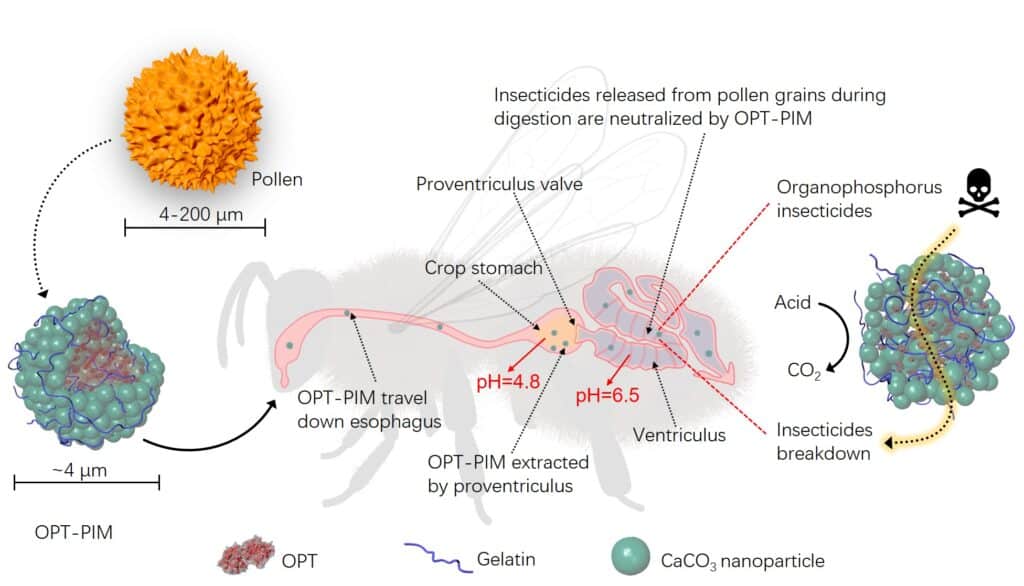
The scientists demonstrated the effectiveness of the antidote on live bees in the lab. They fed the insects an organophosphate pesticide and then the particles. They administered a control group only the pesticide. They saw a 100% survival rate in the bees fed the particles, while all the unprotected bees died in the following days.
Co-author James Webb, MS, who is also the CEO of Beemmunity, said:
We have a solution whereby beekeepers can feed their bees our microparticle products in pollen patties or a sugar syrup, and it allows them to detoxify the hive of any pesticides that they might find.
Beemmunity is currently taking the concept a step further. It is developing particles consisting of a casing made of insect proteins and filled with an absorbent oil instead of enzymes. Many pesticides, including neonicotinoids, work by targeting insect proteins. So, the coating soaks up the chemical, and the oil entraps it. Eventually, the bees defecate the sequestered toxin.
Senior author Minglin Ma, the lab leader and an associate professor in the College of Agriculture and Life Sciences, said:
This is a low-cost, scalable solution which we hope will be a first step to address the insecticide toxicity issue and contribute to the protection of managed pollinators.
The company will be conducting trials this summer across 240 hives in New Jersey and plans to launch its products next year in February.


