
Scientists at the Malaysian Nuclear Agency have achieved a breakthrough in crop development: new cassava varieties that mature in roughly six months, nearly halving the standard 11-to-12-month growing period. The discovery, announced in August 2026, uses a decades-old technique called mutation breeding, in which gamma radiation induces genetic changes in plant material to accelerate the natural process of evolution. If commercialized, these faster-maturing cassava lines could reshape food production across Southeast Asia and beyond.
The research, which began in 2021 at the agency’s Agrotechnology and Biosciences Division, is part of a broader national effort to strengthen food security using nuclear science. It also carries international backing through the International Atomic Energy Agency (IAEA) and the Food and Agriculture Organization (FAO), which have promoted mutation breeding as a safe, proven tool for crop improvement in more than 70 countries.
Malaysia’s Nuclear Cassava Breakthrough
Research officer Norazlina Noordin, who leads the cassava project at the Malaysian Nuclear Agency, described the results at a public advocacy event in Cyberjaya on August 22, 2026. “After five to six years of research, we obtained several new lines that could reduce the harvesting period to about six months without compromising yield,” she said. “The yields were higher than those of the control plants.”
The project targets one of cassava’s biggest limitations: its long growing cycle. Conventional cassava varieties in Malaysia typically require 11 to 12 months before harvest, which limits how many cropping cycles farmers can complete in a year. By cutting that timeline nearly in half, the nuclear-bred varieties could allow farmers to plant cassava twice annually, significantly boosting economic returns.
Norazlina noted that the new lines also show improved culinary qualities, including less fibre, faster cooking time, and a softer texture. The agency is now conducting final screening to confirm that these traits remain stable across multiple generations, a requirement before any variety can receive regulatory approval for commercial release. Researchers expect that process to take another one to two years.
What Is Mutation Breeding?
Mutation breeding, also known as variation breeding, is a technique that uses physical radiation or chemical agents to induce spontaneous genetic changes in plants. Unlike genetic modification techniques such as CRISPR, which introduce foreign DNA or make targeted edits to a plant’s genome, mutation breeding works with a plant’s own genetic material. It simply accelerates what nature already does: the slow, random process of genetic mutation that drives evolution.
In practice, scientists expose seeds, stem cuttings, or tissue cultures to controlled doses of ionizing radiation, most commonly gamma rays from a cobalt-60 source. The radiation causes random breaks and alterations in the plant’s DNA. Most of these changes are neutral or harmful, but a small fraction produce beneficial traits, such as shorter growing times, higher yields, disease resistance, or improved nutritional content.
The technique has been used since the 1920s and gained momentum after World War II. Today, the IAEA’s Mutant Variety Database records approximately 3,400 officially released mutant crop varieties from 70 countries, covering more than 200 different types of crops, including rice, wheat, barley, cotton, sunflower, and legumes.

How Gamma Radiation Transforms Cassava
The Malaysian cassava project follows a well-established mutation breeding pipeline. Researchers begin by exposing cassava stem cuttings to gamma radiation in a controlled facility. The radiation passes through the plant tissue, causing random genetic alterations at the cellular level. The irradiated cuttings are then planted and grown through multiple generations, with scientists carefully screening each generation for the traits they want.
A 2024 study published in the Jurnal Sains Nuklear Malaysia determined the optimal radiation doses for cassava mutation breeding. Researchers found that a dose range of 28 to 33 Gray (Gy) induced significant genetic variability while maintaining sufficient plant viability. The study established a lethal dose threshold (LD50) of approximately 33 Gy and a growth reduction threshold (GR50) of about 28 Gy, providing critical benchmarks for future cassava improvement programs.
Because genetic changes occur randomly, scientists must screen large populations to find the few plants with desirable traits. Norazlina explained that at least 1,000 plants may need to be evaluated for each generation. The entire process, from initial irradiation to confirmed stable varieties, typically takes six to seven years. For the Malaysian cassava project, researchers are now in the final stages of validation.
From 12 Months to 6: The Benefits of Nuclear-Bred Cassava
The advantages of faster-maturing cassava extend well beyond convenience. Cassava is a staple food for more than 500 million people worldwide, particularly in Africa, Asia, and Latin America. It is also a critical industrial crop, used for producing starch, animal feed, and bioethanol. Any improvement in its growing cycle has cascading benefits for food security and rural economies.
The key improvements in Malaysia’s nuclear-bred cassava lines include:
- Earlier maturity: Harvest in approximately six months instead of 11 to 12 months, enabling two cropping cycles per year.
- Higher yields: New lines produced more root mass than control plants, even with the shorter growing period.
- Better cooking quality: Less fibre, faster cooking time, and softer texture make the roots more appealing for consumers.
- Potential disease and climate resilience: Mutation breeding can also screen for resistance to pests, diseases, and environmental stressors, though these traits are still being evaluated in the Malaysian lines.
Nearly halving the harvest time could allow Malaysian farmers to double their annual cassava output from the same plot of land, a transformative change for a crop that currently ties up fields for nearly a full year.
| Feature | Conventional Cassava | Nuclear-Bred Cassava |
|---|---|---|
| Time to harvest | 11 to 12 months | Approximately 6 months |
| Annual cropping cycles | 1 per year | Up to 2 per year |
| Fibre content | Standard | Reduced |
| Cooking time | Standard | Faster |
| Texture | Standard | Softer |
| Yield | Baseline | Higher than control plants |

Is Nuclear-Bred Food Safe to Eat?
One of the most persistent misconceptions about mutation breeding is that the resulting food is radioactive. Malaysian researchers have been vocal in addressing this concern. “The radiation only passes through the material, much like an X-ray,” Norazlina explained. “There is no radioactive residue left behind.”
The IAEA confirms this assessment. According to the agency, plant varieties bred using radiation are equally safe as those developed through conventional breeding, since the radiation does not pass on to further generations of the bred variety. Plants can be bred for many generations to achieve the best result without suffering damage or becoming radioactive.
Mutation breeding is fundamentally different from nuclear contamination. The technique uses radiation as a tool to create genetic variation, much like how a doctor uses X-rays to image the body without leaving radiation behind. The resulting plants and their food products contain no radioactive materials. This distinction is critical for public acceptance, and agencies like the IAEA and national nuclear bodies continue to invest in public education on the topic.
Malaysia’s Nuclear Agency director-general, Dr. Muhammad Rawi Mohamed Zin, reinforced this message: “The products we develop through nuclear techniques are not radioactive.” The agency has already demonstrated this with the commercialized NMR 152 rice variety, which was developed using the same gamma radiation technique and is currently grown by Malaysian farmers without any safety concerns.
A Proven Track Record: Thousands of Mutant Crop Varieties Worldwide
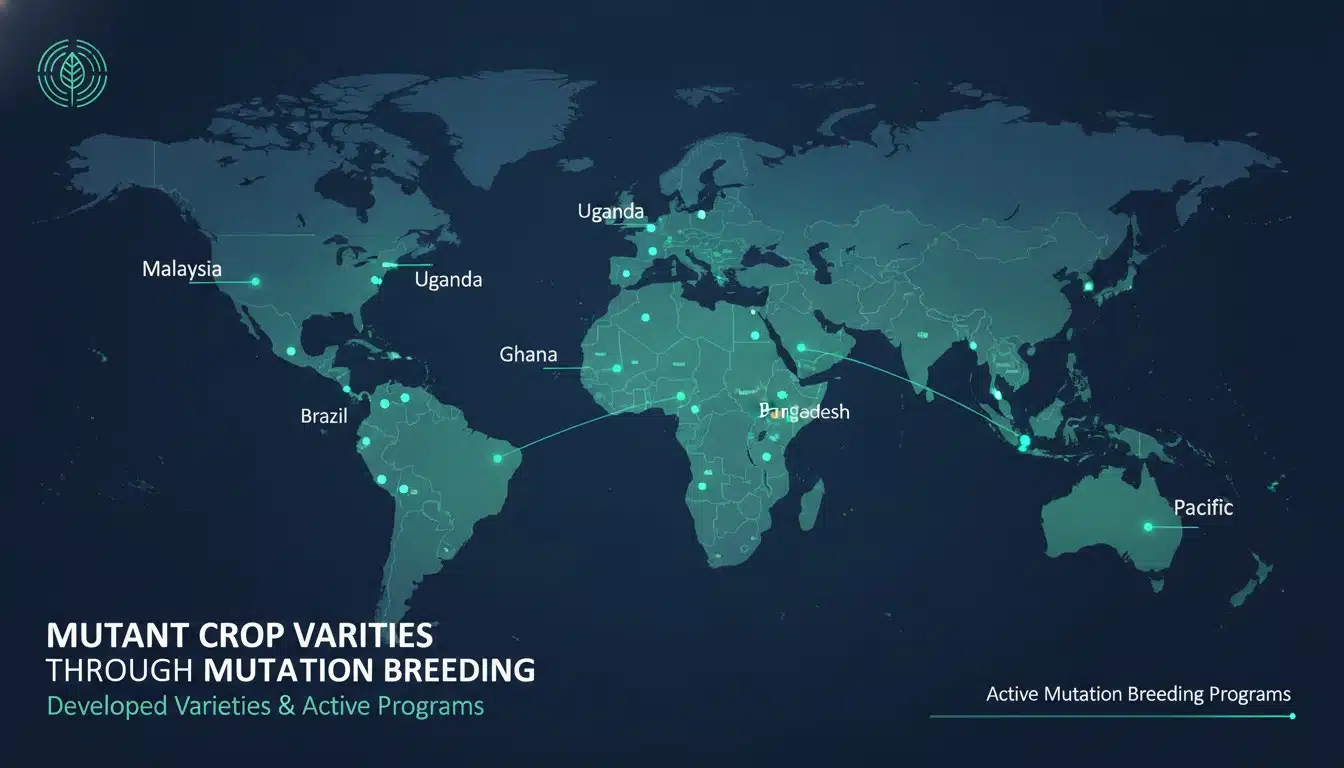
Malaysia’s cassava project is part of a much larger global movement. The country has developed 53 mutant varieties across multiple crops, including 19 rice varieties, bananas, groundnuts, orchids, chrysanthemums, and other ornamental plants. The NMR 152 rice variety, which can be cultivated for five seasons within two years, stands as the most prominent success story.
Internationally, the numbers are even more impressive. The IAEA’s Mutant Variety Database documents around 3,400 officially released varieties from 70 countries, spanning more than 200 crop types. An IAEA impact assessment of the Regional Cooperative Agreement (RCA) programme in Asia and the Pacific found that mutation breeding contributed to a 32.7 percent increase in total crop production and added an extra 34.8 million tonnes of produce between 2000 and 2019.
Recent examples of mutation breeding successes include:
- Bangladesh: A new cotton variety with improved fibre quality developed in just five years (2021).
- Uganda: 42 new cassava lines developed to resist Cassava Brown Streak Disease, with four showing promising resistance.
- Ghana: IAEA-funded research to develop disease-tolerant cassava using gamma radiation and chemical mutagenesis.
- Fiji-led regional project (2026-2029): A new IAEA-backed initiative to improve disease resistance in banana, cassava, taro, ginger, and yams across Asia-Pacific.
The technique’s versatility is one of its greatest strengths. Unlike some modern breeding tools that work only on specific crop types, mutation breeding can be applied to virtually any plant species, including those that reproduce vegetatively, like cassava, bananas, and potatoes, which are notoriously difficult to improve through conventional crossbreeding.
What This Means for Food Security in Malaysia and Beyond
Malaysia’s investment in nuclear agriculture comes at a critical time. Climate change, population growth, and supply chain disruptions are placing unprecedented pressure on global food systems.

Cassava, as a drought-tolerant, calorie-dense crop, is increasingly viewed as a strategic food security asset, particularly in tropical regions.
The Malaysian Nuclear Agency is collaborating with the Department of Agriculture and the Ministry of Agriculture and Food Security to conduct field trials on designated plots. Beyond cassava, the agency is applying the same nuclear techniques to other strategic crops, including rice, bananas, other tuber crops, and animal feed grass.
Dr. Muhammad Rawi noted that each new variety must undergo at least five generations of testing before receiving regulatory approval, a process that ensures both stability and safety. “The new seeds must first be proven stable and meet the required characteristics before they can be commercialized,” he said.
If the cassava varieties pass their final validation rounds, they could reach Malaysian farmers within two years. The broader implications extend across Southeast Asia and Africa, where cassava is a dietary staple for hundreds of millions of people and where shorter growing cycles could meaningfully improve food security outcomes.
Frequently Asked Questions
What crops have been created through mutation breeding?
Mutation breeding has produced improved varieties of more than 200 crop types worldwide, including rice, wheat, barley, cotton, sunflower, soybeans, bananas, cassava, and many ornamental plants. The IAEA’s database records approximately 3,400 officially released mutant varieties from 70 countries.
What are the downsides of mutation breeding?
The main limitation is that genetic changes are random, meaning most irradiated plants will not show beneficial traits. Scientists must screen thousands of plants across multiple generations to find the few with the desired characteristics, making the process time-intensive. It can take five to ten years from initial irradiation to a commercially released variety.
Is mutation breeding the same as genetic modification?
No. Mutation breeding uses a plant’s own genetic material and accelerates the natural process of genetic mutation. It does not introduce foreign DNA from other organisms, which is the defining feature of genetic modification (GM). Crops developed through mutation breeding are generally not subject to the same regulatory frameworks as GM crops.
Does radiation make the food radioactive?
No. The radiation passes through the plant material like an X-ray and does not leave any radioactive residue. The resulting plants and their food products are completely safe to eat and are not radioactive. This has been confirmed by the IAEA, the WHO, and national nuclear agencies worldwide.
How long does mutation breeding take?
The timeline varies by crop, but typically ranges from five to ten years. Each new variety must pass through multiple generations of screening and validation to ensure that the desired traits are stable. For cassava, one generation takes six to nine months, so the full process from irradiation to commercialization can take six to seven years.

