
It’s late on a Sunday, and you suddenly remember that your annual check-up is two months overdue. A decade ago you’d have put a sticky note on the fridge and called the clinic on Monday, probably from your desk, probably on hold. Now there’s a decent chance you’ll book it from the sofa before the TV show you’re watching ends.
That convenience runs on more than one program. Booking, records, prescriptions, and billing are usually handled by different types of medical software, often made by different companies and connected with varying degrees of success. You rarely see any of it. You just notice that some things got easier, and a few didn’t.
So what has actually changed for patients, and what hasn’t?
Booking, Reminders, and Bills: Healthcare Gets an Online Front Door
You notice the first change before you even see anyone. Instead of getting whatever appointment the receptionist has, you just scroll through open times and pick what works for you. You get a text reminder the day before, and if life throws a curveball, there’s a link to reschedule. Your old slot isn’t wasted; someone else grabs it.
Even the dreaded paperwork is online now. Lots of places email intake and consent forms ahead of time, so the waiting room clipboard is fading away. Some clinics let you check in from your car. After your visit, the bill comes as a link with a clear breakdown of charges. Honestly, that’s way better than trying to decode a paper statement.
This stuff isn’t exactly cutting-edge tech, but it fixes two main pain points: booking an appointment and dealing with admin. That’s where most people quit on healthcare.
The Doctor Will See You Now: On Screen
Remember spring 2020, when video appointments took over? That surge didn’t last, but virtual visits stuck around. The American Medical Association checks in with about 5,000 doctors for their yearly reports. In 2024, nearly half (49.6%) saw at least one patient by video each week. Four years ago, it was nearly 60%. Around 63% worked at clinics offering video visits at all.
Telehealth ended up finding its groove. It’s perfect for med check-ins, going over test results and therapy sessions, the kinds of appointments you don’t need to be in the room for. But for a sore knee or a stubborn cough, doctors still want to see you in person.
Medicare’s keeping telehealth alive, at least for now. The expanded rules, which let patients see clinicians from home anywhere in the country, are good until the end of 2027.
When Clinics Have Their Own App
You may also have noticed that some clinics now have an app of their own, with their logo on it, instead of a generic portal. Clinics usually commission these from outside teams. Healthcare app developers such as Intellectsoft build booking, video-visit, and follow-up tools that plug into the records system a clinic already uses, which saves staff from typing the same details in twice.
From the patient’s side, it means fewer places to look. Appointments, messages, video calls, and results end up in one spot, and the app feels like part of the clinic rather than a separate service you had to sign up for.
Your Medical Record: In Your Pocket
Back in 2008, only 42% of US office doctors used any kind of electronic health record (EHR). Records were still mostly paper, filed away in cabinets. By 2024, that shot up to 95%, according to the Assistant Secretary for Technology Policy (ASTP).
You mostly notice this through a portal, a secure site or app where you check labs, read visit notes, request refills, or send your doctor a message. ASTP found that in 2024, 77% of Americans got this kind of access, and 65% actually used it. That was just 57% two years ago. Now, a third of people log in six times or more a year.

Caregivers saw the biggest jump. Proxy access, which lets someone handle another person’s records (usually an adult child helping a parent), hit 51% in 2024, way up from 24% in 2020. So, say a son three hours away can see his mom’s cardiology appointments, read the doctor’s notes, ask about prescriptions, all without calling the clinic during his lunch break.
One quiet but important finding: When a doctor pushes patients to use the portal, 87% actually do. Without that nudge, only 57% bother. Turns out, thirty seconds from your clinician works better than any reminder email.
From Step Counter to Clinical Tool
Old fitness trackers just counted steps. Now, they track sleep, heart rate, blood oxygen, and more. In Rock Health’s 2025 survey, almost half (46%) of US adults own a wearable. Ten years ago, only 13% did.
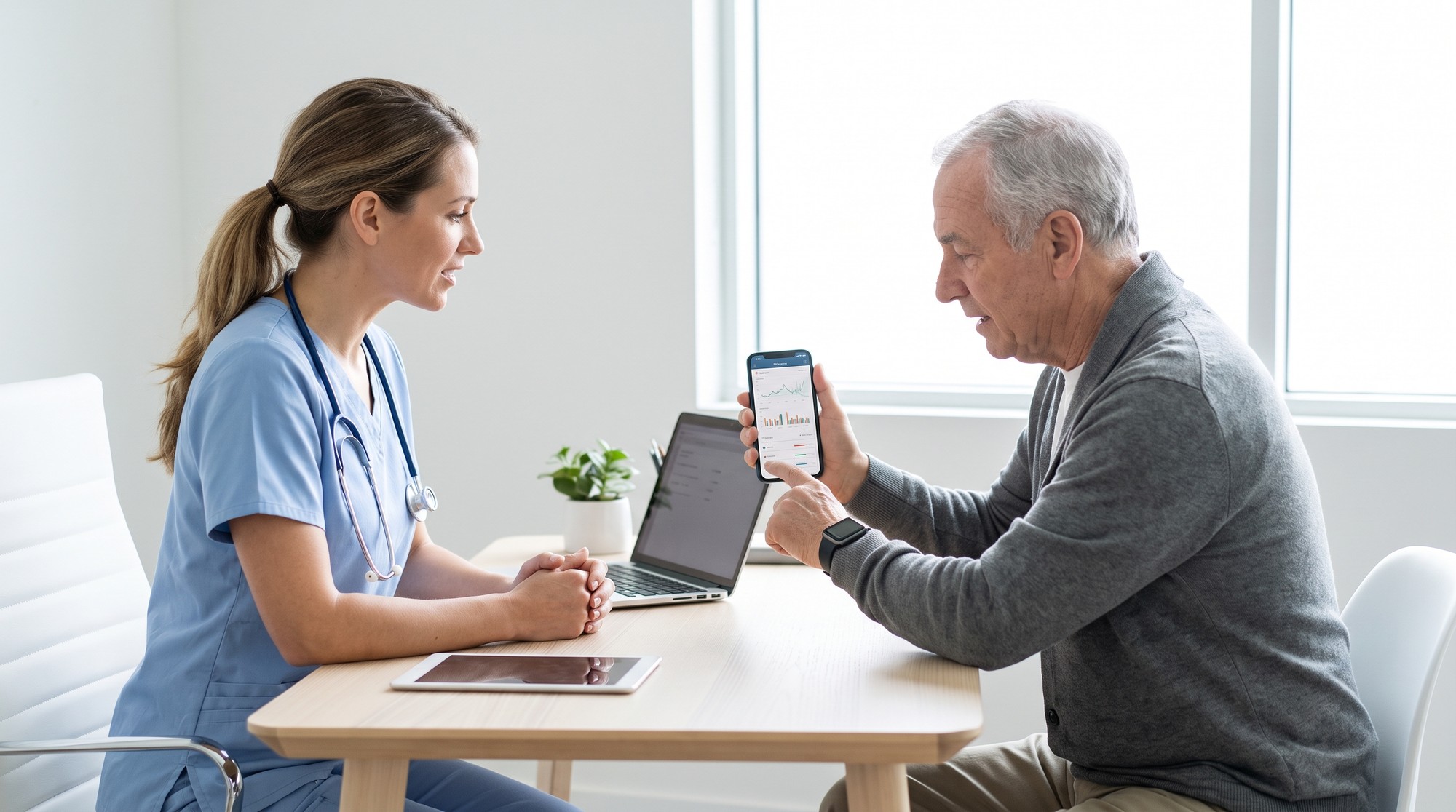
That data isn’t just for you. Among wearable users, 59% have talked about their numbers with a healthcare provider, and almost a third discuss it regularly. Another 20% plan to, but just haven’t gotten around to it.
Remote patient monitoring goes one further. These devices, like blood pressure cuffs, glucose monitors, and pulse oximeters, are prescribed instead of bought, and send readings straight to your care team. Staff reach out when numbers start to drift. Combined with video visits, this setup has created hospital-at-home programs. Some patients who would normally be admitted now recover at home with daily remote check-ins. Medicare’s authority runs through September 2030 for these programs. For a lot of families, it’s simply a more clinical version of the remote care tools they already use for elderly relatives at home.
AI Is Working Behind the Scenes
When people picture AI in medicine, they tend to imagine a machine making diagnoses. The reality, for now, is more mundane. Most of it is helping with paperwork.
It’s spreading quickly, though. In an AMA survey of nearly 1,700 physicians released in March 2026, 81% said they used AI in their work, more than double the 2023 figure. Summarizing medical research was the most common use (39%). Next came drafting discharge instructions and care plans (30%) and documenting visit notes and billing codes (28%). Around one in five used it to help write replies to patient portal messages.
Some clinics have gone further with “ambient” note-taking. With the patient’s consent, a tool listens to the appointment and drafts the visit summary, which the doctor then checks and signs. If you’ve ever spent a consultation looking at the back of a laptop while your doctor typed, you can see the appeal.
Physicians aren’t uncritical about it. In the same survey, 88% worried that leaning on AI could erode the skills of doctors still in training. It’s a fair worry, and a reasonable expectation for patients is that a human clinician stands behind anything an AI tool produces.
What Technology Hasn’t Fixed Yet
Not every problem has gone away. Some have simply moved online.
Medical records still don’t move easily from one place to another. Your hospital, your family doctor, and your specialist might all use digital tools, but they still struggle to share your information. So, you end up emailing PDFs instead of handing over paper copies, just a different kind of hassle.
People worry about privacy, and so do doctors. In an AMA survey, 86% of doctors said we need tougher data privacy rules before AI starts playing a bigger role in healthcare. If you’re thinking about connecting a fitness app or your smartwatch to your medical records, it’s smart to check what the app actually does with your data before you link anything up.
Then there’s the question of who benefits. Rock Health found that wearable owners tend to be younger, wealthier, more urban and healthier than people without one. That’s close to the opposite of the people who would gain most from monitoring. Older adults, rural communities and anyone without reliable internet or a smartphone are at risk of falling behind as more care moves online.
And while technology can take a lot of admin off a doctor’s plate, it can’t replace the conversation itself. Ideally, it gives clinicians more time for it.
What This Means for You
You don’t have to be an early adopter to get something out of all this. A few small steps help:
- Set up your patient portal if you haven’t yet, and switch on notifications for new results and messages.
- If you help a parent or partner with their care, ask the clinic about proxy access. It’s usually just a form.
- Ask whether your next follow-up could be a video visit. It can save half a day off work for a 15-minute conversation.
- Before connecting a wearable or health app to your records, check its privacy settings.
- Go in with questions, not just data. Smartwatch charts are useful, but a written list of what you want to ask still makes for a better appointment, as our patient guide to preparing for a heart transplant shows.
Most of what’s changed in healthcare technology over the past ten years happened behind the scenes. The better you understand those tools and where they fall short, the more use you can get out of them.


