
Buying an automotive part online can look simple until a customer reaches the details. Two products may appear almost identical but fit different vehicles. A component may require an additional bracket. A workshop may need several items for different jobs, each with its own compatibility requirements.
For automotive brands, these situations create a practical design challenge. The website needs to help customers make an informed selection while giving business buyers an efficient way to order.
A better experience starts with understanding the decision the customer is trying to make. Some visitors need guidance. Others know the exact part they want. Dealers may need access to their purchasing terms before they can decide whether to proceed.
The most useful improvements connect product information, compatibility, and ordering rather than treating them as separate website features, and they sit within wider e-commerce website optimization rather than a single fix.
Start with the Customer’s Route to the Product
Not every customer arrives with the same information.
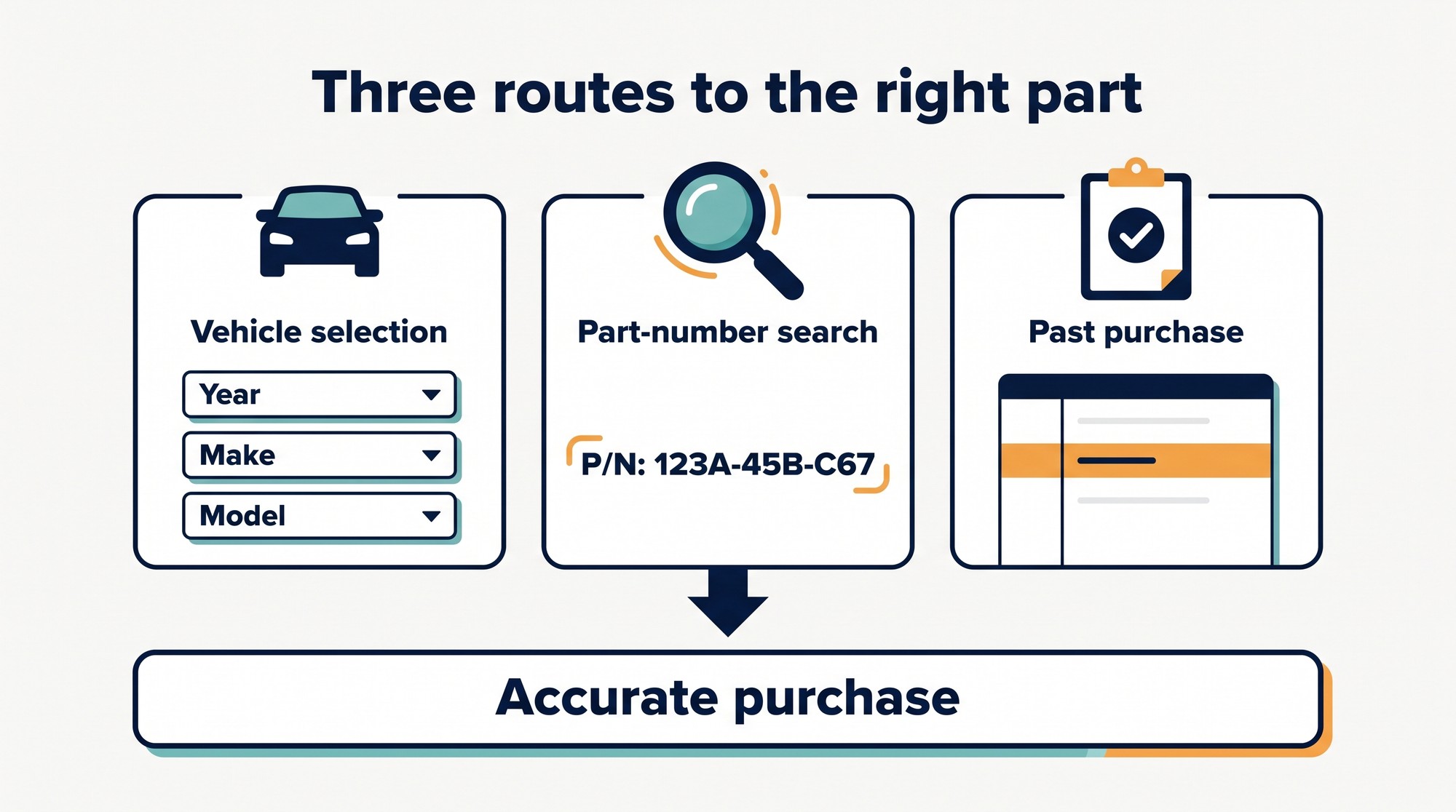
An enthusiast may know the vehicle but not the name of the component. A technician may have a manufacturer reference. A repeat buyer may begin with a previous order. Someone purchasing a configurable product may know the desired outcome but need help choosing the right options.
An automotive store should make those different starting points understandable.
Vehicle selection can support guided browsing. Direct search can help people who already know the product. Clear categories and technical descriptions can help customers who need to compare options.
The aim is to remove unnecessary steps while preserving the information needed for an accurate purchase.
Make Compatibility Clear Where the Decision Happens
A search result is only the beginning of the decision.
The product page should help the customer understand whether the item suits their application and whether any relevant exceptions apply. Important compatibility notes should appear where the customer evaluates the product, rather than being buried in a separate document.
Consider a product that fits a vehicle family but excludes a particular engine or configuration. A broad category label may not communicate that distinction clearly enough.
For businesses that maintain their own fitment data, industry standards such as the ACES and PIES data standards provide a common, machine-readable way to describe which parts fit which vehicles. Reliable underlying data makes every downstream compatibility feature easier to trust.
The same principle applies to required accessories. If a purchase needs an additional component, the customer should understand the relationship before placing the order.
For business buyers, clarity is especially useful when several people are involved in selecting, approving, and receiving the goods.
Give Trade Customers an Efficient Buying Path
A repair shop placing a routine order does not always need the same browsing experience as a first-time consumer.
Business customers may need to locate known items quickly, enter several quantities, review the applicable purchasing conditions, and pass the order into an established internal process.
The website brief should describe those tasks in ordinary language.
For example, a dealer needs to find three known products, confirm that they are purchasing under the correct account, and submit the order without re-entering information the business already holds.
That description is more useful than a vague request for a “B2B portal.” It gives the project team something concrete to design and test.
Make Complex Purchases Easier to Explain
Some products cannot be reduced to a single selection and an immediate checkout.
A custom assembly may require several choices. A buyer may need a quotation before approval. An installer may need to confirm whether the proposed configuration meets the job’s requirements.
A well-designed website can still improve those purchases.
It can collect relevant details, show the customer what they selected, and pass a complete request to the sales team. The objective is to reduce repeated questions and prevent important information from being lost between the website and the conversation that follows.
The process should also explain what happens next. Customers need to know whether they have placed an order, requested a quote, or submitted a question.
Ecommerce Agencies to Consider for Automotive and B2B Stores
Choosing an implementation partner becomes easier when the brief identifies the problem clearly. The entries below focus on agencies that publish a dedicated automotive or B2B ecommerce practice, and they cover different combinations of Shopify development, product discovery, and trade ordering.
This is a short, illustrative selection rather than an exhaustive one, and the order is for reference only rather than a ranking. Each description is based on information the agency publishes about its own services, so partner tiers, certifications, and results should be verified directly with the agency, through the relevant platform’s official partner directory, or via independent review platforms such as Clutch and G2 before you commit.
1. Fyresite
A strong fit for: Automotive brands that need compatibility and purchasing workflows developed together.
Fyresite is a Shopify Premier Partner with an automotive practice covering fitment, custom product logic, and store migrations.
For a business considering Fyresite, the useful starting point is a real product-selection problem and the information required to resolve it.
What to compare: The customer journey, compatibility requirements, and handoff between online selection and order processing.
2. Uncap
A strong fit for: Automotive businesses serving both trade accounts and consumers.
Uncap provides Shopify services for automotive manufacturers and distributors, alongside Uncap Garage, a year/make/model parts-search app with visual fitment tools and configurable search widgets.
It is a relevant option when the same product range needs to support different customer groups.
Bring examples of how a dealer and a consumer would buy the same item. The proposed experience should explain where their journeys can be shared and where they need to differ.
What to compare: Vehicle discovery, trade purchasing, and ongoing catalog maintenance.
3. IWD Agency
A strong fit for: Businesses evaluating technical automotive and B2B requirements.
IWD Agency works across Shopify, Adobe Commerce, and BigCommerce, with a published automotive practice covering year/make/model fitment, ACES and PIES product data, VIN lookup, and cross-reference, and serving trade and retail buyers from a single store.
It is worth considering when the business needs to examine the overall operating model before selecting an implementation.
A useful discussion should establish which existing processes customers value and which create unnecessary work.
What to compare: The proposed platform approach and the treatment of difficult purchasing exceptions.
4. 121eCommerce
A strong fit for: Parts sellers balancing product research with regular business purchases.
121eCommerce provides automotive ecommerce services across Shopify, Adobe Commerce, and BigCommerce, including year-make-model and part-number lookup that confirms a part fits before it reaches the cart.
Consider it when the brief needs to serve customers who require detailed guidance as well as returning buyers who want to complete familiar tasks quickly.
What to compare: Product-page clarity, direct lookup, and the steps required to place a repeat order.
5. Absolute Web
A strong fit for: B2B projects connected to a wider set of business systems.
Absolute Web offers Shopify development and B2B services involving account portals, quoting, and integrations, with teams in Miami, Los Angeles, and Lisbon.
It is a candidate when the website depends on information maintained elsewhere in the business.
What to compare: Where important information originates, how it reaches the customer, and who handles errors.
6. scandiweb
A strong fit for: Stores needing a focused review of search and filtering.
scandiweb offers Shopify search integration with Algolia, including facets, relevance configuration, synonyms, and merchandising controls, and it publishes integrations across a wide range of commerce platforms.
This makes it relevant when the catalog contains the right products but customers struggle to locate them.
What to compare: Results for real customer searches and the work required to maintain the search experience.
7. OuterBox
A strong fit for: Automotive brands connecting catalog improvements with online visibility.
OuterBox combines automotive e-commerce development with search marketing across Shopify, BigCommerce, Magento, and WooCommerce. Its published services address automotive catalogs and the ways customers discover parts, and it holds Google Premier Partner status.
It is worth evaluating when the business wants the journey from external search to product selection considered as a whole.
What to compare: Landing-page usefulness, navigation, and the clarity of information available before purchase.
Compare every entry on the same few points:
- Platform, and where your catalog already lives
- Catalog size and fitment complexity
- B2B and trade-account support
- Budget and engagement size
- Geographic coverage and ongoing support
Several of these firms are full-service and enterprise-focused, so they may be a poor fit for a small catalog or a limited budget. A platform’s native features, or work handled in-house, can also be sufficient where the catalog is simple.
Test with Real Buying Tasks
Before approving a new store or major update, invite people who understand the products to complete realistic tasks.
Ask a salesperson to review a quote request. Ask a regular trade customer to find a familiar item. Ask someone unfamiliar with the catalog to determine whether a product fits a particular vehicle.
Observe where they hesitate and what information they seek.
The most valuable findings may be small: an unclear label, a missing specification, or a confirmation message that does not explain the next step. Resolving those issues can make the store more useful without adding unnecessary complexity.
Plan for the Catalog to Change
The buying experience needs to remain useful after launch.
New products, revised compatibility information, and changing customer requirements should have a clear maintenance process. Decide who can update each type of information and how the team checks that the change appears correctly.
A good handover should include practical training using the brand’s own products.
The business should be able to manage ordinary changes confidently and know when a more complex update needs technical support.
Frequently Asked Questions
What makes automotive e-commerce different from a general online store?
Customers often need to establish compatibility before purchasing. The store may also need to explain configurations, required accessories, or purchasing requirements for trade accounts.
Does every automotive store need a custom fitment system?
No. The appropriate solution depends on the complexity and quality of the catalog data. Start with the decisions customers need help making, then evaluate the simplest implementation that handles them reliably.
Can a store support both consumers and business buyers?
Yes, but the buying paths should reflect their different needs. A consumer may need guidance, while a professional buyer may prioritize direct product lookup and efficient ordering.
How should a brand choose an e-commerce agency?
Use a small set of real products and purchasing tasks. Ask each agency to explain its proposed approach, demonstrate relevant experience, and describe how the business will maintain the result after launch.


