
A flash of light lasting less than a millisecond can heat a semiconductor coating to nearly 2,000°C while the glass beneath it stays cool enough to touch. Researchers at the Hebrew University of Jerusalem used this technique, called flash photonic heating, to rearrange atoms inside bismuth oxide thin films, producing a crystal phase that generates up to 50 times more electrical current from light than the conventional form. The method works on the same transparent conducting glass used in solar cells and touchscreens, opening a path to higher-performance solar energy materials without the damage that traditional furnaces would cause.
The Problem: Why Conventional Furnaces Fail on Solar Glass
Solar cells and touchscreens rely on transparent conducting glass, typically coated with fluorine-doped tin oxide (FTO) or indium tin oxide (ITO). To maximize the performance of semiconductor thin films deposited on this glass, high-temperature processing is essential. Heating a semiconductor to 800°C or above improves its crystallinity, reducing defects that trap electrical charges and lower efficiency.
There is a fundamental contradiction, however. FTO glass and its conductive layer begin to degrade above 500–600°C. Place the entire stack in a conventional furnace, and the substrate fails before the semiconductor film ever reaches its target temperature. Stop at a temperature the substrate can survive, and the film remains riddled with crystal defects, unable to efficiently convert light into electricity.
This constraint becomes even more limiting when polymorphism enters the picture. Many semiconductor materials can exist in multiple crystal structures, or phases, with dramatically different properties. The phase with the most desirable characteristics is often only stable at high temperatures. Cool it slowly, and it reverts to the ordinary, less useful phase. Conventional furnaces, which heat and cool gradually, have no way to trap these high-performance metastable structures at room temperature.
What Is Flash Photonic Heating?
Flash photonic heating (FPH) is a technique that uses extremely short, intense pulses of white light to heat a thin semiconductor coating almost instantaneously. The concept is similar to a photographic flash, but far more powerful and precisely controlled.
In experiments published in Small Structures on July 28, 2026, a team led by Shahar Artzi and Dr. Ronen Gottesman deposited thin films of bismuth oxide (Bi2O3) on FTO conducting glass and exposed them to powerful pulses of white light. Each pulse lasted from about one-tenth of a millisecond to a few milliseconds.
The semiconductor film absorbs the light directly and heats up almost instantaneously. Because the energy is delivered so quickly, cooling finishes before the glass substrate beneath it has any time to catch up thermally. The film reached roughly 2,000°C, while the FTO glass underneath stayed below 100°C, a temperature gap that is impossible to achieve with a conventional furnace.
How It Works: 10 Million Degrees Per Second
The heating rates achieved by flash photonic heating are staggering: up to 10 million degrees Celsius per second. For comparison, a typical laboratory furnace heats at around 10°C per minute, which is roughly six orders of magnitude slower.
The key to this extreme speed is the direct absorption of light energy by the thin film. When a pulse of white light strikes the bismuth oxide coating, the material absorbs the photons and converts their energy into heat within microseconds. The heat does not have time to conduct into the glass substrate before the pulse ends, creating a brief window in which the film exists at extreme temperatures while the substrate remains nearly at room temperature.
This thermal decoupling between the film and the substrate is what makes FPH possible.

| Parameter | Conventional Furnace | Flash Photonic Heating |
|---|---|---|
| Film temperature reached | Up to 500–600°C (limited by substrate) | ~2,000°C |
| Substrate temperature | Nearly identical to film | Below 100°C |
| Heating rate | ~10°C per minute | Up to 107 °C per second |
| Cooling rate | Slow (atoms revert to equilibrium phase) | Extremely fast (locks in metastable phase) |
| Phase selectivity | Only thermodynamically stable phase | Alpha or beta phase selectable via pulse conditions |
| Reversible switching | Not possible (substrate cannot survive it) | Demonstrated repeatedly on FTO glass |
The researchers compared the process to a blacksmith quenching hot steel: cool it fast enough, and the atoms do not have time to settle back into their preferred arrangement. In this case, the team accomplishes the transformation with light, on a millisecond timescale, on the exact same kind of transparent conductive glass found behind a smartphone touchscreen.
Alpha vs. Beta: Trapping a High-Performance Crystal Phase
Bismuth oxide can form multiple crystal structures, or polymorphs, with significantly different optical and electrical properties. The stable alpha phase (α-Bi2O3) has a monoclinic crystal structure with a bandgap of about 2.8 eV. It appears pale gray and is the form that conventional heating produces.
The beta phase (β-Bi2O3) has a tetragonal crystal structure with a narrower bandgap of about 2.5 eV. This narrower bandgap means it absorbs a broader range of visible light wavelengths, capturing light that the alpha phase simply lets pass through. The beta phase is bright yellow and has been known since at least 2010 to show higher photocatalytic activity.
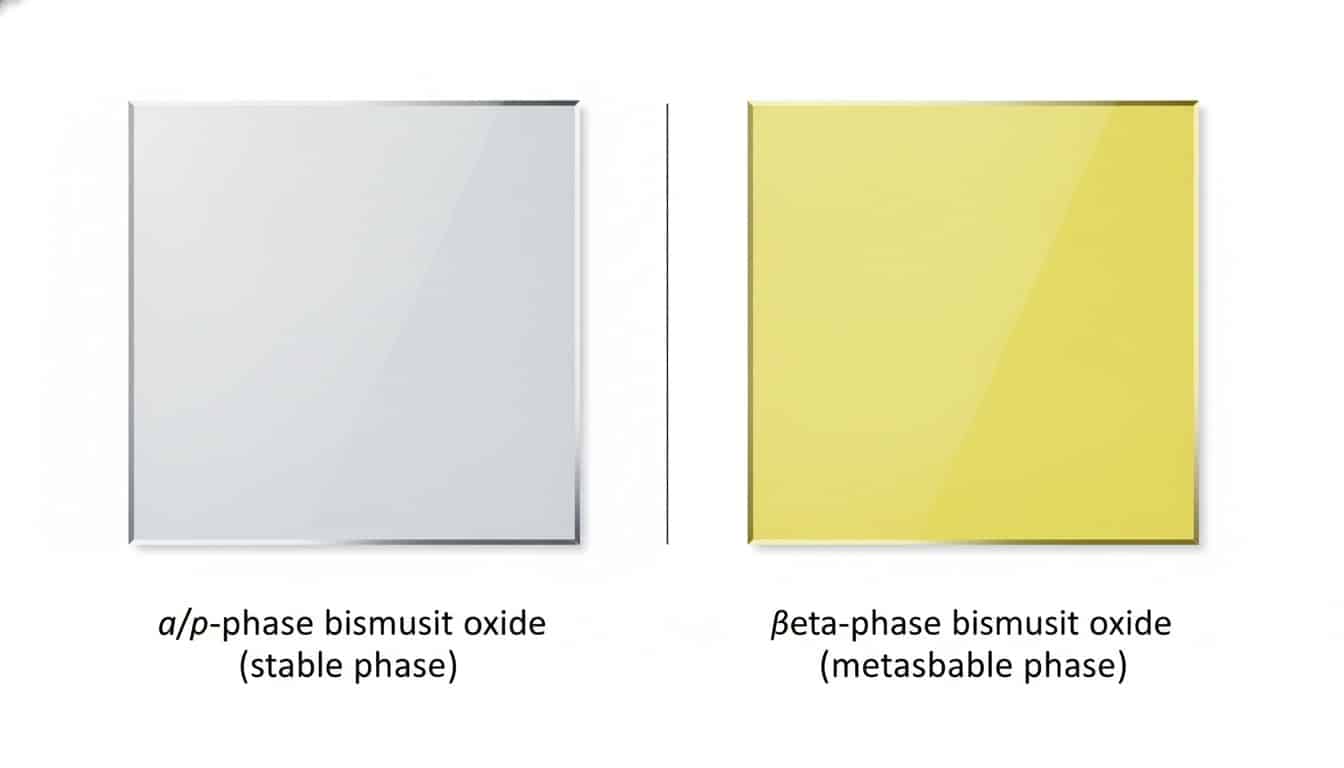
The problem has always been that the beta phase is metastable: it only exists at high temperatures and reverts to the alpha phase when cooled slowly.
Flash photonic heating solves this problem through kinetic control. By heating and cooling the material extremely rapidly, the researchers trap the beta phase at room temperature before the atoms have time to rearrange back into the stable alpha configuration. The result is a metastable crystal structure that would normally disappear, preserved on a conducting glass substrate ready for use in real devices.
The improvement in photocurrent was dramatic. Depending on how the films were prepared, the beta phase generated between 10 and 50 times more electrical current from light than the alpha phase. The researchers attributed this improvement partly to more effective movement of electrical charges through the altered crystal structure.
Why Speed Matters More Than Total Energy
One of the most striking findings from the study is that the speed at which energy is delivered can be more important than the total energy supplied. Even when the total energy delivered by a pulse was held constant, simply changing the delivery speed, the combination of pulse width and intensity, switched which crystal phase formed.
Longer pulses produced the stable alpha phase. Shorter, more intense pulses locked in the metastable beta phase at room temperature. This is not thermodynamic equilibrium at work. It is kinetic control: the cooling completes before the atoms have a chance to revert to their preferred arrangement.
As Dr. Gottesman explained in a press release: “The idea is to heat and cool the material so quickly that we can trap it in a crystal structure that would normally disappear. It gives us access to useful properties that are hard to preserve with conventional heating methods.”
This insight has implications beyond bismuth oxide. Any material system where a high-temperature phase has desirable properties but cannot survive slow cooling could potentially benefit from flash photonic heating. The technique adds a new degree of freedom to materials processing: controlling crystal structure through the speed of energy delivery rather than through temperature alone.
Reversible Switching: A New Degree of Freedom
The team also demonstrated something that had not been previously achieved on conductive glass: reversible switching between the alpha and beta phases. By simply changing the pulse conditions, the same film could be flipped back and forth between gray and yellow, over and over.
This capability could be significant for electronic and photoactive devices.
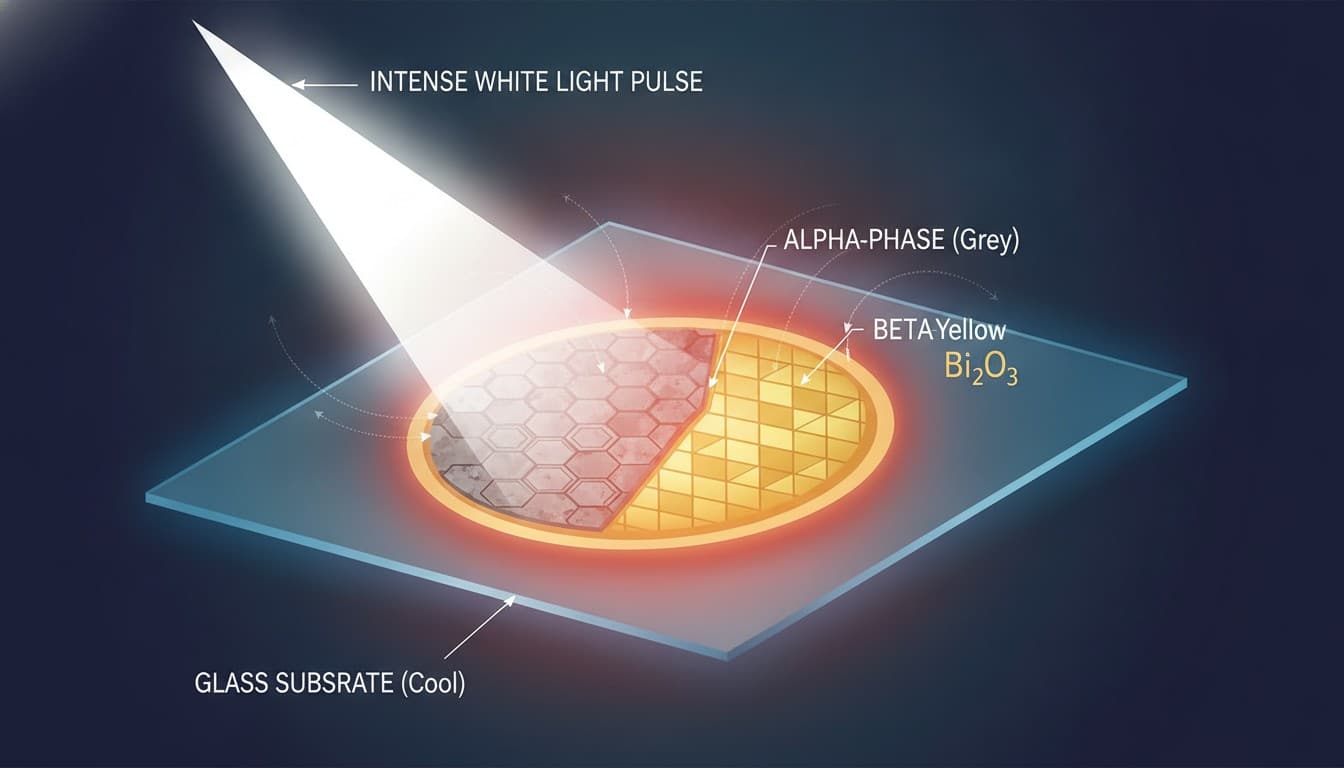
It suggests that material properties can potentially be tuned in place, without replacing the underlying component. A solar cell or photocatalytic device could, in principle, be reconfigured on the fly by adjusting the light pulses used to process it.
Flash lamp annealing itself is not new. The technique has been used in semiconductor manufacturing since the 1970s for dopant activation after ion implantation. More recently, it has found applications in perovskite solar cells and flexible electronics. However, most existing applications aim at crystallization or sintering. This study is the first to demonstrate selective, reversible control over crystal polymorphism on a conductive substrate.
Implications for Solar Cells and Beyond
The immediate application for flash photonic heating is solar energy conversion. Transparent conducting glass is a fundamental component of modern solar cells, and the ability to process semiconductor films at extreme temperatures without damaging the substrate could unlock new material phases and higher efficiencies.
The technique could also extend to other fields, as recent advances in novel semiconductor compounds have shown:
- Photocatalysis: Beta-phase bismuth oxide has shown higher photocatalytic activity than the alpha phase, making it relevant for water splitting and environmental remediation.
- Photoelectrodes: The team is exploring FPH for photoelectrode materials used in solar water splitting, where efficient light absorption and charge transport are critical.
- High-entropy oxides: At a 2026 conference, Dr. Gottesman mentioned applying FPH to high-entropy rare-earth oxides, suggesting the technique’s reach extends well beyond bismuth oxide.
- Flexible electronics: The team is investigating whether flash heating can be adapted to plastic and flexible substrates, which have even lower heat tolerance than FTO glass.
The broader context is encouraging. Researchers worldwide are pursuing multiple strategies to improve solar cell materials, from advanced thermal management to new compound semiconductors. Flash photonic heating adds a powerful tool to this toolkit, one that sidesteps the traditional trade-off between processing temperature and substrate survival.
Unanswered Questions
Several important questions remain unresolved:
- Long-term stability: Being metastable, the beta phase thermodynamically “wants” to revert to the alpha phase. The paper does not fully address how well it would hold up under temperature fluctuations, humidity, and prolonged light exposure over months or years of operation.
- Device-level performance: The reported 10-to-50-fold improvement in photocurrent was measured on thin films, not in working solar cells. How much of this gain translates into actual efficiency improvements in a complete photovoltaic device remains to be verified.
- Scalability: The experiments used laboratory-scale equipment. Whether flash photonic heating can be scaled up to process large areas of glass suitable for commercial solar panel manufacturing is an open question, though the speed of the process (millisecond pulses) suggests it could be compatible with roll-to-roll or conveyor-belt production methods.
Frequently Asked Questions
What is flash photonic heating?
Flash photonic heating is a technique that uses extremely short, intense pulses of white light to heat a thin semiconductor coating to extreme temperatures (up to 2,000°C) in milliseconds, while the substrate underneath remains cool. It was developed by researchers at the Hebrew University of Jerusalem.
How does flash photonic heating differ from conventional furnace heating?
A conventional furnace heats both the material and the substrate together, slowly and uniformly. Flash photonic heating delivers energy directly into the thin film so quickly that the substrate does not have time to heat up. This allows temperatures that would destroy the substrate to be reached within the film itself.
Why is the beta phase of bismuth oxide better for solar cells?
The beta phase has a narrower bandgap (about 2.5 eV vs. 2.8 eV for the alpha phase), which means it absorbs a broader range of visible light wavelengths. This results in 10 to 50 times more photocurrent, the electrical current generated by light, compared to the stable alpha phase.
Can flash photonic heating work on flexible substrates?
The researchers are currently investigating whether the technique can be adapted to plastic and flexible surfaces. If successful, this could enable new lightweight and flexible solar and electronic devices.
Is the beta phase of bismuth oxide stable at room temperature?
When trapped by flash photonic heating, the beta phase persists at room temperature. However, being metastable, it thermodynamically prefers to revert to the alpha phase. Long-term stability under real-world operating conditions is still being studied.


