
For a new lawn, plan on 6 to 8 pounds of seed per 1,000 square feet for most cool-season grasses, or roughly 2 to 8 pounds depending on species. For overseeding an existing lawn, cut that rate roughly in half, since you are filling gaps in soil that already has grass rather than starting from bare dirt. Getting the rate wrong in either direction causes problems: too little seed leaves a thin, weedy stand, and too much seed creates overcrowded seedlings that compete with each other for water, light, and nutrients.
Seeding rate is not one universal number. It changes based on grass species, seed size, whether you are seeding bare soil or overseeding, and how the manufacturer packages the product. The table below gives you a starting point, and the sections after it walk through how to calculate the right amount for your specific lawn.
Grass Seed Coverage Rates by Type
| Grass Type | New Lawn (lb per 1,000 sq ft) | Overseeding (lb per 1,000 sq ft) | Notes |
|---|---|---|---|
| Tall Fescue | 6 to 8 lb | 3 to 4 lb | Most common cool-season lawn seed |
| Kentucky Bluegrass | 2 to 3 lb | 1 to 2 lb | Tiny seed, goes further per pound |
| Perennial Ryegrass | 5 to 8 lb | 2 to 4 lb | Often blended with fescue or bluegrass |
| Fine Fescue | 3 to 5 lb | 1 to 2 lb | Shade blends, lower seeding rate |
| Bermuda Grass | 1 to 2 lb | 0.5 to 1 lb | Hulled seed, small and dense |
| Zoysia Grass | 1 to 2 lb | Rarely overseeded | Slow to establish, sod is common instead |
| Centipede Grass | 0.25 to 0.5 lb | Rarely overseeded | Very small seed, easy to overapply |
How to Calculate How Much Grass Seed You Need
The math is straightforward once you know your square footage and the seeding rate for your grass type:
Lawn area (sq ft) ÷ 1,000 × seeding rate per 1,000 sq ft = total pounds needed
Measure your lawn by breaking it into rough rectangles and triangles, multiplying length by width for each section, then adding the sections together. Most bagged seed also lists a coverage rate directly on the label, since blends with multiple species have their own combined rate that will not match a single-species chart exactly.
How Much Grass Seed for a New Lawn
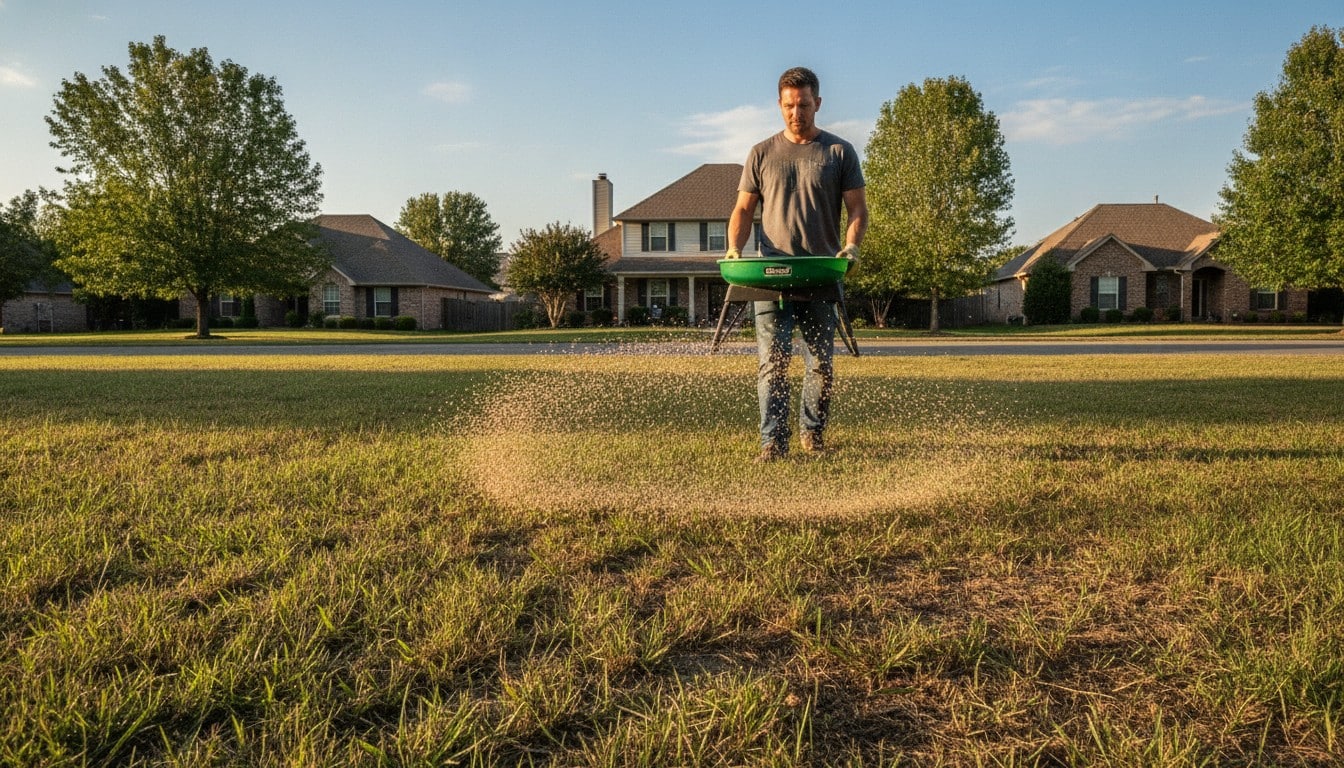
New lawns need a higher seeding rate because you are starting from bare soil with no existing turf to fill in gaps. Every seed that fails to germinate leaves a bare spot with nothing else competing to cover it. This is why new lawn rates for tall fescue land at 6 to 8 pounds per 1,000 square feet, roughly double the overseeding rate for the same species.
It is tempting to add extra seed “just in case,” but going meaningfully above the recommended rate does not produce a thicker lawn. Overcrowded seedlings compete for the same limited water and nutrients in that top inch of soil, which can actually reduce the percentage that survive to maturity.
How Much Grass Seed to Overseed
Overseeding rates are lower because the existing turf already provides some coverage, and the new seed only needs to fill thin spots and boost density. A typical overseeding rate for tall fescue is 3 to 4 pounds per 1,000 square feet, about half the new lawn rate. If your lawn is thin and patchy rather than mostly bare, you can lean toward the higher end of the overseeding range.
Before overseeding, mow shorter than usual and rake out dead thatch so seed can reach the soil rather than sitting on top of existing grass. Seed that lands on thatch instead of soil rarely germinates, regardless of how much you put down.

How Much Grass Seed to Overseed 10,000 Sq Ft
For a 10,000 square foot lawn, multiply the per-1,000-square-foot rate by 10. Using tall fescue as an example:
- New lawn: 6 to 8 lb per 1,000 sq ft × 10 = 60 to 80 pounds total
- Overseeding: 3 to 4 lb per 1,000 sq ft × 10 = 30 to 40 pounds total
For Kentucky bluegrass on the same 10,000 square foot area, overseeding would run closer to 10 to 20 pounds total, since bluegrass seed is much smaller and covers more ground per pound.
Always check your specific product’s label rate before buying, since blended seed products combine species at ratios that shift the total away from a single-species estimate.
Grass Seed Coverage per Pound

Seed size drives how far a pound of seed goes. Tall fescue seed is relatively large, so a pound covers roughly 125 to 165 square feet at new lawn rates. Kentucky bluegrass seed is tiny by comparison, so a pound can cover 330 to 500 square feet at the same density. This is why swapping grass types without adjusting the pound amount is one of the most common overseeding mistakes: the same weight of two different seeds does not put down the same number of seeds per square foot.
If a bag does not list square footage coverage directly, divide 1,000 by the recommended pounds-per-1,000-square-foot rate to get the coverage per pound for that specific product.
Factors That Change How Much Seed You Need
A few conditions push the right amount above or below the standard chart numbers:
- Soil quality: Compacted, poor, or heavily disturbed soil benefits from slightly higher rates since germination rates tend to run lower.
- Slopes and erosion-prone areas: Steeper areas lose more seed to runoff, so a modest increase can offset that loss.
- Spreader accuracy: Broadcast spreaders distribute less evenly than drop spreaders, and uneven coverage means some spots get double the rate while others get none, even when the total amount is correct.
- Seed quality and purity: Check the label for pure live seed percentage. A bag with a lower germination or purity rating needs more total weight to deliver the same number of viable seeds as a higher-quality bag.
Signs You Used Too Much or Too Little Seed
Too much seed shows up as dense, spindly seedlings that stay thin and pale because they are competing for the same resources in a small patch of soil. Too little seed shows up three to four weeks in as visible bare soil between sparse patches of grass, often with weeds filling the gaps before the grass can close in. Both problems trace back to the same fix: measure your area accurately, use the rate on your specific product’s label, and apply it with a calibrated spreader rather than eyeballing it.
Starting with a high-quality grass seed blend suited to your climate and lawn type also matters as much as the rate you put down. For a deeper look at choosing the right grass for your region, see our ultimate guide to grass and lawn solutions. A well-bred blend with strong germination rates gets more usable seedlings out of the same pound of seed than a generic mix with a lower purity rating. The Iowa State University Extension recommends checking the seed label for germination rate and purity before purchasing, since these two numbers determine how much viable seed you are actually getting per pound.
FAQs
How Much Grass Seed Do I Need per 1,000 Square Feet?
For a new lawn, most cool-season grasses need 5 to 8 pounds of seed per 1,000 square feet, with tall fescue toward the higher end and Kentucky bluegrass toward the lower end because of its smaller seed size. For overseeding, cut those numbers roughly in half.
Is It Possible to Use Too Much Grass Seed?
Yes. Overapplying seed crowds seedlings into competition for the same water, light, and nutrients, which can lower the overall survival rate and leave you with thin, weak grass rather than a thicker lawn. More seed does not equal a denser result once you are above the recommended rate.
How Much Grass Seed Do I Need for a 5,000 Square Foot Lawn?
Take the per-1,000-square-foot rate for your grass type and multiply by 5. For tall fescue, that is roughly 30 to 40 pounds for a new lawn or 15 to 20 pounds to overseed.
Does Grass Seed Coverage Change by Brand?
Yes, slightly. Blended seed products mix multiple species and cultivars at different ratios, so the recommended rate printed on the bag reflects that specific blend rather than a single-species chart. Always follow the rate on the label over a general estimate when the two conflict.
How Much Grass Seed Do I Need to Overseed 10,000 Sq Ft?
For tall fescue, plan on roughly 30 to 40 pounds to overseed a 10,000 square foot lawn. For finer-seeded grasses like Kentucky bluegrass, that number drops to closer to 10 to 20 pounds because the seed is smaller and covers more area per pound.


