
The zero-emission vehicle market has split into two competing camps: battery electric vehicles (BEVs) powered by lithium-ion cells, and fuel cell electric vehicles (FCEVs) running on hydrogen. Each technology offers a fundamentally different path away from fossil fuels, and each carries distinct trade-offs in efficiency, cost, range, and real-world practicality. This hydrogen fuel cell vs. lithium-ion battery comparison breaks down every metric that matters for 2026 and beyond.
How Hydrogen Fuel Cells Work
A hydrogen fuel cell does not store electricity. It generates it on demand through an electrochemical reaction between hydrogen gas (H2) and oxygen from the air. Inside a proton exchange membrane (PEM) fuel cell, hydrogen molecules are split into protons and electrons at the anode. The protons pass through a polymer membrane to the cathode, while the electrons travel through an external circuit, creating the electric current that powers the vehicle’s motor. At the cathode, the protons, electrons, and oxygen combine to form water (H2O) and heat, the only byproducts of the reaction. A September 2026 breakthrough from the Beijing Institute of Technology could make these cells far more compact, delivering a fourfold power boost from a redesigned catalyst interface while cutting platinum requirements.
The hydrogen itself must be produced, compressed to 700 bar (10,000 psi), stored in reinforced carbon-fiber tanks, and delivered to refueling stations. This supply chain is where most of the energy losses and costs accumulate, long before the fuel cell ever converts hydrogen back into electricity.
How Lithium-Ion Batteries Work
Lithium-ion batteries operate as energy storage devices, not energy generators. They store electricity chemically by shuttling lithium ions between two electrodes through a liquid electrolyte. During discharge, lithium ions move from the graphite anode to the metal oxide cathode, releasing electrons that flow through the vehicle’s motor. During charging, an external power source reverses the process, pushing ions back into the anode.
This design has been refined over three decades and currently delivers energy densities of 250 to 350 watt-hours per kilogram (Wh/kg) in the best commercial cells. The simplicity of the system, storing energy directly with no intermediate conversion steps, is the fundamental reason for its efficiency advantage.
Key Differences at a Glance
| Metric | Lithium-Ion Battery (BEV) | Hydrogen Fuel Cell (FCEV) |
|---|---|---|
| Energy Conversion | Stores electricity directly | Generates electricity from hydrogen |
| Full-Chain Efficiency | 80–90% (well-to-wheel) | 30–40% (well-to-wheel) |
| Gravimetric Energy Density | 250–350 Wh/kg | 33,000 Wh/kg (hydrogen fuel only) |
| Volumetric Energy Density | 500–700 Wh/L (pack level) | 1,000–2,000 Wh/L (compressed at 700 bar) |
| Refueling / Recharging Time | 20–30 min (DC fast charge); overnight at home | 3–5 minutes |
| Typical Range | 350–600 km (215–375 mi) | 550–700 km (340–435 mi) |
| Vehicle Cost Premium | $35,000–$55,000 (mainstream sedans) | $50,000–$65,000 (limited models) |
| Fuel / Energy Cost per km | $0.03–$0.06 | $0.09–$0.15 |
| Refueling Infrastructure (Global) | ~4 million EV chargers | ~1,800 hydrogen stations |
| Tailpipe Emissions | Zero | Water vapor only |
| Lifespan | 1,000–2,000 charge cycles | 5,000–8,000 operating hours |
Energy Efficiency: The Decisive Gap
If there is one metric that determines the long-term viability of each technology, it is energy efficiency, measured as the percentage of original energy that actually moves the vehicle.
Battery electric vehicles are remarkably efficient. A modern BEV converts approximately 80 to 90 percent of the electrical energy drawn from the grid into motion at the wheels. The only losses occur during AC-to-DC conversion at the charger and minor resistance in the battery and motor. Charging at home overnight captures grid electricity directly, with no intermediate processing required.
Hydrogen fuel cell vehicles face a far more complex energy pathway. The process begins with electrolysis, splitting water into hydrogen and oxygen, which operates at 70 to 80 percent efficiency. The hydrogen must then be compressed to 700 bar for storage and transport, losing another 10 to 15 percent of its energy. Finally, the fuel cell converts hydrogen back into electricity at 50 to 60 percent efficiency. Multiply these stages together, and the full-chain efficiency drops to 30 to 40 percent.
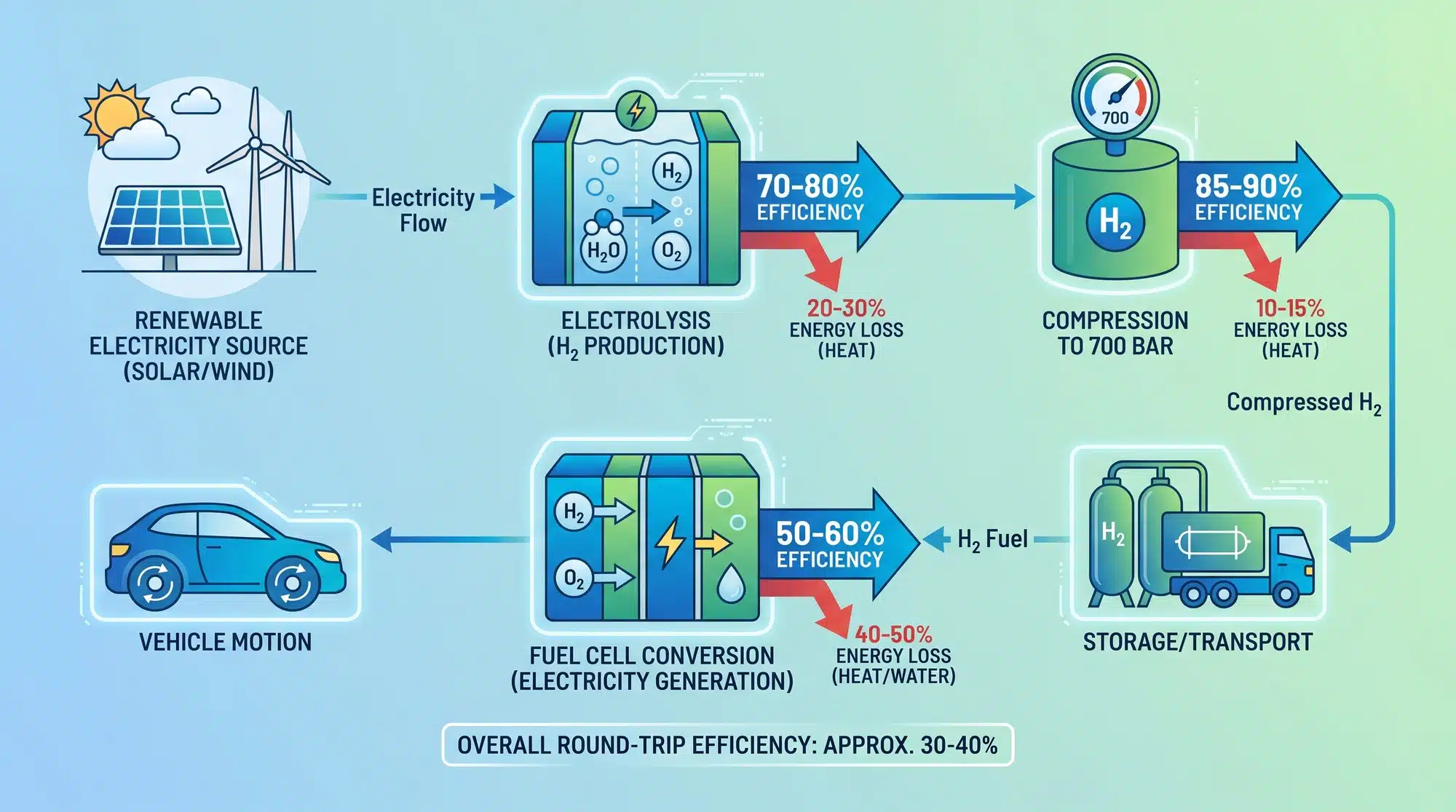
In practical terms, this means a fuel cell vehicle requires roughly three times more renewable electricity to travel the same distance as a battery electric vehicle. An FCEV consumes approximately 1 kilogram of hydrogen per 100 kilometers, which requires about 55 kWh of electricity to produce. A comparable BEV covers the same distance on just 15 to 18 kWh. This thermodynamic reality, not an engineering shortcoming, is the primary reason most passenger vehicle manufacturers have committed to battery electric technology.

Energy Density and Range
Hydrogen’s energy density by mass is extraordinary. At 33,000 Wh/kg, it contains roughly 100 times more energy per kilogram than a lithium-ion battery. The Toyota Mirai carries just 5.6 kilograms of hydrogen in its tanks and achieves over 650 kilometers of range. A BEV with equivalent range would need a battery pack weighing 700 to 800 kilograms.
However, hydrogen’s volumetric energy density tells a different story. Compressed to 700 bar in heavy carbon-fiber tanks, hydrogen stores roughly 1,000 to 2,000 Wh per liter, comparable to or worse than a lithium-ion battery pack at the system level. The tanks themselves add significant weight and take up considerable space, partially offsetting hydrogen’s mass advantage.
This distinction matters most in commercial applications. For long-haul trucking, every kilogram of battery weight is a kilogram of lost cargo capacity. A battery electric truck needs 3 to 5 tonnes of batteries for a 500-kilometer range, while a fuel cell truck achieves the same range with less than a tonne of fuel cell equipment and hydrogen storage. This mass penalty is the primary reason commercial trucking is converging on hydrogen while passenger cars are increasingly battery-dominated.
Refueling and Charging: The Infrastructure Reality
Hydrogen’s refueling speed is its most intuitive advantage. A fuel cell vehicle fills in 3 to 5 minutes, matching the familiar gasoline experience. This is a genuine benefit for drivers who cannot wait, fleet operators with tight schedules, and vehicles covering long distances with minimal stops.
Yet the comparison is less straightforward than it appears. Approximately 80 percent of battery electric vehicle charging happens at home or work, where drivers plug in and let the vehicle charge overnight or during the workday. A driver with a 60-kilometer commute uses less than 20 percent of a modern BEV’s range daily and may visit a public charger only a few times per month. Overnight charging at residential electricity rates is also the cheapest way to fuel any vehicle, electric or otherwise.
The critical constraint for hydrogen is infrastructure. As of early 2026, there are approximately 1,800 hydrogen refueling stations worldwide, concentrated heavily in Japan, South Korea, California, and parts of Germany. By contrast, there are roughly 4 million EV chargers globally, with rapid expansion continuing. In most countries, finding a hydrogen station still requires careful route planning, while BEV charging is becoming as ubiquitous as parking.
Hydrogen refueling stations also cost $1 to $2 million each to build and require specialized cryogenic and high-pressure equipment. Scaling the network to match EV charging density would require investment in the tens of billions of dollars, a figure no government or private consortium has committed to at the necessary scale.
Cost: Purchase Price, Fuel, and Total Ownership
Over a 5-year ownership period, a battery electric sedan saves approximately $8,000 to $15,000 compared to a hydrogen fuel cell vehicle in most markets. The gap is widening as BEV costs continue to fall.
Battery pack costs have dropped 85 percent since 2010, reaching $100 to $130 per kWh in 2026. Mainstream BEVs like the Tesla Model 3 and Hyundai Ioniq 6 now start at $35,000 to $45,000. Solid-state battery technology is expected to push these costs even lower by the early 2030s. Hydrogen fuel cell vehicles remain limited to the Toyota Mirai and Hyundai NEXO, priced at $50,000 to $65,000, with far fewer purchasing options and minimal resale market liquidity.
Fuel costs show a similar pattern. Charging a BEV at home costs $0.03 to $0.06 per kilometer, depending on local electricity rates. Hydrogen at the pump costs $0.09 to $0.15 per kilometer, two to three times more. Green hydrogen, produced from renewable electricity, currently costs $3.50 to $6.00 per kilogram in most developed markets, down from $5 to $8 in 2022 but still far from cost-competitive with grid electricity.
The economics shift for large commercial fleets. For a fleet of 50 delivery trucks running 16-hour shifts, hydrogen’s 5-minute refueling eliminates multi-hour downtime that would require doubling the BEV fleet to maintain continuous operations. This is why hydrogen’s commercial adoption is focused on trucking, bus fleets, and material handling, where the total cost of ownership calculation favors operational uptime over per-kilometer fuel cost.
Environmental Impact: Emissions, Mining, and Hydrogen Production
Both technologies produce zero tailpipe emissions: battery electric vehicles emit nothing at all, and fuel cell vehicles emit only water vapor. The real environmental footprint lies upstream, in how the electricity or hydrogen is produced.
- Grey hydrogen (~95% of production): Made from natural gas via steam methane reforming; releases 9–12 kg CO2 per kg H2
- Blue hydrogen: Same process as grey but with carbon capture; 80–90% capture rates, residual methane leakage
- Green hydrogen: Produced by electrolysis using renewable electricity; emission-free but costs $3.50–$6.00/kg
For battery electric vehicles, the primary concern is the mining and processing of lithium, cobalt, nickel, and graphite. These materials carry documented environmental and social costs, though the industry is shifting toward lower-impact chemistries like lithium iron phosphate (LFP) and investing in battery recycling infrastructure to reduce the need for virgin materials. Sodium-ion batteries are also emerging as a lower-impact alternative for stationary storage, though the industry is shifting toward lower-impact chemistries like lithium iron phosphate (LFP) and investing in battery recycling infrastructure to reduce the need for virgin materials.
For hydrogen, the environmental impact depends entirely on how it is produced. Today, approximately 95 percent of global hydrogen is “grey” hydrogen, produced from natural gas via steam methane reforming. This process releases 9 to 12 kilograms of CO2 for every kilogram of hydrogen produced, making it more carbon-intensive than burning gasoline. “Green” hydrogen, produced by splitting water using renewable electricity, is emission-free but currently accounts for less than 1 percent of production and costs two to four times more than grey hydrogen.
A middle category, “blue” hydrogen, captures emissions from the grey process using carbon capture technology. However, real-world capture rates typically reach only 80 to 90 percent, and methane leakage during natural gas extraction further reduces the climate benefit. Until green hydrogen becomes the dominant supply, fuel cell vehicles running on grey or blue hydrogen may produce more lifecycle emissions than battery electric vehicles charged from a moderately clean grid.
Where Each Technology Wins: Cars, Trucks, and Beyond
The hydrogen fuel cell vs. lithium-ion battery debate is increasingly framed not as a head-to-head competition, but as a question of which technology fits which application best.
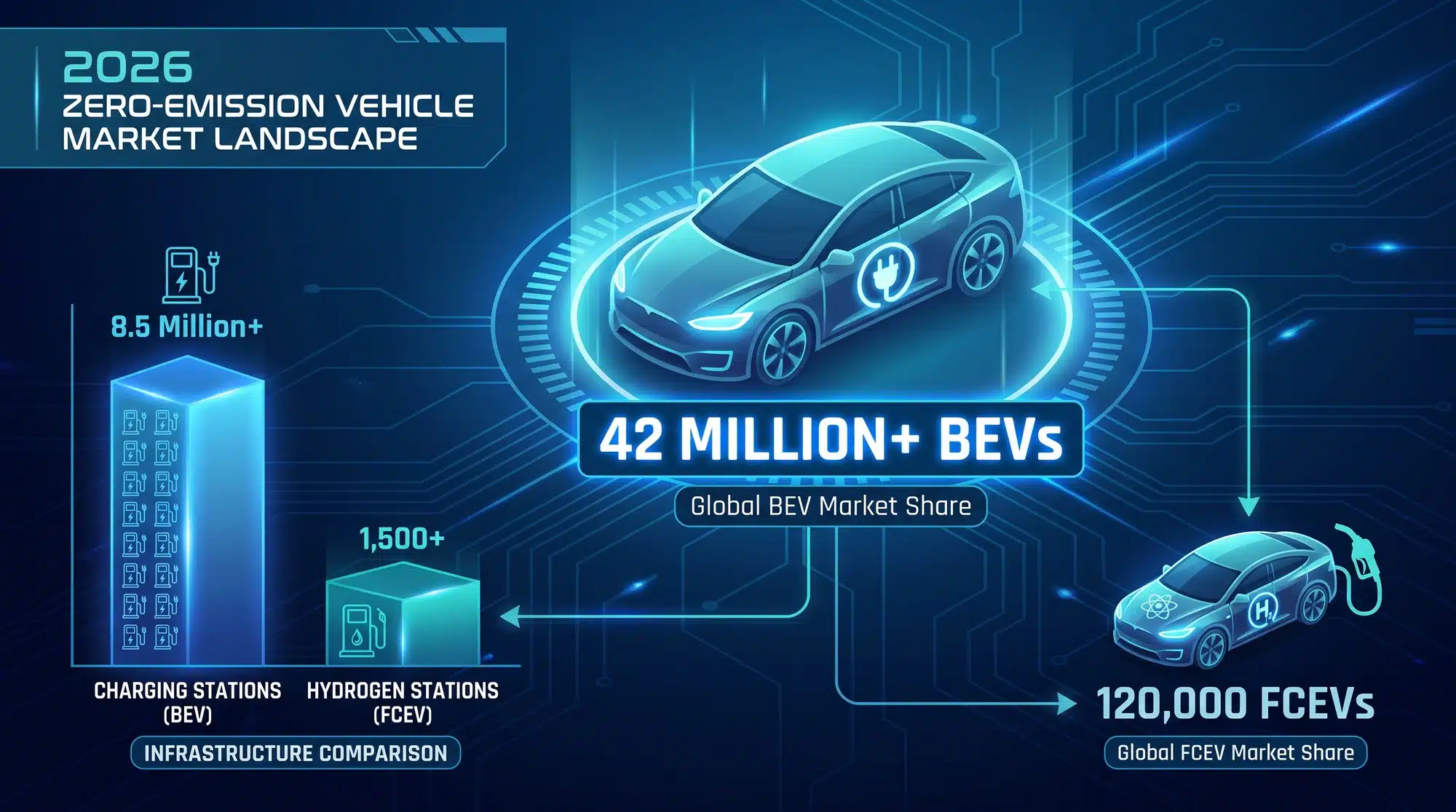
For passenger cars and urban commuting, battery electric vehicles hold a commanding advantage. The existing charging infrastructure, superior energy efficiency, lower total cost of ownership, and expanding model selection make BEVs the default choice for most consumers. In 2026, this is reflected in the market: over 42 million BEVs are on the road worldwide, while FCEV stock sits at roughly 120,000 units. Hydrogen fuel cell vehicles continue to occupy a niche position in the passenger car market.
For heavy-duty trucking, the calculation reverses. A battery electric truck hauling freight over 800 kilometers would need a battery pack so heavy it would sacrifice 20 to 30 percent of its cargo capacity. Hydrogen’s superior energy density by mass makes fuel cell trucks the more practical solution for long-haul routes, with companies like Hyundai XCIENT and Daimler Truck already deploying hundreds of fuel cell trucks in commercial operations.

For shipping and aviation, neither current technology provides a complete solution, but hydrogen and its derivatives (ammonia, synthetic fuels) are the leading candidates.
- Passenger cars: BEVs dominate with superior efficiency, lower cost, and 4M+ chargers globally
- Long-haul trucking: Hydrogen wins on mass efficiency and 5-minute refueling for tight schedules
- Shipping: Hydrogen-derived fuels (ammonia, synthetic) are the only viable zero-emission path
- Aviation: Hydrogen and e-fuels lead for long-haul flights; batteries limited to short-range regional
- Grid storage: Batteries excel for hours to days; hydrogen enables seasonal storage across months
- Industrial heat: Green hydrogen can decarbonize steel, cement, and chemical production
A battery pack large enough to power a container ship would be heavier than the cargo itself. Hydrogen-based fuels, while still in early development for these sectors, offer the only realistic path to zero-emission long-distance transport.
For grid-scale energy storage, hydrogen offers something batteries cannot: seasonal storage. Batteries excel at short-duration storage (hours to days), but storing renewable energy from summer solar production for use in winter heating would require battery systems of impractical scale and cost. Hydrogen can be produced in excess during sunny or windy periods, stored underground in salt caverns or depleted gas fields for months, and converted back to electricity when needed.
Current Market Status in 2026
The 2025 and early 2026 data paints a clear picture of two technologies at very different stages of adoption. Global FCEV sales reached 16,011 units in all of 2025, a 24.4 percent increase over the previous year, driven primarily by Hyundai’s second-generation NEXO launch in South Korea. In the first half of 2026, FCEV sales totaled 4,643 units, a 13 percent year-over-year increase, with Hyundai capturing 71.9 percent of the global market through 3,337 NEXO sales.
Toyota, once a hydrogen pioneer, recorded just 306 Mirai and Crown FCEV units in the first half of 2026, a 56.7 percent decline year-over-year, with its market share falling from 17.2 percent to 6.6 percent. Honda’s CR-V e:FCEV managed only 185 units in all of 2025. The global hydrogen vehicle market was valued at $13.75 billion in 2026 and is projected to grow to $28.23 billion by 2030, but almost all of that growth is expected in commercial vehicles and buses rather than passenger cars.
Meanwhile, the global BEV fleet has surpassed 42 million vehicles, with new model launches, falling battery costs, and expanding charging networks driving accelerating adoption across every major market. The ratio of roughly 350 BEVs for every FCEV on the road reflects not a temporary gap, but the fundamental cost and infrastructure advantages that batteries hold for personal transportation.
Frequently Asked Questions
Why are we not using hydrogen fuel cells more widely?
Three barriers have limited hydrogen fuel cell adoption: infrastructure, cost, and efficiency. There are only about 1,800 hydrogen refueling stations worldwide compared to roughly 4 million EV chargers. Green hydrogen costs $3.50 to $6.00 per kilogram, making it two to four times more expensive per mile than charging a battery electric vehicle. And the full-chain energy efficiency of hydrogen, 30 to 40 percent well-to-wheel, is roughly half that of battery electric vehicles at 80 to 90 percent. For passenger vehicles, batteries currently offer a more practical, affordable, and efficient solution.
What will replace lithium-ion batteries?
Solid-state batteries are the most promising near-term successor, offering energy densities of 400 to 500 Wh/kg (versus 250 to 350 for current lithium-ion), faster charging, and improved safety. Toyota and Samsung SDI have committed to commercial production around 2027, with solid-state designs already demonstrating 400 to 600 Wh/kg energy densities. Beyond solid-state, sodium-ion batteries are gaining traction for grid storage due to their use of abundant materials, while lithium-sulfur and lithium-air chemistries remain in early research stages.
How long will a hydrogen fuel cell last?
Automotive fuel cell stacks typically last 5,000 to 8,000 operating hours before significant degradation, translating to approximately 240,000 to 320,000 kilometers (150,000 to 200,000 miles) at average driving speeds. Toyota and Hyundai both offer 8-year or 160,000-kilometer warranties on their fuel cell stacks. Stationary fuel cells, operating under more controlled conditions, can exceed 40,000 hours of operation.
Can you drink the water from a hydrogen fuel cell?
The water produced by a fuel cell is essentially distilled water, but it may contain trace contaminants from the membrane, catalyst materials, or air intake. While it is non-toxic, it is not produced or collected in quantities or conditions suitable for drinking. The small amount of water vapor is typically vented from the vehicle as a harmless exhaust.
Is hydrogen more efficient than lithium batteries?
No. Lithium-ion batteries are 2 to 3 times more efficient than hydrogen fuel cells in converting energy into vehicle motion. Battery electric vehicles achieve 80 to 90 percent well-to-wheel efficiency, while fuel cell vehicles achieve only 30 to 40 percent when accounting for hydrogen production, compression, and conversion. This means a fuel cell vehicle requires roughly three times more renewable electricity to travel the same distance as a battery electric vehicle.


