
FUE is a surgical method that moves healthy follicles from one part of the scalp to another. Unlike strip surgery, FUE hair restoration does not require removing a long section of scalp.
This helps avoid a single linear scar and can support shorter hairstyles. Results develop over several months as the transplanted follicles enter new growth cycles.
Key Takeaways
- FUE moves single follicular units from a donor area to thinning or bald areas. It does not remove a strip of scalp.
- The procedure avoids a single linear scar, but it still creates small extraction scars and depends on a limited donor supply.
- Good candidates usually have stable hair loss, enough donor density, realistic goals, and a clear diagnosis before surgery.
- Results appear gradually over several months, and long-term planning is important because native hair can continue to thin.
How FUE Hair Transplants Work
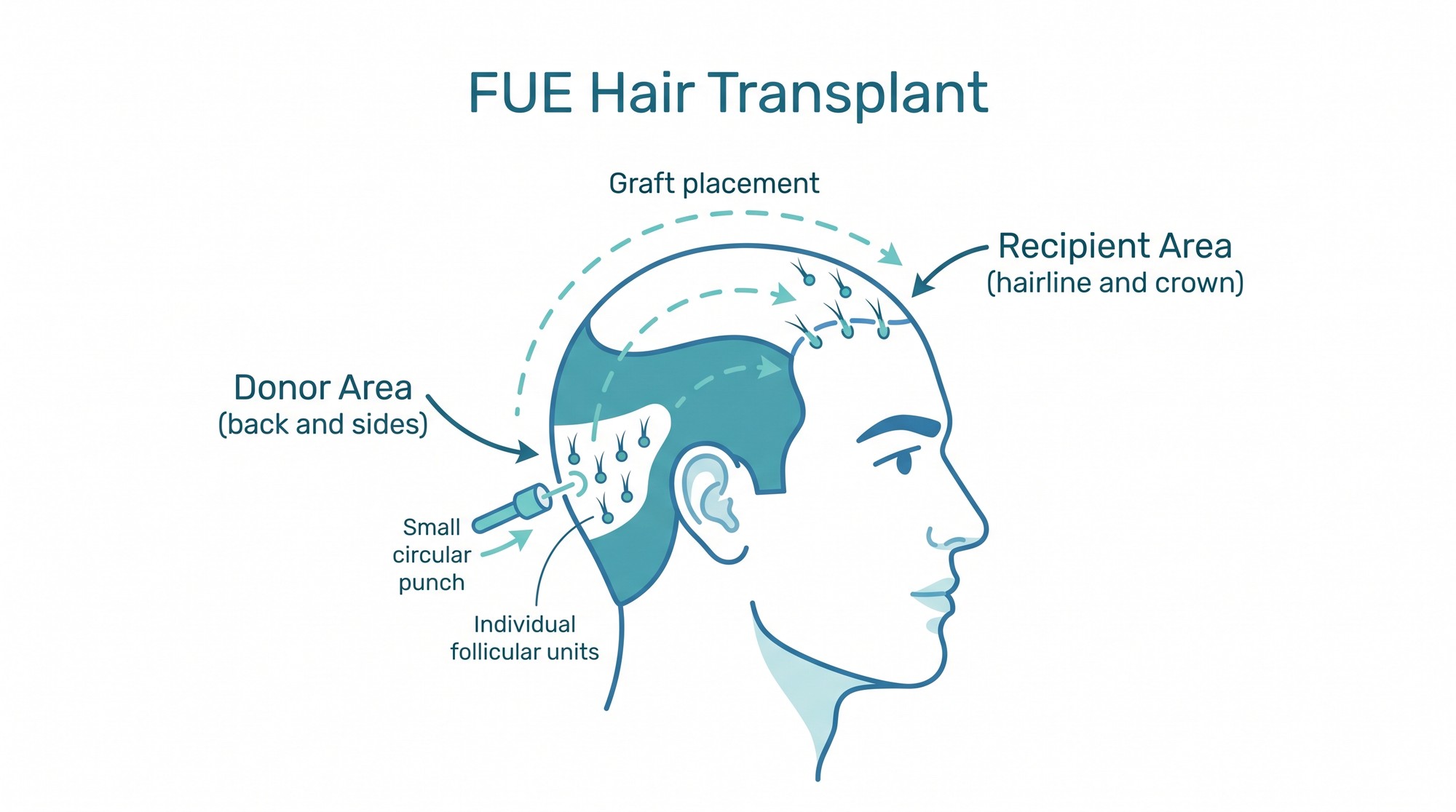
An FUE hair transplant moves natural follicular units from areas with stronger growth to areas affected by thinning. Each unit may contain one or several hairs and is removed with a small circular punch. The surgeon then places these grafts where added density is needed.
For anyone asking what an FUE hair transplant is, the key point is simple. FUE redistributes existing follicles rather than creating new ones. Because removed follicles do not grow back in the same donor spot, careful planning matters.
The process often includes:
- Designing the hairline and treatment zones.
- Applying local anesthesia.
- Removing individual follicular units.
- Creating recipient sites.
- Placing the harvested grafts.
The exact steps can vary by patient and surgeon. Donor density, age, hair type, and future hair loss all affect the plan.
Planning Donor and Recipient Areas
Before hair transplant surgery, the surgeon examines where follicles can be safely taken. The donor area is usually on the back and sides of the scalp. Hair in these regions often has better long-term resistance to common pattern hair loss. As the NHS explains, hair transplant surgery moves hair to an area that is thin or bald, so the quality of the donor zone shapes what is possible.
Planning also determines how many grafts are needed for each bald area. The surgeon studies hair thickness, scalp visibility, curl, existing density, and the size of the recipient area. These factors can strongly affect how much coverage a patient may achieve.
A treatment plan may review:
- Donor density and stability.
- Size of the thinning area.
- Expected future hair loss.
- Previous procedures or scars.
- Hairline goals and age.
- Overall medical history.
People researching follicle transplants for hair loss should know that surgery does not stop future thinning. A follicle transplant only moves existing follicles, so preserving donor supply is important.
The FUE Procedure Step by Step
During the FUE hair transplant procedure, the scalp is prepared and numbed. The surgical team then separates each individual hair follicle or follicular unit from nearby tissue. Careful handling helps protect the hair follicles during removal and placement.
The team then makes small openings in the recipient sites. The hair grafts are inserted based on the planned angle, direction, and density. Front hairline areas often use smaller grafts to help create a softer appearance.
The length of the FUE procedure depends on graft count and treatment size. Large sessions may take several hours and sometimes require more than one session. FUE requires careful technique because it removes each graft separately.
FUE Compared With FUT
FUE and follicular unit transplantation (FUT) use different methods to collect donor hair. FUE removes small follicular units one at a time. FUT uses strip harvesting, where a narrow section of scalp is removed and divided into grafts.
Main differences include:
- FUE avoids one long linear scar.
- FUT may collect many grafts from one focused area.
- FUE creates many small extraction scars.
- FUE may suit patients who prefer shorter hairstyles.
- Recovery can differ between the two methods.
Neither option is right for every person. The choice depends on donor supply, scalp features, previous surgery, styling preferences, and long-term goals.
Who May Be a Good Candidate?
A good candidate usually has enough stable donor hair and a clear diagnosis. Expectations should also match what surgery can realistically provide. Younger patients may need more careful planning because future thinning can change the appearance of an early hairline.
People considering FUE should look beyond the immediate result and think about how future hair loss may affect their appearance. Exploring Dr. Ross Kopelman’s approach can help you understand how donor supply, hairline design, and long-term planning are evaluated before surgery.
A well-designed treatment plan should improve current density while preserving enough donor follicles for possible future needs.
Common candidate factors include:
- Adequate donor density.
- A stable pattern of loss.
- Realistic density goals.
- Good general health.
- Willingness to follow recovery instructions.
An experienced hair restoration physician may also recommend delaying surgery in some cases. This can happen when the cause of shedding is unclear, donor supply is weak, or future loss needs more evaluation.
Recovery After FUE
Small crusts often form where follicles were removed and implanted. These usually improve during the first one to two weeks. Patients should follow their surgeon’s specific washing and activity instructions.
Some transplanted hair often sheds after surgery. This doesn’t always mean the follicles were lost, because the roots may remain under the skin. New hair growth develops gradually as follicles return to an active growth phase. Following a detailed post-surgery hair transplant care routine can help protect the grafts during this phase.
When Does New Hair Grow?
Visible growth takes time. New strands often appear at different stages because follicles do not all grow at the same rate. Density and texture continue changing as the hair grows and matures.
Early growth may look fine or uneven. Patients often need many months before they can judge the result fairly. Native hair around the treated area may also continue to thin over time.
Benefits and Limits of FUE
FUE can collect donor follicles without removing a long strip of scalp. This reduces concern about a visible linear scar and can give patients more hairstyle options. Small extraction marks still remain, so FUE should not be described as scar-free.
The donor supply is also limited. Removing too many follicles can leave visible thinning in the donor region. Careful graft planning helps protect options for future procedures.
Risks and Side Effects
Like other hair transplant procedures, FUE carries potential risks. These can include swelling, crusting, numbness, folliculitis, minor infection, temporary shedding, scarring, or uneven growth. Poor harvesting may also reduce donor density.
The person performing each surgical step can affect safety and results. Patients should ask who performs extraction, creates recipient sites, and places grafts. Medical oversight is important if complications occur.
What Affects FUE Results?
Results depend on more than the number of grafts placed. Hairline design, graft survival, donor density, hair thickness, recipient angles, and future loss all matter. Two patients with similar graft counts can still have different outcomes.
Long-term planning is also important. Using too much donor hair early may limit future options. A conservative plan can help protect coverage if thinning continues later.

Choosing an FUE Surgeon
Review the physician’s training, role in the procedure, and results from patients with similar hair features. Ask how donor limits are measured and how the clinic chooses a safe graft count.
Before-and-after photos, such as those featured by Kopelman Hair, can also help you evaluate hairline design and donor management.
FUE is more than a way to avoid a strip scar. It requires diagnosis, careful planning, precise extraction, and accurate graft placement. A strong treatment plan should focus on both current improvement and future hair preservation.


