
A food security master’s student at the University of Reading has created the first chocolate bar made entirely from British ingredients since 1932, when a six-year-old Princess Elizabeth became the only person in history to taste one. The new bar, called the Reading 100 Chocolate Bar, was crafted to mark the university’s centenary using cocoa grown not in Ghana or Ecuador, but in Berkshire.
From Pod to Bar Without Leaving Berkshire
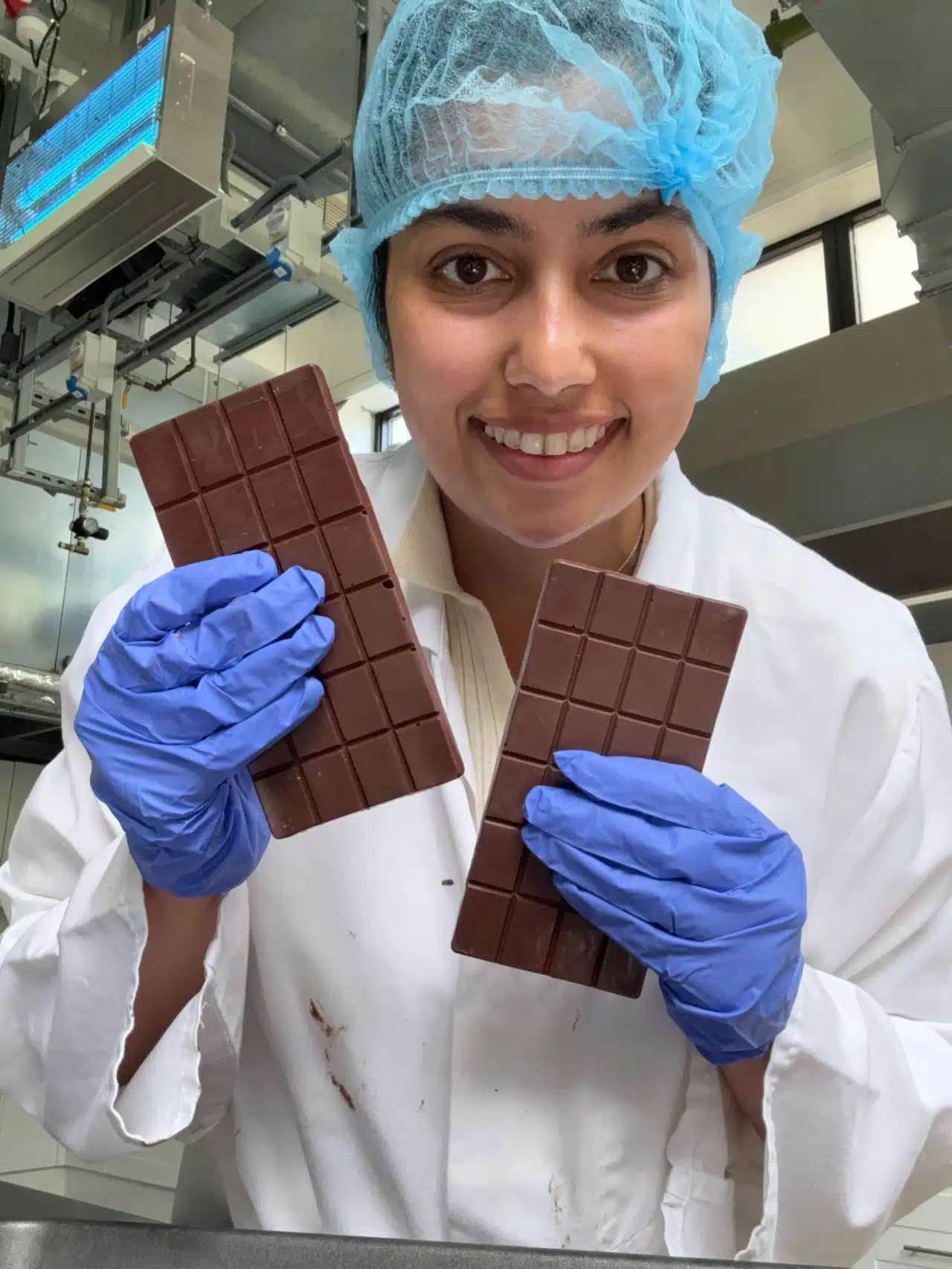
Maha Khan harvested, fermented, and processed the cocoa herself at the University of Reading’s Department of Food and Nutritional Sciences. She combined the home-grown cocoa with British sugar and British milk to produce a chocolate bar that never left Reading at any stage of its creation.
“It has been amazing to follow the entire chocolate-making process, from pod to bean to bar, without leaving Reading,” Khan said. She described the finished product as “delicious,” noting that the flavour drew from more than 300 cocoa varieties grown at the university’s quarantine centre.
“It’s incredible to taste the complexity of the flavour profiles as the cocoa is made from plants originating from over 300 varieties grown here,” she added. Khan also highlighted the raw cacao experience: “The beans are coated in a white flesh that tastes like lychee and isn’t something many people in this country get to try.”
Only six bars have been produced so far. Each cocoa pod takes roughly six months to mature, which limits how quickly production can scale. The university has not announced plans for a commercial launch, though Khan has expressed hope that the project could expand depending on bean availability.

Inside the International Cocoa Quarantine Centre
The cocoa for the Reading 100 bar came from the University of Reading’s International Cocoa Quarantine Centre, a facility that most people, even in the UK, have never heard of. The centre houses more than 300 types of cocoa plant and handles 97% of the world’s international movement of cocoa plants.
The climate-controlled facility in Berkshire exists to prevent the spread of pests and diseases between different cocoa-growing regions. When researchers or breeders need to transfer cocoa plant material between countries, the centre quarantines it for two years before release, carefully screening for threats like cacao swollen shoot virus (CSSV) and witches’ broom disease.
Funded by the Cocoa Research Association, the centre also provides scientists with the opportunity to study cocoa plants in a controlled environment. The pods used for the Reading 100 bar would normally be removed and discarded, but Khan saw an opportunity to put them to use.
“So the cocoa is quarantined there for two years, and so from those plants that are growing I decided to make this chocolate bar,” she told the BBC. “It is the primary hub of transfer for 97% of cocoa growing countries.”
How Cocoa Beans Become Chocolate: A Step-by-Step Process
Turning raw cocoa pods into a finished chocolate bar involves a labour-intensive process that most consumers never see. Khan followed each stage by hand at the university’s facilities.
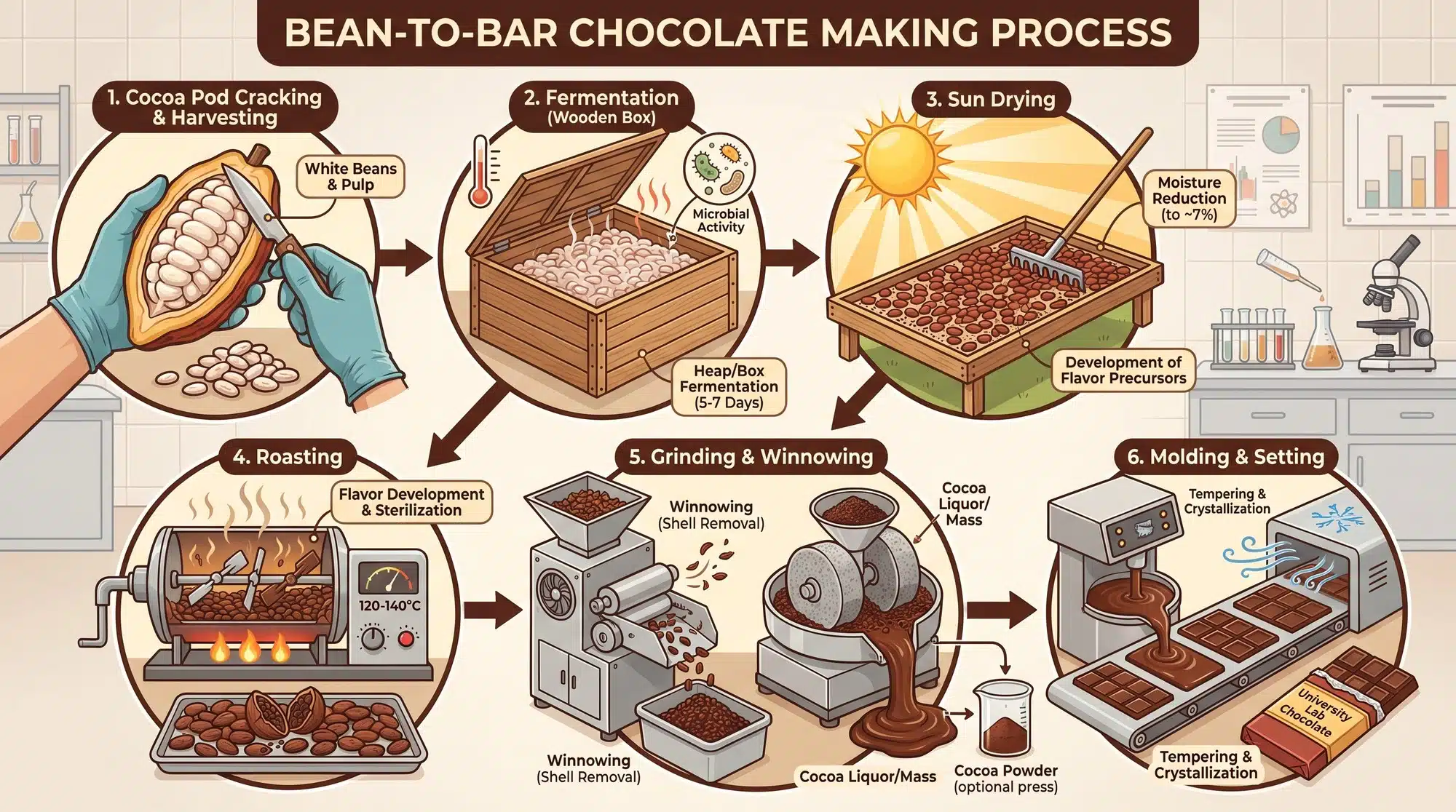
- Harvesting: Cocoa pods are cracked open and the beans, surrounded by white pulp, are removed. The pulp has a sweet, fruity flavour often compared to lychee or citrus.
- Fermenting: The beans are left to ferment for seven to 10 days. This stage develops the precursor compounds that give chocolate its characteristic flavour.
- Drying: Khan laid the beans out in the sun to dry, taking advantage of the UK’s unusually warm summer weather in 2026.
- Roasting: The dried beans are roasted to bring out the deep, complex chocolate flavour.
- Winnowing and grinding: The roasted beans are cracked to separate the nibs from the shells, then ground into a fine cocoa powder or paste.
- Blending and moulding: The cocoa is blended with British milk and sugar, then heated, shaped, and formed into a finished bar.
“It’s a lot of work,” Khan admitted. The process she described mirrors the traditional bean-to-bar methods used by artisan chocolate makers, though the starting material here was far more unusual: cocoa grown in the English climate.
The 1932 Bar: When Rowntree’s Gifted Chocolate to a Future Queen
The last time someone ate a chocolate bar made entirely from British ingredients was in 1932. That year, confectionery company Rowntree’s grew a cocoa plant in a glasshouse at its York headquarters and used the beans to produce a single bar of chocolate. They gifted it to Princess Elizabeth, then just six years old, making her the first person in history to eat a 100% British chocolate bar.
She later became Queen Elizabeth II, and to this day she remains the only person known to have tasted that original bar. The gesture was a technical demonstration rather than a commercial venture, and no further British-grown chocolate was produced for decades.
More recently, the Eden Project in Cornwall produced chocolate using cocoa from its rainforest biome, in partnership with Cornish craft chocolate maker Chocolarder. Those plants, too, were originally sourced through the University of Reading’s quarantine centre.
The Reading 100 bar now joins this small handful of British-grown chocolate, and it is the first to be made entirely on British soil with all-British ingredients in 94 years.
Why Growing Cocoa in the UK Should Be Impossible
Cocoa trees (Theobroma cacao) are tropical plants that thrive only within a narrow band roughly 20 degrees north and south of the equator. They require consistent temperatures between 18 and 32 degrees Celsius, high humidity, heavy rainfall, and rich, well-drained soil. These conditions exist naturally in West Africa, Central and South America, and parts of Southeast Asia, but not in Berkshire.
The University of Reading’s quarantine centre overcomes this limitation by growing cocoa in climate-controlled glasshouses. The plants are not intended for commercial production; they exist for research and quarantine purposes. The 300+ varieties housed there represent a living library of cocoa genetics, collected from growing regions around the world.
This is precisely why the Reading 100 bar is a demonstration, not a business model. The UK cannot realistically replace its cocoa imports with domestic production. The bar serves a different purpose: it highlights how much labour, science, and global coordination underpins every chocolate bar we take for granted.

Climate Change Is Reshaping the Global Chocolate Industry
The Reading 100 project was designed to draw attention to a deeper crisis. Global cocoa production has become increasingly unstable as climate change disrupts growing conditions in the countries that supply nearly all of the world’s cocoa.
West Africa produces roughly 65% to 70% of global cocoa, with Côte d’Ivoire and Ghana accounting for the majority. In 2023 and 2024, the region experienced a devastating combination of extreme weather events:
- Unexpectedly heavy rainfall during Ghana’s dry season caused widespread black pod disease, which rots cocoa plants.
- A severe drought followed in 2024, affecting more than one million people in Ghana alone.
- Cocoa production in Côte d’Ivoire fell by approximately 20% to 25%, while Ghana’s output declined even more sharply.
- Global cocoa production dropped from 5.016 million tonnes in 2022-23 to 4.368 million tonnes in 2023-24, a fall of 12.9%, according to the International Cocoa Organization (ICCO).
The supply shock sent cocoa prices soaring. After hovering around $2,500 per tonne for a decade, prices rocketed past $12,000 per tonne in late 2024, a more than 400% increase. While prices have since corrected, they remain well above historical norms.
Khan framed her project directly in these terms: “This British bar of chocolate highlights the precarious nature of our food supplies. Cocoa plants are very sensitive to changes in temperature and rainfall, and climate change is already causing problems in countries that produce most of the world’s cocoa.”
Research from climate intelligence firm ClimateAi warns that roughly half of the land currently suitable for cocoa cultivation could become unusable by 2050. An El Niño event expected in 2026-27 could further disrupt production, echoing patterns that have historically triggered price spikes.
The UK’s chocolate market is worth £10.4 billion annually, but the industry is entirely reliant on imported cocoa. Prof Carol Wagstaff, director of AgriFood Futures at the University of Reading, described the vulnerability this creates.
“The UK chocolate industry rests on a supply chain that starts thousands of miles away in the tropics of Africa, South America and Asia,” she said. “A resilient global market is crucial to the many smallholder farmers who underpin the industry and find themselves farming in some of the regions most exposed to risks from climate change.”
The Chocolate Industry’s Search for Alternatives
The cocoa crisis has accelerated efforts to develop alternatives. Some companies are investing in cocoa-free chocolate analogues made from ingredients like grape seeds or fermented oats. Others are exploring cell-cultured cocoa, which would grow cocoa cells in bioreactors rather than on trees.
The quarantine centre’s work in preserving and studying 300+ cocoa varieties could prove vital in this context. If breeders can identify or develop varieties that are more resistant to drought, heat, or disease, those plants could help secure the future of traditional chocolate production.
“Protecting different varieties is vital if farmers need hardier plants that can cope with a changing climate,” Khan said.
A Gift for Another Future Queen?
Khan has expressed hope that one of the six Reading 100 bars could be presented to Catherine, Princess of Wales. The connection is more personal than it might first appear.
“We haven’t decided yet who will get to eat the chocolate,” Khan told the Guardian. “As the last British chocolate made was eaten by the future queen in 1932, it would be fitting if the next bar was a gift to another future queen, the Princess of Wales, who, like the chocolate, was also born in Reading.”
Catherine Middleton was born at Royal Berkshire Hospital in Reading in 1982, giving her a geographical link to the bar’s origins. Whether the gift materialises remains to be seen, but the symbolism connects nearly a century of British chocolate history in a single gesture.
Frequently Asked Questions
Can cocoa really grow in the UK?
Not naturally. Cocoa trees are tropical and require consistent warmth, high humidity, and heavy rainfall. The University of Reading grows cocoa in climate-controlled glasshouses at its International Cocoa Quarantine Centre, which exists primarily for research and to quarantine plants during international transfers. The Reading 100 bar was a demonstration project using pods that would normally be discarded.
Why was the last British chocolate bar made in 1932?
In 1932, confectionery company Rowntree’s grew a cocoa plant in a glasshouse at its York headquarters and produced a single bar of chocolate, which was gifted to the six-year-old Princess Elizabeth. No commercial or research effort to produce British-grown chocolate followed until recent small-batch experiments at the Eden Project and now the University of Reading.
Could British-grown chocolate ever be sold commercially?
It is extremely unlikely at scale. The UK lacks the climate for outdoor cocoa cultivation, and glasshouse production is prohibitively expensive for commercial volumes. A single cocoa pod takes six months to mature. The Reading 100 project’s value lies in raising awareness about cocoa research, food security, and the climate threats facing global chocolate production.
How does climate change affect chocolate prices?
Cocoa prices rose more than 400% between 2023 and 2024, driven by drought, flooding, and disease in West Africa, which produces around 65% to 70% of the world’s cocoa. Researchers warn that half of current cocoa-growing land could become unsuitable by 2050. Chocolate has already become noticeably more expensive and smaller on shop shelves.

