
A research team at the Beijing Institute of Technology has engineered a redesigned catalyst interface that quadruples the power output of proton-exchange membrane fuel cells. The design, detailed in a study published September 10, 2026, in the journal Science, addresses one of the most stubborn physical bottlenecks in hydrogen energy conversion: the sluggish movement of protons through dense catalytic layers.
By constructing a molecular hopping network within the cell, the researchers achieved dramatic improvements in proton transport while maintaining high durability and slashing requirements for expensive platinum, an advance the South China Morning Post notes holds immediate implications for heavy-duty freight transport and aerospace systems that demand extreme power density within tight space and weight budgets.
Key Takeaways
- Fourfold output: under standard operating conditions, the novel cell generated 0.75 watts per square centimeter at 0.7 volts, roughly four times the output of conventional proton-exchange membrane fuel cells.
- Catalytic relay mechanism: the team integrated an open-framework Brønsted acid-Lewis base interface that creates intermediate stepping stones, accelerating proton diffusion tenfold and boosting conductivity 6.5 times.
- Record platinum efficiency: the system achieved a power density of 6.9 kilowatts per gram of platinum, dramatically lowering the precious metal loading needed to deliver commercial power levels.
- Enhanced durability: after 30,000 accelerated stress cycles, the experimental cells retained 63 percent of their initial peak power, compared to just 30 percent retention in standard fuel cells.
- Dual-sector potential: the compact, high-density architecture is tailored for long-haul commercial trucks and aerospace systems operating on liquid oxygen.
Overcoming the Catalyst Layer Bottleneck
Proton-exchange membrane fuel cells, or PEMFCs, are among the most versatile clean energy converters available today. Operating at relatively mild temperatures between 60 and 80 degrees Celsius (140 to 176 degrees Fahrenheit), they convert 50 to 60 percent of hydrogen’s chemical energy directly into electricity, releasing only pure water vapor and heat as byproducts.
The electrochemical reaction relies on a delicate balance across three phases. At the anode, hydrogen gas molecules split into electrons and protons. While electrons travel through an external electrical circuit to power a motor, the protons must migrate across a polymer electrolyte membrane to the cathode. At the cathode, protons recombine with incoming oxygen and the returning electrons to form water.
However, modern commercial fuel cells face an internal physical roadblock. To ensure protons reach the reaction sites, manufacturers mix platinum catalysts with an ionomer binder, typically Nafion. At the nanoscale, Nafion often wraps tightly around the catalyst particles, forming dense, hydrophobic fluoropolymer layers. This confinement restricts proton mobility and suffocates oxygen transport, forcing fuel cell engineers to add excess platinum, re-engineer catalyst alloys, or accept lower electrical output.
How Relay Islands Accelerate Proton Hopping
To eliminate this resistance, the Beijing Institute of Technology team designed a porous open-framework structure incorporating a Brønsted acid-Lewis base interface. In chemistry, a Brønsted acid donates protons, while a Lewis base possesses a lone pair of electrons capable of accepting or coordinating with them.
By strategically positioning complementary acidic and basic chemical groups along the catalyst boundary, the researchers created a series of intermediate energetic islands. Instead of forcing protons to plow directly through tortuous, dense ionomer films, the architecture operates like a microscopic relay race: protons hop rapidly from one basic coordinating site to another across a pre-aligned hydrogen-bonding network.
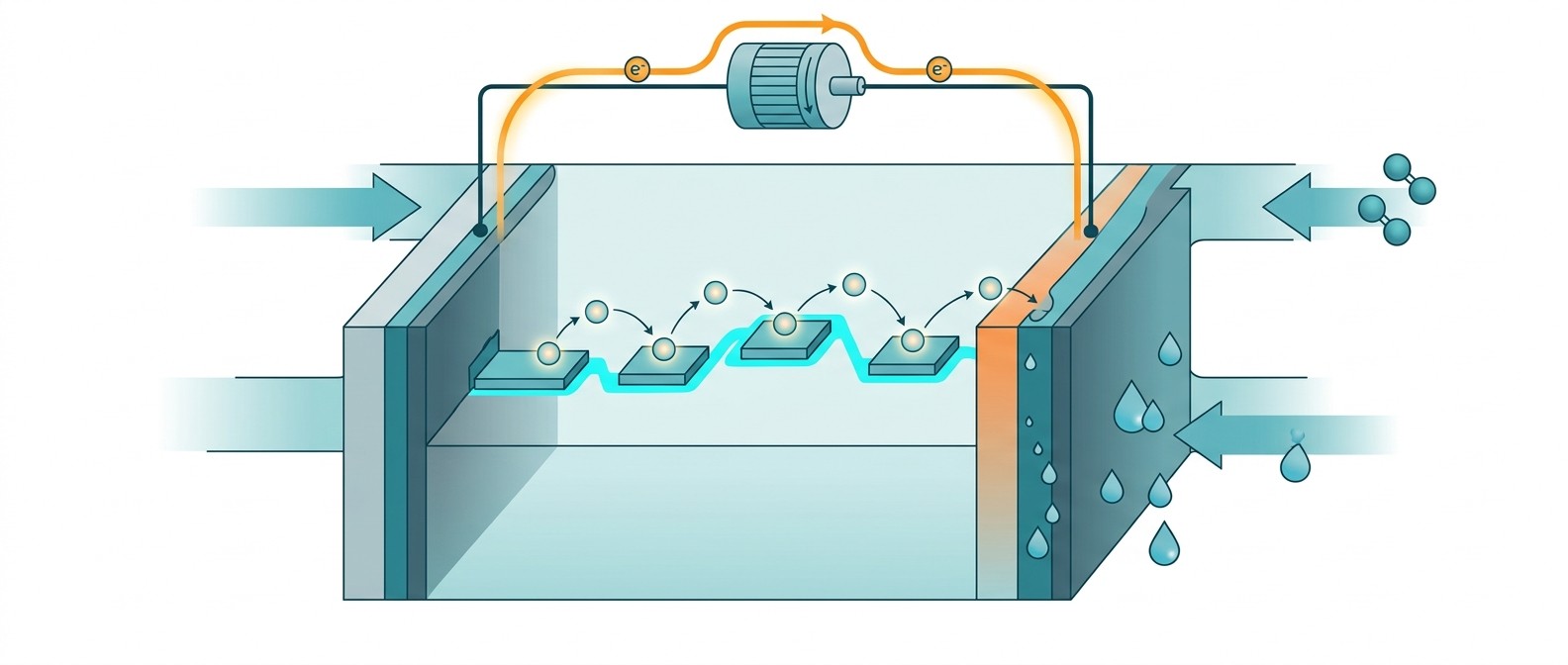
Laboratory measurements confirmed the efficacy of this mechanism. Proton diffusion rates surged tenfold, proton conductivity increased by a factor of 6.5, and the activation energy required to initiate the transport reaction dropped by more than half. This frictionless transfer allowed electrochemical reactions at the cathode to proceed at speeds previously unobtainable in low-temperature cells.
Platinum Economics and Commercial Feasibility
Beyond electrical output, the study tackles the primary economic barrier impeding the hydrogen transition: the cost of platinum group metals. Platinum serves as the indispensable catalyst that accelerates oxygen reduction at the cathode. Because platinum is one of the rarest and most expensive precious metals on Earth, catalyst loading accounts for a significant share of the total manufacturing cost of a commercial fuel cell stack.
A typical hydrogen passenger car or medium-duty truck requires between 20 and 35 grams of platinum, adding substantial raw material expense before assembly even begins. Automotive benchmarks established by international agencies, including the United States Department of Energy, have long targeted catalyst usage below 0.1 grams of platinum per kilowatt of rated power, or power densities exceeding 6 to 8 kilowatts per gram of platinum, to reach cost parity with internal combustion engines.
The Beijing Institute of Technology cell achieved 6.9 kilowatts of power per gram of platinum under practical cell voltages (0.7 volts). By utilizing precious metal atoms with far higher catalytic turnover, the design suggests that a high-power 100-kilowatt automotive stack could function on less than 15 grams of platinum, bringing hydrogen commercialization significantly closer to economic viability.
A More Practical Alternative to Platinum-Free Catalysts
In recent years, many academic efforts have focused on synthesizing platinum-group-metal-free (PGM-free) catalysts, such as iron-nitrogen-doped carbon composites. While eliminating precious metals entirely sounds attractive on paper, PGM-free catalysts suffer from severe practical limitations: they demonstrate sluggish kinetic activity in acidic media, require thick catalyst layers that impede gas flow, and degrade rapidly due to Fenton reactions that produce destructive free radicals.
The Beijing team took an alternative path. Rather than abandoning platinum for unstable replacements, they optimized the microenvironment surrounding low-load platinum. By dramatically lowering transport resistance, the relay interface unlocks the full catalytic potential of minimal platinum loadings, offering a more stable and near-term bridge to commercial mass production.
From Heavy Freight to Deep Space
Because the new design generates four times the power per unit area, it fundamentally alters the volume and weight profile of fuel cell hardware. Assistant Professor Li Jie, a co-author of the study at the Beijing Institute of Technology, emphasized the practical vehicle advantages: “The power stack of a fuel cell vehicle can be made smaller and lighter, and the vehicle can get stronger continuous output and a longer driving range.”
Li clarified that fuel cells are not intended to compete directly with battery electric vehicles in urban passenger commuting. “Fuel cell vehicles don’t need to copy battery EVs. Battery EVs fit short trips. Fuel cells fit heavy trucks, long hauls, and cases that need quick refueling and long range,” she explained.
Heavy-duty trucks carrying cargo over long distances cannot afford the massive weight penalty and multi-hour charging stops associated with oversized lithium-ion battery packs. A fourfold increase in power density means a smaller, lighter stack can deliver continuous high-wattage power, preserving payload capacity and enabling rapid hydrogen refueling.
The technology also shows promise for aerospace systems. Unlike terrestrial vehicles that draw ambient air containing 21 percent oxygen, spacecraft and planetary landers rely on closed systems fed with pure liquid oxygen. Under pure oxygen conditions, high proton throughput is the defining metric that governs power density. “Our technology addresses how to generate power with higher efficiency and higher power density inside a smaller stack volume. This fits what aerospace energy systems need,” Li noted.

Stationary power is another frontier. High-power-density fuel cells are increasingly viewed as candidates for backup and primary power at facilities such as data centers, where footprint and reliability both matter.
Proven Durability Under Accelerated Stress
Laboratory fuel cell breakthroughs frequently collapse during longevity testing, as chemical degradation and physical wear degrade delicate nanoscale interfaces. To test operational resilience, the researchers subjected the new cell design to 30,000 accelerated stress-test cycles, simulating years of harsh vehicle operation involving sudden load shifts, high voltages, and thermal swings.
The experimental cell retained 63 percent of its initial peak power output at the conclusion of the test. In comparison, conventional benchmark fuel cells subjected to identical protocols degraded precipitously, retaining just 30 percent of their original power.
The open-framework architecture shielded catalytic sites from agglomeration and prevented the structural collapse typically seen in standard ionomer matrices.
What Happens Next: Scaling Beyond the Bench
The primary hurdle facing the new interface is the transition from academic synthesis to industrial roll-to-roll manufacturing. In bench-scale experiments, the team demonstrated preliminary production capacity. “In the lab right now, they can make about 100 grams in three days. That’s enough for 10 100-kilowatt-class stacks,” Li stated.
However, producing specialized catalyst slurries in gram-scale batches is vastly different from coating continuous square meters of membrane electrode assemblies on high-speed factory lines. Researchers and industrial partners must verify that the Brønsted acid-Lewis base open frameworks maintain uniform dispersion and adhesion under continuous mechanical stress.
Furthermore, full-scale automotive operation will test the interface against airborne contaminants. Ambient air drawn into vehicle fuel cells contains trace levels of carbon monoxide, nitrogen oxides, and sulfur compounds, all of which can poison basic coordination sites over thousands of driving hours. “Next, the team will build and test high-performance fuel cell stacks for different scenarios. We’ll also scale up the related materials and technology and turn them into real-world products,” Li added.
The breakthrough arrives as China rapidly scales its hydrogen infrastructure. With tens of thousands of fuel cell vehicles already on Chinese roads and national policy targeting 100,000 units by 2030, technologies that lower platinum costs and raise power output will determine whether hydrogen can achieve commercial parity in heavy transportation.
Frequently Asked Questions
Why is a fourfold increase in fuel cell power output significant?
Generating four times more power from the same active area means fuel cell stacks can be engineered at one-fourth the traditional size and weight. In heavy-duty trucks, trains, and aircraft, reducing stack volume frees up critical cargo capacity and lowers overall vehicle weight, directly translating to greater efficiency and extended operating range.
How much platinum does a standard hydrogen fuel cell use?
A typical first-generation hydrogen fuel cell vehicle requires 20 to 35 grams of platinum, compared to just 2 to 4 grams in a conventional catalytic converter. By achieving 6.9 kilowatts of power per gram of platinum, the new design could cut stack platinum consumption by more than half.
How does a Brønsted acid-Lewis base interface work?
In standard cells, protons must push through dense polymer coatings that surround catalyst particles. The new design introduces an open molecular framework containing electron-rich Lewis base sites alongside proton-donating Brønsted acid groups. This creates an energetic pathway where protons hop from one site to the next, similar to stepping stones across a river, slashing transport resistance.
When could this technology enter commercial production?
While the laboratory synthesis of 100 grams in three days shows promising batch capability, industrial deployment typically requires years of developmental testing. Engineers must validate large-scale manufacturing processes, conduct multi-thousand-hour automotive durability trials, and confirm that the interface tolerates real-world atmospheric pollutants before mass integration begins.


