
Hydrogen fuel cell technology presents us with an opportunity to switch over from carbon-emitting fossil fuels to clean energy. Many large companies like Hyundai, Toyota, and Honda are interested in the possibility of using polymer-electrolyte fuel cells.
An exciting new development in hydrogen fuel cells has been achieved at the NYU Tandon School of Engineering, who worked together with scientists from Lawrence Berkeley National Laboratory to create a polymeric material.
The team led by Miguel Modestino, a professor of Chemical and Biomolecular Engineering recently had their work called, “Highly Permeable Perfluorinated Sulfonic Acid Ionomers for Improved Electrochemical Devices: Insights into Structure-Property Relationships,” published in the Journal of the American Chemical Society.
Hydrogen fuel cell have electrolyte membranes with an anode and a cathode on either side. Electricity is produced when hydrogen reacts with the anode and atmospheric oxygen reacts with the cathode. When the oxygen and the cathode combine, protons mix with oxygen-producing electricity and water. Ionomers are ion-conducting polymers that carry the protons to the reaction sites, this is where oxygen from the air needs to permeate through them, which causes electricity-generation.
The team has created a hybrid material that generates more power by delivering large amounts of oxygen from the atmosphere to the cell’s electrode reaction sites. The hybrid material also reduces the amount of expensive material normally needed in fuel cells such as platinum.
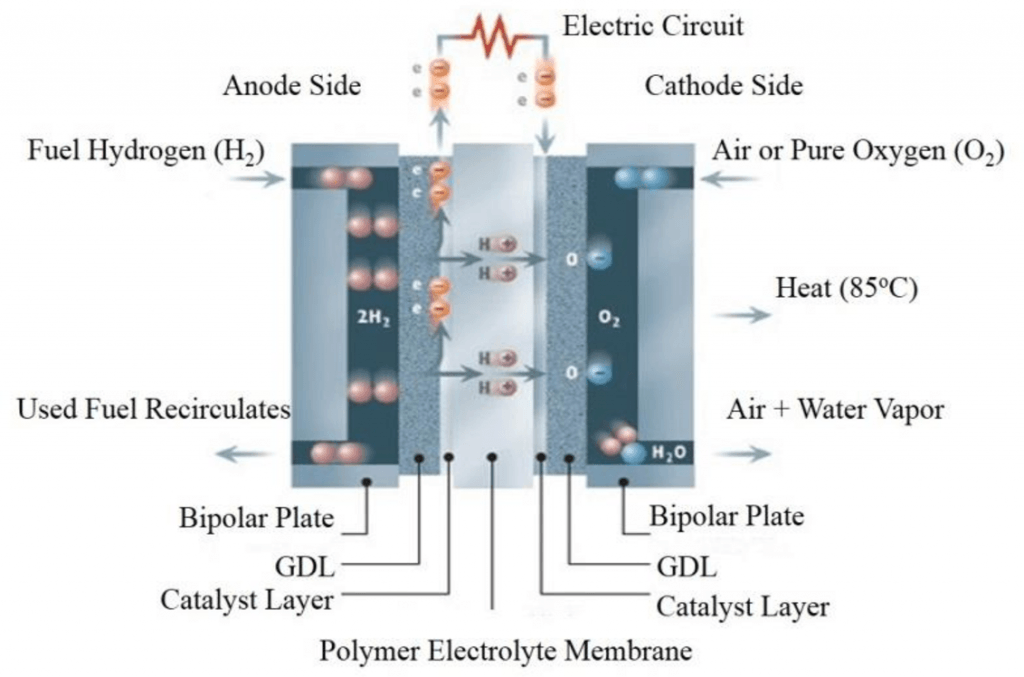
The commercial ionomers currently available on the market are typically perfluorinated sulfonic acid (PFSA) polymers that comprise a linear chainlike backbone composed of polytetrafluoroethylene (PTFE) matrix, and pendant sulfonic acid groups attached to the PTFE backbone that impart ion conductivity. This complex combination is molecularly similar to Teflon, offering high mechanical strength, but due to low oxygen permeability, it leads to a significant amount of energy loss for fuel cells.
The scientists believe they have found a way to solve several problems at the same time with this new hybrid. Yoshi Okamoto is a professor of Chemical Engineering and the Director of the Polymer Research Institute at NYU Tandon. Working together with Ph.D. student Adlai Katzenberg they swapped out the linear PTFE polymer chains with a bulky fluorinated chain. This greatly enhanced the ability to transport oxygen in fuel cells, by adding more free volume to the matrix.
Modestino explains how the hybrid material comprises a highly permeable matrix and an ion-conducting polymer:
We’ve created a novel copolymer—two components bound together. One part conducts ions, and the other is highly permeable to oxygen. Okamoto had been working on highly permeable polymers for gas separation processes. When I joined NYU Tandon, we realized that the polymers that he had developed could be adapted to improve fuel cells.
This discovery by the scientists can be used on an industrial scale, lowering production costs as well as consumer costs. This could have large environmental benefits for the future of electric vehicles when their emissions are reduced to only water vapors.


