
Researchers at the Korea Institute of Energy Research have built a nickel cobalt electrode for water electrolysis that performs like a platinum electrode in alkaline conditions. The result is real. The headline number needs a closer look. The reported 99% saving applies to electrode material cost, not to the cost of hydrogen. A cheaper electrode removes one real economic barrier. On its own, it does not make green hydrogen cheap.
Water electrolysis means using electricity to split water into hydrogen and oxygen. When the electricity comes from renewables, the hydrogen is often called green hydrogen. The team led by Dr. Kyung-Soo Kang and Dr. Hyun-Jun Lee reported the work in Advanced Science. This article explains what was built, what the numbers mean in plain terms, and what must still be proved at plant scale. Exact dates are untangled in the timeline section below.
What the 99% Figure Actually Measures
The 99% figure compares raw metals only. It compares the cost of nickel and cobalt in the new electrode with the cost of platinum and ruthenium used in noble metal electrodes. Hydrogen cost is a different calculation. It is driven far more by electricity price, capital cost, how often the plant runs, and stack efficiency than by grams of electrode metal.
That distinction matters because electrode metal is a small slice of a large system. An alkaline plant also pays for membranes or diaphragms, porous transport layers, bipolar plates, power electronics, water treatment, compression, buildings, and labor. This is why a 99% cut in one material can still leave hydrogen expensive. It is 99% of a small number.
| Metal | Cost per gram as reported by KIER | Same price per kilogram |
|---|---|---|
| Nickel | About $0.02 | About $20 |
| Cobalt | About $0.05 | About $50 |
| Platinum | About $58 | About $58,000 |
| Ruthenium | About $54 | About $54,000 |
The table uses prices as reported in the KIER release, not as current market facts. Spot prices move. Converted to kilograms, the gap looks stark. Nickel at about $20 per kilogram and cobalt at about $50 per kilogram sit beside platinum near $58,000 per kilogram and ruthenium near $54,000 per kilogram. That is where the 99% material saving comes from.
Hydrogen made with clean power still costs far more than fossil hydrogen. Green hydrogen often costs $3.50 to $6.00 per kilogram in developed markets, while fossil-based hydrogen is often near $1 to $2 per kilogram, as explained in our coverage of membrane-free electrolysis and the $1 per kilogram challenge. Electricity and utilization explain most of that gap. The same lesson appears at project level, where standardized 50 MW alkaline blocks target installed cost rather than catalyst cost alone. For wider context on where hydrogen fits and where it struggles, see the hydrogen fuel cell versus lithium ion battery comparison.
What the Team Actually Built
The electrode is called a heterostructure. That word means two different materials share one surface and work as a pair. Here the pair is nickel oxide and a nickel cobalt alloy. A catalyst is a material that speeds a chemical reaction without being used up. In this design, each part handles a separate slow step.
Nickel oxide promotes water dissociation. That is the step where a water molecule breaks into hydrogen and hydroxide pieces. The nickel cobalt alloy then helps hydrogen pieces join into hydrogen gas. The paper reports that this division of labor lowers the energy barrier of the Volmer step, which is the rate-determining water-splitting step in alkaline conditions.
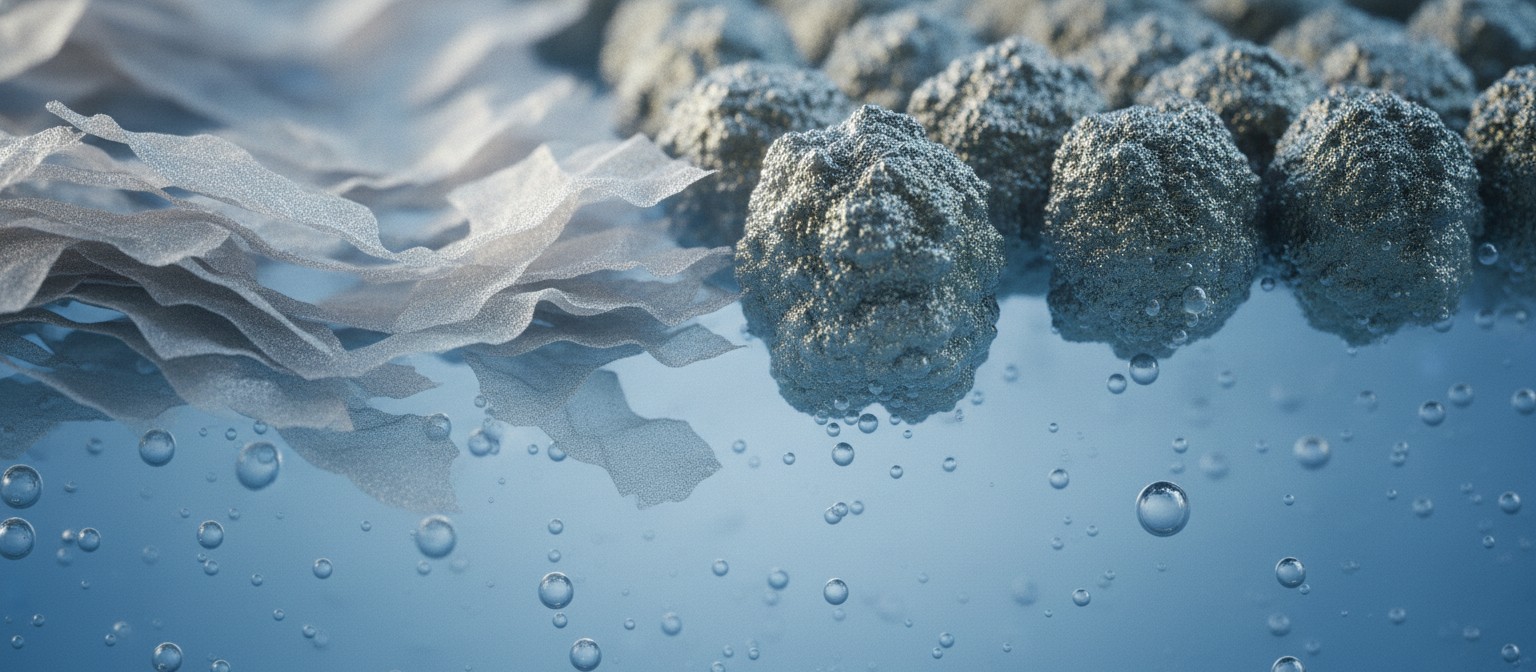
The structure was made in stages. The team formed nickel oxide plates through hydrothermal growth and heating, then electrodeposited nickel cobalt alloy onto areas where nickel oxide was absent. The insulating nature of nickel oxide helped keep the two phases separate but in contact. Tests of nickel oxide alone and alloy alone performed worse than the combined surface, which supports the synergy claim in the full text of the Advanced Science paper.
This is part of a longer earth-abundant thread. Intelligent Living has covered hydrogen from iron, nickel and water, a nickel-iron based next-generation electrolyzer aimed at low-cost scale; and a different cobalt route in cobalt and visible light hydrogen production. The KIER electrode is different because it was engineered for alkaline conditions and for the start-stop pattern of renewable power, not just for cheaper metals.
Why Alkaline Hydrogen Is Slow Without Precious Metals
Alkaline electrolysis and acidic electrolysis both split water, but the liquid around the electrodes is different. Alkaline uses a strongly basic solution such as potassium hydroxide. Acidic uses an acidic environment. Industry likes alkaline for large plants because equipment costs can be lower and the technology is mature. The drawback is speed.
In alkaline conditions, the first hydrogen step is sluggish. The paper and the institute release both describe alkaline water splitting kinetics as more than 100 times slower than in acidic conditions. That is why industry has often used precious metal catalysts such as platinum and ruthenium. They raise the reaction rate, but their prices block mass production.
The performance claim rests on one term: overpotential. Water needs a theoretical minimum voltage to split. Overpotential is the extra voltage you must pay above that minimum to get hydrogen at a useful rate. Lower overpotential means less wasted electricity for the same hydrogen output.
On nickel foam in alkaline solution, the paper reports 22.7 millivolts at 10 milliamps per square centimeter for the new electrode, against 56.5 millivolts for a commercial platinum reference under the same conditions. At 100 milliamps per square centimeter, the reported values are 130.9 millivolts against 181.6 millivolts. Current density means work rate per patch of electrode, so higher current density means more hydrogen per area. The paper’s comparison tables show it beat previously reported nickel oxide and nickel cobalt catalysts without noble metals and matched several nickel oxide or nickel cobalt catalysts that do contain noble metals. KIER separately describes the result as top tier among non-noble metal alkaline electrodes reported over the prior three years.
A single cell test moved beyond small coupons. With an 8.7 centimeter diameter cathode of 59.4 square centimeters in 25 weight percent potassium hydroxide at 80 degrees Celsius, the cell ran at 2.014 volts at 1 ampere per square centimeter, which was 262 millivolts lower than bare nickel foam at 2.276 volts. That is the reported 11% lower cell voltage.
What 600 Start-Stop Cycles Prove
A start-stop cycle means turning the electrolyzer on and off, or swinging between high current and zero current. Renewables cause thousands of such swings because sun and wind rise and fall through the day. Each swing can stress electrodes through voltage spikes, reverse currents, gas bubbles, heat shifts, and surface changes. A lab electrode can look fast for an hour and then fade once cycling starts.
The paper reports two durability checks. In a half-cell test, the combined electrode held performance through 600 on-off cycles, while nickel oxide alone and alloy alone degraded. Before and after values at 10 milliamps per square centimeter moved only from 136.9 to 158.6 millivolts, with little change at 100 milliamps. In a single cell, on-off cycling at 400 milliamps per square centimeter and zero current left operating voltage at 1 ampere per square centimeter, only 13 millivolts higher than before, rising from 2.014 to 2.027 volts. A separate 100-hour run at 1 ampere per square centimeter also showed no clear voltage decay.
Those are durability signals, not a lifetime guarantee. Six hundred cycles and 100 hours show tolerance for intermittent power. They do not prove years of service. Industrial stacks are expected to run for tens of thousands of hours with maintenance planning and financing tied to uptime. The next durability bar is higher. A platinum-free catalyst that sustained industrial current for over 1,000 hours shows what longer runs look like. Other alkaline parts matter too, including separators that must resist gas mixing and heat, as in hybrid separator work for higher hydrogen purity.
What Remains Unproven at Plant Scale
Three gaps sit between this result and an actual factory order:
- Long-term durability beyond the reported cycles is still unknown. The paper notes slight cobalt dissolution during stability testing and says more work is needed on exact degradation causes, even though structure and oxidation states largely held.
- Performance in a real megawatt alkaline stack is not established. A single cell with one improved cathode is not a full plant with many large cells, manifolds, pumps, and controls. The team reports fabrication of larger 40-centimeter-diameter electrodes and a research goal of expanding electrode area beyond 5,000 square centimeters for megawatt-scale testing. That is a stated research direction from Dr. Hyun-Jun Lee, not something already demonstrated at the megawatt scale. Nothing in the current paper proves megawatt performance.
- The manufacturing cost of the heterostructure itself is not the same as the metal price. Hydrothermal growth, calcination at 400 degrees Celsius, cleaning, and controlled electrodeposition all cost energy, time, equipment, and yield loss. The paper describes a straightforward fabrication route, but it does not give a costed manufacturing line. Until that exists, the honest claim is narrower: raw electrode metals are far cheaper, and cell voltage looks promising. Factory economics are still open.
This is where recent industrial coverage helps. Pressurized alkaline modules aim to cut wiring, buildings, compression stages, and commissioning risk, not only stack chemistry. Membrane-free routes attack a different cost center by removing fragile membranes. The KIER electrode would still need to prove it can slot into such systems without adding hidden steps.
Cobalt Is Cheap, but It Is Not Problem Free
The least covered point is also the most important for scale. A platinum-free electrode that depends on cobalt has not escaped the critical minerals problem. It has swapped one scarce material for another. Platinum group metals are rare and expensive. Cobalt comes with its own supply, price, and ethical problems.
Cobalt supply is geographically concentrated, mining carries documented environmental and social costs, and battery makers already compete for clean supply. A hydrogen industry that replaces platinum with large cobalt demand would join that queue. That does not take away from what the team achieved. It simply means the electrode still needs careful sourcing, recycling, and the lowest cobalt loading that works.
There is also a design question the paper does not answer. How much cobalt does each square meter of commercial electrode actually need? How much is lost over time? And can the loading be reduced without losing the benefit of the two-layer structure? Until those numbers are public, buyers cannot judge how exposed they would be. In other words, platinum is avoided, but cobalt is inherited instead. That trade may well be worth making, but it should be named for what it is.
When This Story Reached English Readers
The timing matters because dates have drifted as the story has been retold. The paper appeared online in Advanced Science on 15 August 2026. KIER published its Korean language release on 17 September 2026. KIER then posted an English notice on its own site on 1 October 2026. English distribution through the National Research Council of Science and Technology appeared on Newswise on 19 October 2026, and broader English pickup, including Interesting Engineering, followed on 20 October 2026.
Dr. Kyung-Soo Kang said, “This research proves that non-noble-metal electrodes can achieve world-class performance and durability in alkaline water electrolysis. This technology will pave the way for the domestic sourcing of essential materials for alkaline electrolysis, which has relied significantly on imports, ultimately contributing to lower green hydrogen production costs.” Dr. Hyun-Jun Lee said, “We have successfully verified the feasibility of scaling up this technology by fabricating large-scale electrodes with a diameter of 40 cm, and we are currently optimizing the process for commercial mass production. Going forward, our research will focus on expanding the electrode area to 5,000 cm2 for deployment in megawatt-scale alkaline electrolysis systems.” Both quotes are from the institute distribution, and spellings inside the quotes are left as published.
Frequently Asked Questions
How much does 1 kilogram of green hydrogen cost?
Most developed market estimates put green hydrogen near $3.50 to $6.00 per kilogram, with some projects higher. Fossil based hydrogen is often near $1 to $2 per kilogram. The gap comes mainly from renewable electricity cost, equipment cost, and how many hours the plant runs at high output. Cheaper electrode metal helps the equipment slice, but it cannot close the whole gap alone.
How much does 1 gallon of hydrogen cost?
A per gallon figure is not a standard hydrogen price because hydrogen is sold by mass, not liquid volume at the pump the way gasoline is. One kilogram of hydrogen holds roughly the usable energy of one gallon of gasoline, so a $5 per kilogram green hydrogen price is sometimes loosely compared with $5 per gallon of fuel. Compression, storage, transport, and station costs sit on top of production cost, which is why pump prices can exceed plant gate estimates.
Why is no one buying green hydrogen yet at scale?
Buyers need steady supply at a predictable price. Many green projects are still costly, intermittent, or far from demand. Heavy users such as refineries, ammonia plants, and steel sites will switch only when delivered cost, purity, reliability, and contracts look bankable. Durability under renewable cycling is part of that test, which is why start-stop results get attention.
Is hydrogen cheaper than gas?
Usually not when hydrogen is green. Natural gas remains cheaper per unit of energy in many markets before carbon pricing. Green hydrogen can compete where clean power is very cheap, utilization is high, and transport or policy support closes the gap. Per kilogram comparisons also hide storage, compression, and delivery costs.
What is overpotential in plain terms?
It is the extra voltage you must pay above the theoretical minimum to make hydrogen at a useful speed. In everyday terms, it is a toll on top of the base fare. A lower toll means less electricity wasted as heat for the same amount of hydrogen. In the reported alkaline test, the KIER electrode paid a smaller toll than platinum.
Does this electrode make hydrogen 99% cheaper?
No. It cuts electrode material cost by about 99% relative to noble metal electrodes, based on metal prices reported by KIER. Hydrogen cost includes electricity, plant construction, maintenance, water treatment, compression, and financing. Those larger items did not fall by 99% in this study.
What needs to happen before factories use it?
Longer life tests beyond 600 cycles, larger cells beyond laboratory size, full stack data at high current, a costed manufacturing route, and cobalt supply planning. The stated next target is an electrode area above 5,000 square centimeters toward megawatt-scale testing. Until those steps are published, this remains a strong laboratory and single-cell result with a clear path worth testing.
Bottom Line
The KIER team showed that clever design can outperform expensive materials. Nickel oxide splits water faster. Nickel cobalt alloy finishes the hydrogen step. Together they matched platinum on voltage in alkaline tests while using metals that cost only cents per gram at the prices the institute reported. The 600-cycle and single-cell data give the result weight for renewable use. That weight is not the same as proof of decades of service.
The question that will decide the outcome is scale. How long does the interface last, how much would the coating cost per square meter, how much cobalt would a large plant need, and what would a full stack draw over months of running? Intelligent Living will keep this in its platinum-free cluster, alongside longer-duration catalysts, solar leaf routes that pair hydrogen with cleanup, and industrial alkaline hardware. If the next data answers manufacturing, lifetime, and cobalt loading together, then the 99% material number will have earned its headline.

