
The most boring job in the energy system may be walking the sky above wires nobody looks at. In France, that job still belongs largely to helicopters. A small French company says a 12-meter airship can do part of it more quietly and for longer with no crew on board. The shape looks like the 1930s. The math looks like 2026.
HyLight, based at Le Plessis-Pâté, said on 12 October 2026 that it raised a Series A round of 13 million euros, company-reported, to grow from four aircraft flying daily to fifteen aircraft operating at once in 2027. The company also reports more than 750 flight hours and 7,000 kilometers inspected in 2026, up from 400 kilometers in 2025, for operators including Enedis, NaTran, Téréga, VINCI, and SNCF Réseau. This article explains the engineering and the economics behind that claim and where the limits sit. All company figures below are company-reported unless noted as operator-confirmed.
What HyLight announced on 12 October
HyLight said the 13 million euro Series A was led by Rubio Impact Ventures, with DRW and Teampact Ventures joining and Y Combinator and Ring Capital returning. The company puts total funding at roughly 16.7 million euros after a 3.7 million euro seed round in April 2024. Those totals are company-reported. Independent trade coverage of the announcement, including Unmanned Airspace reporting on the funding round and Sesamers reporting on the round details, confirms the participants and the fleet target but does not independently verify the private financial figures.
The company says the money buys industrial capacity, not a first prototype. It points to a new production facility, plans to bring more component work in-house, and plans to hire about 50 people across engineering, artificial intelligence and data, operations, regulation, and sales. Commercial expansion is planned first for Germany and the Netherlands, according to the company announcement.
Chief executive Martin Bocken put the pitch in plain terms: “Most power lines are still inspected by helicopter, just as they were fifty years ago. Our HyLighters already do the same job, with greater precision and less risk. This funding takes us from four aircraft to a fleet.” The quote comes from the company announcement as carried in trade coverage. The company was founded in 2022 and operates from Air Base 217 at Brétigny-sur-Orge, with its registered base at Le Plessis-Pâté, according to the French company registry and trade coverage. Missions are flown from a control center in Paris, according to the company.
Helium lifts, hydrogen drives
Many summaries call the HyLighter a hydrogen airship. That shorthand hides the split that makes it work. Helium provides lift. A hydrogen fuel cell provides propulsion.
An airship is a lighter-than-air aircraft. It floats because a large envelope holds a gas lighter than air, so it does not need wings or rotors to stay up. A drone stays up by spinning rotors fast and using battery energy every second. A helicopter stays up by burning kerosene to drive a large rotor. An airship gets lift almost for free, then uses only a small amount of power to move forward.
In this design, inert helium inside the envelope does the floating. Helium does not burn. A separate hydrogen system feeds a fuel cell that makes electricity for small electric motors and propellers. Endurance means time aloft on one energy load. HyLight reports up to ten hours aloft and a target range of 350 kilometers in one mission. Those are company-reported specifications for a 12-meter aircraft carrying up to 10 kilograms of sensors.
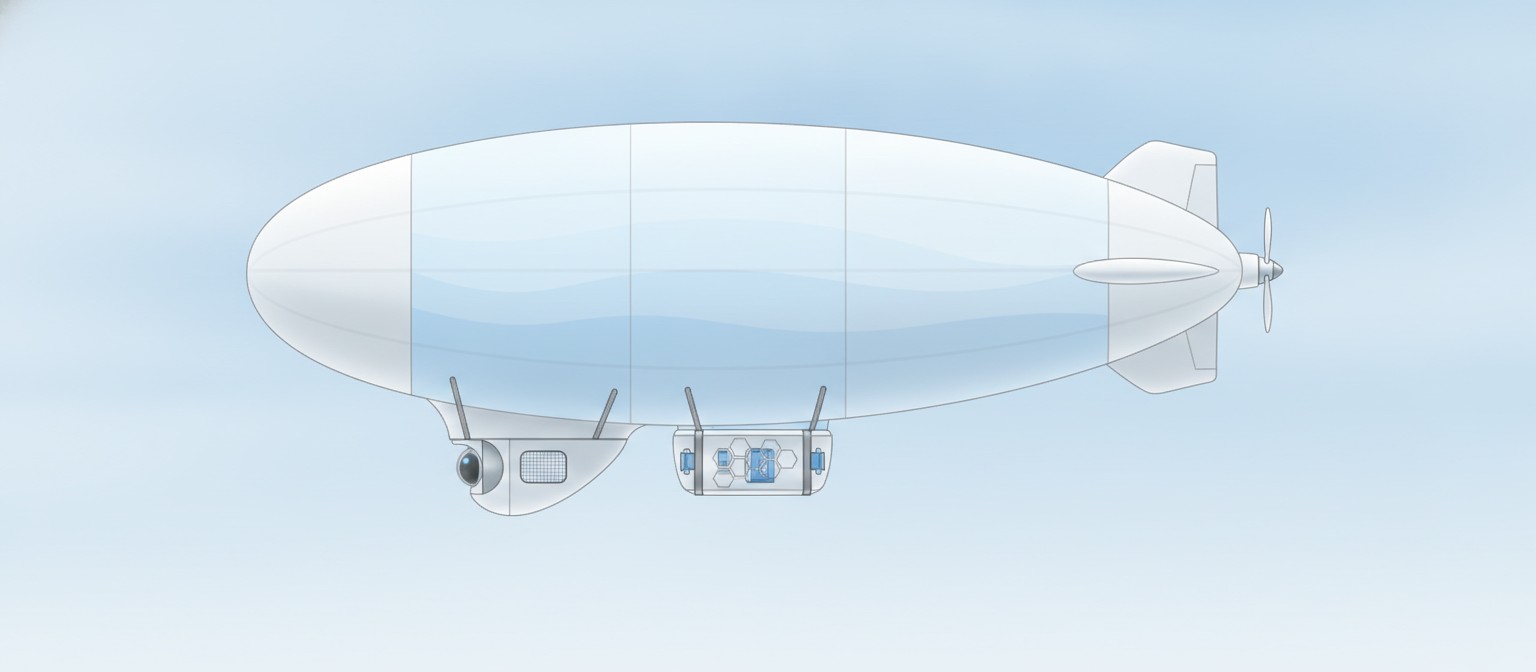
The pairing matters because airships and fuel cells suit each other. Buoyancy carries the weight, so the fuel cell can be small and steady rather than large and peaky. Hydrogen fuel cells have been proposed for larger airships for the same reason, since lift costs little energy and cruise needs only enough thrust to overcome drag. Hydrogen-electric aircraft show the same logic in fixed-wing flight, where a fuel cell replaces combustion but still has to carry the whole aircraft. Here helium already does that part.
The safety question follows directly. The Hindenburg used hydrogen for lift, so leaking lift gas could burn. Modern inspection airships in this class, including helium airships such as the Airlander 10, use helium for lift precisely to avoid that failure. Hydrogen remains on board as fuel in tanks, which still needs careful storage and handling, but a fuel leak and a lift gas fire are not the same risk.
Why slow wins on a power corridor
A grid corridor is a long, thin problem. It runs for tens or hundreds of kilometers, often only a few dozen meters wide. The inspection task is continuous. Every tower, insulator, wire spacer, tree branch, and rust patch along the line needs a clear image and a location.
A helicopter does this in passes. It is fast in transit, but it is expensive per hour, loud, and it carries a crew close to live wires. HyLight estimates, company-reported, that a helicopter inspection flight emits up to one metric ton of carbon dioxide equivalent per flight hour. A battery drone is quiet and precise, but short range forces many launches, battery swaps, and road moves. Hydrogen fuel cell drones that flew for hours in tests improved endurance, yet they still image in short hops compared with a corridor hundreds of kilometers long.
An airship turns slowness into coverage. It flies low, at about 25 meters in HyLight operations, and holds a steady speed for hours. One continuous pass can image a whole line section without landing, relaunching, or repositioning a ground crew. Low speed reduces motion blur. Low altitude improves resolution. Long endurance turns many small sorties into one flight file.
That is the cost logic. Cost per kilometer falls when one flight covers more kilometers with no pilot on board and no kerosene. HyLight has not published a per kilometer price, so no public rate can be quoted. The direction of the effect is clear from the inputs: more kilometers per flight, fewer people in the air, and no direct combustion emissions. Whether that becomes a lower invoiced price at scale is part of what the 2026 program is meant to prove.
What the sensors actually deliver
An airship without sensors is only a balloon with motors. The HyLighter carries up to 10 kilograms of payload, company-reported, including cameras, LiDAR, and methane detectors. Each sensor answers a different maintenance question.
A camera image at 1 millimeter per pixel from 25 meters, company-reported, means a crack, a missing cap or a frayed strand can be seen rather than guessed. LiDAR sends laser pulses down and times the returns. A return is one reflected pulse from a surface. Dense returns, reported at more than 1,000 points per square meter, build a 3D shape of wires, towers, and nearby trees. That shape tells a grid operator whether vegetation is growing into the clearance zone.
Methane detection changes the value on gas pipelines. Methane is colorless and hard to see, but it absorbs specific wavelengths, so a detector can spot a plume from the air. Finding methane leaks matters because small leaks add up fast. The same logic that tracks landfill gas applies to a pipeline corridor: walk the whole line, flag the spot, fix it early. Satellites that hunt methane super-emitters see wide areas but lack the millimeter detail a line crew needs. An airship sits between satellites and ground sensors, wide enough to patrol and close enough to pinpoint.
HyLight says its software tags and geolocates more than 50 types of grid defects plus vegetation risk, so crews receive a place, a type, and a picture instead of thousands of raw frames. Regional trials listed corrosion, foreign objects on lines, vegetation encroachment, missing or damaged insulators, and damaged or wrongly fitted parts. An EDSO case study describing Enedis trials with HyLight says those finds were integrated into Enedis asset management processes after tests in Nord-Pas-de-Calais, Picardie, Côte d’Azur, Sillon Rhodanien, and Limousin.
Four airships against more than 100,000 kilometers
Scale is where honest numbers matter. Enedis, the French distribution operator, carries out more than 100,000 kilometers of overhead line inspections every year for vegetation, faults, and reliability. That figure is operator-confirmed in the EDSO case study, which says helicopters still do most of that work.
HyLight reports 7,000 kilometers inspected in 2026 across every customer, not Enedis alone. Even if all of it were for one operator, it would be less than seven percent of that operator’s annual program. It is a thin slice, not a takeover. Separately, TechFundingNews reports that Enedis plans airship inspections over 15,570 kilometers in 2026 against 120,000 kilometers by helicopter, which puts the current displacement at roughly one eighth on that plan. Four aircraft is a service in operation, not an industry.
| Platform | Distance | Time aloft | People on board | Direct emissions |
|---|---|---|---|---|
| HyLighter airship | 350 km target per mission, company-reported | Up to 10 hours, company-reported | None, flown from Paris control center | None during flight, hydrogen fuel cell propulsion |
| Small inspection drone | About 20 km per day, per company chief executive estimate | Short hops, battery limited | None on board, often within visual line of sight | Low, battery powered |
| Inspection helicopter | Bulk of Enedis 100,000-plus km yearly program, operator-confirmed | Hourly sorties, crew limited | Crew on board | Up to 1 metric ton CO2e per hour, company estimate |
The 2026 brief, as described in the EDSO case, is to prove volume, zero accidents involving third parties or network assets, and economic competitiveness against helicopters and ordinary drones. Germany and the Netherlands are named by the company as the first export markets. Until utilities sign repeat coverage large enough to keep fifteen ships busy, the fleet target is a plan supported by a new factory and hiring, not a contracted outcome.
What an airship cannot do
Every limit belongs next to the claim. Wind is first. A light envelope presents a large area to moving air. Helicopters also stop for weather, and French inspection crews cite winds above about 50 kilometers per hour as a no-go, but a buoyant aircraft typically waits out marginal conditions more often. HyLight has not published a wind operating limit, so no threshold should be assumed.
Transit speed is second. A 350-kilometer mission in up to ten hours averages about 35 kilometers per hour. That is ideal for imaging, but slow for reaching a distant corridor. A helicopter repositions fast, then inspects. An airship inspects on the way, but it will not rush across the country between jobs.
Weather windows are third. Low cloud, rain that harms visibility, icing risk, and strong gusts all narrow flying days. Cameras need light and clarity. LiDAR needs a stable path. A quiet aircraft does not remove meteorology.
Regulation is the real unlock. The company says the HyLighter is authorized by France’s DGAC civil aviation authority and by EASA to fly beyond the visual line of sight over critical infrastructure in rural, suburban, and urban settings. Beyond visual line of sight means the aircraft flies farther than the pilot can see, using instruments and links instead of eyes. The EDSO case says long-range approvals arrived in November 2025 with scope comparable to helicopter inspections outside restricted airspace. Routine, large-scale approval across more countries and airspace types is not yet demonstrated in public sources, and it should not be assumed. Each new corridor, country, and urban area is its own permission.
Helicopters also keep jobs airships cannot take. Emergency response, heavy lifting, line stringing, and rapid fault patrol after storms need speed, hover power and crew at the scene. A hydrogen-powered helicopter path would cut emissions while keeping those abilities, which shows why rotorcraft work and airship work are partly overlapping but not identical. On one mission type, a routine corridor survey, the airship displaces some helicopter hours. It does not eliminate the helicopter.
Frequently asked questions
Do hydrogen airships still exist?
Yes. Modern airships use helium for lift and, in designs like HyLight’s, hydrogen only as fuel for a fuel cell. They operate in small numbers for tourism, research, surveillance, and now infrastructure inspection. The fleet is tiny compared with airplanes and helicopters, but the aircraft are real and flying paid missions.
What hydrogen blimp blew up?
The Hindenburg, a German passenger zeppelin filled with hydrogen for lift, caught fire on 6 May 1937 while docking at Lakehurst in the United States. Thirty-six people died, 35 of the 97 on board and one ground crew member. The images ended the hydrogen lift era for passenger travel.
What caused the Hindenburg to fail?
The US Commerce Department found that leaking hydrogen mixed with air and ignited, with a brush discharge judged the most probable ignition source. Later debate has covered coatings, weather, and handling, but the core cause was flammable lift gas meeting air and a spark. Modern designs avoid that specific risk by using inert helium for lift.
Are any Hindenburg survivors still alive?
No. The last surviving person from the disaster, Werner Gustav Doehner, died in November 2019 at age 90. He was eight years old at the time and lost his father and sister in the fire.
Can hydrogen airships be safe?
No aircraft is risk free. The modern approach separates the jobs: helium lifts, hydrogen fuels a fuel cell in contained tanks. That removes the large volume of flammable lift gas that made the Hindenburg vulnerable. Remaining risks are fuel handling, weather, collision avoidance, and routine beyond visual line of sight operation, which is why regulators approve specific missions rather than all flights everywhere.
What 13 million euros actually buys
Thirteen million euros buys a fleet attempt. It pays for envelopes, sensors, a production line, pilots in a control room, data staff who turn images into work orders, and the regulatory work to fly beyond visual line of sight as a routine service. It does not buy a proven cost per kilometer, a fifteen-ship operation, or a grid that no longer needs helicopters.
The reason to watch is narrower and more interesting. If a slow, quiet aircraft can turn a 100,000-kilometer yearly chore into a labeled map that tells crews where to go, then the oldest aircraft shape becomes a data tool. Four ships will not prove that. Fifteen ships, flying full seasons for Enedis, Téréga, and other operators, and skipping helicopter passes because the file was trusted, would. The funding opens that test. It does not decide it. European methane rules under Regulation EU 2024/1787 on methane emissions reduction add repeat pipeline surveys to the same test, which is why gas lines matter as much as wires in this story.

