
At 92 metres long, the Airlander 10 is the largest aircraft in the world by volume, longer than an Airbus A380 and wider than a football pitch. But unlike the jumbo jets that dominate our skies, this colossal machine floats on helium, cruises at a leisurely 80 knots, and can stay airborne for five days without refuelling. It does not need a runway. It can land on water, sand, ice, or grass. And by the end of this decade, it could be flying 100 passengers with zero emissions.
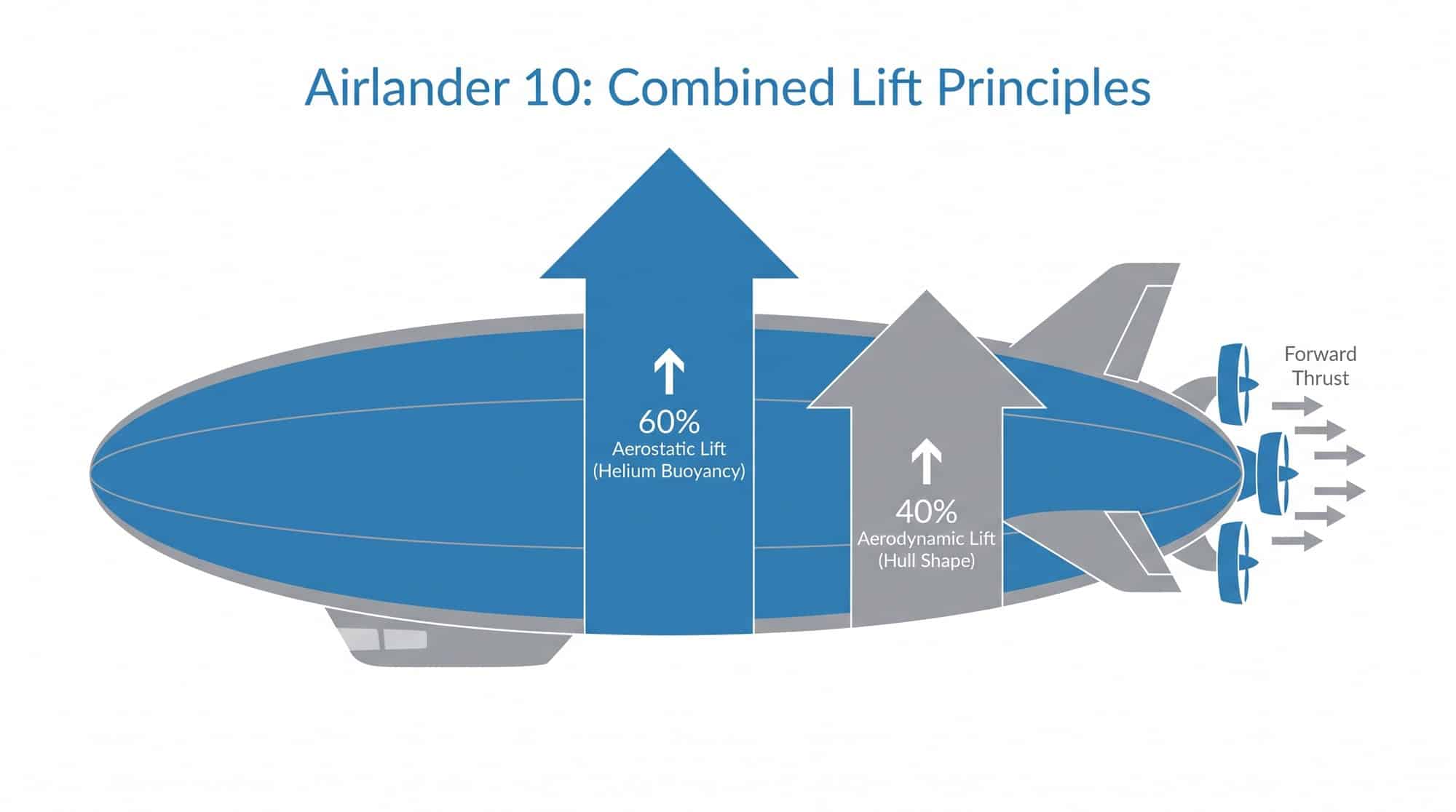
Built by British firm Hybrid Air Vehicles (HAV), the Airlander 10 is a hybrid airship, part blimp and part aeroplane, that generates up to 40 percent of its lift from its aerodynamic shape and the rest from buoyant helium. After more than a decade of development, setbacks, and resurgence, the aircraft is now in its Type Certification programme with the UK Civil Aviation Authority. Production is being planned at a new factory in Doncaster, England, with commercial service targeted for 2028 or 2029. Here is everything you need to know about the aircraft that could change how we think about flight.
What Is the Airlander 10?
The Airlander 10 is a hybrid airship designed and manufactured by Hybrid Air Vehicles, based in Bedford, UK. It belongs to a category of aircraft that sits between lighter-than-air and heavier-than-air flight. Helium gas in its 38,000-cubic-metre envelope provides roughly 60 percent of the lift, while the remaining 40 percent comes from the hull’s elliptical, cambered shape, which acts as a lifting body when the aircraft moves forward, much like a fixed-wing aeroplane.
Four 350-horsepower turbocharged diesel engines mounted in ducts provide vectored thrust for takeoff, landing, and cruise. The production model will measure 98 metres in length, 43.5 metres in width, and 26 metres in height, capable of carrying a 10-tonne payload, or more than 100 passengers, across distances of up to 4,000 nautical miles. Its informal nickname, “The Flying Bum,” comes from its distinctive twin-lobed hull shape.
The aircraft has no internal framework. Its form is maintained entirely by helium pressure, just 0.15 psi above the surrounding atmosphere, held within an envelope made from a triple-layer laminate of Vectran (a high-performance liquid crystal polymer fibre), Mylar (a tough polyester film that seals in the helium), and Tedlar (a weather-resistant vinyl fluoride polymer). Inside, 15 compartments linked by valves provide redundancy; a slow leak in one compartment does not threaten the entire airship.
The Story So Far: Development, Setbacks, and Revival
The Airlander 10 traces its roots to a US Army programme. In 2010, the military awarded HAV a contract to develop the Long Endurance Multi-intelligence Vehicle (LEMV), designated the HAV 304. The prototype completed a single successful test flight in New Jersey in 2012, but budget cuts cancelled the programme the following year. HAV bought the airship back from the US government for just £1 and repatriated it to its historic Cardington hangars in Bedfordshire, the same sheds where Britain’s great airships of the early 20th century were built.
After a major rebuild, the aircraft was unveiled as the Airlander 10 in March 2016. Its first UK flight on 17 August 2016 lasted 30 minutes and went smoothly. The second flight, one week later, was less forgiving. During landing, the nose dropped and the flight deck sustained damage, though the crew walked away uninjured. The Air Accidents Investigation Branch (AAIB) identified 63 modifications, including the addition of inflatable “bump bags” on the underside that deploy within 15 seconds, and the airship returned to flight in May 2017.
The most dramatic incident came on 18 November 2017. While moored at Cardington between test flights, the Airlander 10 broke free from its mooring mast in gusting winds. An automatic safety system fired emergency compressed-gas bolts that deflated the envelope within minutes, bringing the aircraft to rest on the ground. One member of staff suffered minor injuries, and HAV later confirmed the hull was beyond repair. The prototype was officially retired in January 2019.
Rather than rebuild the damaged prototype, HAV shifted focus entirely to the production-standard Airlander 10, a significantly refined design incorporating lessons from every test flight. In February 2024, the company formally entered the Type Certification programme with the UK Civil Aviation Authority, a milestone that placed the aircraft on a defined regulatory path to commercial service. A production site in Doncaster was announced the same year, and as of mid-2026, the company reports a US$3.7 billion order pipeline.

Inside the Airlander 10: Design, Cabin, and Capacity
The production Airlander 10 features a main cabin measuring 46 metres in length, longer than the passenger compartment of most single-aisle airliners. HAV has designed the interior to be fully reconfigurable depending on the mission. In a passenger configuration, the cabin accommodates more than 100 people with generous seat pitch, large windows, and space to move around. For luxury or experiential travel, it can be fitted with lounges, dining areas, private suites, and even glass floor panels for viewing the landscape below.
For cargo and logistics roles, the same cabin footprint converts to carry 10 tonnes of freight. A surveillance configuration packs the cabin with sensors, radar arrays, and communications equipment for military or coastguard patrols that can last five days at a stretch, far exceeding what helicopters or drones can sustain.
The landing system uses six air-cushion “feet”, pneumatic tubes that extend for touchdown and retract flush into the underside of the outer hulls during flight. These allow the Airlander to set down on almost any reasonably flat surface, including water, sand, snow, and unprepared fields, without needing a runway, a crane, or a large ground crew. Takeoff and landing require roughly 550 metres of clear space, and the aircraft can handle crosswinds of up to 35 knots during vertical operations.
Performance and Capabilities: Speed, Range, and Endurance
The Airlander 10 is not built for speed. Its cruise velocity of 80 knots (148 km/h) and top speed of around 92 mph make it slower than a regional turboprop and far slower than a jet. But speed is not the point. The airship’s value lies in endurance, payload flexibility, and infrastructure independence.
With a maximum range between 2,000 and 4,000 nautical miles depending on payload and configuration, the Airlander can connect cities without airports, deliver cargo to remote communities, or loiter over a disaster zone, relaying communications for up to five days with a crew on board. Unmanned variants could stay aloft even longer, with estimates ranging from 15 to 20 days, making them attractive for persistent surveillance and environmental monitoring missions.
The four ducted propellers can be vectored independently, giving the aircraft precise low-speed control and the ability to hover. With a service ceiling of 20,000 feet, it flies below commercial airliner traffic but high enough to clear most terrain. Power comes from four 4-litre V8 turbocharged diesel engines in the base configuration, though HAV’s electrification roadmap will change this substantially over the coming years.
| Specification | Airlander 10 (Production) |
|---|---|
| Length | 98 m (320 ft) |
| Width | 43.5 m (143 ft) |
| Height | 26 m (85 ft) |
| Envelope volume | 38,000 m3 |
| Payload | Up to 10 tonnes (22,000 lbs) |
| Passengers | 100+ (configurable) |
| Cruise speed | 80 knots (148 km/h) |
| Max range | Up to 4,000 nautical miles |
| Endurance | 5 days (manned) |
| Service ceiling | 20,000 ft (6,100 m) |
| Takeoff/landing distance | ~550 m (1,800 ft) |
| Engines | 4 × 350 hp diesel (base); transitioning to hybrid-electric |

How Much Does the Airlander 10 Cost?
HAV has not published an official purchase price for the Airlander 10. Early estimates from the company’s communications team placed the build cost of the prototype at roughly US$100 million (£60 million), but production aircraft are expected to cost significantly less as manufacturing scales. The company’s order pipeline, valued at $3.7 billion, spans both civil and defence customers, suggesting per-unit pricing somewhere in the tens of millions of dollars, comparable to a regional jet, but with far lower operating costs per flight hour.
As for ticket prices, no airline has yet announced fares. Air Nostrum, the Spanish regional carrier that has reserved 20 Airlander 10 aircraft, operates short-haul routes where conventional ticket prices range from €50 to €150. Industry analysts expect that the Airlander’s dramatically lower fuel consumption, up to 90 percent less than a comparable-capacity fixed-wing aircraft, could translate into competitive or even cheaper fares on certain routes, especially those linking cities without major airports.
Who’s Buying It? Commercial and Military Orders
The first commercial reservation came from Air Nostrum Group in 2022, with the Spanish airline placing an initial order for 10 aircraft. In August 2023, the carrier doubled its reservation to 20 Airlander 10s, making it the aircraft’s largest customer. Air Nostrum plans to deploy the airships on domestic and regional Mediterranean routes, where the aircraft’s ability to operate from small coastal airfields and its low emissions profile align with the airline’s sustainability goals.
French expedition company Grands Espaces has reserved Airlander 10 aircraft for luxury experiential travel to the Arctic, offering passengers a slow, low-altitude journey over some of the most remote landscapes on Earth. In Scotland, the Highlands and Islands Transport Partnership (HITRANS) is targeting the deployment of six Airlander 10s to connect communities across the Highlands and islands, where conventional air and ferry links are expensive and weather-dependent.
On the defence side, HAV announced its first military aircraft reservation in October 2025: an undisclosed “innovative defence contractor” has reserved three Airlander 10s, with plans to offer the capability to its own government and military customers. The company’s total civil reservation pipeline stands at over $2 billion, with the defence order adding to a combined $3.7 billion backlog. In parallel, HAV has established a US subsidiary, HAV USA, led by former NASA executive John Schumacher, signalling a serious push into the American defence and logistics market.
Airlander 10 vs the Hindenburg: Why Helium Changes Everything
When people hear “airship,” many still think of the Hindenburg, the German passenger zeppelin that caught fire in 1937, killing 36 people. That disaster, captured on film and broadcast around the world, effectively ended the airship era. But the Airlander 10 shares little in common with its 1930s predecessor beyond a general shape.
The most critical difference is the lifting gas. The Hindenburg was filled with hydrogen, a highly flammable gas that ignited within seconds when a spark met leaking gas. The Airlander 10 uses helium, an inert noble gas that does not burn and does not react with other elements. Even if you held a lit match directly to a helium leak, nothing would happen.
The structural philosophy is also fundamentally different. The Hindenburg had a rigid aluminium framework covered in doped cotton, materials that burned fiercely. The Airlander 10 has no internal frame at all, and its envelope is made from modern fire-resistant polymers. Its helium is pressurised only 0.15 psi above the surrounding air, meaning any puncture produces a slow, manageable leak rather than an explosive rupture. The 15 internal compartments isolate damage, and the aircraft can fly on three engines or execute a controlled float-down if all engines fail.

The Path to Zero Emissions: Electric Airlander by 2030
The Airlander 10 is already one of the most fuel-efficient aircraft ever conceived. Because helium handles most of the lift, the engines only need to overcome drag and provide forward thrust, not fight gravity. Compared with similar-capacity fixed-wing aircraft, the base diesel Airlander 10 produces up to 90 percent fewer emissions per passenger, building on the 75 percent reduction demonstrated by earlier prototypes.
But HAV’s ambitions go further. The company has laid out a three-stage electrification roadmap. The initial production model will use four diesel engines. A hybrid-electric intermediate stage, originally planned for around 2025, will replace two of the four engines with electric motors, cutting emissions further. The final stage, an all-electric Airlander 10 powered by four electric motors, is targeted for 2030.
The most significant step toward that goal came in November 2025, when HAV signed a Memorandum of Understanding with ZeroAvia, a leader in hydrogen-electric aviation propulsion. Under the agreement, the two companies will study fitting the Airlander 10 with four of ZeroAvia’s ZA600 hydrogen-electric powertrains. Each ZA600 generates 600 kilowatts using a proton-exchange membrane fuel cell that combines hydrogen and oxygen to produce electricity, water vapour, and heat, with no combustion and no carbon emissions. Because the Airlander’s enormous hull provides ample internal volume for hydrogen storage tanks, the hydrogen-electric variant could match or exceed the diesel version’s 4,000-nautical-mile range while carrying 100-plus passengers with zero in-flight emissions.
ZeroAvia’s technology is advancing through certification in parallel. In November 2025, the UK Civil Aviation Authority granted ZeroAvia Design Organisation Approval, the first hydrogen-electric powertrain developer globally to achieve that status. In March 2026, the US Federal Aviation Administration published final special conditions for the ZA601 electric engine, the motor component of the ZA600 system, advancing it through the FAA’s own type certification process. HAV is also partnering with infrastructure firm AECOM to plan hydrogen production and refuelling facilities at future Airlander operating bases. The Airlander is not the only next-generation airship in development. Google co-founder Sergey Brin’s LTA Research is building its own airship powered by the largest hydrogen fuel cell ever made, signalling a broader resurgence of lighter-than-air technology.
Frequently Asked Questions
What happened to Airlander 10?
The original Airlander 10 prototype was retired in January 2019 after a mooring breakaway incident in November 2017 damaged the hull beyond economical repair. HAV shifted development to the production-standard Airlander 10, which entered the Type Certification programme with the UK Civil Aviation Authority in February 2024. The company is now planning a manufacturing facility in Doncaster, England, with commercial service targeted for 2028 or 2029.
Why did the Airlander 10 crash?
The Airlander 10 never experienced a crash with casualties. It had two notable incidents during testing. In August 2016, the aircraft made a heavy landing on its second UK test flight, damaging the flight deck, the crew were uninjured. In November 2017, while moored at Cardington Airfield, the airship broke free from its mast in strong winds and its automatic safety system deliberately deflated the envelope to prevent it from drifting away. One ground crew member suffered minor injuries. Both incidents informed the production design, which incorporates numerous safety improvements.
How much does the Airlander 10 cost?
HAV has not released an official purchase price. Early estimates placed the prototype build cost at approximately US$100 million. Production aircraft are expected to cost significantly less, with per-unit pricing likely in the tens of millions of dollars, comparable to a regional jet but with substantially lower operating costs.
What airlines have ordered the Airlander 10?
Spanish regional carrier Air Nostrum Group has reserved 20 Airlander 10 aircraft, doubling its initial order of 10. French expedition company Grands Espaces has reserved aircraft for Arctic experiential travel. Scotland’s HITRANS is targeting six aircraft for Highlands and Islands connectivity. Additionally, an undisclosed defence contractor has reserved three aircraft for military use.
Is the Airlander 10 still flying?
The original prototype is no longer flying. It was retired in 2019. The production-standard Airlander 10 is currently in development, with Type Certification underway. No new Airlander 10 has yet been built, but manufacturing is expected to begin at the Doncaster production site ahead of commercial entry into service in 2028 or 2029.
Where is Airlander 10 now?
The original prototype was dismantled at Cardington Airfield. HAV continues to operate from its Cardington headquarters in Bedfordshire, UK, where design, engineering, and certification work is ongoing. The company’s future manufacturing will take place at a new production facility in Doncaster, South Yorkshire.
The Future of Flight, One Helium-Filled Step at a Time
The Airlander 10 does not fit neatly into any existing category of aircraft, and that is precisely its strength. It is slower than a plane, smaller than a ship, and more expensive to build than either. But it can reach places neither can, burn a fraction of the fuel, and carry meaningful payloads without needing a single metre of tarmac. For the communities, supply chains, and defence forces that live and operate beyond the reach of runways, that combination is not just novel; it is transformative.
With Type Certification advancing, a growing order book, and a credible path to zero-emission flight through hydrogen-electric propulsion, the Airlander 10 is closer to reality than at any point in its long and turbulent history. Whether ferrying passengers across the Mediterranean, delivering aid to a flood-stricken coastline, or patrolling maritime borders for days on end, the world’s largest aircraft may soon be one of its quietest and cleanest.


