Global electricity demand for air conditioning is surging. In 2024 alone, building electricity consumption rose by over 600 terawatt-hours, nearly 60% of total global electricity growth, driven largely by rising cooling needs during severe heatwaves, according to the International Energy Agency. At the same time, urban heat islands push city temperatures 10 to 15°C above surrounding rural areas, intensifying the cycle of heat and energy consumption.
Researchers at Graz University of Technology (TU Graz) in Austria have developed an alternative that requires no compressors, no refrigerants, and no electricity during operation. Their solution: a 3D-printed ceramic cooling system, porous cubes that lower the surrounding air temperature through nothing more than water and evaporation.
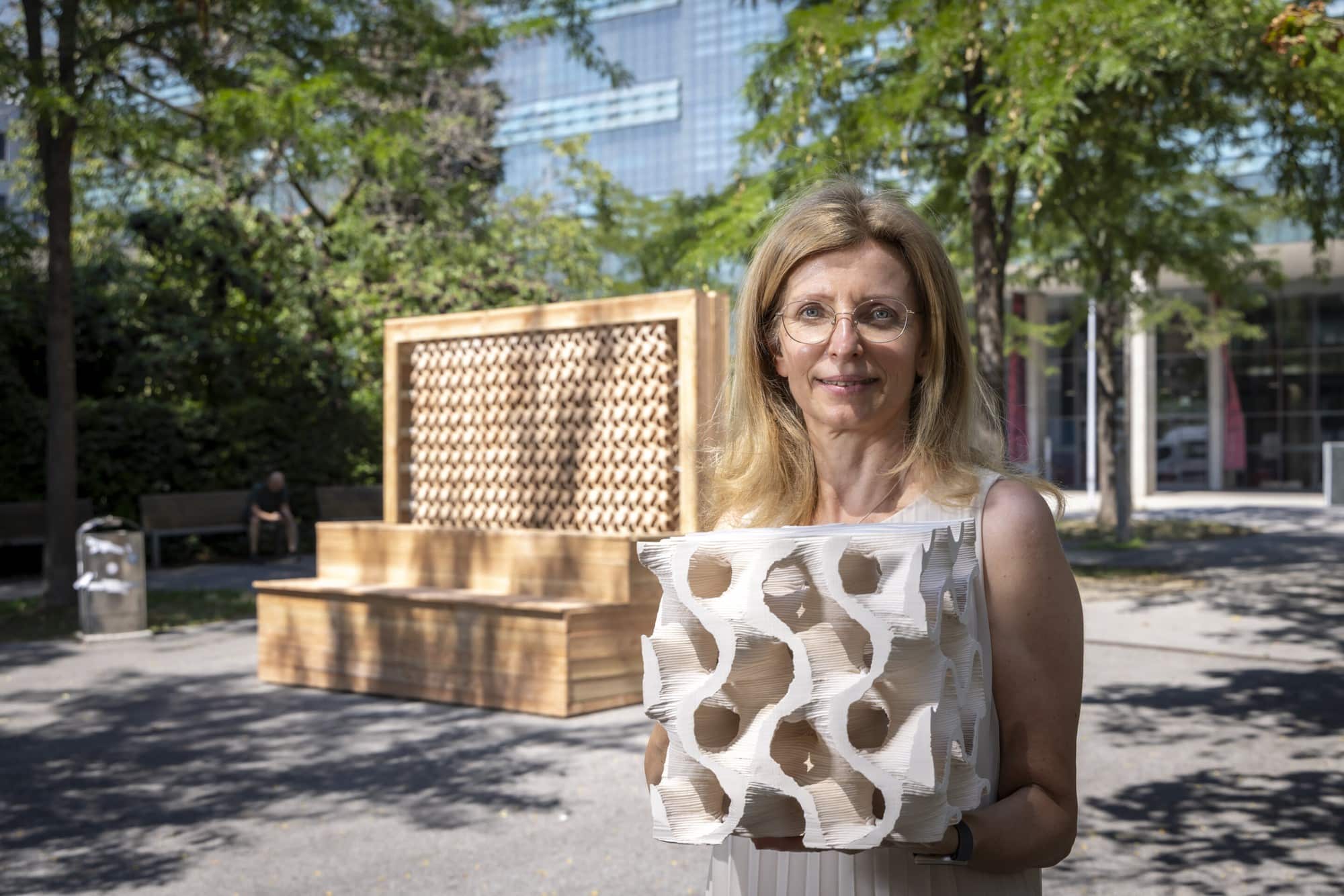
In field tests, a single water-filled cube lowered the air temperature in its immediate vicinity by nearly 7°C (12.6°F). A full-scale demonstration wall now stands on the university’s campus, offering a glimpse of how buildings might stay cool without the environmental cost of conventional air conditioning.
How Evaporative Cooling Works in Porous Ceramics
Evaporative cooling is one of the oldest cooling techniques known to humanity. When water transitions from liquid to vapor, it absorbs heat from its surroundings, a principle governed by the latent heat of vaporization. Vaporizing a single kilogram of water pulls approximately 2,256 kilojoules of thermal energy from the adjacent air.
Traditional clay water jugs and wind towers in the Middle East and South Asia have exploited this effect for centuries, and modern 3D-printed designs are now reviving these ancient principles at an architectural scale. Unglazed clay allows small amounts of water to seep to the outer surface, where evaporation continuously draws heat away, keeping the contents and the surrounding space cool.
The TU Graz team, led by Associate Professor Milena Stavric at the Institute of Architecture and Media, took this ancient principle and paired it with modern additive manufacturing. Each cube measures approximately 23 centimeters (9 inches) per side and is 3D-printed from a ceramic clay mixture. The printed clay is fired at low temperatures, which preserves a highly porous structure rather than vitrifying it into a dense, impermeable surface.
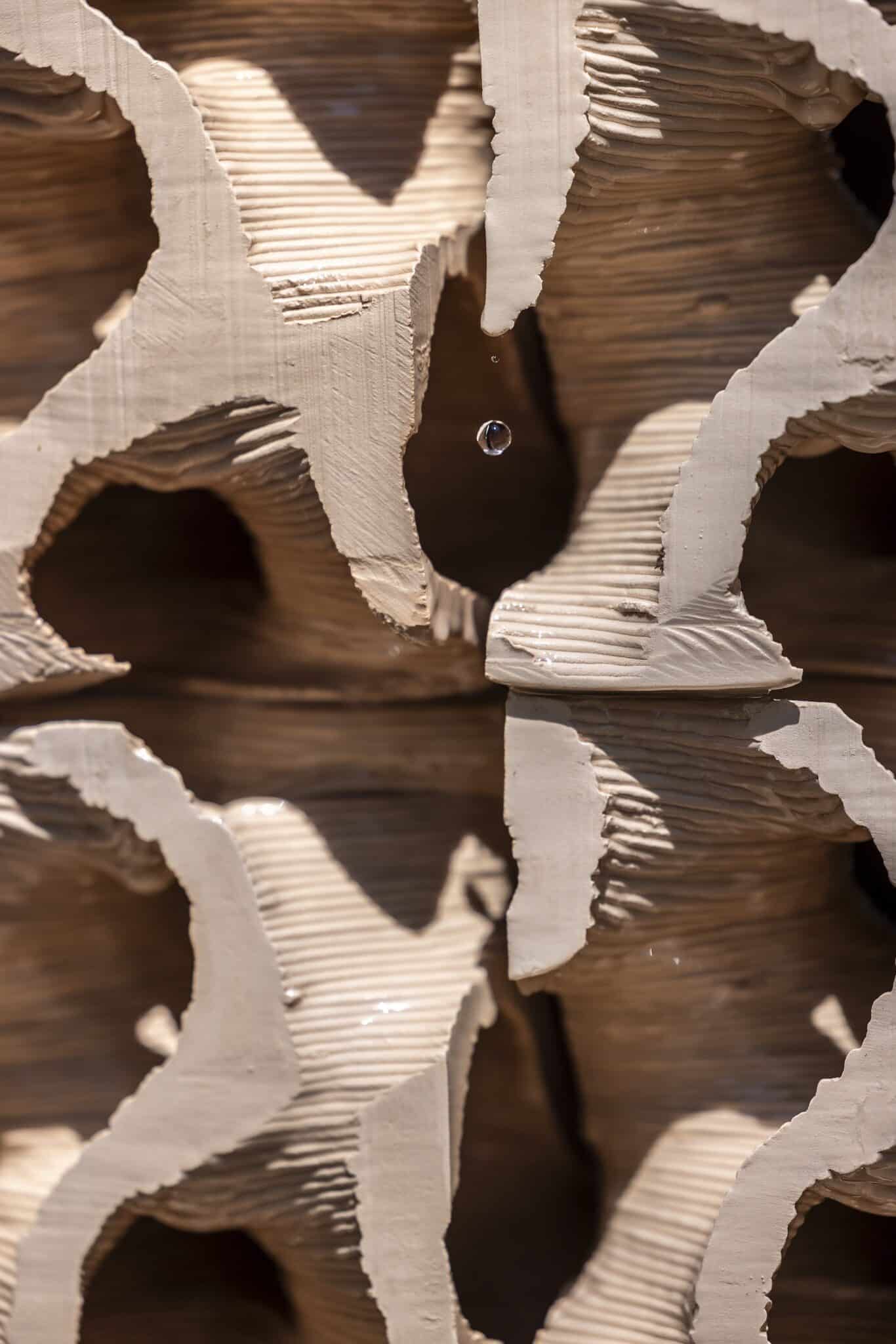
Water enters the porous ceramic through capillary action, the same force that draws liquid up a paper towel. It spreads evenly through the complex internal geometry and evaporates continuously across an enormous surface area. As Stavric explains, “These special structures store water particularly efficiently and, despite their small volume, create an enormous evaporation surface.”
The TPMS Geometry: Why Shape Determines Cooling Power
What distinguishes the TU Graz cubes from a simple clay brick is their internal architecture. Each cube is digitally designed around a triply periodic minimal surface (TPMS), a mathematical structure that maximizes surface area while using minimal material.
A TPMS is a surface that is locally area-minimizing, meaning that any small patch of the surface has the smallest possible area for its boundary. These structures repeat in three dimensions and divide space into two interwoven, continuous channel networks. The most well-known TPMS geometries, the gyroid, Schwarz P, and diamond surfaces, appear in nature in butterfly wing scales, sea urchin skeletons, and cell membranes, where efficient transport across a large surface is essential.
In the cooling cubes, the TPMS design serves the same purpose. The continuous, branching channels allow water to spread uniformly while maintaining maximum contact with passing air. This geometry provides significantly more evaporative surface area than a solid block or simple lattice of the same outer dimensions, translating directly into greater cooling capacity per cube.
The geometry also lends structural integrity. Despite being mostly empty space internally, the TPMS framework distributes mechanical stress efficiently, making the cubes robust enough for assembly into larger wall structures.

Mycelium-Enhanced Ceramics: Growing a Pore Network with Fungi
The TU Graz team has pushed the concept further with a bio-inspired manufacturing process developed in the institute’s Shape Lab. Before 3D printing, fungal cultures and sawdust are mixed into the clay as a nutrient medium. Over time, a mycelium, the thread-like network of fungal filaments, grows throughout the material.
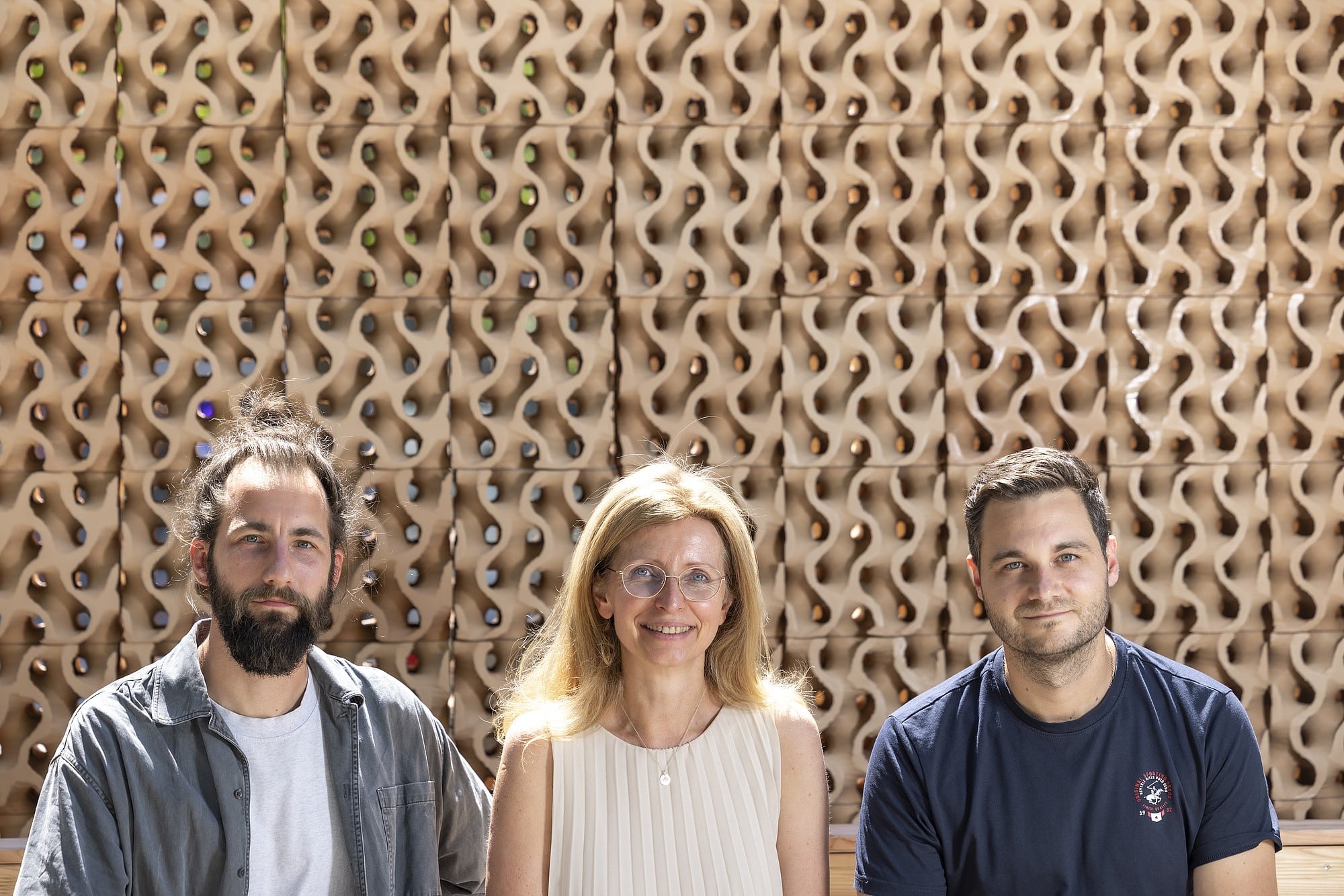
The clay-fungus mixture is then 3D-printed and fired. During firing, both the mycelium and sawdust burn away completely, leaving behind a dense, interconnected network of micro-pores and macro-pores throughout the ceramic. This secondary pore network significantly enhances water distribution inside the cube, allowing moisture to reach every part of the geometry more efficiently than capillary action alone.
The result is a material with two distinct pore scales: the macro-scale channels of the TPMS geometry and the micro-scale tunnels left by the fungal network. Together, they maximize both water retention and evaporative surface exposure, improving the overall cooling performance beyond what geometry alone can achieve.
From Lake Sediment to Cooling Walls: Circular Material Innovation
Beyond optimizing performance, the TU Graz researchers are exploring how to make the cubes themselves more sustainable. One promising avenue involves sediment from Lake Neusiedl, a large shallow lake on the Austrian-Hungarian border.
Lake Neusiedl requires regular dredging to slow the natural process of silting, the gradual accumulation of sediment that would eventually transform the lake into marshland. Until now, most of the extracted sediment has been disposed of without any productive use. The TU Graz team believes this lake sediment could replace a significant portion of the virgin clay used in the ceramic printing mixture.
If successful, this approach would transform a waste disposal problem into a resource stream for passive cooling infrastructure, a circular economy model where maintaining a lake’s ecological health also produces material for climate-adaptive architecture.
Real-World Testing: A 7°C Temperature Drop
A controlled field test at TU Graz put the concept to the test. Researchers placed a single water-filled cube in a hot campus attic and monitored the surrounding temperature. The air immediately around the cube dropped by nearly 7°C (12.6°F) compared to baseline conditions.
“The cooling effect was clearly noticeable throughout the room,” said Kristijan Ristoski, who integrated the cubes and a controllable water supply circuit into a cooling wall for his master’s thesis.
A free-standing demonstration wall measuring two by two meters now stands at TU Graz’s Campus Neue Technik in Graz. The public can visit and experience the cooling effect firsthand. A second installation is on display at the city’s Museum of Perception.
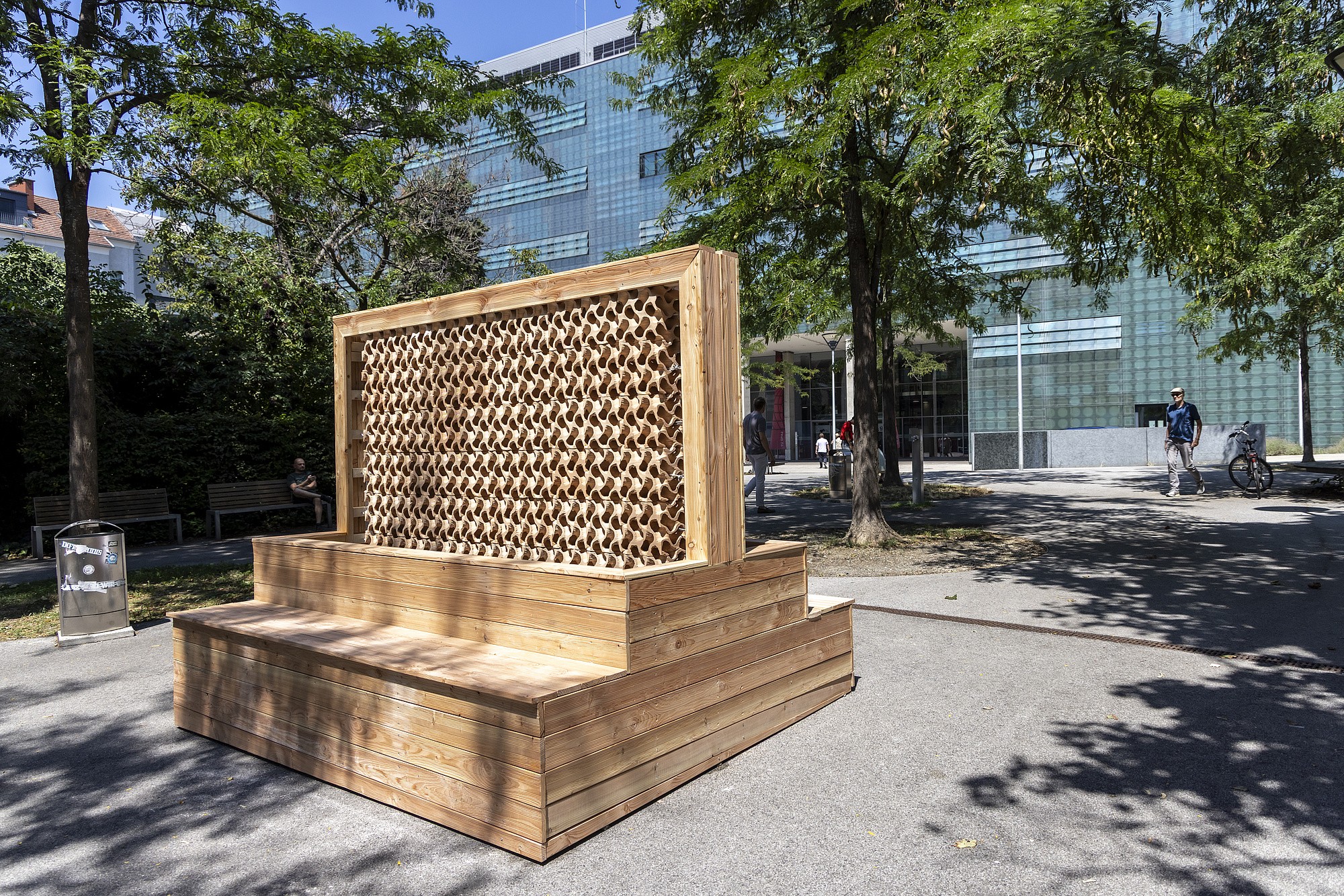
The project, titled “3D-Printed Ceramic Cooling Walls for Sustainable Urban Architecture,” was conducted in collaboration with TU Graz’s Institute of Building Physics, Services and Construction and funded by Austria Wirtschaftsservice GmbH (AWS) as part of its proof-of-concept programme.
Where Evaporative Cooling Works Best, and Its Limits
For all its promise, ceramic evaporative cooling has clear physical boundaries. The most significant limitation is humidity. Evaporative cooling works by adding moisture to the air; when the air is already saturated, which is common in tropical and coastal climates, evaporation slows dramatically and the cooling effect diminishes.
This is why traditional evaporative coolers, also known as swamp coolers, are most popular in arid and semi-arid regions. The TU Graz cubes follow the same physics: they perform best in hot, dry conditions and lose effectiveness as relative humidity rises above roughly 60%. In humid climates, pairing the cubes with ventilation or dehumidification strategies would be necessary to maintain comfort.
Other practical considerations include:
- Water supply: The cubes require a continuous water source to maintain surface saturation, and consumption scales with both temperature and airflow.
- Water quality: Hard water can leave mineral deposits that clog the porous ceramic over time, requiring periodic maintenance or replacement.
- Airflow: Passive cooling performance depends on adequate air movement to carry away the cooled, humidified air and bring in warmer, drier air for the next evaporation cycle.
- Durability: Low-fired ceramic is more porous but less mechanically robust than high-fired ceramic. Outdoor installations would need to account for freeze-thaw cycles, impact, and long-term weathering.
These are not disqualifying limitations. They are design parameters that architects and building engineers already manage when specifying any evaporative cooling system. The difference is that the TU Graz cubes make those trade-offs worth optimizing, because the geometry itself can be tuned to match specific climate conditions.
How Ceramic Cooling Stacks Up Against Conventional Air Conditioning
Conventional air conditioning is energy-intensive by design. A compressor compresses refrigerant, a fan blows air across cooled coils, and the extracted heat is dumped outside, adding to the urban heat island effect. The International Energy Agency reports that space cooling currently accounts for roughly 10% of global electricity consumption, and that figure is projected to rise sharply as incomes grow in hot countries and heatwaves become more frequent.
Ceramic evaporative cooling operates on a fundamentally different model, one that other research teams are also pursuing with programmable ceramic fabrication techniques. It consumes no electricity during operation, only water, much like other passive cooling systems that harness evaporation and natural processes. It requires no synthetic refrigerants, many of which are potent greenhouse gases if leaked. And unlike conventional AC, it does not expel waste heat into the surrounding environment, meaning it can be deployed in dense urban areas without contributing to the very heat problem it aims to solve.
The trade-off is cooling capacity. A compressor-based AC can reliably maintain a set indoor temperature regardless of outdoor humidity. The ceramic cubes provide temperature reduction that varies with ambient conditions and is unlikely to match the deep cooling of a powered unit on the hottest, most humid days.
Where the cubes shine is in shifting the baseline. In many climates, a 7°C reduction turns an uncomfortably hot 35°C (95°F) day into a tolerable 28°C (82°F), enough to make a space livable without switching on energy-intensive cooling. The cubes can also work alongside conventional systems, pre-cooling incoming air and reducing the AC compressor’s workload, an approach that radiant cooling panels have demonstrated can cut air conditioning energy use by half.
Stavric frames the goal in practical terms: “Our aim is to provide cooling where people suffer particularly from the heat, for example, in cities where trees are sometimes unable to provide sufficient cooling. To achieve this, we rely on natural cooling principles rather than energy-intensive air-conditioning technology.”
The target applications include:
- Residential and office buildings in hot, dry climates
- Schools and public waiting areas
- Outdoor urban spaces where trees cannot provide enough shade
- Hybrid systems where ceramic pre-cooling reduces the workload on conventional air conditioning
Planners and companies interested in evaluating the technology are invited to contact the TU Graz team directly. A similar passive cooling innovation inspired by camel fur has also shown that bio-inspired materials can deliver meaningful temperature reductions without external power.
Frequently Asked Questions
How does ceramic cooling work?
Ceramic cooling relies on evaporative cooling. Porous ceramic absorbs water through capillary action, and as that water evaporates from the surface, it draws heat from the surrounding air. The temperature drop occurs because the phase change from liquid to vapor requires energy, which is taken from the immediate environment in the form of heat.
What is a downside of evaporative cooling?
The main limitation is humidity. Evaporative cooling adds moisture to the air, and its effectiveness drops substantially when the air is already humid. In tropical or coastal climates with high relative humidity, the cooling effect is minimal. Other challenges include the need for a continuous water supply and the potential for mineral buildup from hard water.
How much does a terracotta cooling system cost?
The TU Graz ceramic cubes are still in the research and demonstration phase, so commercial pricing is not yet available. However, the raw materials, clay, water, and, in some formulations, lake sediment, are inexpensive and widely available. The primary cost variables will be 3D printing time, firing energy, and water supply infrastructure. These are expected to be competitive with or cheaper than conventional AC systems over the lifecycle, given the absence of electricity costs during operation.
Is passive cooling effective?
Yes, when applied in the right conditions. The TU Graz field test demonstrated a nearly 7°C temperature drop from a single cube. Passive cooling strategies are most effective in hot, dry climates and can significantly reduce reliance on mechanical air conditioning. In humid regions, they typically need to be combined with ventilation or used as a pre-cooling supplement rather than a standalone solution.
Does terracotta keep water cool?
Yes. Unglazed terracotta and other porous ceramics have been used for centuries to keep water cool through surface evaporation; this is the same physical principle behind traditional clay water jugs found in hot regions worldwide. The TU Graz cubes apply this ancient principle at an architectural scale using 3D-printed geometries that maximize the evaporative surface area.