
A small Bedford-based company called Hybrid Air Vehicles (HAV) is on a mission to bring commercial airships back as an eco-friendly way to carry freight from Africa, and as luxury transport for expeditions to the Arctic. It even raised £1.6m already in a crowdfunding campaign. Lots of people are excited about it, especially those involved in the flygskam (flight-shaming) movement.
Tom Grundy, the company’s chief executive, said:
The COVID pandemic and the flygskam movement against air travel could drive huge demand for the low-emissions craft. The pandemic has changed almost every aspect of our lives. But one thing is for sure – it has given us all a glimpse of a cleaner future. In just weeks, carbon levels dropped significantly, partly driven by a massive reduction in air travel. Still, it’s a temporary change and only a fraction of what we must achieve to keep global warming within target levels.

The hybrid design delivers significant efficiency over conventional fixed and rotary-wing aircraft. Just the use of helium for buoyant lift reduces the fuel-burning requirement because the helium’s buoyancy counters most of the airframe’s weight.
The company explains the aircraft’s unique hybrid make-up on its website:
Airlander uses a combination of proven aerospace technologies from a mixture of airships (hull fabric and helium), fixed-wing aircraft (composite structures, engines, and avionics), and helicopters (vectored thrust). This combination makes Airlander a cutting-edge aircraft with a game-changing capability.
Airlander 10, in its current configuration, produces about 75% fewer emissions than other aircraft in mobility and logistics applications. However, the company is currently developing a hybrid-electric Airlander 10, set to debut in 2025, which will provide 90% fewer emissions. And by 2030, it plans to have a fully-electric Airlander 10 – yes, a genuinely zero-emissions aircraft.
The airship can take off and land from nearly any flat surface and can carry a payload of up to 10,000 kilograms (22,050 pounds). During its final test, it reached heights of 7,000 feet and speeds of up to 50 knots, but the company says it should be able to cruise at 10,000 feet (3.000 meters) at speeds between 20-60 knots. (37-111 km/h). It has a 4,000 nautical mile max range, which can keep it airborne for up to five days!
US company Lockheed Martin, the defense giant whose got an innovation arm called Skunk Works also designing airships (but to carry medical supplies to remote locations), said:
Burning less than a tenth of the fuel of a helicopter per ton, the Hybrid Airship will redefine sustainability. With unlimited access to isolated locations around the globe, hybrid airships safely and sustainably support a wide range of activities in areas with little to no infrastructure. The airship offers the simplicity of a pickup truck by carrying cargo loads and personnel in and out of remote areas daily.
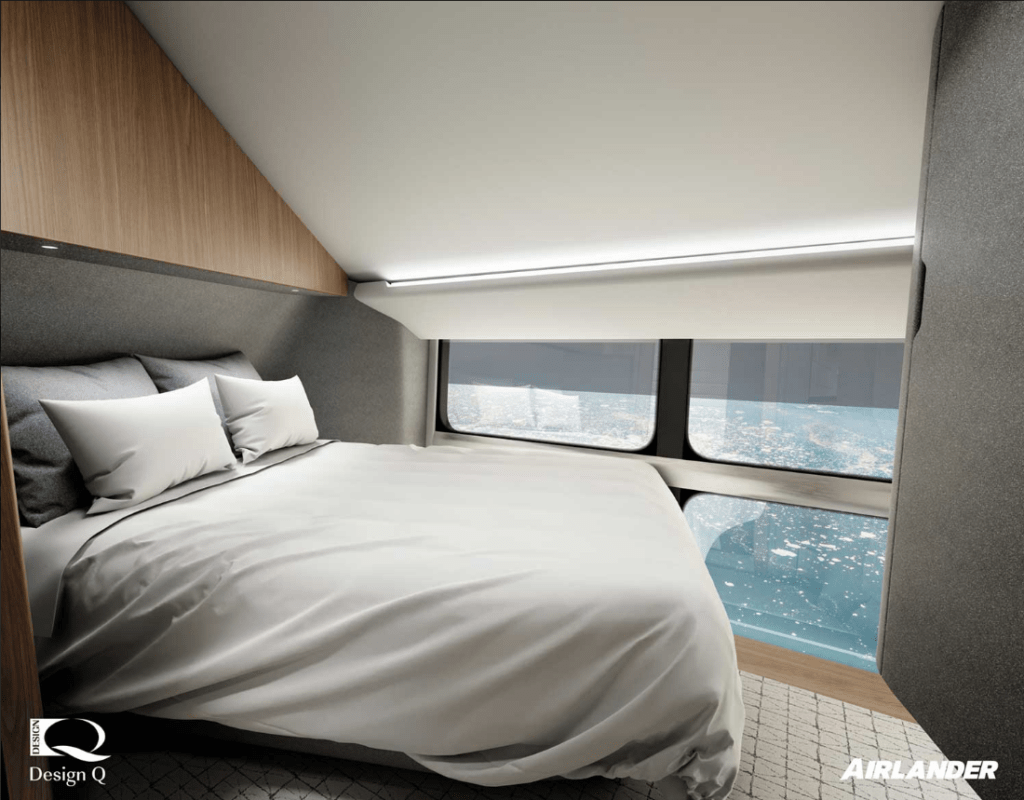
HAV is taking a different approach. It has teamed up with OceanSky Cruises to tap into the luxury travel market. Together, they will offer customers the chance to see the North Pole from the comforts of a five-star hotel atmosphere in the skies. OceanSky’s Alexander 10 will have ten luxury en-suite bedrooms and breathtaking horizon-to-horizon views since the unpressurized cabin allow for panorama windows and glass floors.

The company writes in its adverts:
The expedition will show that travel and transport by air can be sustainable. Lighter-than-air technology can supply humanity with ultra-efficient means of mobility, and operate in areas without infrastructure and civilization.
By 2025, HAV’s airship should be ready and taking people on the expedition of a lifetime – and perhaps also transporting people and cargo with lower emissions.


