
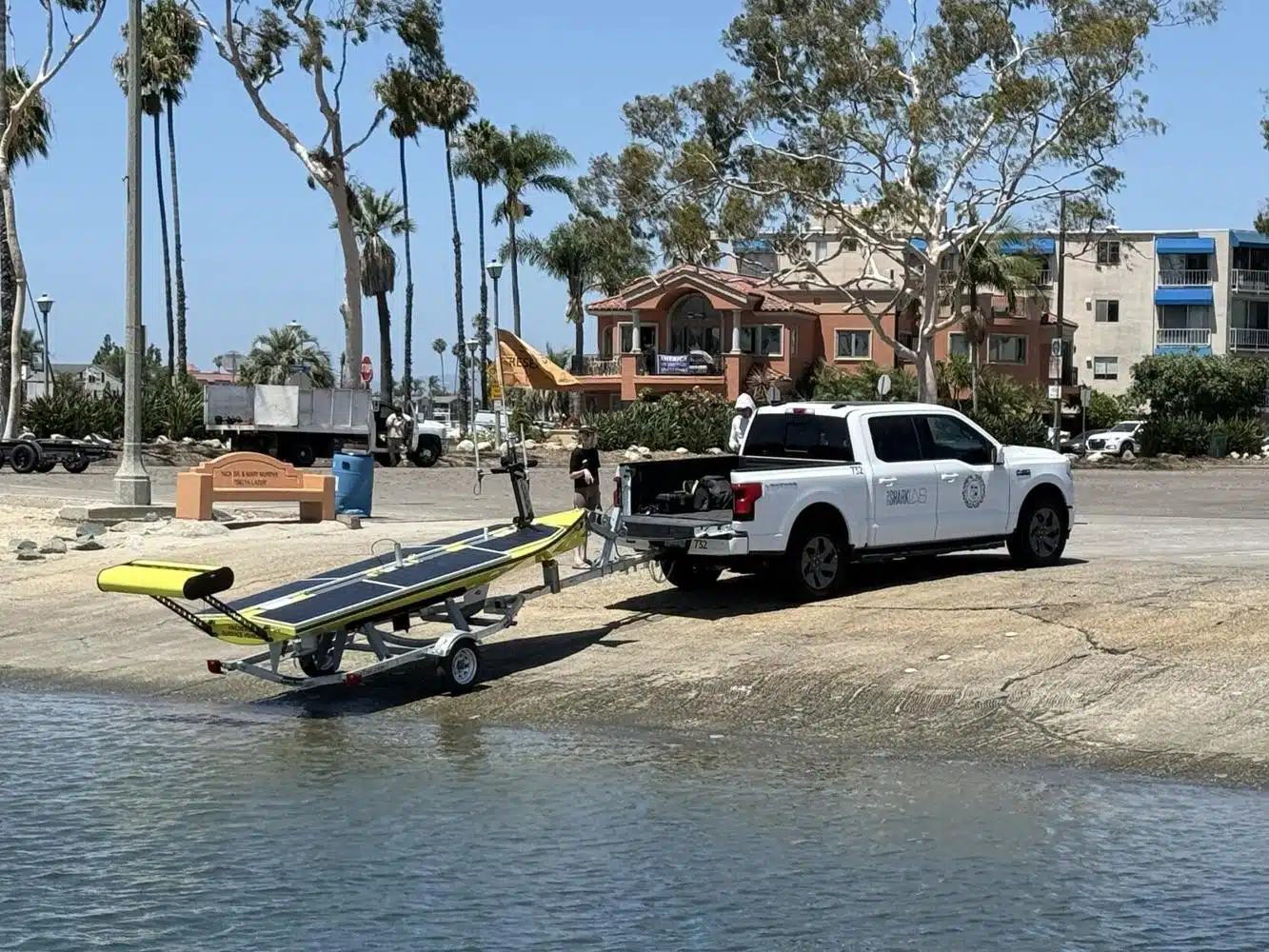
From a distance, it looks like a surfboard drifting near the shoreline. But this unmanned craft, roughly 10 feet long and 3 feet wide, is not a beachgoer enjoying the afternoon. It is a semi-autonomous robot built to track great white sharks before swimmers ever see a fin.
Researchers at California State University, Long Beach’s Shark Lab have begun testing a shark surveillance robot, which they call the Shark Surveillance Bot (SSB) — a floating prototype designed to patrol coastal waters, detect the presence of great white sharks, and beam real-time information back to lifeguards and marine biologists on shore.
What Is the Shark Surveillance Bot?
The shark surveillance robot is a solar-powered, semi-autonomous watercraft developed by the Shark Lab at CSU Long Beach, in collaboration with the New York University Center of Robotics and the Monterey Bay Aquarium Research Institute (MBARI). Funded by a $300,000 grant from the Seaver Institute, the prototype hit the water for the first time in July 2026 off the coast of Southern California.
Once fully operational, the robot will be capable of patrolling a single beach for up to a week at a time, operating on a pre-programmed route that Shark Lab director Chris Lowe likens to “mowing the lawn — just going back and forth in the ocean.” Lifeguards will be able to pilot it remotely, and researchers can control it from the lab as well.
The craft streams live data and 360-degree video over Wi-Fi to the Shark Lab, and a nesting aerial drone on its deck will provide a second layer of surveillance from above. This is not the first time researchers have turned to autonomous ocean robots to solve maritime challenges — from collecting plastic pollution to mapping the seafloor, uncrewed vessels are becoming essential tools for marine science. The goal is to give lifeguards better information so they can assess conditions, communicate clearly with beachgoers, and make informed public safety decisions — without causing unnecessary panic.
Three Ways the Robot Detects Sharks
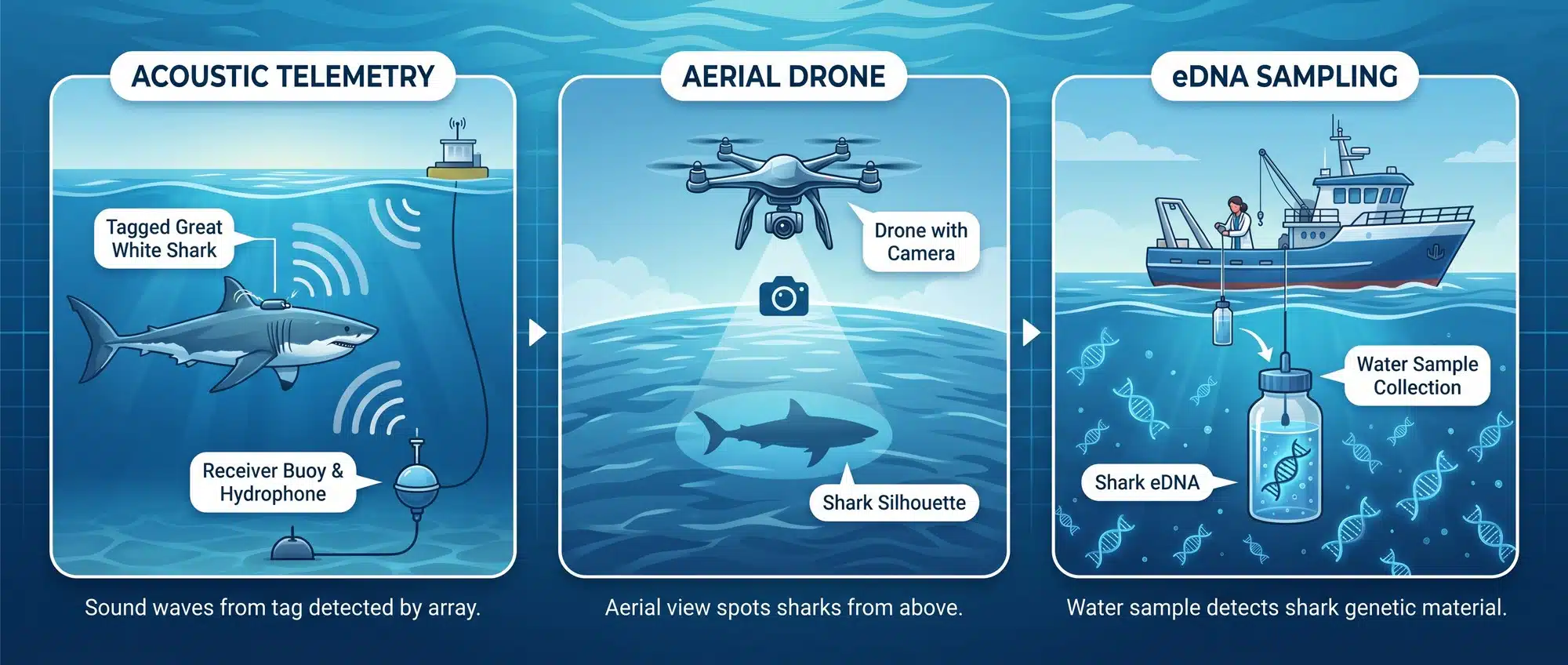
What sets the SSB apart from a simple camera drone is that it combines three distinct detection methods on a single platform. Each method answers a different question about shark activity, and together they provide a layered picture of what is happening beneath the surface.
Acoustic Telemetry
Many great white sharks along the California coast have been fitted with acoustic tracking tags by researchers. These tags emit a unique sound pulse that can be picked up by underwater receivers. The SSB carries acoustic receivers tuned to listen for tagged sharks in real time. When a tagged shark swims within range, the robot registers the detection instantly — this is the fastest and most reliable of the three methods.
The limitation is coverage: hundreds of sharks have been tagged, but thousands more have not. Acoustic telemetry can only detect sharks that scientists have already caught and tagged, which means it provides a partial, rather than complete, picture of shark presence.
Aerial Drone Surveillance
A drone housed on the SSB’s deck can launch into the air to capture a bird’s-eye view of the surrounding water. The drone transmits live 360-degree video, which means lifeguards and researchers can visually scan for sharks—tagged or untagged—across a wide area. This is especially useful in clear, shallow water where sharks are visible from above.
Drones are already used for shark spotting elsewhere in the world, and attaching one to a floating base station that stays on station for days at a time is a significant step toward persistent, automated surveillance rather than single-flight spot checks. Satellites and drones are already transforming ocean monitoring across multiple fronts, from tracking marine debris to mapping coral reef health.
Environmental DNA (eDNA) Sampling
The third and most novel method involves collecting and analyzing water samples for traces of shark DNA. This technology, developed by MBARI, can detect genetic material shed by sharks through their skin, mucus, blood, and waste. If shark eDNA is present in a sample, it confirms that a shark passed through the area — though not necessarily how recently.
How Environmental DNA Reveals a Shark’s Trail
Environmental DNA, or eDNA, is one of the fastest-growing tools in marine biology. Every living organism constantly sheds microscopic genetic material into its surroundings. In the ocean, a shark leaves behind a faint trail of skin cells, scales, and biological waste as it swims. By collecting a water sample and analyzing it for species-specific DNA markers, researchers can determine whether a great white shark has been in the area.
MBARI scientist Jim Birch, who leads the eDNA integration effort for the SSB project, has previously used the technology to study algae blooms in Lake Huron and to track ocean species between San Francisco and the Aleutian Islands. The same approach can identify harmful algae blooms, detect whether endangered salmon are present in rivers, and flag invasive species like zebra mussels in lakes.
However, eDNA has important limitations. Barbara Block, a professor of marine sciences at Stanford University who has studied great white sharks for decades, notes that the technology cannot yet identify individual sharks, and water movement complicates the picture. Shark DNA takes roughly 72 hours to fully degrade in seawater, meaning a positive eDNA reading could indicate a shark that swam by three days ago rather than three minutes ago.
“The DNA is in the water, and the water is moving,” Block told the Mercury News. “It takes 72 hours before it degrades. You might be looking at DNA from three days ago or today. It is a challenge for all of us. Did a shark pass today or two days ago?”
For this reason, eDNA is best understood as a broad biological survey tool rather than a real-time alarm system. It tells researchers that sharks have been present in an area — which, combined with acoustic tag data and drone footage, builds a far richer picture than any single method could on its own.
Racing the Clock: The 2028 Los Angeles Olympics
The project has a hard deadline. Lowe says he hopes to have the surveillance device fully operational within two years — in time for the 2028 Summer Olympics in Los Angeles, when triathletes will be swimming in Long Beach Harbor, an area known to be visited by great white sharks. The surfing events, scheduled for the famed cobblestone break at Lower Trestles, add another dimension: surfers sit in the water for extended periods, often in areas where juvenile white sharks congregate.
Initial testing is focused on Southern California waters, including Long Beach Harbor, Santa Monica Bay, and Huntington Beach. With enough funding, Lowe believes additional units could be built and deployed along beaches in Central and Northern California, where shark incidents have historically been more common.
The Shark Lab’s annual operating budget is roughly $1 million, and a request for $1.7 million in NOAA funding was submitted to carry the lab through 2026 and 2027. Whether the robot program scales beyond the prototype phase depends in part on whether that funding materializes.
How Shark Detection Tech Compares Around the World
California is not the only place investing in technology to reduce shark-human encounters. Several countries have deployed their own systems, each with distinct strengths. The table below compares the major approaches.
| Technology | Location | Coverage | Key Strength | Key Limitation |
|---|---|---|---|---|
| Shark Surveillance Bot (SSB) | California, USA | Single beach, up to 1 week | Combines acoustic, eDNA, and aerial data on one platform | Still a prototype; eDNA is not real-time |
| NSW Shark Drone Program | New South Wales, Australia | ~70 beaches, 365 days/year | Largest aerial shark surveillance program in the world; 500,000 flights/year | Visual only; relies on human or AI interpretation of drone footage |
| SharkSpotter AI | Australia (various) | Drone-based, select beaches | AI-powered real-time shark identification from video | Water clarity dependent; still in trial phase |
| SharkSmart Listening Stations | Sydney Harbour, Australia | Fixed buoy network | Real-time alert when tagged shark passes | Only detects tagged sharks; fixed locations |
| Shark Barriers (Eco-barriers) | South Africa, Australia | Single beach enclosure | Physical exclusion; no bycatch | Expensive to install; limited to calm waters; no data collection |
What distinguishes the SSB from these other systems is its multi-sensor approach. Australia’s drone program excels at wide-area visual coverage, and acoustic listening stations offer real-time alerts, but no other system currently combines acoustic telemetry, eDNA sampling, and aerial drone surveillance on a single mobile platform that can stay at sea for days at a time.
Sharks and Swimmers: Understanding the Real Risk
The SSB is not designed to sound an alarm every time a shark appears. Researchers at the Shark Lab emphasize that sharks and humans share California’s coastal waters every day, almost always without incident.

“Our data suggests that there are sharks around our beaches all the time without incident,” Lowe said. “Knowing what sharks, and how many are out there helps lifeguards make better decisions in beach safety operations and in advising the public.”
The California Department of Fish and Wildlife has documented 236 shark-human interactions since 1950, including 17 fatalities. To put that in perspective, millions of people swim, surf, kayak, and dive in California’s ocean waters every year, and the annual number of shark incidents is typically in the single digits. However, 2025 set an unsettling record: 10 shark incidents, the highest annual total ever recorded in the state, surpassing the previous high of nine in 2017.
Adult great white sharks primarily hunt seals and sea lions, not humans. Juveniles feed on fish, squid, and rays. Researchers believe most bites on humans are cases of mistaken identity — a shark briefly confusing a surfer or swimmer for its natural prey. Lowe estimates that along Southern California beaches, “dozens of encounters a week” occur without a single bite.
The philosophy behind the SSB, Lowe explains, is similar to the signs at Yellowstone National Park warning visitors to stay 150 feet from bison. “It is not about ‘there is a shark in the water, let’s pull everybody out.’ It is about giving people more information so they can make decisions for themselves.”
Frequently Asked Questions
Can a drone spot a shark from the air?
Yes. Drones equipped with high-resolution cameras can spot sharks in clear, shallow water, and this technique is already used by lifeguard services in Australia and California. The SSB’s aerial drone adds persistent surveillance — rather than a single flight, it can launch repeatedly from the robot over the course of a week-long patrol.
How long can shark surveillance drones stay in the air?
Consumer and professional surveillance drones typically have flight times of 20 to 40 minutes per battery charge. The SSB’s drone is designed for short, repeated flights launched from the robot’s deck throughout the day, recharging between missions. Australia’s NSW program, by contrast, uses a fleet of drones operating from shore with pilots rotating throughout the day for dawn-to-dusk coverage.
Is shark eDNA detection accurate?
eDNA is effective at confirming that a shark has been present in an area, but it is not a real-time detection method. DNA can persist in seawater for up to 72 hours and is carried by currents, so a positive result does not tell researchers exactly when or where the shark was. It is best used alongside acoustic tags and visual surveillance for a more complete picture.
Will this robot replace lifeguards?
No. The SSB is designed as a tool to provide lifeguards with better information so they can make more informed decisions about beach safety. It does not make decisions on its own and is not a substitute for trained lifeguards assessing conditions and communicating with the public.
When will the Shark Surveillance Bot be fully operational?
Chris Lowe, director of the CSULB Shark Lab, has set a target of two years — putting the completion date around mid-2028, just in time for the Los Angeles Summer Olympics. The prototype is already being tested in Southern California waters, and much of the remaining work involves integrating the eDNA sampling equipment and refining the drone-launch system.


