
When Honda retired ASIMO in 2022, it felt like the end of an era. The child-sized humanoid had been Japan’s most recognizable robot for over two decades, walking, running, dancing, and even playing soccer at demonstrations around the world. Behind the scenes, however, Honda’s robotics engineers were already working on something entirely different. In 2026, that work came to light: a multi-fingered robotic hand so precise it can thread a 1.6-millimeter screw, yet strong enough to lift 5 kilograms with its fingertips alone.
This is not a sequel to ASIMO. It is a deliberate pivot: from locomotion to manipulation, from spectacle to factory floors, from a humanoid that captivated crowds to a tool built to solve one of manufacturing’s hardest remaining problems.
The ASIMO Legacy: What Happened to Honda’s Famous Robot?
ASIMO, short for Advanced Step in Innovative Mobility, debuted in 2000 and quickly became a global symbol of Japanese technological ambition. It could walk on uneven surfaces, recognize faces, and respond to voice commands. At its peak, ASIMO was more than a research project; it was a cultural phenomenon that appeared at Disneyland, conducted orchestras, and met world leaders.
But ASIMO had a fundamental problem. Despite its advanced walking and interaction capabilities, Honda could not eliminate safety concerns around unpredictable human contact. The company worried that in unexpected situations, such as a child suddenly hugging the robot, ASIMO might knock someone over. This made commercial deployment difficult to justify, and after years of diminishing public appearances, Honda officially retired the program in 2022.
What few outside Honda knew was that around 2019, the robotics team had already shifted its research focus away from bipedal walking and toward something far more practical: robotic fingers capable of dexterous manipulation.
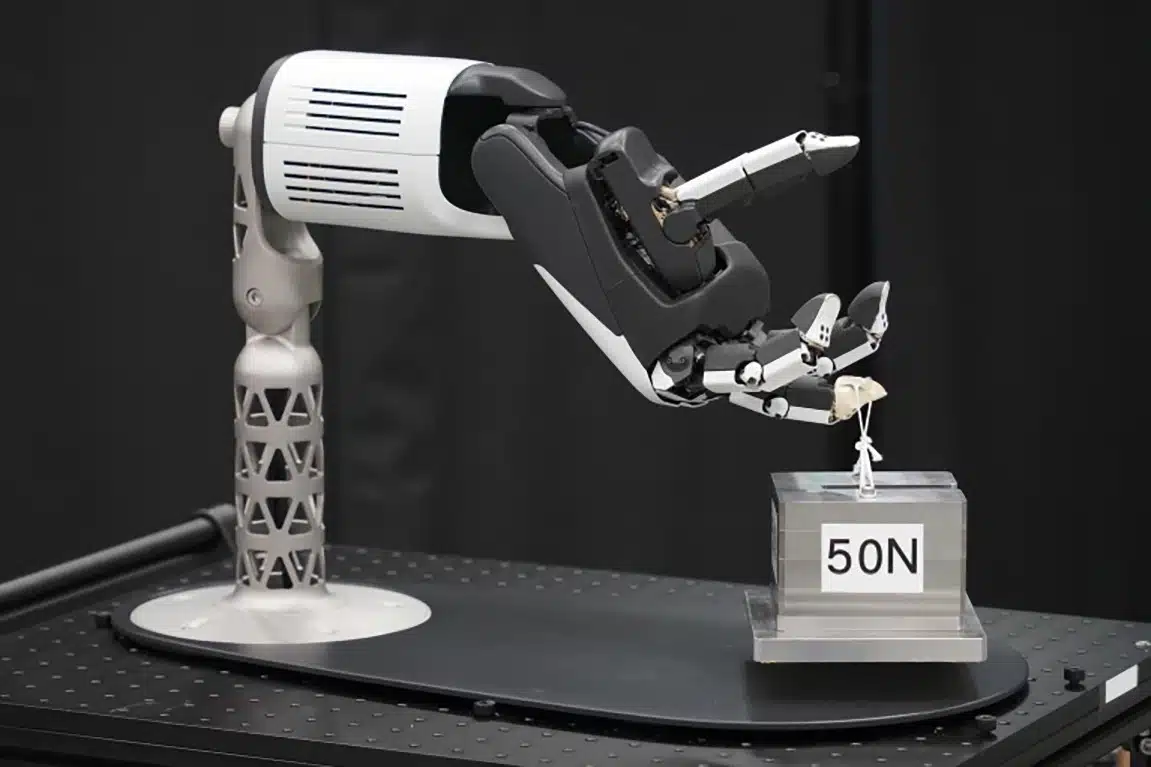
Honda’s New Direction: Inside the Multi-Fingered Robotic Hand
Unveiled at a robotics exhibition in Tokyo in late May 2026, Honda’s multi-fingered hand is a complete departure from the humanoid ambitions of the ASIMO era. The hand uses four fingers, deliberately omitting the little finger, and combines fine motor control with industrial-grade strength in a single system.
The specifications are striking:
- Grasps a screw measuring just 1.6 millimeters in diameter between thumb and index finger, rotating it in-hand and inserting it into a threaded hole
- Lifts objects weighing up to 5 kilograms using only its fingertips
- Achieves 16 degrees of freedom for manipulating components into the correct orientation before assembly
- Equipped with 6-axis force sensors in each fingertip and distributed tactile sensors across the finger pads and palm for real-time grip adjustment
- Surpasses 8 million cycles in durability testing, with fingertip force reaching approximately 12 kilograms, roughly twice the force of an average human fingertip
- Operates at nearly human-equivalent speed, making it viable for real production environments

The sensory feedback from the distributed tactile sensors and force-sensing fingertips allows the hand to adjust its grip in real time, gripping a polished metal component with the same confidence as a textured plastic part.
“We’ve achieved a remarkable level of smoothness, even in very delicate movements,” said Takahide Yoshiike, executive chief engineer at Honda R&D Co.
Willow Drive: The Engineering Innovation Powering the Hand
At the core of Honda’s robotic hand is a newly developed actuation system the company calls Willow Drive. Conventional robotic fingers typically rely on motors connected to cables or tendons, a design that works well in research labs but introduces durability challenges in high-cycle industrial environments. Cables stretch, fray, and snap under repeated load.
Willow Drive takes a fundamentally different approach. Honda has filed a patent application for a mechanism that, in Yoshiike’s words, “bends like a willow, while still delivering force efficiently.” Rather than routing power through vulnerable cables, the system uses a direct-drive-like architecture that transmits force through a flexible but durable linkage, preserving both the compliance needed to handle delicate parts and the stiffness required for precise positioning.
This is the kind of problem that separates laboratory robotics from industrial robotics. A research hand might perform brilliantly for a few hundred cycles on video; a factory hand needs to perform identically for millions. Willow Drive appears designed to bridge that gap.
From Lab to Factory: Honda’s Path to Commercialization
Honda is not keeping this technology in the research lab. The company plans to begin full-scale field testing at its Yorii factory in Saitama Prefecture, where the robotic hand will first tackle parts sorting, organizing large volumes of components arriving from subcontractors. If successful, the scope will expand to more complex assembly operations, including connector assembly and wiring harness installation.
The commercialization timeline targets the early 2030s, which places Honda’s hand in a competitive window where several dexterous manipulation platforms are expected to reach market maturity. The hand has already attracted multiple business inquiries since its May 2026 unveiling, according to the company.
This factory-first strategy is deliberate. By deploying the technology in its own production lines first, Honda can refine the system under real manufacturing conditions before offering it to external customers. The company frames the goal as creating a single robot that can perform multiple tasks, the kind of flexibility that is increasingly critical as manufacturers grapple with labor shortages.
Physical AI: The RIKEN Partnership and Autonomous Learning
Hardware is only half the story. In fiscal 2026, Honda will launch a joint research project with RIKEN, Japan’s premier scientific research institute, to accelerate development of what the company calls “Physical AI.”
RIKEN formally announced the project on July 1, 2026, describing it as an initiative to develop “physical intelligence models” capable of recognizing, predicting, judging, and generating actions from multimodal sensory information, including tactile and visual data, in a single integrated system. The aim is robots that can autonomously learn tasks rather than relying entirely on traditional programming for every new operation.
In practice, this means Honda’s robotic hand would not need to be painstakingly programmed for every new component it encounters. Using Physical AI, the system could observe a task, understand the physical properties of the objects involved, and generate its own manipulation strategy, adapting to variations in part shape, weight, and surface finish without human intervention.
This is a significant differentiator. Most industrial robots today are reprogrammed for each new task by specialist engineers, an expensive bottleneck. A system that learns autonomously could dramatically accelerate deployment and reduce costs.

How Honda’s Hand Compares to the Dexterous Robotics Landscape
Honda is entering a field that has seen rapid advancement in recent years. While ASIMO was unusual in its time for being a bipedal humanoid, the dexterous hand space is now crowded with startups and established players racing to solve the manipulation problem. Here is how Honda’s hand stacks up against key competitors:
| System | Degrees of Freedom | Key Strength | Durability | Status |
|---|---|---|---|---|
| Honda Multi-Fingered Hand | 16 | 12kg fingertip force, Willow Drive | 8M+ cycles | Field testing (2030s target) |
| ZWHAND B20 | 20 | 600g lightweight design | Not disclosed | Post-CES 2026 production |
| Linkerbot L20 | 20 | 90% drive efficiency | 1M+ cycles | Available |
| Tacta Systems Tacta Hand | 15 | Fluidic Tendon actuation, skill capture AI | Millions of cycles | Announced July 2026 |
| DexRobot DexHand021 Pro | 22 | Dual-tendon drive, 50N payload | 300K+ cycles | Automate 2026 launch |
| ORCA orcahand touch | 9 | 351 tactile sensing pixels | Not disclosed | $6,100, available |
Honda’s hand distinguishes itself primarily through its combination of high fingertip force and extreme durability: the 8 million cycle rating is among the highest claimed in the industry. The Willow Drive mechanism also offers a distinct technical path compared to the tendon-driven systems used by DexRobot and Linkerbot, the fluidic approach taken by Tacta, or the visuo-tactile sensing found in emerging platforms like SharpaWave.
However, Honda’s timeline to commercialization is longer than most competitors. Several systems are already available for purchase, while Honda is targeting the early 2030s. This gap reflects Honda’s deliberate, vertically integrated approach, testing in its own factories before scaling, versus the startup model of shipping early and iterating in the field.
What Dexterous Automation Means for the Future of Manufacturing
The push for dexterous robotic hands is not happening in a vacuum. It is a direct response to a structural shift in global manufacturing.
Japan, where Honda is headquartered, faces one of the world’s most acute labor shortages. The country’s working-age population has been declining for decades, and the manufacturing sector is feeling the squeeze acutely. According to the International Federation of Robotics, Japan already has one of the highest robot densities in the world, but most existing industrial robots are single-purpose machines designed for repetitive tasks like welding or painting.
What factories increasingly need are systems flexible enough to handle the unpredictable variety of tasks that human workers manage daily: sorting irregularly shaped parts, routing flexible cables, aligning connectors, and assembling components that vary from batch to batch. Conventional industrial robots struggle with all of these.

A dexterous hand with advanced tactile sensing and autonomous learning capabilities could change that equation.
Honda is not alone in recognizing this opportunity. South Korean automaker Hyundai is deploying Boston Dynamics’ Atlas humanoid robots in its factories, while Chinese companies are racing to field humanoid robots for manufacturing applications. Honda’s hand-focused strategy represents a different bet: that dexterous manipulation is the bottleneck, not bipedal mobility, and that solving the hand problem is the faster path to practical factory automation.
Frequently Asked Questions
What was the famous robot designed by Honda?
Honda’s most famous robot is ASIMO (Advanced Step in Innovative Mobility), a humanoid robot that debuted in 2000. ASIMO could walk, run, climb stairs, recognize faces, and respond to voice commands. It became one of Japan’s best-known technology icons before being retired in 2022.
What happened to the Honda robot?
ASIMO was officially retired in 2022 after more than two decades of demonstrations and development. Honda determined that safety concerns, particularly the risk of the robot accidentally knocking over people in unpredictable situations, made further business expansion difficult. However, Honda’s robotics research never stopped. Around 2019, the team pivoted from bipedal locomotion to dexterous manipulation, which led to the multi-fingered robotic hand unveiled in 2026.
What is the newest Honda robot?
Honda’s newest robotics development is a multi-fingered robotic hand unveiled in May 2026. It uses a proprietary Willow Drive actuation system, features 16 degrees of freedom, and can handle tasks ranging from threading a 1.6mm screw to lifting 5-kilogram objects. The hand is designed for factory automation and is expected to reach commercialization in the early 2030s.
What are the big 4 of robotics?
The “big four” of industrial robotics typically refers to ABB, FANUC, KUKA, and Yaskawa, the four companies that dominate the global market for traditional industrial robot arms used in manufacturing. Honda’s new robotic hand targets a different segment: dexterous end-effectors for fine manipulation tasks that conventional industrial arms cannot perform.
Is Honda working on humanoid robots again?
Honda has not announced plans to develop a new humanoid robot. The company’s stated focus is on dexterous manipulation, specifically the robotic hand, rather than bipedal locomotion. However, executives have noted that if a clear use case for bipedal robots emerges in the future, Honda retains the ASIMO-derived expertise to develop one. For now, the company believes the most urgent technical challenge in factory automation is the hand, not the legs.
What is Physical AI?
Physical AI refers to artificial intelligence systems designed for robots that operate in the physical world, as opposed to AI that exists purely in software. It integrates multimodal sensory data (touch, vision, force) to allow robots to recognize objects, predict outcomes, and generate manipulation strategies autonomously. Honda’s joint research with RIKEN, announced for fiscal 2026, aims to develop Physical AI models that enable robots to learn new tasks without traditional step-by-step programming.
The latest chapter of Honda robotics does not look like what many expected. There is no new humanoid walking across a stage, no ASIMO successor waving to crowds. Instead, there is a four-fingered hand inside a factory in Saitama, quietly sorting parts and threading screws, doing the kind of unglamorous, precise work that has resisted automation for decades. If Honda’s bet pays off, that hand may prove more transformative than ASIMO ever was.


