
Machine intelligence is escaping the laboratory to inhabit the factory floor, with Hyundai spearheading this industrial metamorphosis. Hyundai recently unveiled plans to deploy Boston Dynamics’ Atlas humanoid robots in its Georgia manufacturing plant by 2028. Unlike the acrobatic prototypes that captivated social media audiences, these next-generation robots will have a far more practical mission: performing repetitive, physically demanding sequencing tasks that prepare materials for assembly.
Automating factory work is about making processes safer, smarter, and more efficient. Hyundai initiates this transition with highly structured processes to validate what it calls a “human-centered automation model.” Such a concept pairs machine endurance with human judgment to create a transformative, human-centered production model.
The forthcoming 2028 rollout focuses on parts sequencing—a critical logistical bottleneck that often leads to worker fatigue and repetitive strain injuries. Such a targeted application serves as a rigorous proving ground for Atlas’s dexterity and balance in a controlled factory setting. Initial deployment represents the foundational phase of a broader vision: a software-defined factory ecosystem that thrives on real-time data feedback and continuous performance optimization.

Essential Facts: Hyundai Humanoid Factory Automation Roadmap
- Deployment Start: 2028 at Hyundai Motor Group Metaplant America (HMGMA) in Georgia
- Initial Task: Parts sequencing, meaning organizing materials for human assemblers
- Expansion Goal: Component assembly by 2030
- Annual Production Target: 30,000 humanoid units
- Key Partners: Boston Dynamics, NVIDIA, and Google DeepMind
- Supporting Infrastructure: Robot Metaplant Application Center (RMAC) and Software-Defined Factory (SDF)
- Design Focus: Worker safety, repetitive task relief, and operational precision
Hyundai’s Official Roadmap for Industrial Humanoid Integration
In January 2026, Hyundai confirmed that limited humanoid robot deployment would begin at its Georgia plant by 2028, marking the start of a staged rollout. Atlas robots in the first wave will focus on parts sequencing, a logistical process where materials are arranged in precise order before reaching the assembly line. A deliberate start reflects Hyundai’s cautious but confident approach, testing real-world reliability before expanding into more complex assembly tasks by 2030.
Validation-Based Deployment and the RMAC Training Hub
Official communications contained no suggestion that humanoids would fully replace factory workers. Specific production numbers and individual unit costs remained absent from the announcement. Instead, Hyundai emphasized its validation-based strategy, where every new function introduced must first pass safety, efficiency, and quality benchmarks at the Robot Metaplant Application Center (RMAC), scheduled to open in 2026. RMAC serves as a vital infrastructure for refining robot behavior through real-world data, ensuring safety through real-world feedback.
Strategic collaborations with NVIDIA and Google DeepMind highlight Hyundai’s commitment to advanced simulation frameworks and AI model training for the robots’ perception and movement systems.
Such partnerships represent the digital spine of Hyundai’s broader vision—factories that are continuously learning systems rather than static production lines. These alliances ensure that machine perception evolves at the same pace as physical hardware.
On the contrary, Hyundai has been explicit about positioning its robotics program as an enhancer of human labor. Workers will continue to oversee, maintain, and train robots, ensuring that automation augments rather than displaces the workforce.
Why “Parts Sequencing” Is the Perfect First Job for a Humanoid
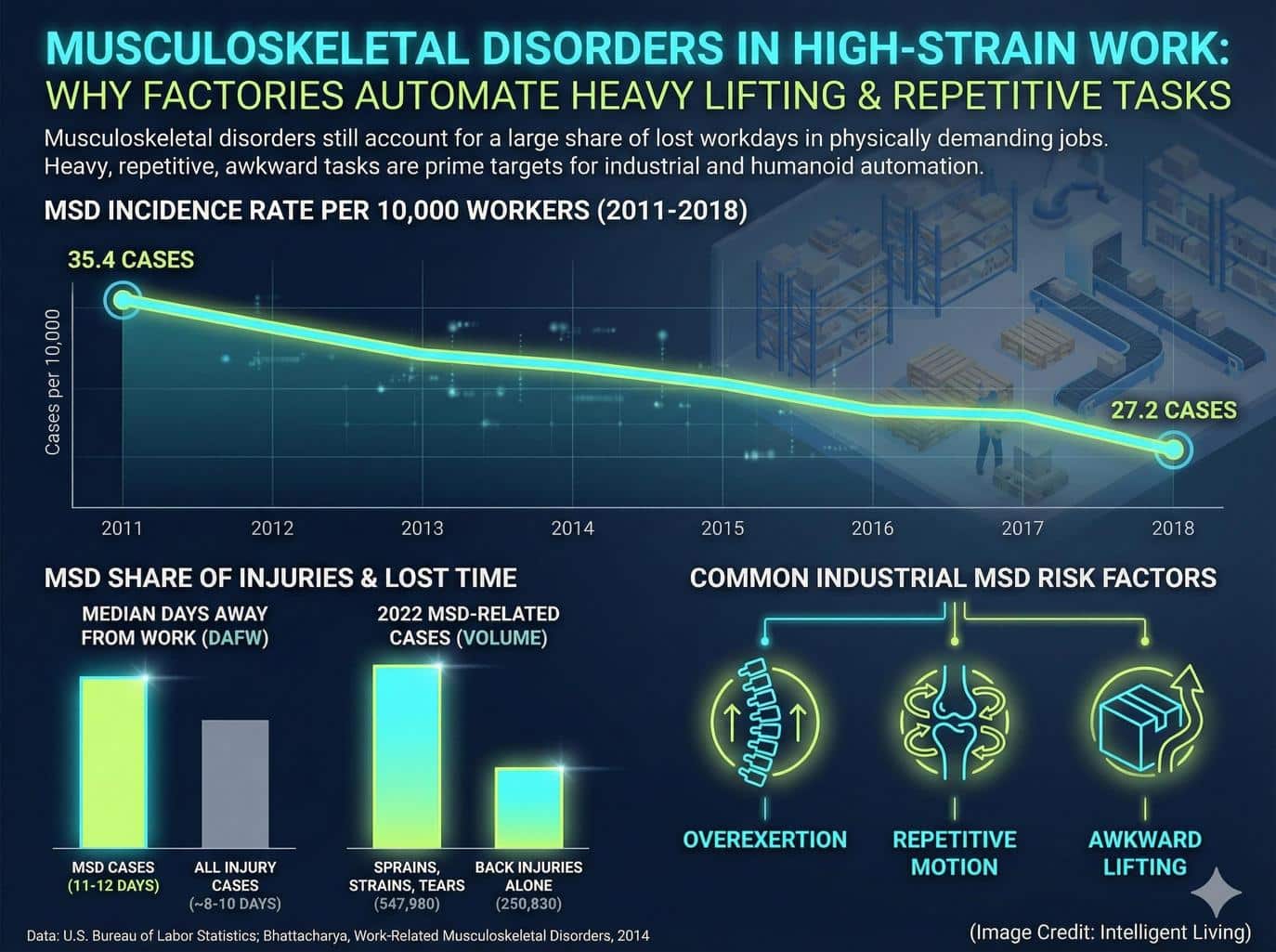
In manufacturing, sequencing refers to the organization of parts or materials in the exact order required for assembly. Repetitive and ergonomically taxing, sequencing defines some of the most difficult labor on the factory floor. For humans, hours spent sorting heavy or awkwardly shaped components can lead to fatigue and repetitive strain injuries. For humanoid robots like Atlas, it’s a perfect proving ground.
Sequencing provides a specialized industrial laboratory where humanoid capabilities face rigorous testing. This controlled environment minimizes unpredictable variables, allowing safety systems to operate with extreme precision. It is the opposite bet from UBTECH’s, which began delivering the UWorld U1 companion humanoid to homes in September as a consumer companion rather than a factory worker.
Key Environmental Advantages for Initial Sequencing Trials
- Consistent and optimized facility lighting
- Predictable spatial arrangement of objects
- Fixed movement paths for safety validation
- Standardized bins and material containers
Robotic balance and limb dexterity enable Atlas to manage these containers with human-like ease. Human operators remain nearby, overseeing the transition as machine precision begins to handle the bulk of the physical sorting.
Sequencing workflows provide the landscape where Hyundai’s human-centered automation philosophy takes shape. The company’s approach ensures that robots handle physically demanding work while people manage supervision, inspection, and troubleshooting. As a result, human workers can shift to higher-value tasks that require flexibility and critical thinking.
Transitioning Toward Task-First Automation Models
Successful sequencing trials could redefine how industrial automation scales. Rather than focusing on a one-size-fits-all robot, the company is refining a task-first model that trains robots to master narrow but vital jobs before gradually expanding their skillsets. It’s a strategy rooted in realism, one that builds reliability through incremental progress rather than flashy demonstrations.
Meet Atlas: The Specs that Matter on a Factory Floor
Boston Dynamics’ latest version of Atlas isn’t just a stunt performer; it is a fully electric, enterprise-grade humanoid designed to operate in real manufacturing conditions. Standing around 1.9 meters tall and weighing roughly 90 kilograms, Atlas is engineered for endurance and precision rather than spectacle, continuing a path established when the Spot quadruped transitioned into one of Boston Dynamics’ first commercial successes.
- Battery Life: Up to four hours on a single charge, with autonomous battery swapping in about three minutes
- Payload Capacity: 50 kilograms for short lifts; 30 kilograms sustained
- Mobility: 56 degrees of freedom for human-like movement
- Durability: IP67 rating, operational from -20°C to 40°C
- Connectivity: Integrated with factory control systems through Boston Dynamics’ Orbit software, which links directly to MES (Manufacturing Execution Systems) and WMS (Warehouse Management Systems)
Operational capabilities echo other humanoid platforms utilizing autonomous battery swapping to support near-continuous operation to support near-continuous industrial operation. Its sealed construction protects against dust and moisture, while its endurance rating allows for extended shifts on the production floor.
Perception Systems and 360-Degree Industrial Awareness
Perhaps most importantly, Atlas includes tactile sensing and 360-degree vision, which enable it to recognize human co-workers and navigate safely without physical barriers.
Balancing independence and awareness is what makes Atlas viable for Hyundai’s phased rollout. It’s not just about strength or agility; it’s about reliability, safety, and seamless integration into existing factory ecosystems. With these capabilities, Atlas represents the next step toward what Hyundai calls a Software-Defined Factory, where every machine—human or robotic—can be continuously updated and optimized through data feedback loops.
Digital Infrastructure Powering Software-Defined Factory Ecosystems
Quiet architectural frameworks provide the operational foundation for every humanoid robot headline. For Hyundai, that infrastructure is the Robot Metaplant Application Center (RMAC) and the Software-Defined Factory (SDF), two initiatives that turn factories into living data ecosystems and build on AI milestones that turned advanced models into everyday collaborators across both consumer technology and heavy industry.
RMAC, opening in 2026, functions as a physical and digital proving ground for robotic performance. It will collect performance data from Atlas robots, run simulations, and feed that data back into the Software-Defined Factory system. Active data cycles enable Hyundai to retrain robot behavior continuously based on real-world conditions, optimizing everything from movement efficiency to error prevention.
The integration fits neatly into a wider wave of smart manufacturing technology in 2026 that turns industrial sites into sophisticated, data-driven decision engines. Connected factories now operate with the agility of software platforms.
Global Scalability Through Over-the-Air Factory Updates
Conceptualized as a factory that learns, the SDF allows production performance to evolve similarly to smartphone software updates. Instead of static production lines, every machine, conveyor, and robot becomes part of a connected network that can be updated through over-the-air improvements.
Adaptive environments emerge for workers as workflows and safety protocols become instantly updatable. For Hyundai, it means global scalability. A process refined in Georgia could be implemented across other plants worldwide in near real time.
Scale Plan: 30,000 Robots per Year, Automotive Supply Chains, and the Service Model
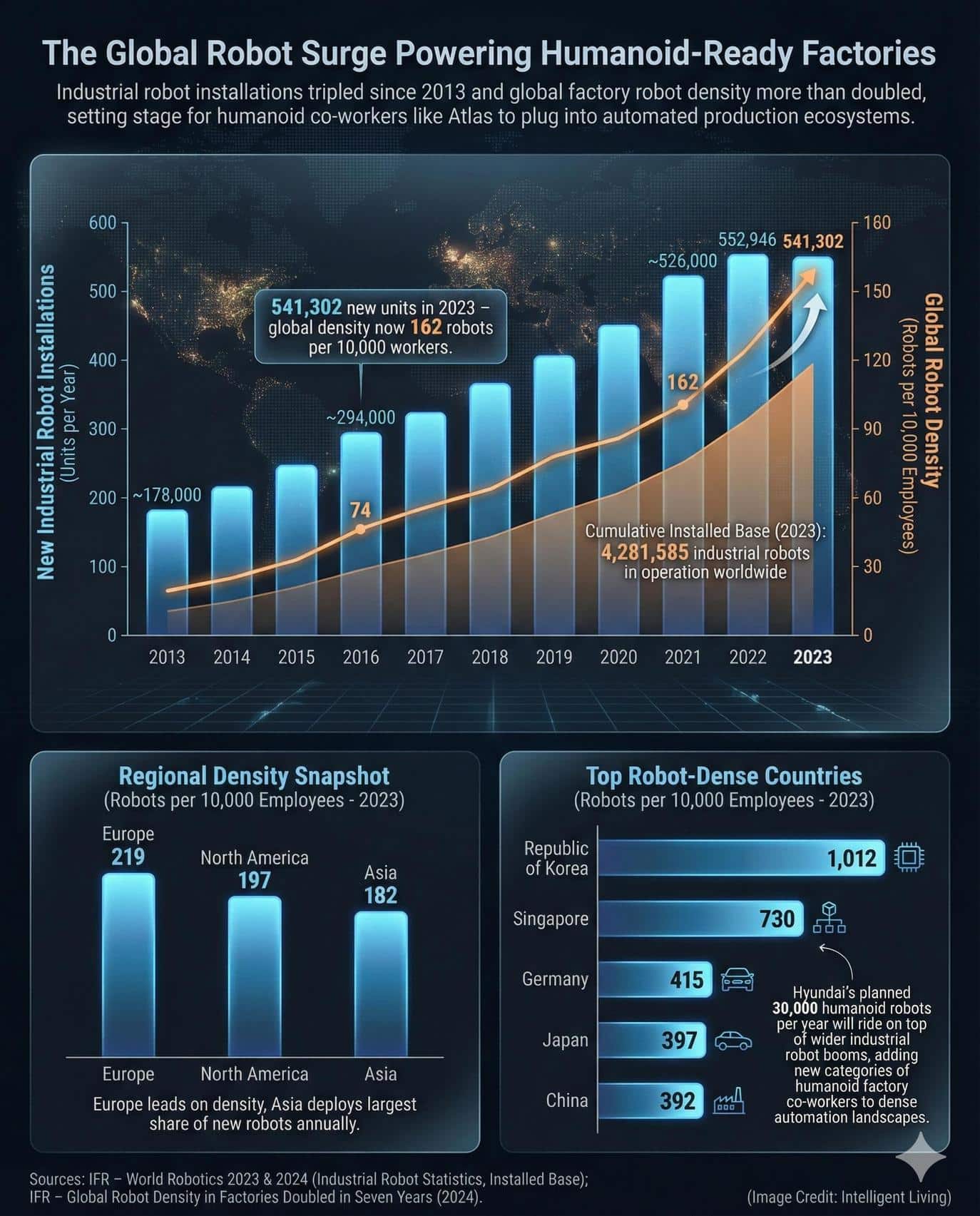
Hyundai’s ambition doesn’t stop with a single plant. The company plans to leverage its automotive-scale manufacturing expertise to mass-produce humanoid robots at a rate of up to 30,000 units annually by 2028, supported by its existing logistics and supplier networks.
Tiered supply chain models currently supporting vehicle production will likewise facilitate humanoid manufacturing. Standardized production not only reduces cost but also supports global deployment without overhauling existing infrastructure. Such scalability aligns with the way automation is already revolutionizing major industries through smart factories and interconnected machines across automotive, logistics, and heavy manufacturing.
Hyundai’s partnership with Boston Dynamics also introduces a new layer of innovation through Robotics-as-a-Service (RaaS). Instead of selling robots outright, Hyundai and Boston Dynamics plan to offer operational subscriptions that include maintenance, software updates, and performance monitoring. For companies wary of large capital expenditures, this model lowers the barrier to entry for adopting humanoid robots.
The RaaS structure could reshape industrial automation economics. It enables predictable operational expenses, reduces upfront investment, and ensures that every deployed robot remains current with the latest safety and performance software. This continuous improvement cycle aligns perfectly with Hyundai’s Software-Defined Factory vision.
Workforce Reality: Safer Work, New Roles, and the Job-Loss Question
No conversation about automation is complete without addressing its impact on workers. Hyundai has been explicit in describing its humanoid robotics initiative as a job redesign project, not a workforce reduction strategy. The company’s messaging consistently emphasizes safety, ergonomics, and the creation of new technical roles.
Atlas is expected to handle specific tasks categorized as high-risk or high-strain to preserve human health. These roles often lead to significant physical degradation over long shifts.
Primary robotic responsibilities during the initial rollout include:
- Repetitive heavy lifting of assembly bins
- High-volume material sorting
- Precision parts sequencing
- Ergonomically taxing logistical movements
Ethical Oversight and the Future of Technical Reskilling
Industrial evolution echoes broader trends across manufacturing, where AI and automation are fundamentally redefining labor as a collaboration between human judgment and machine precision. Simultaneously, advanced manufacturing technology depends on human oversight to maintain safety and accountability across complex systems.
Transferring these responsibilities to robots aims to reduce workplace injuries and fatigue-related errors. Meanwhile, human workers will transition toward maintenance, programming, and oversight positions—roles that leverage judgment and adaptability rather than physical endurance. As robots like Atlas become standard tools, demand for skills in robot maintenance, data analysis, and workflow integration will grow. Hyundai’s approach demonstrates that a human-centered factory is one where workers and machines complement, rather than compete with, each other.
Complex hurdles involving retraining and ethical oversight define the next phase of this industrial transition. If Hyundai delivers on its promise, the 2028 rollout could become a model for responsible automation worldwide.
Critical Industrial Benchmarks for Robotics Deployment (2026–2030)
The next few years will be pivotal for Hyundai’s robotics roadmap:
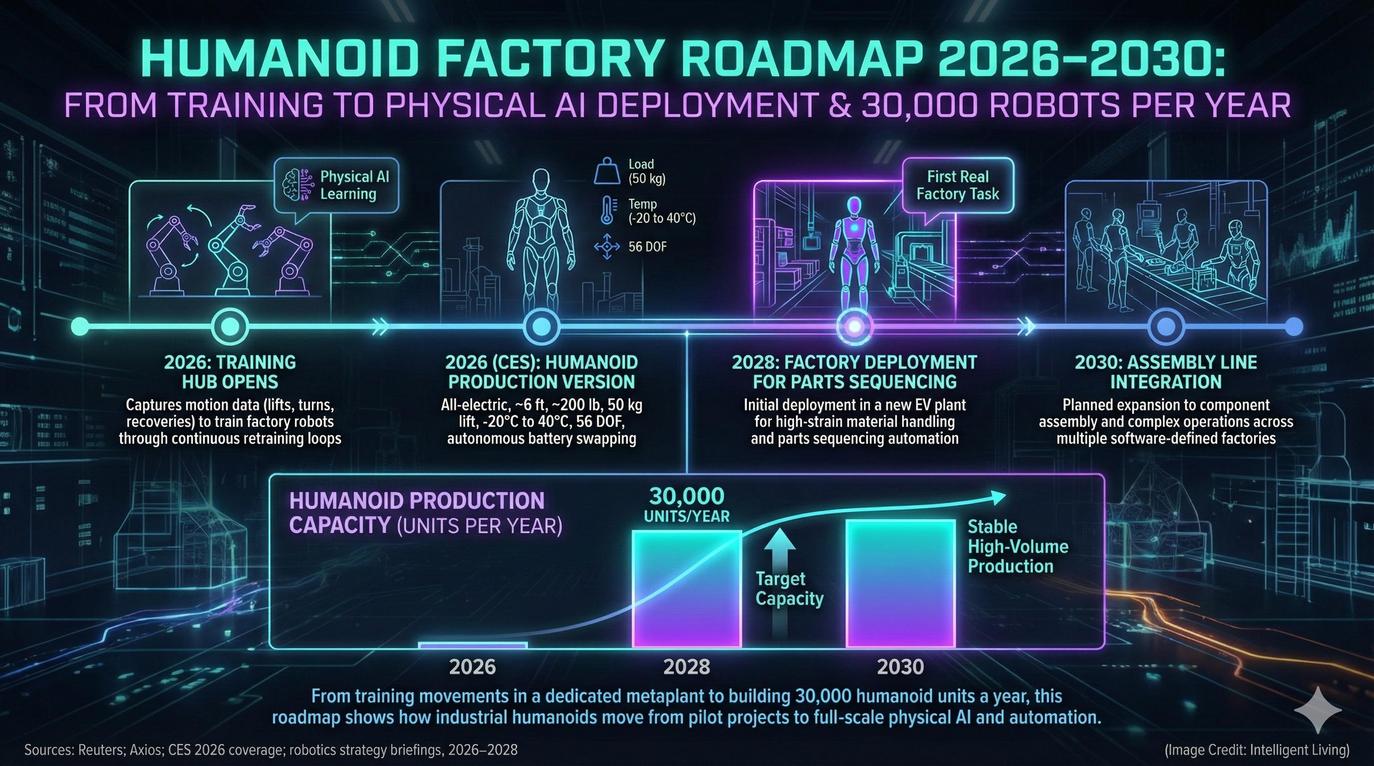
- 2026: The Robot Metaplant Application Center (RMAC) begins operations, training early Atlas models and validating safety protocols.
- 2028: Atlas enters production environments for parts sequencing at Hyundai’s Georgia plant.
- 2030: Expansion into component assembly and wider deployment across global manufacturing sites.
Regulatory developments and public responses to human-robot collaboration serve as additional indicators for future growth, alongside the performance of Hyundai’s RaaS model. Long-range experiments such as a 66-mile autonomous humanoid endurance walk in China will also signal how close robots are to matching full human shifts. The success or failure of upcoming industrial checkpoints determines if humanoid robots move from concept to cornerstone of modern manufacturing.
The Future of Human-Centered Industrial Evolution
Strategic integration of humanoid robotics at Hyundai signifies a fundamental departure from traditional replacement-based automation toward a model of genuine machine-human partnership. By coupling Boston Dynamics’ robotics engineering with AI platforms from NVIDIA and Google DeepMind and drawing on research from the Boston Dynamics AI Institute in Cambridge, the automaker is turning data into motion and safety into innovation.
Operational success hinges on this balance—ensuring that while robots master the repetitive and hazardous, human employees maintain the creative and critical oversight necessary for industrial excellence. Manufacturing resilience in the coming decade will be measured by the ability of organizations to scale these collaborative technologies without sacrificing workforce integrity.
As the 2028 checkpoints approach, the industrial world will look to the Georgia Metaplant as the gold standard for responsible, high-tech transformation. The era of the humanoid collaborator is no longer a speculative horizon; it is an active, data-driven reality currently being refined through every movement of the Atlas platform.

Frequently Asked Questions: Hyundai’s Humanoid Robot Deployment
When exactly will Atlas robots arrive at the Georgia plant?
Hyundai targets 2028 for the initial deployment of Atlas humanoid robots at its Georgia Metaplant, starting with specific logistical tasks.
What specific factory tasks will these humanoid robots handle?
Robots will first manage parts sequencing, which involves organizing and preparing materials in precise order for human assembly teams.
How does Hyundai ensure worker safety around these robots?
Atlas utilizes 360-degree vision and tactile sensors to navigate safely around humans, operating without physical barriers in a shared environment.
Will these humanoid robots eventually assemble complete vehicles?
Yes, Hyundai plans to expand Atlas’s responsibilities to include component assembly by 2030 following the success of initial sequencing trials.
Can the robots operate continuously throughout a factory shift?
Atlas features autonomous battery swapping that takes approximately three minutes, allowing for near-constant operation across extended industrial shifts.


