
Hidden beneath the terrestrial surface is a sophisticated network of molecular negotiations that dictate the pace of global climate change. Soil functions as far more than a simple container for decaying matter; it is a high-stakes environment where iron minerals serve as the primary architects of long-term carbon sequestration. Recent findings suggest that these minerals are not passive participants but active mediators that determine which organic molecules remain locked in the earth and which escape back into the atmosphere.
The latest research from Northwestern University, appearing in a detailed soil mineralogy study within Environmental Science & Technology, reveals a hidden “carbon grip” in soil governed by the mineral ferrihydrite. This shift in perspective, also reflected in recent findings on iron minerals and soil chemistry, moves us from a static storage model to a dynamic chemical marketplace.
Mastering the nuances of organic carbon stabilization allows scientists and land managers to develop more precise climate change solutions. This microscopic lens on soil mineralogy offers a roadmap for enhancing Earth’s natural ability to pull CO2 from the sky and secure it deep within the ground for centuries.
This discovery redefines what it means for soil to “store” carbon. Instead of a static sponge, soil functions more like a microscopic marketplace where iron minerals form selective bonds with organic molecules. Gaining a deeper insight into this chemistry could improve carbon modeling and guide sustainable land management strategies that enhance long-term CO2 storage in the ground.

Primary Insights into Soil Mineralogy and Carbon Stability
- Study Lead: Northwestern University research team led by Dr. Danielle Trewyn, with results published in a peer-reviewed soil chemistry study in Environmental Science & Technology.
- Key Finding: Iron minerals like ferrihydrite bind organic carbon through multiple mechanisms—including electrostatic attraction, hydrogen bonding, and stronger chemical bonds known as ligand exchange.
- Scale of Impact: Iron-bound carbon may represent roughly one-third of all topsoil carbon globally, or around 233 petagrams of carbon according to a Nature Communications meta-analysis.
- Strategic Significance: Complex molecular interactions dictate the lifespan of soil carbon and its vulnerability to climatic fluctuations or land-use changes.
Global Soil Carbon Storage Estimates and Mineral Chemistry
Soil is an intricate ecosystem that maintains verified stocks of terrestrial organic matter totaling roughly 1,500 billion tons of carbon within its top layers. This is approximately twice as much as what exists in the atmosphere.
The science behind how this carbon stays put has long been murky. Traditional models assumed that organic carbon simply adheres to mineral surfaces and remains there indefinitely. The new findings reveal a far more nuanced reality.
Molecular Anchors and the Future of Atmospheric CO2
Iron minerals such as ferrihydrite act as molecular anchors that attach organic carbon compounds like amino acids, sugars, and plant residues to mineral surfaces. But these bonds are not permanent.
Environmental factors such as flooding, oxygen exposure, and root exudates can weaken or break these connections, potentially releasing CO2 back into the atmosphere. This dynamic relationship highlights the urgent need to incorporate mineral chemistry into global climate models—a priority recently emphasized in a soil carbon meta-analysis using data from large-scale soil surveys.
Gaining mastery over these processes at the microscopic level can empower land managers and policymakers. From regenerative farmers improving soil health to urban planners designing green infrastructure, the science of soil carbon sequestration offers a tangible way to strengthen Earth’s natural defenses against climate change.

Ferrihydrite: The Reactive Anchor for Organic Carbon Stabilization
Ferrihydrite is one of the most common and reactive iron minerals found in soils worldwide. It forms in moist, oxygen-rich environments—precisely where roots and microbes thrive. What makes ferrihydrite so special is its vast surface area and irregular structure, which give it a remarkable ability to interact with organic molecules.
According to the Northwestern study, ferrihydrite doesn’t rely on a single mechanism to hold onto carbon. Its surface behaves like a patchwork quilt of positive and negative charges. This allows it to attract a wide variety of organic compounds, from simple sugars to complex aromatic acids.
The research used advanced techniques such as atomic force microscopy and infrared spectroscopy to visualize these interactions at the nanoscale. These visuals confirmed that ferrihydrite’s binding capacity is both flexible and robust, a result highlighted in a Northwestern Engineering article on iron minerals and soil carbon.
Mineral Surface Heterogeneity: Selective Binding in Ferrihydrite
In simple terms, ferrihydrite operates like a universal adapter in the soil ecosystem—its versatile bonding behavior allows it to secure carbon molecules that might otherwise escape into the air. By refining how scientists measure and simulate these processes, the study opens the door to more accurate climate projections and more targeted soil conservation practices.
Such heterogeneous binding behavior helps explain why some soils are far better at retaining carbon than others. It also underscores how small-scale chemistry can ripple upward into global climate processes—a perfect example of nature’s complexity working quietly beneath our feet.
- Positively charged sites attract negatively charged organic acids through electrostatic attraction.
- Neutral molecules form flexible hydrogen bonds with the mineral surface.
- Stronger covalent-like connections develop through ligand exchange.
Each bond type influences how resistant the carbon is to decomposition. Stronger bonds may persist for centuries, while weaker ones might break down within years.

Three Primary Mechanisms of Iron-Based Carbon Sequestration
Ferrihydrite facilitates at least three distinct carbon binding modes, each serving a critical role in stabilizing mineral-associated organic matter for carbon sequestration.
Electrostatic Attraction
Electrostatic attraction represents the simplest and most immediate mechanism. Attraction between oppositely charged surfaces pulls organic molecules toward mineral anchors, mimicking magnetic interaction. When ferrihydrite’s positively charged patches encounter negatively charged organic molecules, such as carboxylic acids or phosphates, they form quick, reversible bonds. Ionic interactions help establish the first layer of carbon stabilization but can be undone by shifts in soil pH or moisture.
Hydrogen Bonding
Hydrogen bonds act like the Velcro of soil chemistry. They provide flexible connections between the mineral surface and organic molecules, creating a dynamic network that adapts to environmental changes. Collective strength across these many flexible links makes carbon retention surprisingly resilient under moderate conditions.
Ligand Exchange
The strongest of the three mechanisms, ligand exchange, involves a direct chemical replacement, where parts of the organic molecule swap places with hydroxyl groups on the mineral surface. This creates more permanent bonds, effectively locking the carbon in place. Although these reactions are slower and energy-intensive, their stability means the protected carbon can remain in soil for hundreds or even thousands of years.
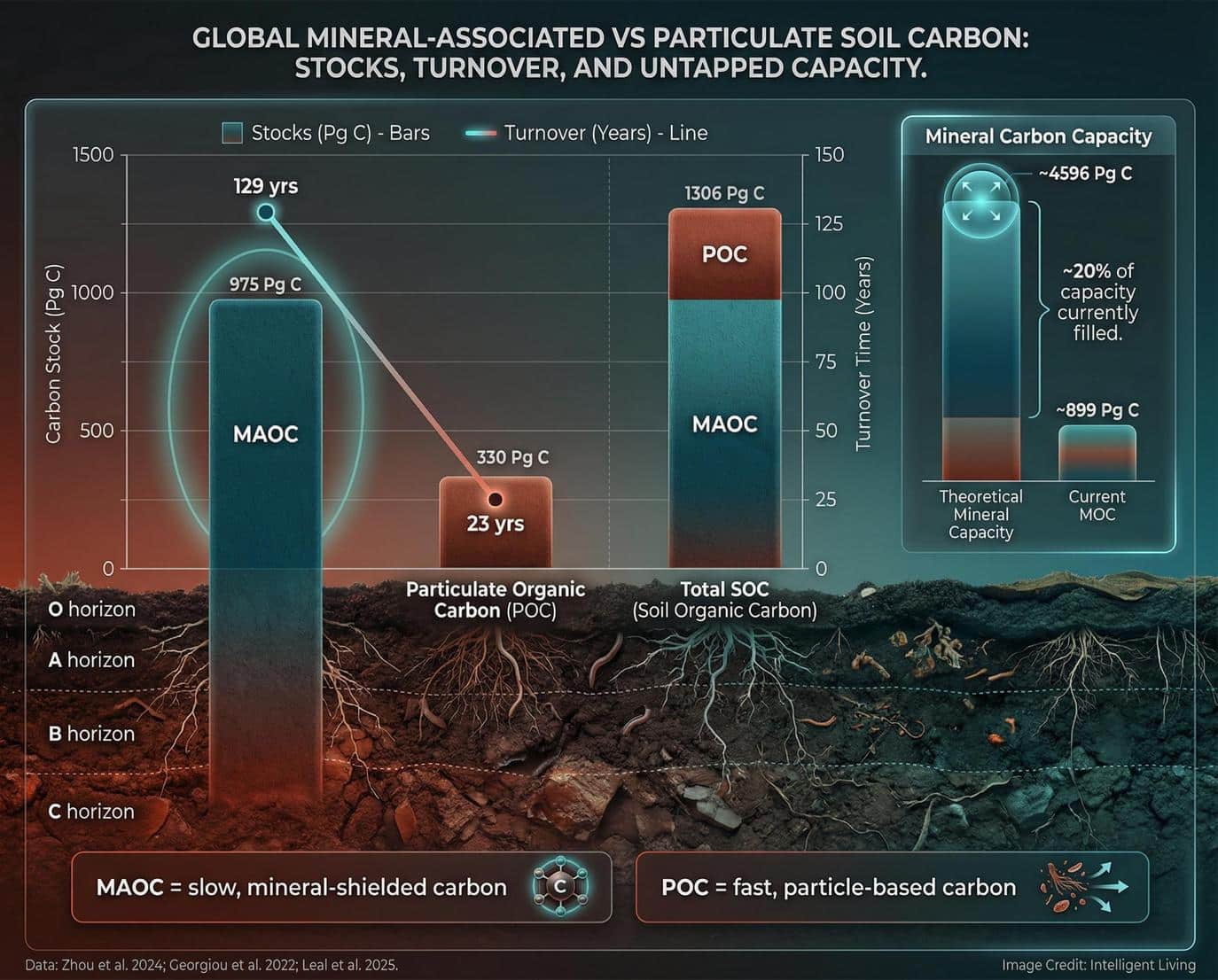
The Global Scale of Iron-Bound Carbon
Mapping where and how this mineral-bound carbon is concentrated helps scientists identify priority regions for conservation and restoration by highlighting how healthy ground functions as a powerful solution for sequestering carbon to mitigate atmospheric warming.
Global statistics remind us that what happens at the microscopic level has planetary consequences. When iron minerals successfully stabilize carbon molecules, they extend the lifespan of that carbon in the soil, slowing its return to the atmosphere. Conversely, when these minerals lose their grip due to changes in moisture or pH, vast amounts of carbon could be mobilized within decades. According to a comprehensive Nature Communications meta-analysis, iron-bound organic carbon (known as OC-Fe) accounts for roughly 33 ± 15 percent of all topsoil carbon globally, representing an estimated 233 petagrams of carbon. This is nearly a quarter of all the carbon held in Earth’s soils within just the top meter.
Environmental Threats to Long-Term Soil CO2 Storage
While iron minerals form one of the strongest natural defenses against atmospheric CO2, their stability is not guaranteed. In flooded, waterlogged, or oxygen-poor conditions, ferrihydrite can undergo a process known as iron reduction, where its structure changes and the iron binds with different elements. This transformation often breaks existing carbon bonds, releasing CO2 or methane into the environment.
Climate-driven changes such as prolonged droughts followed by heavy rainfall can accelerate these cycles of oxidation and reduction. When oxygen reenters the soil after flooding, iron reacts quickly, sometimes causing previously trapped carbon to escape. Similar effects occur in permafrost and wetland regions where fluctuating water tables repeatedly expose and submerge soil minerals.
Soil pH is part of that same picture, because it governs which of these mineral reactions can happen at all. A 2026 analysis of water chemistry in the Mississippi River Basin found that the crushed limestone farmers spread to correct soil acidity has quietly been a net carbon sink since 1900, removing between 300 and 400 million metric tons of CO2.
Analyzing the deep connection between soil management and hydrology helps sustain iron’s stabilizing function, preventing sudden bursts of greenhouse gas emissions during extreme weather events. Protecting vital peat-rich subterranean reservoirs also prevents these cycles from triggering sudden mobilized carbon release.

Enhancing Natural Carbon Sinks through Sustainable Land Management
This insight could transform land management. Practices that enhance mineral stability—such as maintaining moderate moisture levels and encouraging root diversity—may promote long-term sequestration. For regenerative farmers, this reinforces the value of restoring degraded land through regenerative methods that rebuild soil health while producing food.
Urban Infrastructure and Carbon-Negative Design
Even urban planners can apply this understanding when designing sustainable urban forest infrastructure that uses biochar to lock carbon while improving soil health and water retention. For homesteaders and small land stewards, the same chemistry underpins emerging resource-efficient land stewardship designs that treat soil carbon, water, and biomass as a single, closed-loop system.
Policy Frameworks for Verifiable Carbon Storage
At the policy level, carbon credit systems and monitoring frameworks may soon incorporate mineral-associated carbon as a measurable and verifiable storage pool. Mineral-based evidence now supports what many ecologists have long suspected: not all soil carbon is equal, and some of it truly can endure for centuries if the conditions are right.
Critical Assessments of Soil Carbon Storage
1. Measurement Complexity
Soil carbon tests often focus on total organic carbon without distinguishing between transient and mineral-bound fractions. Measurement gaps can lead to overestimating how much carbon is truly stable. Future monitoring frameworks may rely on spectroscopy or advanced satellite monitoring for soil stability to assess sequestration potential more accurately.
2. Modeling Limitations
Global climate models rarely include mineral variables like surface charge density or ligand exchange rates. Integrating iron mechanisms will help predict how soils respond to warming and land-use change more reliably, aligning scientific models with real-world chemistry.
3. Capacity and Risk Saturation
Even though iron minerals have impressive carbon-holding capacity, their surfaces can become saturated. Once that happens, additional carbon has fewer binding options and may decompose more quickly. Protecting and restoring unsaturated soils ensures there’s still “room” for carbon to lock in—and that the locks don’t fail during cycles of flooding or drought.

Sustaining Earth’s Carbon Vault through Mineral Chemistry
Refining the scientific grasp of iron-bound organic carbon mechanisms is essential for the next generation of climate strategy. The discovery that ferrihydrite uses a mosaic of surface charges to selectively bind organic matter changes the math on soil carbon storage. It suggests that the longevity of carbon in our fields and forests depends heavily on the mineral-associated soil organic matter found at the nanoscale.
As environmental conditions shift, the strength of these chemical bonds—from flexible hydrogen bonding to the permanence of ligand exchange—will determine the resilience of our natural carbon sinks. Protecting these vital soil mineralogy interactions requires a shift in how we approach land management and regenerative agriculture.
By maintaining the structural integrity of iron-rich soils and supporting complex root systems where fungi as underground climate allies collaborate with iron-charged surfaces, we can ensure the ground remains a reliable ally against atmospheric warming. The future of carbon sequestration lies in respecting the silent chemistry happening beneath our feet, where every iron mineral plays a part in stabilizing the planet’s atmosphere as a carbon-sequestering climate solution.
Frequently Asked Questions About Soil Carbon Sequestration
What Role Do Iron Minerals Play in Soil Carbon Storage?
Iron minerals, particularly ferrihydrite, act as molecular anchors that bind organic carbon to mineral surfaces, preventing it from decomposing and entering the atmosphere as CO2.
Why Is Ferrihydrite Considered a Universal Adapter?
Its surface contains a variable mosaic of positive and negative charges, allowing it to attract and secure a diverse range of organic molecules through multiple chemical mechanisms.
How Does Moisture Affect the Stability of Iron-Bound Carbon?
Excessive moisture or flooding can lead to iron reduction, a process that breaks the chemical bonds between minerals and carbon, potentially releasing greenhouse gases.
What Is the Difference Between Electrostatic Attraction and Ligand Exchange?
Electrostatic attraction involves quick, reversible bonds based on charge, while ligand exchange creates much stronger, more permanent chemical connections that can last for centuries.
How Can Regenerative Agriculture Improve Carbon Sequestration?
Practices like cover cropping and reduced tillage help maintain soil mineral stability and provide a steady supply of organic matter for iron minerals to lock away.


